REVIEW · POMPEI CAMPANIA
Pompei: Audio guide of the archeological site
Book on GetYourGuide →Operated by Echo Audioguides · Bookable on GetYourGuide
Pompeii has a way of grabbing you fast. This audio guide gives you about 50 minutes of guided storytelling as you walk the streets of a Roman city, preserved under volcanic ash. I like that it sticks to historical authenticity while still sounding human, not like a textbook.
You’ll also appreciate the practical map and the freedom to go at your own pace, not on some rigid group schedule. One thing to plan for: this is an audio experience, not a live tour, and you’ll need to cover basics yourself like the entrance ticket and earphones.
In This Review
- Key points
- Why This Pompeii Audio Guide Works Better Than You Think
- What You Actually Receive: Map, Audio Link, Photos, and Documentation
- Following the Story: How the 50-Minute Walk Feels on the Ground
- Getting Oriented Before You Start Walking
- Streets and the Life of a Roman City
- Markets, Villas, and Temples: Where Public Life Shows Up
- Bathhouses and Household Frescoes: Seeing Daily Routines
- The City’s Tragic Fate
- Map-Plus-Audio Navigation: How to Not Lose Your Way
- Convenience and Flexibility: When Audio Is a Real Advantage
- Price and What You Still Need to Pay for On Site
- Languages and Host Support: Italian and English
- Who This Experience Fits Best
- My Booking Checklist Before You Go
- Should You Book This Pompeii Audio Guide?
- FAQ
- How long is the Pompeii audio guide?
- Is the audio guide valid for more than one day?
- What is included in the purchase?
- What is not included?
- Can I use the audio offline?
- Which languages are available?
- Is there any host or greeter support?
- How much does it cost?
- Are there starting times?
- Is free cancellation available?
- Is there a reserve-and-pay-later option?
Key points
- About 50 minutes of narration across key parts of Pompeii
- Map-first navigation so you can follow a suggested path
- Offline replay for 2 days using a digital audio link
- Italian and English narration with a host/greeter support
- Cheap but not complete: entrance ticket and earphones are not included
- One format risk: if you want a person to answer questions on the spot, audio may feel limiting
Why This Pompeii Audio Guide Works Better Than You Think
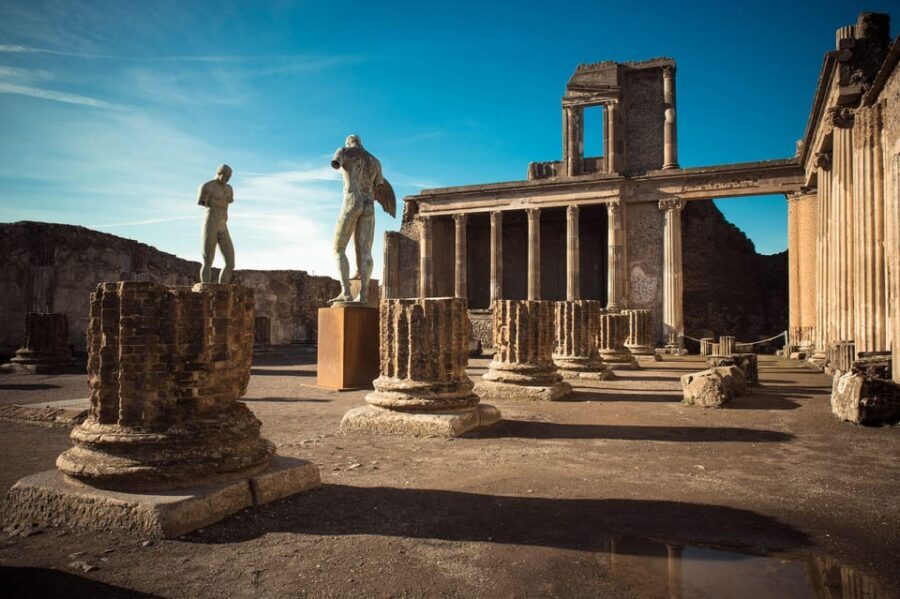
Pompeii can feel overwhelming. You arrive, you see walls and columns and doorways everywhere, and suddenly your brain asks: Where do I start? What am I actually looking at?
This format helps because it gives you a story thread while you walk. Instead of just wandering, you get narration that connects the streets to daily life—markets, homes, bathhouses, and temples—so the ruins make more sense.
The other win is control. You’re not trapped in a group pace. If you want to linger at a doorway or step back to re-check where you are, you can.
You can also read our reviews of more guided tours in Pompei Campania



What You Actually Receive: Map, Audio Link, Photos, and Documentation

This isn’t just a voice file. You get a digital file, plus a map, photo materials, and documentation. That matters at Pompeii because the site is big and the ground can be confusing, especially when you’re seeing repeating patterns—arches, room layouts, and fresco fragments—without a guide standing beside you.
The biggest practical perk is the audio access style: you get a link to the audio file, and you can use it offline with unlimited replay during your valid window. Translation: you can re-listen after your walk, or even once you’re back at your accommodation and want to remember what you saw.
Following the Story: How the 50-Minute Walk Feels on the Ground

Think of the narration as a route that moves from public life to private life. You start by getting oriented in a city that once thrived, then the guide brings you through spaces people used every day—work, shopping, worship, and home routines.
Getting Oriented Before You Start Walking
The audio experience is designed so you aren’t guessing from scratch. With the map and a clear path to follow, you can begin with confidence instead of wandering until you find a highlight.
If you’re the type who likes a plan, this is a good match. If you prefer total freedom, the map is still useful as a safety net. You can use it to stay oriented, then break away when you want.
Streets and the Life of a Roman City
Pompeii is famous for being frozen in time, and the narration leans into that reality. You walk through streets that were once packed with residents, and the guide explains how the city got preserved for centuries by volcanic ash.
That volcanic context changes how you view everything. You stop thinking of ruins as random stones and start imagining the city as something intact—until the moment it wasn’t.
You can also read our reviews of more tours and experiences in Pompei Campania




Markets, Villas, and Temples: Where Public Life Shows Up
As you move through the public and semi-public areas, the narration connects architecture to function. Markets aren’t just a place to buy things; they’re social spaces. Villas aren’t just big buildings; they’re status, comfort, and routine.
Temples help you understand religious life too. The narration aims to make these spaces feel lived-in, not museum-labeled.
A small practical note: Pompeii is open-air. If you’re visiting in hot weather, you may want breaks between zones. Audio helps, but you’ll still feel the sun and uneven walking.
Bathhouses and Household Frescoes: Seeing Daily Routines
This guide pays attention to the more intimate side of Pompeii. Bathhouses show how people spent time and took care of their bodies and social lives. Household frescoes bring you into the home—small walls, personal rooms, and decoration that tells you what people cared about.
This is where the ruins get emotional, in a quiet way. You’re not just looking at surviving architecture; you’re seeing evidence of taste, habit, and ordinary life.
The City’s Tragic Fate
The audio wraps the experience by tying the setting to Pompeii’s fate. You learn what happened to the city and why the ruins matter so much to historians and everyday visitors.
Even if you already know the basic story, the narration’s pacing can still make it land differently—because you’ve been walking through the places the people used.
Map-Plus-Audio Navigation: How to Not Lose Your Way

Pompeii is one of those places where good orientation turns a stressful visit into a smooth one. The map included with the guide is built for that job.
Here’s what I’d do if you want this experience to feel easy:
- Start with the map and match your first spot before you press play.
- Use the audio as your main cue, not the buildings alone.
- If you pause for photos, pause the moment too. Don’t let the narration get too far ahead while you’re stuck figuring out where you are.
The best reviews highlight that the map really helps with following the path. That’s the kind of small detail that saves time and frustration.
Convenience and Flexibility: When Audio Is a Real Advantage
You’re paying $5 per person for an audio experience, which is a low price for a guided format. The value isn’t just cost. It’s that you get flexibility: you can replay, use it offline, and re-orient later when your memory needs a reset.
This is also useful for travelers who don’t want to fight for a spot on a crowded group tour. You can walk when you want, stop when you want, and take the ruins in without hearing the same lecture on repeat at full volume.
Still, audio has limits. There’s no hand to point you toward the next exact detail if something gets blocked or if you’re in a weird spot on a specific day. If you want a live Q&A, you may feel held back.
Price and What You Still Need to Pay for On Site
At $5 per person, this is priced like a budget add-on—because it is. You’re not buying a ticket to the archeological site inside this price.
Two important things are not included:
- Entrance ticket to the archaeological site
- Earphones
If you show up without planning for those, the low price becomes an annoyance. Bring or buy earphones, and budget for the site entry.
The upside is that once you handle those basics, the audio guide itself is good value because you’ll use it more than once. Unlimited replay during the valid period means you’re not paying for one listen and done.
Also note the rating: it sits at 3.4 with 13 reviews. That’s not a deal-breaker, but it does suggest some people may not have matched expectations. If you rely on a very specific type of guidance, read the description carefully and be realistic about what audio can and can’t replace.
Languages and Host Support: Italian and English
The narration is available in Italian and English, and there’s a host/greeter listed with those same languages. That’s helpful if you have questions before you start listening.
If you only want one language, you can plan around it. If you’re bilingual or learning Italian, the option to switch language can add interest without forcing you into a rigid tour group.
Who This Experience Fits Best
This audio guide is a smart choice if you:
- want a self-paced way to see major parts of Pompeii
- like narration that ties ruins to everyday life
- want to learn without committing to a long live guided tour
- enjoy replaying what you saw after your visit (the offline access helps)
It’s less ideal if you need:
- constant help from a person to navigate micro-details
- a real-time answer to questions you didn’t plan for
- a fully guided experience where every step is handled for you
One more thought: because the guide is timed as a “about 50 minutes” experience, you should expect it to feel like a guided route, not a multi-hour wandering plan. If you love getting lost on purpose, pair the audio with extra time.
My Booking Checklist Before You Go
If you want this to go smoothly, prep like it’s a small tech job.
First, bring earphones. They’re not included, and Pompeii is too noisy for phone speakers to work well.
Second, make sure you’ll have your device charged enough for a walking session. Even offline audio still needs battery.
Third, plan for the entrance ticket separately. Don’t assume the $5 covers it.
Finally, use the map immediately. The included path is part of why this works. If you skip that step, you’re basically taking the audio without the navigation support it was designed to pair with.
Should You Book This Pompeii Audio Guide?
Yes, if you want a low-cost, self-paced way to understand what you’re seeing at Pompeii. The combination of compelling narration, a practical map, and offline replay for two days is exactly the kind of value that makes ruins feel personal instead of random.
Skip it or rethink it if you expect a live guide to manage navigation for you or answer questions on the spot. Audio is great for storytelling, but it can’t do the same job as a human companion when you need real-time help.
If you can handle the small extras (earphones and the site ticket), this is an easy, budget-friendly way to get more meaning out of Pompeii in about 50 minutes, then keep learning afterward.
FAQ
How long is the Pompeii audio guide?
The experience is designed around about 50 minutes of narration.
Is the audio guide valid for more than one day?
Yes. The digital access is valid for 2 days.
What is included in the purchase?
You receive a map, a digital file, photo materials, and documentation.
What is not included?
The entrance ticket to the archaeological site is not included, and earphones are also not included.
Can I use the audio offline?
Yes. You get a link to the audio file with offline access, plus unlimited use within the valid period.
Which languages are available?
The audio is available in Italian and English.
Is there any host or greeter support?
Yes. A host/greeter is listed, with support in Italian and English.
How much does it cost?
It costs $5 per person.
Are there starting times?
The availability page will show starting times.
Is free cancellation available?
Yes. You can cancel up to 24 hours in advance for a full refund.
Is there a reserve-and-pay-later option?
Yes. You can reserve now and pay later.