REVIEW · POMPEI CAMPANIA
Vesuvio and Pompeii tour from Naples
Book on GetYourGuide →Operated by Around Vesuvio · Bookable on GetYourGuide
Vesuvius and Pompeii in one day feels efficient. What makes this tour work is the easy transfer from Naples plus a schedule that gives you real time at both sites, not just a quick peek. I especially like that entrance tickets are handled for you, and the Pompeii visit comes with a multilingual audio guide, so you can move at your pace.
Two things I really like: the crater experience is timed well (you get about 90 minutes of free time at Vesuvius), and you get skip-the-line tickets for both Pompeii and the Vesuvius National Park area. One consideration: the Vesuvius walk to the crater rim takes effort, and if your group hits any small delays, Pompeii time can feel tight.
In This Review
- Key things to know before you go
- Morning pickup in Naples: the transfer that sets the tone
- Vesuvius first: the crater walk and what the 90 minutes really means
- The view from Vesuvius: what to look for when you’re up there
- Pompeii after the transfer: entering UNESCO ruins with audio guide freedom
- How the Pompeii timing can help or hurt your visit
- What tickets and skip-the-line entry really do for you
- Price and value: is $108.75 worth it?
- Comfort, footwear, and who should choose this tour
- The small details that make the day smoother
- Should you book the Vesuvio and Pompeii tour from Naples?
- FAQ
- How long is the Vesuvius and Pompeii tour from Naples?
- Where does the tour start and end?
- Are entrance tickets included?
- Is skip-the-line entry included?
- Do I get an audio guide for Pompeii?
- Is there a tour guide on site?
- Will I have time to eat lunch?
- Is this tour suitable for people with mobility impairments?
Key things to know before you go
- Skip-the-line planning: Pompeii entry is included with a skip-the-line ticket, plus Vesuvius entry is also included.
- Audio guide for Pompeii: You get an audio guide in multiple languages, so you can choose your route instead of getting stuck in one loop.
- A structured 7-hour flow: Morning minibus transfer, Vesuvius time, transfer, then Pompeii free time before returning to Naples.
- Crater visit needs stamina: You descend from about 1,000 meters and then walk on foot to the crater.
- Time is the real trade-off: The tour is only about seven hours, so you’ll want to prioritize what you most want to see in Pompeii.
- Small-group style: It’s described as a small group experience aimed at keeping things pleasant and paced.
Morning pickup in Naples: the transfer that sets the tone
Your day starts in Naples with pickup at Via Galileo Ferraris, 40. The meeting coordinates you can use in Google Maps are 40.8505189, 14.2747942, which helps if you’re arriving a little early and want to be confident you’re at the right spot. Your bus is marked with the logo Around Vesuvio, which makes it easier to spot at a busy morning hour.
From there, you board a comfortable minibus and head up toward Mount Vesuvius. The transfer time is about 40 minutes, and it matters more than you might think. When you’re doing two major sites in one day, the whole experience depends on not wasting time in transit—or getting stuck in long ticket lines once you arrive.
Also, the driver is listed as English. That’s useful if you need quick clarifications during the ride (meeting details, the order of stops, and general timing). You’re not stuck guessing, even if you choose to tune out and focus on the view rolling in.
You can also read our reviews of more tours and experiences in Pompei Campania.



Vesuvius first: the crater walk and what the 90 minutes really means
Vesuvius is the kind of place that’s short on comfort but long on payoff. After the transfer, you’ll have around 1.5 hours at Mount Vesuvius as part of the full schedule, and the tour description also includes 90 minutes of free time at Vesuvius. Practically, that’s enough time to get yourself down and back, take breaks, and still feel like you accomplished something.
The route is designed in stages: once you reach around 1,000 meters above sea level, you descend and then walk on foot to the crater. That walk is the part to respect. Even if you’re a regular walker, expect it to be more effort than a flat city stroll. One review notes that the path to the crater rim is connected to some exertion, but the reward is worth it—meaning you’ll probably feel better about the strain once you’re standing near the viewpoint.
Here’s how I’d approach your time at Vesuvius:
- Start with getting oriented and pacing yourself early.
- Save room for the view, because that’s the moment you’ll remember later when Pompeii gets busy.
- Don’t burn all your energy rushing to the first spot. The crater area is big enough that you can find a comfortable angle and then linger.
If you’re prone to getting winded on climbs or uneven ground, pack smart. Comfortable shoes and water are a must.
The view from Vesuvius: what to look for when you’re up there
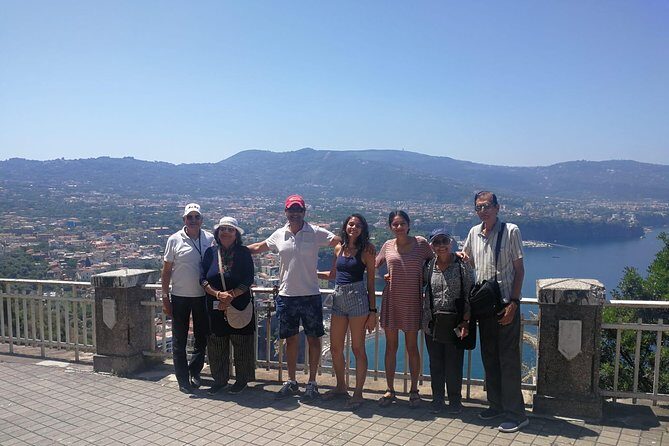
One of the biggest reasons people do Vesuvius first is the panorama. Before leaving again, you get to enjoy the views from the top—specifically the Gulf of Naples, the Sorrento Coast, and, on a clear day, Capri and Ischia.
This is where the tour feels like more than a box-check. You’re seeing how this area actually works geographically. Pompeii is buried by eruption history, but Vesuvius is where that story comes alive in physical form. When you look across the water toward Sorrento and the islands, the setting suddenly makes sense: why volcanoes dominate the area, why cities formed where they did, and why the shadows of ash became permanent.
Timing tip: photos are easiest early on, before crowds fully thicken and your legs start asking for mercy. If you’re traveling in a group, you’ll often have that moment where everyone spreads out to find a shot. Use it. Get your essentials, then switch into slower mode—just enjoy the air and the scale.
Pompeii after the transfer: entering UNESCO ruins with audio guide freedom
After Vesuvius, you transfer again by bus for about 40 minutes to Pompeii. Once there, the tour team shares different itinerary types you can choose and then you explore independently using the Pompeii audio guide in your language.
This is a big deal for how you’ll experience Pompeii. A guided tour can be great, but it can also feel like you’re racing through doorways and street corners. Here, you get structure up front, and then freedom for the parts that catch your eye. In a place this large, that hybrid approach often makes more sense than being marched from stop to stop.
Pompeii is a UNESCO World Heritage Site, and the story is simple but powerful: the city was buried by ash from the eruption of 79 AD, and later centuries brought its ruins to light. Even if you know the headline, walking around the preserved streets and building shells is what makes it click. You see everyday life made physical.
The audio guide is included, and the languages listed include English, German, French, Chinese, Italian, Portuguese, Russian, Dutch, Hebrew. That means you’re not limited to English-only commentary, and you’re not stuck with a one-size-fits-all route.
How the Pompeii timing can help or hurt your visit
Pompeii gets about 3 hours for the visit, and the tour also notes free time for the Pompeii ruins (150 minutes). That works out best if you go in with a simple plan: decide what kind of Pompeii you want first.
You’ll have the best experience if you:
- Pick a priority area before you start walking.
- Use the audio guide as your backbone, not as homework.
- Assume some wandering time will happen, because Pompeii can feel confusing at first.
One review specifically complains that Pompeii felt a bit unorganized early on, and that the time was shorter than promised—resulting in not even seeing a third of the place. That’s the clearest warning sign you can take from the feedback. If delays happen (even small ones), your total Pompeii time can feel squeezed, and Pompeii is not a site where you can slow down without consequences.
My practical advice: at the start of Pompeii, locate where you want to head next and commit. If you find yourself circling because you’re undecided, your time vanishes faster than you expect.
Also note the schedule includes 60 minutes of lunch time, but food and beverages are not included. So you’ll likely either grab something nearby during that window or eat before/after at your own expense.



What tickets and skip-the-line entry really do for you
This tour includes entrance tickets for both the Vesuvius National Park and the Pompeii Archaeological Park. It also includes skip-the-line tickets for Pompeii (listed as €20.00) and for Vesuvius (listed as €11.68). Even when you’re curious about the details of the sites themselves, ticket logistics can make or break the day.
Skip-the-line is valuable here because you’re working against time. You have about 7 hours total, which isn’t long enough to “accidentally” lose an hour in queues. By bundling tickets up front, the tour helps you protect the core experience: walking, looking, and learning without wasting energy on waiting.
You’re also not stuck arranging entry on your own. That sounds minor, but it reduces stress—especially if you’re arriving in Naples and still sorting out trains, local directions, or language basics.
Price and value: is $108.75 worth it?
At $108.75 per person, this is not the cheapest way to do Vesuvius and Pompeii, but it’s also not trying to be. The best way to judge value is to add up what you’re paying for beyond the sites themselves.
In the included list, you’re getting:
- Roundtrip transfer from Naples
- Entrance tickets for both locations
- Skip-the-line tickets for Pompeii and Vesuvius
- Audio guide for Pompeii
- Multiple blocks of free time (Vesuvius plus Pompeii, plus a lunch window)
That matters because a DIY version often costs more once you factor in transport, time lost, and ticket hassles. With this kind of all-in-one schedule, you’re paying for reduced friction. If you’ve ever tried to coordinate a tight route on your own in Campania, you know how quickly “simple” becomes “why am I still standing here?”
The only way the value drops is if the timing goes sideways and you feel the loss at Pompeii. That’s not something you can always control, but it’s a real risk with any single-day two-site plan. The tour’s job is to get you there smoothly, and the comfort of the transfer helps, but seven hours still has hard edges.
Comfort, footwear, and who should choose this tour
This is a great fit if you want a well-paced day trip with minimal planning. It’s also a good choice if you like learning through audio rather than depending on a live guide.
What to bring is spelled out, and it’s right on target for the day’s reality:
- Comfortable shoes (the crater walk needs real traction)
- Sun hat (Vesuvius can be bright)
- Water (bring more than you think you’ll need)
- Comfortable clothes
One more practical note: it’s not suitable for people with mobility impairments. If that applies to you, it’s better to look for a version that can match your needs rather than hoping the terrain will be flexible.
Who I think will enjoy this most:
- Couples and small groups who want a single-day highlight route
- Travelers who like independent exploring but still want help with ticketing and setup
- People who prefer audio guidance and choosing their own path in Pompeii
Who might not love it:
- Anyone who expects Pompeii to be a relaxed wander for hours. This tour packs a lot in, and you’ll need to choose priorities.
The small details that make the day smoother
The tour description emphasizes a pleasant, interesting experience tailored to the needs of participants, and the structure backs that up. You’re given a meeting point, a minibus ride, a clear sequence of stops, and then time to use your audio guide for Pompeii rather than getting locked into one pace.
There’s also a simple benefit to the way it’s organized: you’re not constantly switching plans. Vesuvius is first, then Pompeii. You get a chance to recharge with a lunch window, and you’re back at Via Galileo Ferraris, 40 at the end.
The driver being English helps you feel oriented in the flow of the day. And since the audio guide languages include many options beyond English, you’re less likely to feel stuck if you’re not traveling with a fluent English speaker.
Should you book the Vesuvio and Pompeii tour from Naples?
If you want a practical, low-stress way to hit both Vesuvius and Pompeii in one day, I’d say this tour is a strong candidate—especially because skip-the-line entry and included tickets protect your time.
I’d book it if:
- You’re comfortable with a crater walk that takes some effort.
- You like independent exploring in Pompeii with an audio guide.
- You value the convenience of transfers and tickets handled for you.
I’d think twice if:
- You hate tight timing and need lots of cushion at Pompeii.
- You’re sensitive to delays and know you’ll be disappointed if Pompeii time shrinks.
- Mobility limitations make the crater or ruins challenging.
For most people, the payoff is clear: Vesuvius delivers the emotional “this is where it happened” feeling, and Pompeii lets you translate that story into real streets and buildings. Just go in with priorities, wear the right shoes, and treat Pompeii like a choose-your-own-adventure.
FAQ
How long is the Vesuvius and Pompeii tour from Naples?
The duration is listed as about 7 hours.
Where does the tour start and end?
It starts and ends back at Via Galileo Ferraris, 40 in Naples (the meeting point uses coordinates 40.8505189, 14.2747942).
Are entrance tickets included?
Yes. Entrance tickets are included for both Vesuvius National Park and the Pompeii ruins (Archaeological Park of Pompeii).
Is skip-the-line entry included?
Yes. Skip-the-line tickets are included for Pompeii and for Vesuvius.
Do I get an audio guide for Pompeii?
Yes. An audio guide for Pompeii is included, and it is offered in English, German, French, Chinese, Italian, Portuguese, Russian, Dutch, Hebrew.
Is there a tour guide on site?
The tour description lists that a tour guide is not included. You’ll use the included audio guide for Pompeii.
Will I have time to eat lunch?
Yes, there is 60 minutes of free time for lunch, but food and beverages are not included.
Is this tour suitable for people with mobility impairments?
No, it is listed as not suitable for people with mobility impairments.