REVIEW · POMPEI CAMPANIA
Pompeii, skip-the-line ticket with smartphone audio guide on App
Book on GetYourGuide →Operated by Angelo (Travelcampania) · Bookable on GetYourGuide
Pompeii hits differently at your own pace. This experience is interesting because you get skip-the-line entry and a smartphone audio guide to explain what you’re seeing as you wander. The one drawback to consider: access to the audio guide can involve leaving or showing ID documents, so plan ahead and don’t show up assuming it’s zero-paperwork.
You’ll use this as a self-guided visit for a day, meeting at the Wellcome box and returning there when you’re done. As you walk through Pompeii, you’ll also have that constant visual reminder of Vesuvius watching over the ruins—something you can’t really get from photos.
In This Review
- Key things to know before you go
- Getting started at the Wellcome box (and picking your moment)
- Priority admission at Pompeii: why it matters in the real world
- The smartphone audio guide: useful, but don’t ignore the ID wrinkle
- Walking Pompeii on your own: a route you can actually use
- The Roman forum and the city’s public heartbeat
- Streets, aqueducts, fountains, and baths
- Private houses and businesses, with statues and color
- Amphitheater and dramatic theaters
- What you get for $40 (and when it’s not a great deal)
- Practicalities that can make or break the day
- Languages and on-site help: what to expect
- Who this Pompeii ticket fits best
- Should you book this Pompeii skip-the-line audio ticket?
- FAQ
- What’s included with the ticket?
- How long is the ticket valid?
- Where do I meet, and where does it end?
- What should I bring for the visit?
- Is food or drinks included?
- Is the experience wheelchair accessible?
Key things to know before you go
- Express entry helps you save time at the gates so you can start walking sooner.
- Smartphone audio guide gives on-site explanations while you’re moving through the park.
- Picture map included helps you stay oriented, especially if your phone battery gets stressed.
- A big variety of ruins means you can focus on forum life, public buildings, or residences.
- Travel light: luggage and large bags are not allowed, and drones are off-limits.
Getting started at the Wellcome box (and picking your moment)

Your day begins at the Wellcome box. The ticket includes priority admission, but you’ll still want to show up on time for your selected start. Since the experience is valid for one day and starting times vary, treat it like a timed entry window rather than a vague all-day pass.
A practical tip: plan a route in your head before you enter. Pompeii is huge, and once you’re in, it’s easy to crisscross. Even if you’re not following a strict itinerary, you’ll enjoy it more if you decide what you care about most—public life (forum, baths), dramatic spaces (amphitheater and theaters), or the quieter details (houses, businesses, frescoes).
Also, bring ID. The visit requires identification documents, and you’re asked to provide full name and age for participants. If you think this is just a formality, I’d still keep your documents handy, because this kind of check is exactly what can turn a smooth start into a scramble.
You can also read our reviews of more tours and experiences in Pompei Campania



Priority admission at Pompeii: why it matters in the real world
Pompeii is one of those places where time feels tight even when you have a full day. That’s why express/skip-the-line access is the main value driver here. Instead of burning your energy standing around, you can spend that time actually walking between the ruins.
For your experience, it means two things:
- You can start earlier within your time slot and build a calmer pace.
- You’re less pressured to rush from stop to stop just to beat crowds.
One more thing to keep expectations realistic: this is not a guided tour with a person herding you from highlight to highlight. You’ll explore on your own, using the audio guide. So the priority ticket helps you get in faster, but your enjoyment still comes down to how you manage your own time and attention.
The smartphone audio guide: useful, but don’t ignore the ID wrinkle

The smartphone audio guide is the heart of the “learn as you go” part. It’s designed to help you understand the buildings and scenes you’re seeing, with explanations you can access right there in the park. That’s a big deal at Pompeii, because without context the ruins can blend together into a cool but confusing jumble of stones and doorways.
I like that the guide is paired with a picture map. Even if you’re enjoying the audio, the map helps you keep your bearings when you step into a new cluster of ruins.
Now, the important consideration: access to the audio guide may require leaving or presenting ID documents at the meeting point. In at least one reported case, the request involved leaving a passport, which is the kind of thing that can feel like a red flag if you weren’t expecting it. The listing also clearly says identification documents are required, and you’ll need to provide full name and age.
What I’d do: bring the exact ID they ask for, and be mentally ready for some form of document check tied to audio access. If you’re the type who hates giving physical documents to anyone, make that discomfort part of your decision.
Walking Pompeii on your own: a route you can actually use

You explore Pompeii Archaeological Park independently with priority admission. The good news is that the highlights are spread across the city in a way that supports wandering. You’ll see the ancient Roman city layout and the variety of life-era structures—from public spaces to private homes.
Here’s how to think about the walk so you don’t just follow your feet randomly.
The Roman forum and the city’s public heartbeat
Start your mental storyline with the Roman forum area. The forum is where civic life would have happened, and it tends to give you context fast. As you move through that section, look for how the space feels open and communal compared to residential streets.
The setting helps too. Mount Vesuvius is in the background as you stroll, and that visual anchor adds weight to everything you’re learning. The ruins weren’t just ancient; they were preserved by disaster in 79 AD. That date matters because it’s the difference between seeing “old buildings” and seeing a city frozen at a moment in time.
You can also read our reviews of more guided tours in Pompei Campania



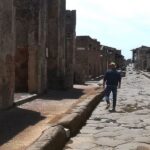


Streets, aqueducts, fountains, and baths
Once you’re past the main public spaces, shift your attention to everyday infrastructure. You’ll encounter remains of the aqueduct, fountains, and public baths. This is where Pompeii becomes more than a set of monuments. It becomes a functioning city system: water supply, hygiene, and shared space.
A simple way to slow down here: pick one theme and stick with it for 20 minutes. For example, spend time thinking about water. Follow the idea of where it would have come from and where it would have gone. You’ll start to see the logic behind the layout.
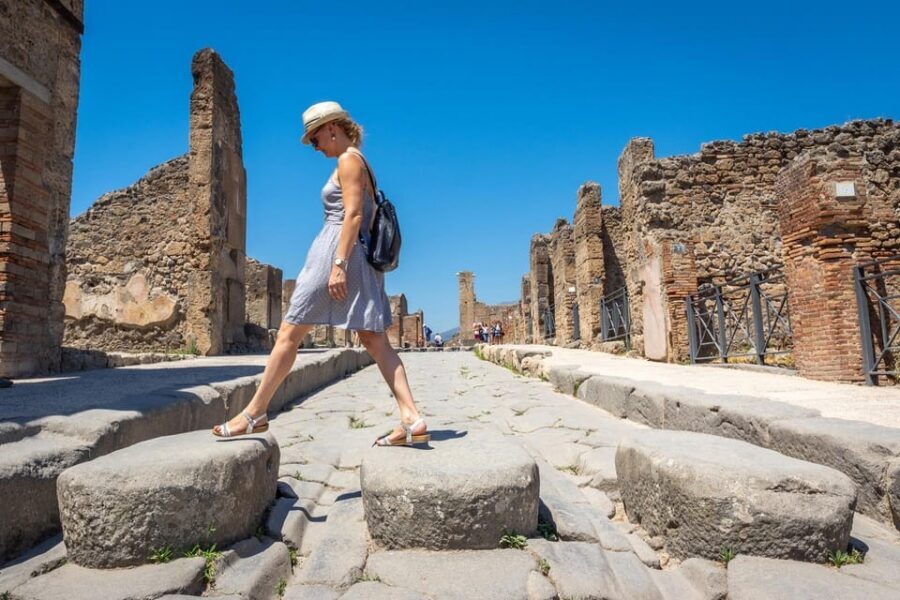
Also, yes, it’s a lot of walking over uneven stone. Wear hiking shoes. This is not the place for flexible sneakers that feel great on smooth floors and terrible on cobblestones.
Private houses and businesses, with statues and color
As you keep moving through the streets, you’ll reach the remains of private houses and businesses, plus statues. This is where the city stops being only “big public Rome” and turns into personal daily life.
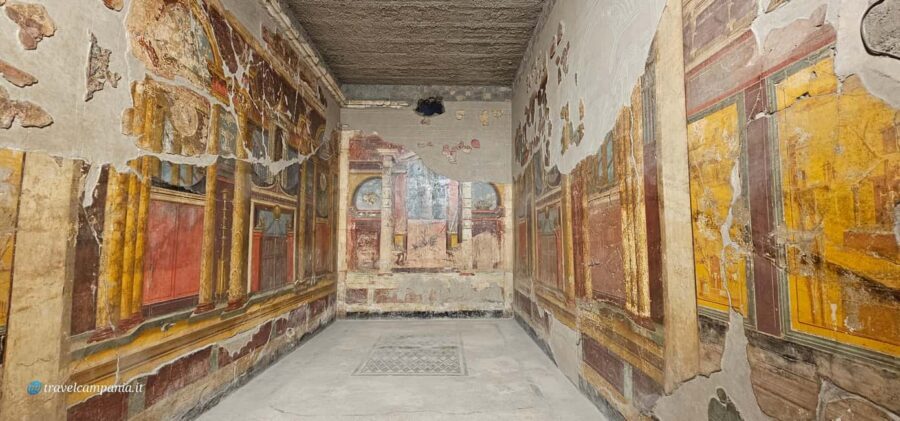
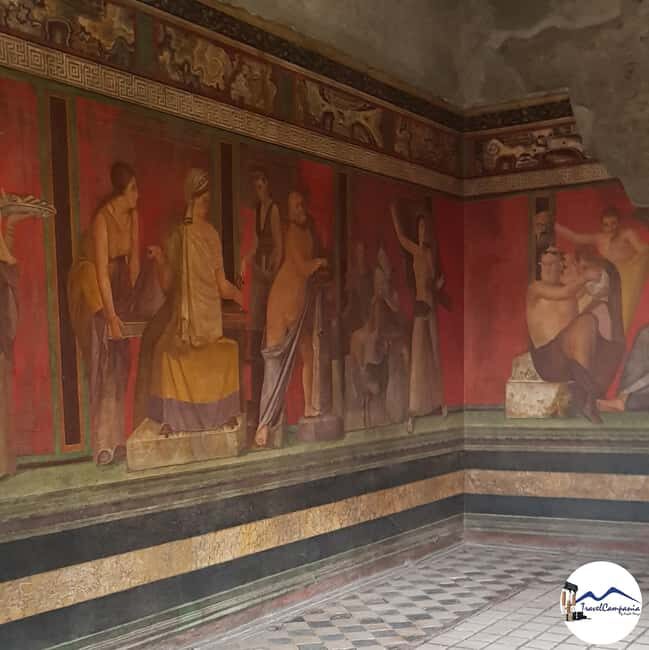
One of the most impressive parts is the mention of colorful frescoes in houses and businesses. Frescoes are evidence of taste, money, and daily visual culture. Even if what you see is partially worn or damaged, the fact that there were bright paintings on interior walls adds a human layer that raw stone alone can’t offer.
You can make this section work well by doing a quick loop: stop, listen to the audio for one building, then move to the next nearby one without letting yourself get lost in side paths. Pompeii rewards focus, not just stamina.
Amphitheater and dramatic theaters
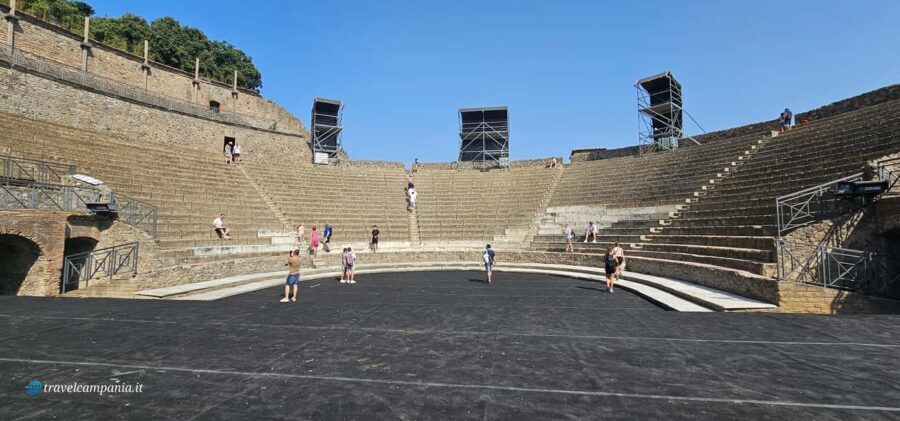
Then come the big performance spaces: the amphitheater and dramatic theaters. If you’re interested in crowd energy, architecture, or how ancient entertainment was designed for visibility, these spaces are where you’ll feel the scale most clearly.
Try to picture the shape of the audience in relation to the stage or arena area. The audio guide is helpful here because it turns the seating and structure into something you can imagine as a living setting.
And if you’re not into theaters and crowds, you can still get value by focusing on materials and construction. Understanding how these buildings were used makes the ruins feel less random.
What you get for $40 (and when it’s not a great deal)
At $40 per person, you’re paying for three things combined:
- Priority admission (the express ticket)
- A smartphone audio guide
- A picture map for navigation
So the value math depends on you. If you hate lines, you’ll feel like the price makes sense quickly. If you’re someone who loves learning on-site and wants explanations without booking a live guide, the audio guide helps justify the cost. And if you’re the kind of traveler who always ends up with a dead phone at the wrong moment, the included picture map is a nice backup.
But there’s a caution worth sharing: if you’d rather just buy entry directly at the site and you don’t care about audio explanations, you may feel the packaged ticket is more expensive than you need. The experience isn’t described as a private tour, so you’re not paying for a personal guide. You’re paying for faster entry plus audio content.
In other words: it’s a good deal if you’ll use the audio and you want that smoother gate experience. If you’re flexible about lines and happy reading on your own, you might compare options before committing.
Practicalities that can make or break the day

A self-guided Pompeii visit works best when you take the friction out of the basics.
Bring:
- Hiking shoes
- A reusable water bottle
Not allowed:
- Luggage or large bags
- Drones
- Pets (assistance dogs allowed)
A couple of small planning ideas:
- Travel light so you don’t spend your energy dealing with bag rules.
- Keep your phone charged, and consider bringing a portable charger if you rely on the audio guide heavily.
- Plan breaks. Pompeii can feel nonstop, especially once you’re clicking around with your audio.
Also note that food and drinks aren’t included. That’s not a criticism; it just means you should plan your own supply strategy. Having water matters more here than it does on some other museum visits.
Languages and on-site help: what to expect

The host or greeter language options are Italian and English. The audio guide is tied to this same idea: you’ll have an audio experience built for those languages.
If you run into trouble with access—especially related to the audio guide and ID—having staff who can communicate in English can help you fix the problem faster. Still, the biggest lesson is preparation: have your ID ready, and have your participant details correct since you’re asked to provide full name and age for participants.
Who this Pompeii ticket fits best
This is a strong match for you if:
- You want to explore on your own without booking a full guided group.
- You like structure but not rigid scheduling.
- You value context from a smartphone audio guide while you walk.
- You care about saving time with skip-the-line entry.
It might be less ideal if:
- You strongly dislike any requirement to hand over ID documents during check-in.
- You prefer a totally no-friction experience where you can show up and go instantly.
- You don’t plan to use the audio at all.
This is also a good option for travelers who want to see a wide spread of ruins in one day, because the park’s layout supports wandering through forum life, public buildings, houses, and performance spaces.
Should you book this Pompeii skip-the-line audio ticket?

Book it if you want a faster start and you’ll actually use the smartphone audio guide. For Pompeii, the difference between seeing ruins and understanding them is often the audio layer—especially when you’re moving through the forum, the baths, and the dramatic theaters.
Skip it or at least compare options if you’re uncomfortable with ID document requirements tied to audio access, or if you’re the type who would rather pay less and go without audio explanations. At $40, the deal is only great when you benefit from the express entry and the learning tools.
If you do book, go in prepared: hiking shoes, water, travel light, and your ID ready at the Wellcome box. That’s how you turn priority entry into priority enjoyment.
FAQ
What’s included with the ticket?
You get express skipping entrance to Pompeii Archaeological Park, a smartphone audio guide, and a picture map of the city.
How long is the ticket valid?
The ticket is valid for 1 day. You’ll need to check availability for starting times.
Where do I meet, and where does it end?
You start at the Wellcome box and the activity ends back at the same meeting point.
What should I bring for the visit?
Bring hiking shoes and a reusable water bottle.
Is food or drinks included?
No. Drinks and food are not included.
Is the experience wheelchair accessible?
Yes, it is listed as wheelchair accessible.