REVIEW · POMPEI CAMPANIA
Pompeii: AR Glasses Augmented Reality Tour
Book on GetYourGuide →Operated by AR Tour srl · Bookable on GetYourGuide
Pompeii with holograms makes sense fast. This AR glasses tour lets you see how temples, houses, squares, and theaters may have looked before the eruption, while the present-day ruins stay in view. I love the real vs reconstructed comparison right on the stones, and you also get an audio guide in multiple languages, so you do not feel stuck waiting for a live explanation.
One thing to plan for: the Pompeii entry ticket is not included, so your total cost will be a little higher than the $20 price you see for the AR portion. It is still a good trade for many people, especially if you want clarity without turning the whole visit into homework.
In This Review
- Key highlights worth your time
- How AR glasses change what you notice in Pompeii
- Starting in Piazza Esedra: Coffee Shop Vittoria as your anchor
- The 2-hour walk through the ruins: what the route is really like
- Stop 1: Coffee Shop Vittoria briefing and AR glasses setup
- Stop 2: Pompeii with overlapping reconstructions (temples, houses, theaters)
- Stop 3: Returning to Coffee Shop Vittoria
- Audio guide languages: how you can match it to your comfort
- Value check: is $20 worth it in Pompeii?
- Who this tour is best for
- Comfort tips that make the AR portion easier
- What the friendly assistant adds (and where expectations should be realistic)
- Should you book the Pompeii AR glasses tour?
- FAQ
- Do I need to buy the Pompeii entry ticket separately?
- How long is the Pompeii AR glasses tour?
- Where do I meet the tour assistant?
- What languages are available during the tour?
- What should I bring for the tour?
- Is the tour suitable for kids and wheelchair users?
Key highlights worth your time
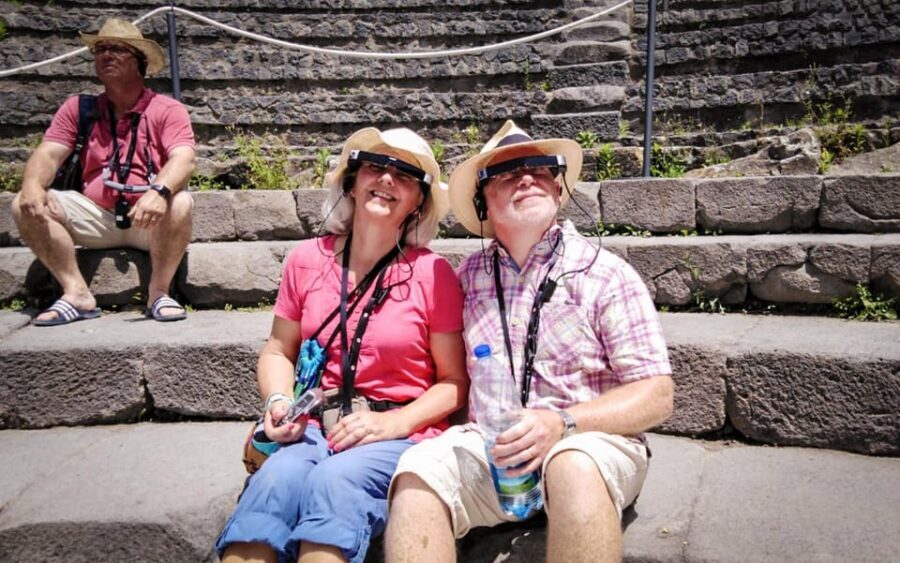
- AR glasses overlay ancient reconstructions directly on top of the existing ruins
- Pre-eruption context in plain language from a tour assistant and multilingual audio
- Small group walking with support the whole way
- Audio in six languages to match your comfort level
- Rain or shine running plan, so you can keep moving even when the weather turns
How AR glasses change what you notice in Pompeii
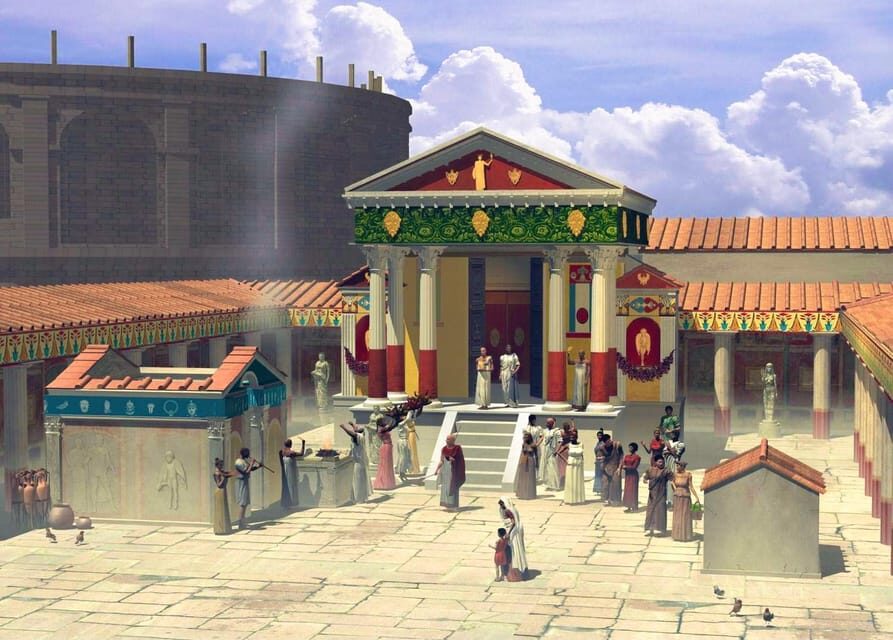
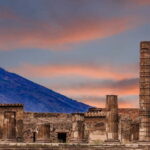
Pompeii can feel like a museum of leftovers until you know what you are looking at. This tour fixes that problem with AR glasses that place holographic reconstructions in front of you, lining up with where you are standing. The key is that you do not have to choose between imagination and reality. You get both: the bones of the city in front of you, plus a suggested version of what it looked like before 79 A.D.
What makes that valuable for you is speed. You spend less time guessing. You start recognizing building purposes and street-scale details—things that usually take a longer guided tour or a lot of reading. The tour focuses on major spots such as temples, theaters, homes, squares, and other prominent buildings. Even though the route can vary based on available time, the “big themes” stay consistent, which is exactly what you want from a 2-hour experience.
Also, the audio component matters. You hear descriptions through the guide system, and you can choose English, Italian, French, German, Portuguese, or Spanish through the included audio. That is a practical advantage because Pompeii is packed with details, and you will often want the context without interrupting your walking pace.
You can also read our reviews of more tours and experiences in Pompei Campania.
Starting in Piazza Esedra: Coffee Shop Vittoria as your anchor
Your tour begins at Coffee Shop Vittoria in Piazza Esedra (Porta Marina Inferiore). It is right next to the entrance area, so you are not wandering around wondering where “the real start” is.
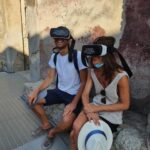
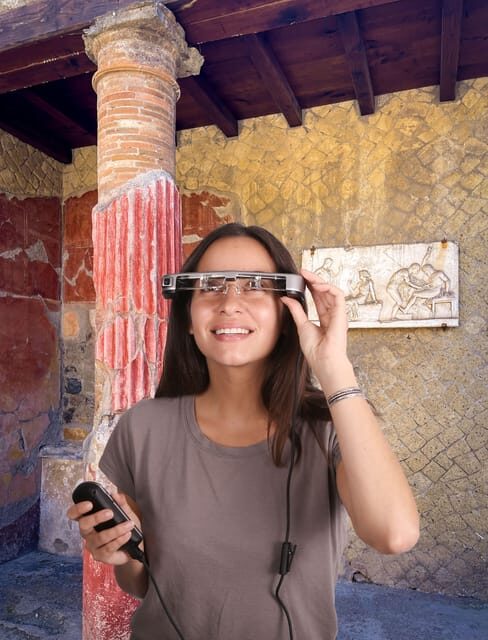
Here is what helps in real life: your Tour Assistant meets you there holding a sign with AR Tour on it. You get brief guidance on the itinerary and how to use the AR glasses. That early moment is not just administrative. It lets you get your bearings fast, and it reduces the chance you spend the first part of Pompeii fumbling with tech while everyone is waiting.
It is also a nice human touch to have a real person walking with you. The provided assistant stays with you for the entire experience and helps you keep the gear working properly.
Quick practical note: if you arrive late, the team waits for a maximum of 5 minutes out of respect for other participants. Plan buffer time, especially if you are connecting from a busier corner of Pompeii or dealing with last-minute ticket lines.
The 2-hour walk through the ruins: what the route is really like
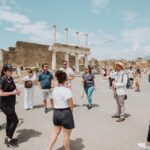
The core of the experience is a guided walking tour through Pompeii over about two hours. The schedule is simple: meet at Coffee Shop Vittoria, go into the archaeological area, and return to the same meeting point.
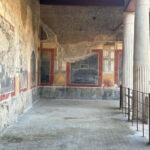
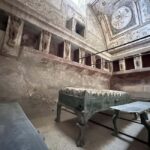
Inside, you do not just look at one monument and move on. The AR approach works best when you keep walking and comparing. As you pass key locations, the glasses create holographic reconstructions that overlap what you are seeing now. That overlap is the whole point. You watch how a theater area, for example, can shift from broken seating into something closer to its original setting. You see how a square or street corner can feel more “lived-in” when old facades and architectural shapes reappear.
Because the tour is predefined but flexible, the assistant can customize the stops based on needs and available time. That flexibility is useful. Pompeii visits often go sideways because weather changes plans, crowds slow you down, or you linger longer at a particular viewpoint. Having the option to adjust keeps the tour from turning into a race.
One more reality check: AR glasses are still tech. The effect is strong, but it is not a Hollywood production. In one piece of feedback, the 3D video part could improve. Translation: expect a helpful reconstruction layer, but do not assume every visual element will be picture-perfect.
Stop 1: Coffee Shop Vittoria briefing and AR glasses setup
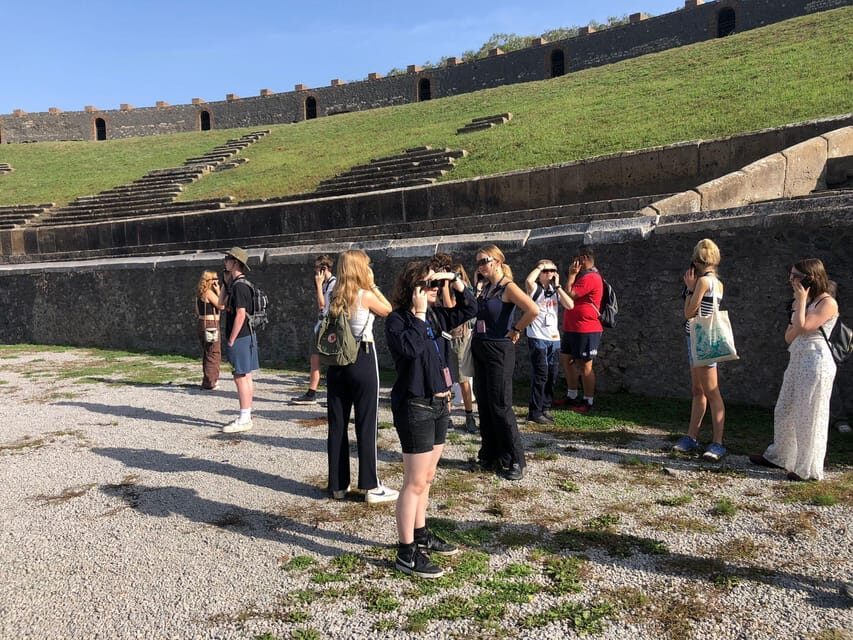
That first stop is mostly about getting you ready. You meet the assistant, get the quick plan, and learn how to use the AR glasses. This is where you can avoid most “on-site stress,” because once you are in the ruins, the clock is running and the walking surfaces are not set up for delays.
If you wear eyeglasses, you can still use the AR glasses. That is a big deal for comfort and clarity. You do not want to spend the tour looking through one pair of glasses while trying to position another one. When setup is quick and correct, the overlay looks sharper and you can focus on the ruins and the reconstructions instead of adjusting gear every few minutes.
This start also matters for timing. You want to get into Pompeii while the light and your energy are still good. Two hours goes quickly once you are walking among the stones.
Stop 2: Pompeii with overlapping reconstructions (temples, houses, theaters)
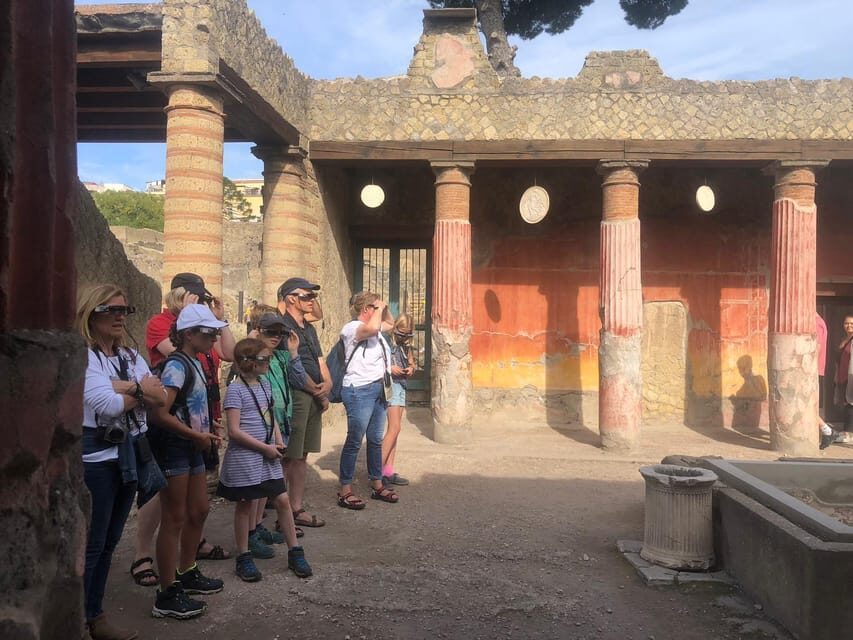
This is the main event. The tour uses AR to place holographic reconstructions over the existing ruins, showing how major buildings and public spaces may have looked before the eruption. The experience emphasizes significant structures like temples, theaters, houses, squares, and other important buildings.
Why this is a smarter way to tour Pompeii
- You learn by comparison: you see what survived and what changed, instead of memorizing a list of buildings.
- You get a sense of scale: reconstructions make it easier to understand proportions, especially in open squares and around theaters.
- You connect architecture to life: homes and public spaces become more than “ruins with columns.”
What you should watch for while walking
- When the overlay appears, pause just long enough to orient yourself. Look at the edges of walls, rooflines, and key openings. That is how your brain locks the reconstruction into the real site.
- Use the audio guide timing as your “secondary breadcrumb trail.” If you miss a sentence, you can reorient and catch up at the next visual cue.
A limit to know about
The tour does not include suburban villas, including Villa dei Misteri. So if you were specifically hoping for that kind of outlying experience, you’ll want a different tour or a separate plan.

Stop 3: Returning to Coffee Shop Vittoria
The tour ends back at the meeting point. That matters more than it sounds. When you finish at the same place you started, you avoid a scramble to find transit or a taxi after two hours of walking in and out of the site.
It also helps if you are pairing this with other Pompeii plans. You can schedule nearby lunch or continue exploring at your own pace without a “where do we end up” headache.
Audio guide languages: how you can match it to your comfort
The audio guide is available in multiple languages, including English, French, Italian, Spanish, German, and Portuguese. There is also a live tour guide listed for English and Italian.
In practice, this is helpful because Pompeii is not just architecture. It is daily life. The audio descriptions help connect what you see to how people used buildings, how streets and squares functioned, and what different parts of the city meant.
If you are traveling with mixed-language companions, this is also a practical advantage. You can often keep the group together while each person listens in the language they prefer, instead of splitting up or relying on one person to translate.
Value check: is $20 worth it in Pompeii?
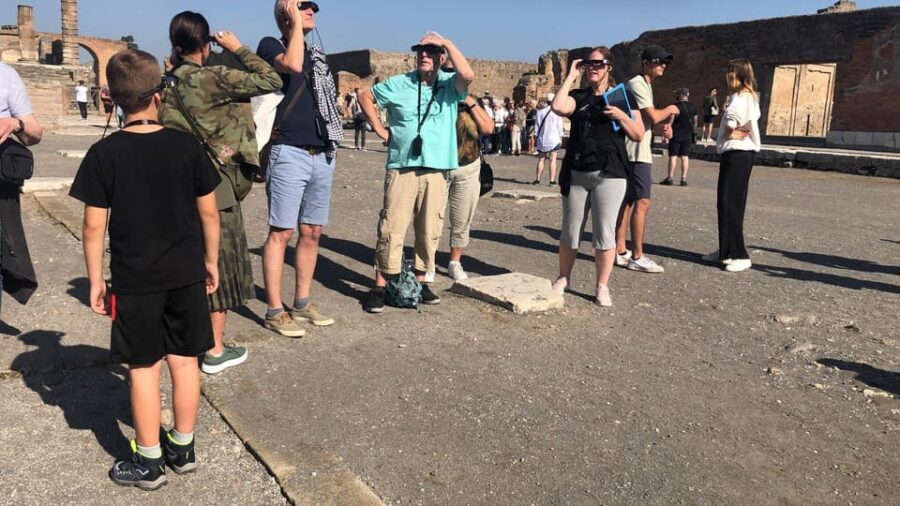
At $20 per person for a two-hour AR glasses experience, the biggest “value lever” is what you get for that time: reconstruction visuals, a guided assistant, and audio descriptions. You are paying for interpretation, not for access to the ruins themselves.
And that is where the pricing reality comes in: Pompeii entry ticket is not included. So your total spend will be the ticket plus the $20 AR tour. If you were already planning to visit Pompeii anyway, this AR add-on can be a strong way to make your time more understandable without turning it into a full-day guided itinerary.
When it feels like great value
- You want a guided structure but do not want a long, lecture-style tour.
- You like learning with visuals and quick context as you walk.
- You want a fun, approachable way to bring the site to life for different ages.
When you might choose differently
- If you are the type who loves reading museum-style labels and already knows the major sites well, you might not need AR support.
- If you were specifically targeting Villa dei Misteri and suburban villas, this tour will not cover that.
Who this tour is best for
This tour is a nice fit for people who want clarity without a heavy planning load. It is also described as suitable for all ages, with one important limit: it is not suitable for children under 8.
I think it works well for:
- Families with kids old enough to handle walking and tech attention
- Couples or friends who want an easy structure and a shared wow-factor
- Solo travelers who appreciate having an assistant with them the whole time
Two other practical constraints you should know up front:
- Not suitable for wheelchair users, since it is a walking format through the archaeological area.
- No luggage or large bags are allowed, so travel light.
Comfort tips that make the AR portion easier
Even with the tech, you still have to walk. Pompeii is outdoors, uneven in places, and weather changes fast. Plan like you are touring a historic site, not a shopping mall.
Bring:
- Comfortable shoes
- Sunglasses and sunscreen
- A sun hat
- Water
- Weather-appropriate clothing
The tour runs rain or shine. That means you should think about rain gear, even if you are hoping for sun. If you show up prepared, the AR reconstructions keep doing their job and you do not waste half your time adjusting your plan.
Also, try to arrive ready to use the glasses. The assistant will set you up, but your best experience happens when your equipment setup only takes a few minutes and you are not distracted by forgetting basics like sunglasses or water.
What the friendly assistant adds (and where expectations should be realistic)
One repeated theme in the feedback is how helpful the guide is. That matters because AR experiences can be awkward if the tech is hard to manage. The assistant’s job is to keep the experience moving and to help when questions come up. When the guide is friendly and present, it reduces the common stress of “Will I get it right?”
There is also a note that the 3D video could improve. I’d treat that as a gentle expectation-setting point. The value is the overlay reconstructions and the explanations you get while walking. Think of it as a guided reality layer, not as a fully cinematic effect that never glitches.
Should you book the Pompeii AR glasses tour?
If you are planning Pompeii for a first trip, I’d seriously consider booking this. It is short enough to fit into a realistic schedule, and it gives you instant context by overlaying reconstructions on the ruins. With the $20 price, you are mostly paying for understanding and guidance, and for many people that is the hardest part of Pompeii to unlock on your own.
Book it if:
- You want a fast, visual way to make sense of temples, houses, squares, and theaters
- You like walking with a small-group structure and a friendly assistant
- You prefer audio explanations in your language choice
Skip it or pair it differently if:
- You specifically want suburban villas like Villa dei Misteri
- You already know the site well and want to rely on your own reading and labeling
- You need wheelchair access
If you do book, plan for the extra Pompeii entry ticket and come with comfortable shoes, sun protection, and water. Then let the AR comparisons do the heavy lifting for you.
FAQ
Do I need to buy the Pompeii entry ticket separately?
Yes. The AR glasses tour includes the equipment and guidance, but it does not include the Pompeii entry ticket.
How long is the Pompeii AR glasses tour?
It lasts about 2 hours. Check availability for the starting times.
Where do I meet the tour assistant?
Meet at Coffee Shop Vittoria in Piazza Esedra (Porta Marina Inferiore), right next to the entrance. The assistant holds a sign that says AR Tour.
What languages are available during the tour?
The live tour guide is listed for English and Italian. The audio guide is available in English, French, Italian, Spanish, German, and Portuguese.
What should I bring for the tour?
Wear comfortable shoes and bring sunglasses, sun hat, sunscreen, and water. Also bring weather-appropriate clothing since the tour runs rain or shine.
Is the tour suitable for kids and wheelchair users?
It is not suitable for children under 8. It is also not suitable for wheelchair users.