REVIEW · POMPEI CAMPANIA
Pompeii Skip the Line Ticket + Guide Book with itineraries
Book on GetYourGuide →Operated by MOTORENT S.R.L. · Bookable on GetYourGuide
Pompeii feels manageable with a real plan. This setup pairs a skip-the-line ticket with a 13-language guidebook and an updated map, so you’re not stuck wandering without context. I also like the flexibility: you pick 2, 4, or 6 hours and move at your own pace. The main drawback is that this is self-guided—there’s no included walking guide—so you’ll want to follow the route in the book to avoid wasting time.
You enter through the Piazza Anfiteatro access point, which is a simple, clear start. You can go in anytime between 9:00 am and 5:00 pm, and you’ll keep the guidebook as a souvenir. Just note that the value depends on your timing and expectations: you’re paying for skip-line convenience plus the book, not for a full guided tour experience.
In This Review
- Key things I’d target before you go
- Pompeii, but with less stress: what this ticket-and-book really gives you
- Where to enter: Piazza Anfiteatro meeting point made simple
- Choosing 2, 4, or 6 hours: build your visit around your pace
- The 2-hour version: the greatest hits sprint
- The 4-hour version: the sweet spot for first-timers
- The 6-hour version: for history lovers and slow walkers
- Navigating Pompeii with the updated map: how not to waste time
- Everyday Pompeii: houses, frescoes, baths, temples, and shops
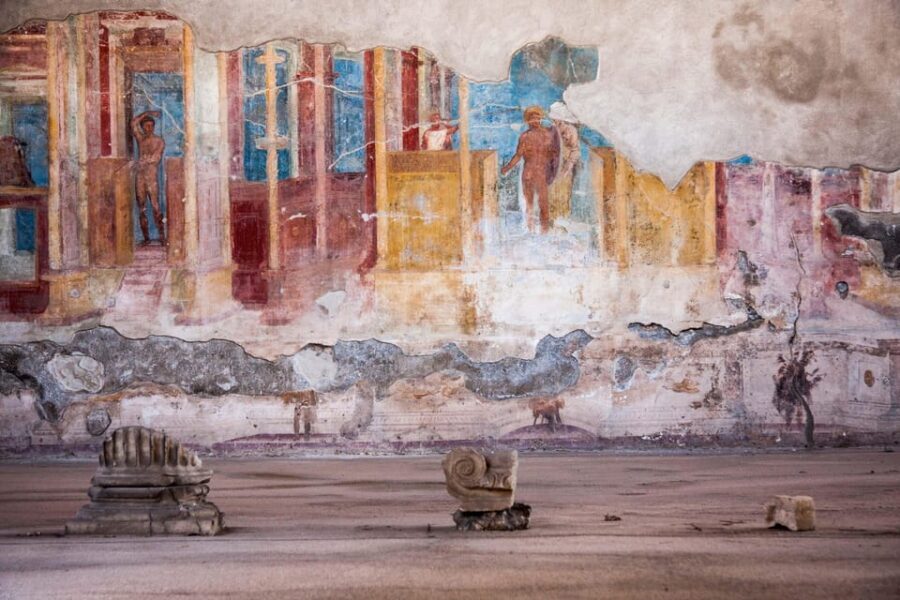
- Frescoed houses: why the details matter
- Spas and baths: life at a slower tempo
- Temples and shops: public meaning and daily needs
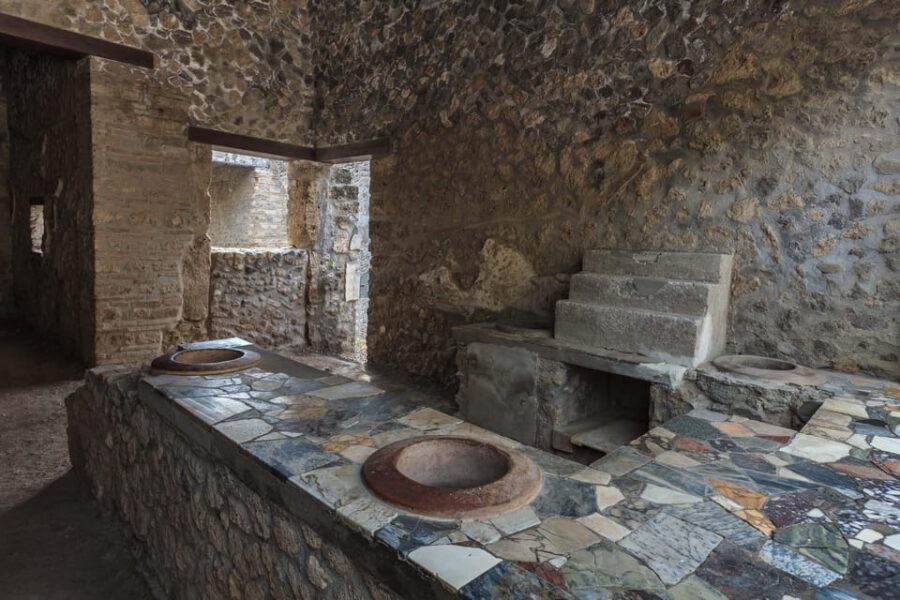
- Thermopolis: the Roman fast-food moment
- Entertainment and big architecture: theaters, brothels, and the amphitheater
- Theaters and performance spaces
- The brothel area: uncomfortable, but historically important
- The Roman amphitheater: the stop you’ll remember
- The casts of the victims: the moment Pompeii gets real
- What skip-the-line changes on arrival (and why it’s worth paying for)
- Price and value: when $41 feels smart, and when to double-check
- What’s not included: plan around food and transportation
- Who this works best for
- Practical tips for a comfortable, clearer visit
- Should you book this Pompeii skip-the-line ticket + guidebook?
- FAQ
- How long is the Pompeii visit with this ticket?
- What are the visiting hours?
- Where do I need to meet the operator?
- Which entrance do I use to access Pompeii?
- Does this include skip-the-line entry?
- Do I get a guide or an audio tour?
- What languages are available for the guidebook?
- How many guidebooks do we get?
- Is food included?
- What should I bring?
- Is there a cancellation policy?
Key things I’d target before you go
- Skip-the-line access saves your morning in a popular site.
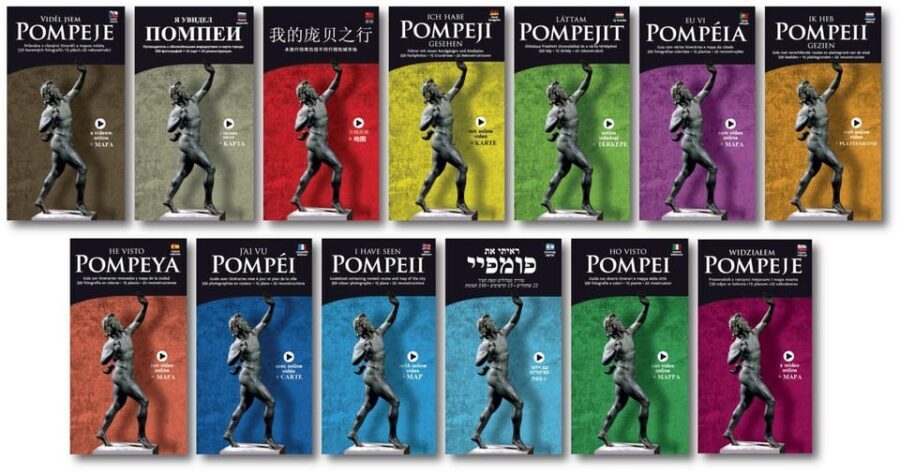
- A 13-language guidebook stays with you after the visit.
- Updated map helps you actually navigate Pompeii’s layout.
- Timed 2/4/6-hour itineraries make planning painless.
- You’ll focus on iconic sights like frescoed houses, thermopolis, theaters, and the Roman amphitheater.
- The book guides you to the casts of the victims, one of Pompeii’s most unforgettable stops.
Pompeii, but with less stress: what this ticket-and-book really gives you
This experience is built for independent exploring, with just enough structure to keep you oriented. You get entry into the Pompeii archaeological park plus a guidebook that includes itineraries for 2, 4, or 6 hours. Think of it as a “choose your pace” system: you can see the highlights quickly, or slow down and connect more dots as you walk.
The best part is that your brain gets a job to do while you’re there. Pompeii can feel like a lot of stone streets and building shells unless someone explains what you’re looking at. With a map and planned routes, you’ll understand what each area was for—homes with frescoes, baths/spas, temples, shops, and the everyday places where people ate and socialized, like the thermopolis (a Roman-era fast-food spot).
And since you can enter any time from 9:00 am to 5:00 pm, you’re not forced into a rigid schedule that can get eaten alive by lines or transport delays. That matters in Campania, where your day can swing based on traffic, weather, or transit timing.
You can also read our reviews of more tours and experiences in Pompei Campania


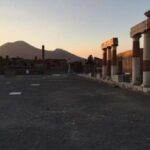
Where to enter: Piazza Anfiteatro meeting point made simple
Your access point is the Piazza Anfiteatro entrance. When you arrive, you meet the operator at the information point at VIA ROMA 123, POMPEI. Then you show your voucher for easy entry into the archaeological park with your reservation.
Why this matters: Pompeii has multiple entrances and pathways, and trying to “figure it out” on-site can waste the very time you’re paying to save. Starting at Piazza Anfiteatro with staff guidance (in English/Italian/Spanish/French) is an efficient way to get moving.
Choosing 2, 4, or 6 hours: build your visit around your pace
The guidebook’s itineraries are the backbone of the experience. You don’t just get a random map; you get a route option for the amount of time you realistically have.
Here’s how I’d choose, and what you’ll likely prioritize based on the sights you’re planning to see:
The 2-hour version: the greatest hits sprint
If you’re tight on time or you’re pairing Pompeii with another stop, the 2-hour itinerary is best as a highlights pass. You’ll hit several major categories without trying to read everything. Expect you’ll focus on the dramatic public sites and the most visual parts of Pompeii—things like the well-preserved Roman amphitheater, key viewing areas for theater/broader entertainment spaces, and a couple of frescoed house stops.
Tradeoff: you’ll see a lot, but you won’t slow down enough to fully absorb the layout and daily life details. Use this time well: plan to spend extra minutes in the places that make you stop and stare (for many people, that’s frescoes and the amphitheater).
The 4-hour version: the sweet spot for first-timers
Four hours is where Pompeii usually clicks. You have time to move between zones—homes, spas/baths, temples, and everyday storefronts—without feeling rushed every ten minutes. You can also build in a more thoughtful pace for the casts of the victims of the eruption, which is one of Pompeii’s emotional anchors.
Tradeoff: the site is still large, so you’ll need to stick to your route rather than wander off-trail in search of perfect photo angles.
You can also read our reviews of more guided tours in Pompei Campania



The 6-hour version: for history lovers and slow walkers
Six hours lets you balance “iconic” with “understood.” You’ll still cover the big landmarks like the amphitheater and the entertainment areas, but you can also give yourself time for the quieter storytelling: how Roman daily life worked, what people ate, where they bathed, and what domestic spaces looked like when frescoes survived.
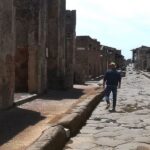
Tradeoff: you’ll likely feel the walking. Pompeii is outdoor walking on uneven ground. If you’re visiting in hot weather, treat this as a comfortable marathon, not a casual stroll.
Navigating Pompeii with the updated map: how not to waste time
Without guidance, Pompeii’s streets can become a maze of “I think I’ve been here.” The updated map in the package is there to prevent that exact frustration. It helps you link what you see in front of you to where you are in the overall plan.
In practice, that means you can:
- bounce between nearby highlights rather than crossing the park randomly,
- find the planned stops in your chosen itinerary,
- spend more time looking and less time recalculating.
A small practical note: aim to get your bearings early. Even with a great map, it takes a few minutes to understand the site flow. Start with the first part of your itinerary right away so your momentum doesn’t fade.
Everyday Pompeii: houses, frescoes, baths, temples, and shops
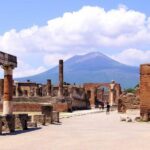
One of the best reasons to do Pompeii is that it doesn’t feel like a museum removed from real life. It feels like a snapshot of daily routines frozen in time. In your guidebook route, you’ll focus on that “everyday city” fabric: the frescoed houses, spas, temples, and shops.
Frescoed houses: why the details matter
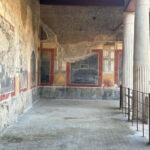
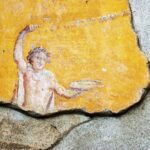
These are the stops where Pompeii’s art and domestic design come alive. Frescoes turn what would be blank walls into stories and social signals—how people decorated their space and what they wanted to communicate.
What to watch for: when you slow down, you start noticing how the homes were arranged and how the rooms likely connected to everyday movement. Even if you only catch pieces, it’s a different experience than just passing by.
Spas and baths: life at a slower tempo
Pompeiian spas and bathing areas help you understand Roman leisure and personal ritual. This is where you get a “how people lived” feel rather than just “what existed.”
Temples and shops: public meaning and daily needs
The temples explain religion as a visible part of city life. Shops show commerce and routine—places where ordinary needs were handled, not just grand ceremonies.
Thermopolis: the Roman fast-food moment
The thermopolis (the Roman-era equivalent of quick, hot food) is one of those surprises that makes Pompeii feel modern. It’s easy to overlook if you rush, so if you’re doing the shorter itinerary, consider giving this area a deliberate stop.
Tradeoff of self-guided: you’ll get more out of these places if you use the guidebook prompts instead of treating them like photo stops only.
Entertainment and big architecture: theaters, brothels, and the amphitheater
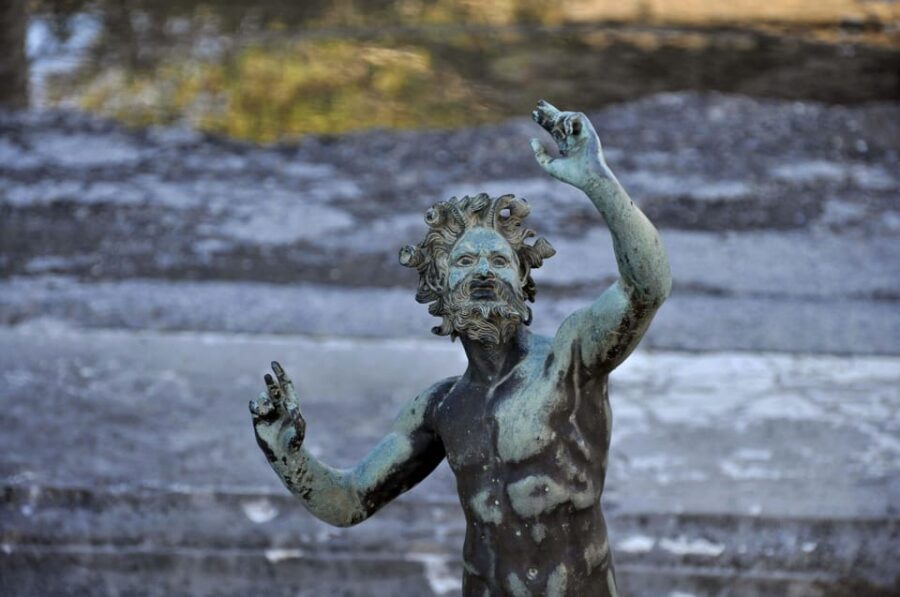
Pompeii isn’t only domestic. It also had strong public entertainment energy. Your route includes theaters and the area connected to brothels, plus one of the best-preserved Roman amphitheaters.
Theaters and performance spaces
Even without a deep technical background, theater architecture gives you instant context. You can often picture crowds gathering for shows, and you get a clear sense of how social life worked in the open air.
The brothel area: uncomfortable, but historically important
This is where Pompeii does not sanitize the past. The guidebook helps you interpret what you’re seeing rather than just labeling it as shocking. If you’re sensitive, it may help to decide in advance that you’ll take it as educational context, not entertainment.
The Roman amphitheater: the stop you’ll remember
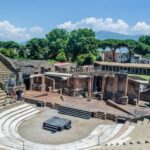
The Roman amphitheater is often a highlight because it’s so intact. When structure survives, you feel the scale immediately. It’s also one of the easiest places to understand visually—where people would sit, how the space worked, and why it drew crowds.
If you’re choosing only a few must-dos, amphitheater time is usually worth it.
The casts of the victims: the moment Pompeii gets real
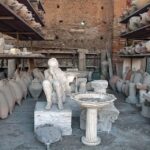
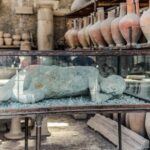
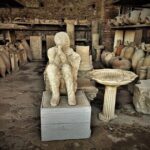
Among the most powerful sights are the casts of the victims of the eruption. These figures turn a citywide disaster into individual, human presence. The guidebook’s role here is huge: it helps you slow down and interpret what you’re looking at instead of rushing through a difficult stop.
Practical tip: don’t treat this as a photo opportunity. Use it as your emotional pacing point. If you’ve spent the morning on houses, shops, and architecture, this stop shifts you from “what was here” to “what happened here.”
What skip-the-line changes on arrival (and why it’s worth paying for)
Pompeii can be busy. A skip-the-line ticket is basically time insurance. Instead of spending your best morning minutes waiting at the entrance, you can start walking and get your planned route underway.
That’s especially valuable because your day isn’t only Pompeii. You might be dealing with transit to Campania, parking issues, or just the reality of being outside in sun and heat. Time saved at the gate usually feels like time you can spend inside the ruins.
Also, because your visit window is 9:00 am–5:00 pm, you’re not trapped in a one-hour slot. You can arrive, show your voucher, enter, and start your chosen itinerary without panic.
Price and value: when $41 feels smart, and when to double-check
At about $41 per person, the value is strongest if you want two things at once: (1) skip-the-line entry and (2) a guidebook you can use immediately and keep afterward. That’s a practical combo, not a fancy add-on.
However, one caution: your cost may feel less justified if you expect you already qualify for free entry or discounted entry elsewhere. A past buyer complained about paying full price when other family members had access via age-based or category-based rules. I can’t verify how your situation will compare, but it’s smart to check whether your group might have access options that reduce your total cost.
Bottom line: pay attention to who’s in your group and what you’re already entitled to. If you’re paying full fare for everyone, skip-the-line plus a multilingual souvenir guidebook can still be a good deal because it saves both time and mental effort.
What’s not included: plan around food and transportation
This experience includes the ticket, the guidebook with itineraries, and a map. What it doesn’t include is the stuff that can quietly ruin your day if you assume it’s covered: transfer and food and beverages.
So plan for:
- getting yourself to Pompeii on your own,
- bringing water,
- having a realistic plan for lunch or snacks during your 2/4/6-hour visit.
You’ll also want comfortable shoes and breathable clothes. Pompeii is walk-heavy, and the ground can be uneven.
Who this works best for
This is a strong fit if you:
- want to explore on your own schedule,
- like structure that helps you not miss key areas,
- want a multilingual guidebook you can study at your pace and keep as a souvenir,
- are visiting for the first time and need help understanding what you’re seeing.
It’s less ideal if you want a full live guide walking with you. The “instructor” languages listed suggest help at entry, but the experience you’re buying is fundamentally self-guided with the book and map.
Practical tips for a comfortable, clearer visit
Pompeii rewards good footwork and good timing. Here’s what you should do so the day feels easier:
- Bring passport or ID card (don’t leave it in your hotel bag).
- Wear comfortable shoes you trust for lots of walking.
- Bring a sun hat and water.
- If you’re doing the 6-hour option, build in your own mini breaks rather than trying to power through.
- Use the guidebook itinerary like a checklist. Even if you move slower, don’t abandon the route—it’s there to keep you efficient.
Should you book this Pompeii skip-the-line ticket + guidebook?
If your goal is to see Pompeii without the headache of lines and without guessing what you’re looking at, I’d say yes. The skip-the-line entry plus a 13-language guidebook with 2/4/6-hour itineraries is a practical way to get both time savings and real context.
Only hesitate if your group includes people who might qualify for free or reduced entry elsewhere, or if you strongly prefer a live guide who explains as you walk. Otherwise, this is exactly the kind of “do it your way, but not clueless” Pompeii plan that works.
FAQ
How long is the Pompeii visit with this ticket?
The experience is valid for 1 day, and the guidebook includes itineraries designed for 2, 4, or 6 hours.
What are the visiting hours?
You can enter from 9:00 am until 5:00 pm.
Where do I need to meet the operator?
Meet at the information point at VIA ROMA 123, POMPEI.
Which entrance do I use to access Pompeii?
Your reservation is accessed through the Piazza Anfiteatro entrance.
Does this include skip-the-line entry?
Yes, you get a skip-the-line ticket.
Do I get a guide or an audio tour?
You receive a guidebook with itineraries and a map. A guide is not included.
What languages are available for the guidebook?
The guidebook is translated into 13 languages. Operator help is available in English, Italian, Spanish, and French.
How many guidebooks do we get?
One guidebook is available for every two participants.
Is food included?
No. Food and beverages are not included.
What should I bring?
Bring your passport or ID card, comfortable shoes, a sun hat, water, and comfortable clothes.
Is there a cancellation policy?
Free cancellation is available up to 24 hours in advance for a full refund.