REVIEW · POMPEII
Pompeii Private Tour with an Archaeologist and Skip The Line
Book on Viator →Operated by ELIANA SANDRETTI · Bookable on Viator
Skip the crowds, feel the city.
This private Pompeii tour with an archaeologist keeps you moving through the best-preserved and most meaningful spots fast, with skip-the-line entry once you’ve handled the Pompeii site ticket (19 euros per person, not included). I like the high-yield route that covers major monuments plus practical slices of daily life, and I like the stops that go beyond the postcard highlights, like the Odeion acoustics spot and the Lupanar area. One catch: you’ll need to buy the entrance ticket separately, so don’t assume the tour price automatically includes park entry.
I also like that the pacing is built for a short visit: about 2 hours, tailored to your interests, and focused on what’s hardest to notice on your own. Some guides are praised for efficient crowd avoidance and for adjusting where they walk, which matters in summer heat and tight shoulder-to-shoulder moments.
The biggest consideration is simple: the tour runs in English, and it’s a walking experience through archaeological surfaces. If English is a stretch for your group, ask about language options early, and plan for some sun or rain gear depending on the day.
In This Review
- Key things to know before you go
- Pompeii Private Tour Price: What You’re Really Paying For
- Meeting at Piazza Esedra and Getting Inside Faster
- The Big Idea: A High-Yield 2-Hour Route
- Pompeii Archaeological Park Highlights: Theaters, Temples, Shops, and the Casts
- Teatro Grande: The Main Stage and Why It Matters
- Via dell’Abbondanza: The Main Street Feeling
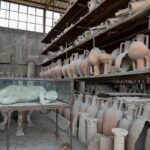
- Granai del Foro: Storage Evidence and the Human Story
- Stabian Baths, Foro, and the Basilica: Where Leisure, Commerce, and Law Intersect
- Quadriporticus and Gladiator Barracks: Training and Daily Setup
- Vicolo del Lupanare and Temple of Venus: The Red District and City Divinity
- Casa del Fauno: Ending at One of Pompeii’s Big Luxury Houses
- Guide Styles That People Call Out: Luisa, Eliana Sandretti, Antonio, and More
- Should You Book This Pompeii Private Tour?
- FAQ
- Are Pompeii entrance tickets included in the tour price?
- Does the tour include skip-the-line access?
- How long is the private Pompeii tour?
- Where do we meet for the tour?
- What language is the tour offered in?
- Is the tour canceled if the weather is bad?
Key things to know before you go
- Skip-the-line only works smoothly after you buy the 19-euro park ticket
- A private, archaeologist-led route built for about 2 hours
- You get a mix of big monuments and everyday Roman life sites
- Victims’ casts and storage evidence help explain what happened in 79 AD
- The walk includes the theaters, the Forum, the Basilica, the Stabian Baths, and Casa del Fauno
- English is the default language
Pompeii Private Tour Price: What You’re Really Paying For
The headline price is $375.05 per group (up to 10 people) for about 2 hours. On paper, that sounds pricey. In practice, it can be good value if you split it across a family or a small group, and especially if you want someone to steer you through Pompeii’s huge footprint without guessing.
Here’s the part to budget correctly: the Pompeii entrance ticket is not included. The ticket is 19 euros per person (and kids under 18 have free entry with ID/passport for proof of age). That means your real total depends on group size:
- If you bring a full group of 10, you’re effectively spreading the tour cost thin, and the 19-euro entry fee becomes the main per-person chunk.
- If it’s just two people, you’ll feel the tour cost more, but you still get the benefit of a private archaeologist and a tightly planned route.
Why this format often wins: Pompeii isn’t one “main attraction.” It’s a whole city, frozen in time. A smart guide helps you see what matters—architecture, daily routines, and the eruption story—without spending your limited hours walking the wrong direction.
You can also read our reviews of more private tours in Pompeii

Meeting at Piazza Esedra and Getting Inside Faster
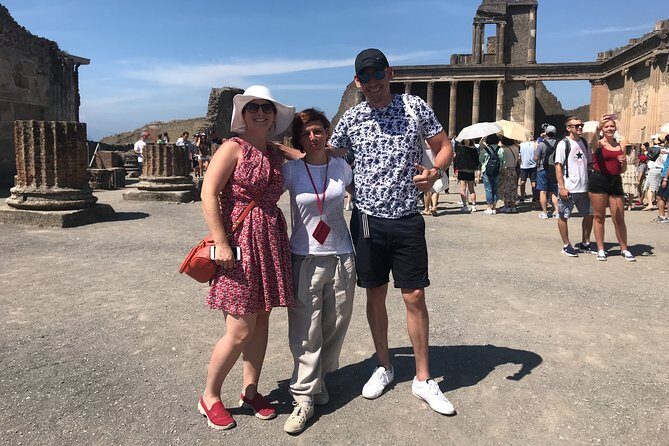
You start at Piazza Esedra, 10, 80045 Pompei NA, Italy, and the tour ends back at the meeting point. That round-trip matters because Pompeii is spread out, and you don’t want to lose your momentum hunting down your starting point again.
About skip-the-line: the tour includes skip-the-line, but your ability to use it smoothly depends on having the correct park entrance ticket. The operator sends a link one day before the tour so you can buy the official tickets online and avoid the ticket office line. In short: do the ticket part first, then show up ready to go.
If you want this to feel effortless, my advice is to treat the 19-euro Pompeii ticket as your “must-do before arrival” step. That’s the difference between gliding in and getting stuck while others wait.
The Big Idea: A High-Yield 2-Hour Route
This is not a slow stroll where you “wander and maybe see stuff.” It’s a guided circuit designed to hit key Pompeii themes quickly. You’ll cover theaters, temples, the Forum area, baths, gladiator zones, a red-light district area, and a major luxury house—plus the casts that represent people who died during the eruption.
Because it’s private, you can often ask for adjustments on the spot. If your group cares more about Roman entertainment, you’ll get the right emphasis. If you care more about daily life and the eruption evidence, the guide can steer the story that way.
One more practical note: the tour doesn’t include food or drinks. Bring water, and if your timing is midday in summer, plan for sun and quick breaks when your guide offers them.
Pompeii Archaeological Park Highlights: Theaters, Temples, Shops, and the Casts
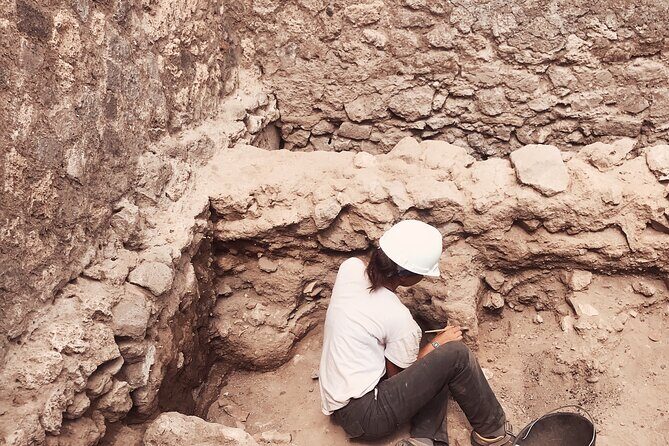
Your first stop is the Pompeii Archaeological Park—with the important reminder that admission tickets are not included for the park itself. Once you’ve bought the entry ticket, this is where the tour starts paying off.
You’ll move through a “greatest hits” blend of monumental and street-level details:
- The theaters and temples: This helps you understand Pompeii wasn’t just housing. It had cultural and religious anchors.
- A rich house: You see how wealth looked in real materials and layout, not just in museum photos.
- Stabian Baths (the spa complex): Pompeii’s bath culture is a big clue to how Romans spent leisure time.
- Shops and even fast food: You’re not just looking at ruins. You’re seeing the rhythm of trade and everyday meals.
- The Lupanar area: This is the ancient brothel district, often one of the most talked-about zones because it shows how Roman society organized pleasure and commerce.
- The Forum and gladiator area: You get the public power center and the entertainment-adjacent world.
- The casts (bodies of people who died during the eruption): This is where the eruption story stops being abstract and becomes human-scale.
After that, you’ll visit the Small Theater (Odeion) to hear how Romans recreated perfect acoustics. Even if you’ve never cared about acoustics before, this kind of stop changes how you picture the space. You start imagining conversation, performance, and crowd energy instead of only seeing stone.
A drawback to be aware of: Pompeii’s surfaces are uneven and the ground can be busy. In a 2-hour format, the guide keeps you moving. If your group needs a very slow pace, consider whether a longer private tour would suit you better.
Teatro Grande: The Main Stage and Why It Matters
Next comes Teatro Grande, the Great Theater of Pompeii—described as the most important theater at the site. You’ll spend about 15 minutes here.
This stop is about more than the fact that it’s impressive. It’s a lesson in how Roman entertainment worked: sightlines, movement through a civic space, and how architecture shaped audience experience. If your brain likes structure, theaters are a great way to “organize” the rest of Pompeii in your mind.
Because this is a guided stop, you’re not just walking around. You’re learning what to look for while you stand there, which is the real time-saver.
You can also read our reviews of more tours and experiences in Pompeii

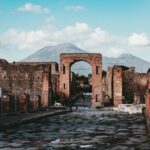
Via dell’Abbondanza: The Main Street Feeling
You’ll cross via dell’Abbondanza, Pompeii’s main street. This is one of those “small but important” stretches.
Why it’s worth stopping: a lot of visitors focus only on the big monuments and forget that most Roman life happened in between them—along streets that connected civic spaces, shops, and social venues. Standing on the route the city used daily makes everything you’ve seen feel less like separate attractions and more like one place.
Granai del Foro: Storage Evidence and the Human Story
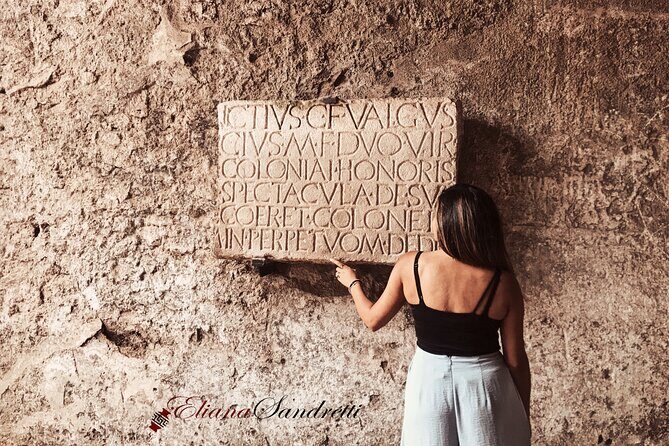
Then you shift to Granai del Foro—the Granaries of the Forum. You’ll see casts here too, along with the archaeological deposit that includes amphorae and work tools.
You’ll spend about 15 minutes. This stop is valuable because it answers a basic question: what did people do for food and storage in an active city? The amphora evidence points to supply lines and everyday logistics. The casts remind you that the disaster struck real lives mid-routine.
If your group likes the practical side of history—how people fed themselves, stored goods, and organized work—this is a strong moment.
Stabian Baths, Foro, and the Basilica: Where Leisure, Commerce, and Law Intersect
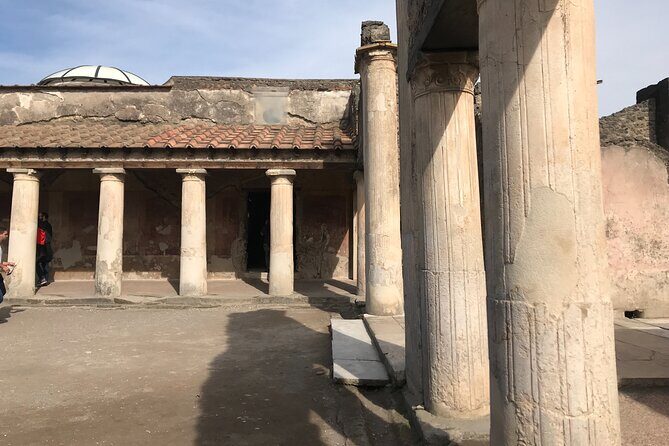
You’ll visit Stabian Baths (Terme Stabiane), described as the best SPA of the Roman Empire in Pompeii. Time here is about 15 minutes.
After the baths, you’ll work your way through the public center:
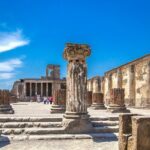
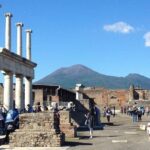
- Foro di Pompei (about 10 minutes): the main square, with markets and temples.
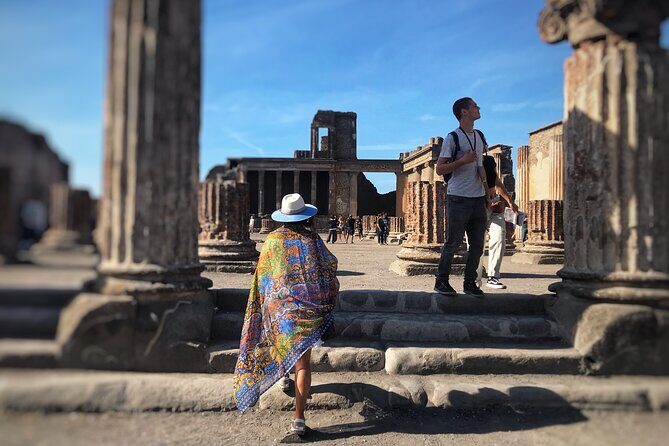
- Pompei La Basilica (about 15 minutes): the civic court space where justice was administered.
- Temple of Jupiter: seen in the main square area.
This cluster matters because it connects three kinds of Roman space:
1) Leisure (baths)
2) Trade and religion (Forum)
3) Authority and law (Basilica)
A minor practical consideration: baths and public squares can be visually intense, with lots to interpret. A good guide keeps it understandable without turning Pompeii into a textbook.
Quadriporticus and Gladiator Barracks: Training and Daily Setup
Next comes the Quadriporticus of the theatres, along with the Gladiator Barracks area. You’ll spend about 15 minutes.
This stop helps you picture how gladiators lived and trained. You’re not only learning that gladiators fought—you’re seeing where they stayed and how the training spaces were arranged. Even if you’re not a sports-history fan, the built environment tells a story about discipline, routine, and organization.
Vicolo del Lupanare and Temple of Venus: The Red District and City Divinity
You’ll visit Vicolo del Lupanare, the ancient brothel lane area, about 15 minutes, marked as free in the tour description. You’ll also see the Temple of Venus, tied to the city’s veneration of divinity.
This section gives you contrast. The Forum and courts reflect public order. The brothel lane reflects private behavior and how economic life threaded through it. The Temple of Venus adds another layer: romance, religion, and social identity in one stop.
If your group is sensitive about explicit subject matter, a quick heads-up to your guide can help set expectations so you’re not blindsided by the topic.
Casa del Fauno: Ending at One of Pompeii’s Big Luxury Houses
You finish with Casa del Fauno (House of the Faun), about 15 minutes. It’s described as one of Pompeii’s richest and most luxurious residences.
Why this ending works: after seeing public places (Forum, theaters) and work or leisure spaces (baths, storage areas), a luxury home shows the contrast. You start thinking about status and domestic comfort—and you also get a sense of how wealth translated into rooms, decoration, and layout.
If you’ve ever wandered Pompeii and felt overwhelmed, a guided ending like this can help you leave with a “last image” that’s clear and memorable.
Guide Styles That People Call Out: Luisa, Eliana Sandretti, Antonio, and More
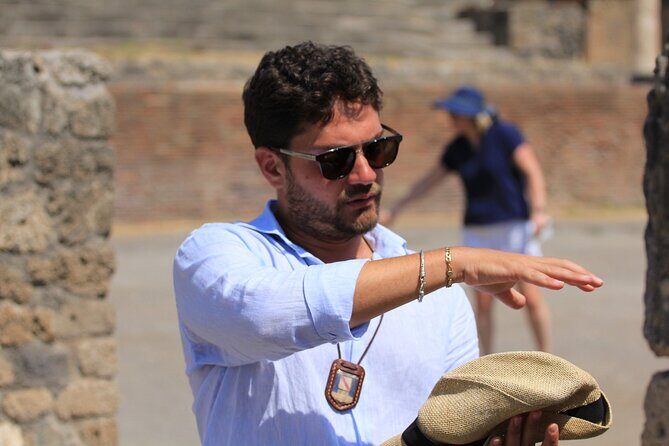
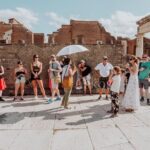
This tour is led by Eliana Sandretti (listed as the experience provider). In the names shared by different guides, a pattern shows up: the best tours feel like a conversation, not a lecture.
Here are examples of what you might experience, based on the style highlighted by guide names people mention:
- Luisa: praised for moving efficiently, avoiding crowds, and keeping the pace photo-friendly.
- Eliana: noted for enthusiastic storytelling and for giving visitors a map with directions afterward.
- Antonio: mentioned with a late-afternoon start as a crowd-buster, especially around the end of July when heat is a factor.
- Viktoria: highlighted for kid-friendly pacing and finding shade.
- Luciana: described as resourceful during rain, using images and keeping things moving while waiting for the weather to improve.
- Danilo / Mattia / Francesco / Marina / Roberto: repeatedly singled out for enthusiasm, adapting to the group, and helping people see more than they would on their own.
The practical takeaway: if you care about crowds, kids, or explanations that fit your interests, choose a time and a guide slot that matches your priorities—and don’t hesitate to say what your group wants to see.
Should You Book This Pompeii Private Tour?
Book it if:
- you have limited time and want a route that covers the core of Pompeii without wasted walking,
- you like the idea of learning while you’re standing in the actual spaces (theaters, baths, Forum, luxury houses),
- you want private guidance for families or mixed-interest groups,
- you prefer not to fight the biggest crowd bottlenecks yourself.
Skip it (or reconsider) if:
- you’re expecting the Pompeii entrance ticket to be included, because it’s not (19 euros per person),
- your group needs a very slow, long-form experience—this is built for about 2 hours,
- English-only tours would be a problem for your group (multi-language is only on request).
If you handle the entrance ticket step in advance and go in ready for a focused walk, this is the kind of Pompeii tour that turns “ruins” into a lived-in city layout—one theater, one street, one bath, and one Forum stop at a time.
FAQ
Are Pompeii entrance tickets included in the tour price?
No. The Pompeii entrance ticket is not included. It costs 19 euros per person, and under 18s have free tickets with ID or passport showing proof of age.
Does the tour include skip-the-line access?
The tour includes skip-the-line help. The park entrance ticket still needs to be purchased separately, and you can buy it online using the official link sent to you one day before.
How long is the private Pompeii tour?
It runs for about 2 hours.
Where do we meet for the tour?
You meet at Piazza Esedra, 10, 80045 Pompei NA, Italy, and the tour ends back at the same meeting point.
What language is the tour offered in?
The tour is offered in English. Other languages are only available on request.
Is the tour canceled if the weather is bad?
The experience requires good weather. If it’s canceled due to poor weather, you’ll be offered another date or a full refund.