REVIEW · 3-HOUR EXPERIENCES
Pompeii Unveiled: 3-Hour Private Tour In-Depth Discovery
Book on Viator →Operated by Visita Con Me · Bookable on Viator
Pompeii makes more sense with a guide. This private 3-hour walk is built around the sites that help you understand how people lived, worked, trained, and relaxed when Vesuvius was still quiet. You’ll move at a human pace, not the frantic shuffle you get on group tours, and you’ll get context right where the stones still look vivid. Private guidance plus a smart route is the real draw here.
What I like most is the mix of stops: you get big public Pompeii (amphitheatre, Forum, baths) and real domestic life (gardens and painted rooms) without racing across the whole site. I also like that the plan includes the Stabian Baths and two domus, since those are the moments that turn Pompeii from buildings into daily routines.
One thing to consider: the tour’s pricing and ticket details look a bit inconsistent in the info you’ll see, so you’ll want to confirm Pompeii site admission during booking. Nothing ruins a good day like showing up and realizing you’re waiting at the gate.
In This Review
- Quick Highlights You’ll Care About
- Why This 3-Hour Pompeii Plan Works
- Roman Amphitheatre First: Oldest Seating and Fast Orientation
- Palestra Grande: Where Training Became a Daily Routine
- Casa di Ottavio Quartione: A Scenic House With a Real Garden Feel
- Pompei Casa dei Ceii: A Small Domus With a Big Hunt Scene
- Stabian Baths (Terme Stabiane): Regeneration in Hot-Bath History
- The Forum de Pompeya: City Heart, Crowd Energy, and Vesuvius
- Price and What It Means for Value (Especially With Private)
- Meeting Point and Ending Point: Plan Your Walk Back
- What Your Guide Adds: Stories, Pacing, and Details You’d Miss
- Who Should Book This Pompeii Private Tour?
- Should You Book This Tour?
- FAQ
- How long is the Pompeii Unveiled private tour?
- What’s the group size for this private tour?
- Is the tour offered in English?
- Are Pompeii site entrance tickets included?
- Where do we meet, and where does the tour end?
- Is the tour only for private groups?
- Is there free cancellation?
Quick Highlights You’ll Care About
- A private group up to 8 means you can ask questions and actually hear the answers.
- Three public anchors plus two domus keeps Pompeii understandable in a short time.
- Stabian Baths give you a break-from-heat moment while still feeling connected to daily life.
- Forum + Vesuvius view lands near the end, so you finish with the big picture.
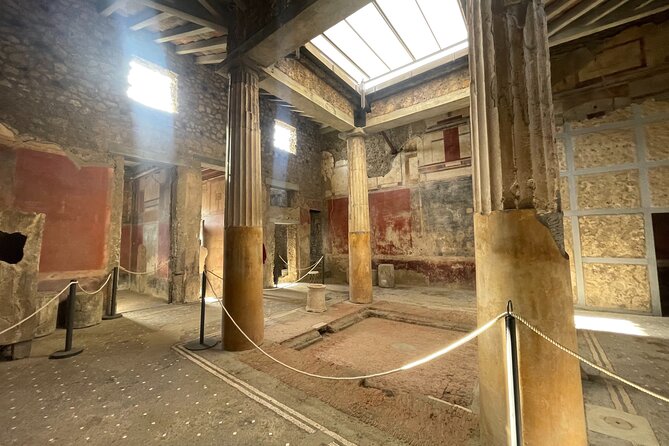
- Garden-focused house visits make it easier to imagine family life beyond just the tragedy.
Why This 3-Hour Pompeii Plan Works
A short Pompeii tour can either feel like a highlights reel… or like you’re getting your bearings fast. This one is designed for the second option. You start with a major public building, then you shift to training and homes, then you cool off in the baths, and you end at the Forum where you can look outward and take the whole city in.
The time split matters. Each stop is about 30 minutes, which is long enough to listen, look around, and connect details. It’s also short enough that you’re not stuck for an hour in one spot while the sun does its thing.
This is also where private really pays off. Pompeii has tons of visual information, but without narration, it’s easy to see only what’s obvious. With a prepared guide, you’ll notice patterns in the layout and the way spaces were used—especially in the houses.
Roman Amphitheatre First: Oldest Seating and Fast Orientation
You kick off at the Anfiteatro Romano, described as the oldest Roman amphitheatre in Pompeii-era terms. It could hold up to 20,000 spectators, not just people from Pompeii, but also visitors from nearby towns. That single fact helps you see Pompeii as more than a single city—you’re looking at a regional cultural hub.
Why start here? It’s a strong orientation point. Amphitheatres teach you how the Romans organized public life: where crowds gathered, how movement worked, and how entertainment fit into the city’s rhythm. In a short tour, that setup helps the rest of your walk click.
Practical note: you’ll want to look around while your guide is explaining it. Amphitheatres are not just “seats and walls.” Even in ruins, you can spot how sightlines and crowd flow would have worked.
Palestra Grande: Where Training Became a Daily Routine
Next comes the Palestra Grande, the main gymnasium area where Pompeians trained. The standout here is the presence of three showcases with charred organic remains found in Pompeian domus. It’s not comfortable viewing, but it’s memorable—and it connects the dots between everyday life and what the eruption preserved.
This stop is valuable because it adds a layer people often miss. Pompeii isn’t only villas and markets. It’s also routines, fitness, grooming, and social life. Once you see the training spaces, the city feels more complete.
If you’re traveling with kids, this is one of those stops where the right guide can turn questions into learning. And if you’re traveling as adults, you’ll likely appreciate the way the guide uses the physical space to explain habits, not just names.
Casa di Ottavio Quartione: A Scenic House With a Real Garden Feel
At Casa di Ottavio Quartione, you get one of the more scenic moments: a house known for its breathtaking garden. Domus tours can sometimes feel like wallpaper and hallway tourism. This one leans into the outdoor-living vibe—courtyards and gardens were central to how wealthy Romans structured their day.
What I love about stopping here is that gardens change your mental map. In Pompeii, the temptation is to focus on the big disaster story. A house with a garden brings you back to the normal part of life: plants, light, privacy, and family spaces.
This stop is also a good reminder that Pompeii’s houses weren’t just decorative. They were living machines, with rooms arranged around how people wanted to move, eat, relax, and host.
Pompei Casa dei Ceii: A Small Domus With a Big Hunt Scene
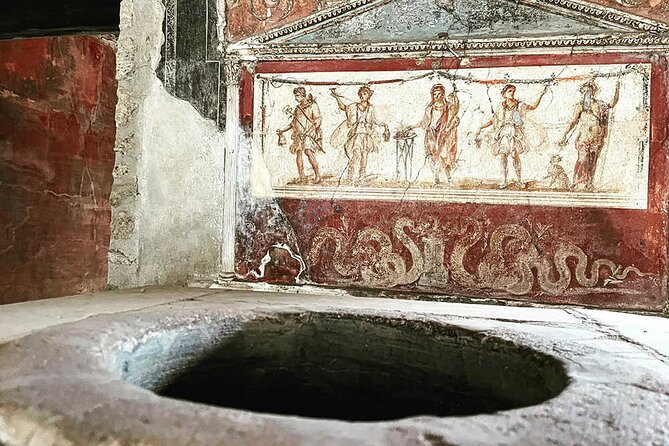
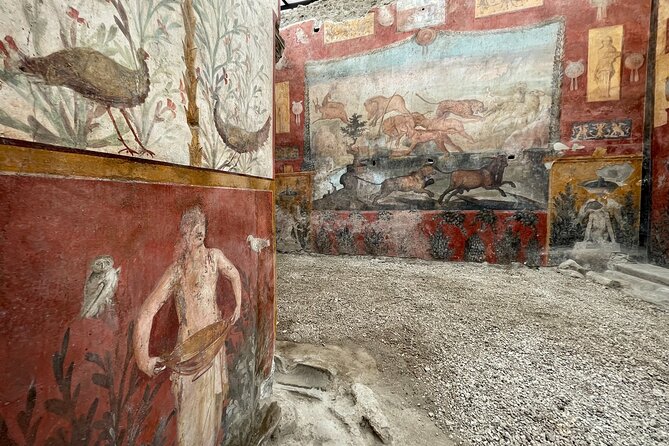
Then you head to a smaller, colorful Pompeian domus, Casa dei Ceii. The star detail here is a hunting scene on the back wall of the garden—one of Pompeii’s finest hunting depictions.
Even though you only spend about 30 minutes here, this kind of specific scene can do a lot of work for your imagination. Hunting imagery tells you about status, leisure, and taste. You’re not just seeing art. You’re reading a message the owners wanted visitors to understand.
A smaller domus also means you can linger. With a private guide, you can stop where the guide points out symbolism or technique and then move on when you’re ready, rather than being swept along.
Stabian Baths (Terme Stabiane): Regeneration in Hot-Bath History
Now for a change of pace: the Stabian Baths. You’re spending about 30 minutes here, framed as the kind of “dip and regenerate” stop that would have been part of daily life.
Even in ruins, Roman baths are fascinating because they show how the city treated comfort as a public service. This is also one of the more practical parts of Pompeii to understand on the ground: you can connect the rooms and pathways to how someone would move through warm water, steam, and rest.
Also, psychologically, baths break up the heavy stone-and-stories feeling. After hours of looking at old walls, it’s refreshing to be in a space designed around body and routine.
The Forum de Pompeya: City Heart, Crowd Energy, and Vesuvius
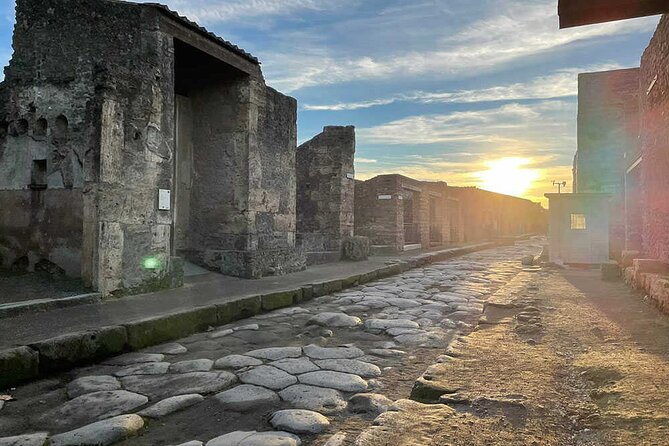
You finish at the Foro de Pompeya, the beating heart of the city. This is where you really start to feel Pompeii as a living place, not only an archaeological site. The Forum is described as teeming with tourists during the visit window, but the setting is hard to beat.
The guide’s big job here is helping you see what the Forum meant in daily power and public life. Temples, civic buildings, and main routes all pull together in one central space. You’ll also get one of the most memorable payoff moments: the view of Vesuvius from the Forum, described as unrivalled.
Ending here makes sense. Once you’ve seen amphitheatre life, training, domestic art, and baths, the Forum becomes the “how it all connects” chapter. It’s a strong way to wrap.
Price and What It Means for Value (Especially With Private)
The price is $361.23 per group for up to 8 people, for about 3 hours, with an English-speaking private guide. That pricing structure is what you want to understand before you book.
Here’s the value logic: if you’re traveling as a small group, private time gets cheaper per person fast. It also gives you something money can’t buy on an audio setup: quick answers. Pompeii questions come nonstop—why this layout, what did this symbol mean, how did people move through space. With a guide, you can ask, and you can move on without losing the thread.
One more value angle: each stop is positioned so you’re not just ticking off famous names. You get a blend of public entertainment + fitness + private living + bathing + civic center. That mix is the difference between seeing Pompeii and actually understanding it in a short window.
One caution on the paperwork: the info you’ll see says ticket entrance to Pompeii Site is not included, but it also lists admission ticket included for multiple stops. Before you go, I’d confirm exactly what you’re expected to pay on the day and whether your guide handles any entry. It’s a small admin check that can save a lot of stress.
Meeting Point and Ending Point: Plan Your Walk Back
You start at Pompei – P.zza Anfiteatro. The tour ends at the Foro di Pompei, near Via Villa dei Misteri, with the nearest exit noted as Porta Marina Inferiore.
That matters because Pompeii isn’t a flat, tidy loop. If you need to return to the same entrance as the meeting point, the info suggests you should allow at least 15 minutes of walking back. In other words, don’t assume you can zip back immediately.
If you’re catching a bus or train after, I’d plan for that end location. Build in a little buffer so you’re not speed-walking while your brain is still in Roman time.
What Your Guide Adds: Stories, Pacing, and Details You’d Miss
The guide is the heart of this tour. Past experiences tied to this provider highlight a few standout strengths you should expect in practice: clear explanations, preparedness, and a tone that can adapt to the group’s interests.
I also noticed a specific pattern in names from past private tours with this company: Annarosa comes up often, and Mariarosa is mentioned as well. You might not get the exact same person, but it’s a good sign the guides are not doing casual storytelling. They’re tying what you see to what archaeologists and historians know, and they’re comfortable answering questions on the spot.
The best part is how pacing works with privacy. In a small group, your guide can slow down for the garden scene you want to stare at, or speed up when you’ve had your fill of one type of ruin. That flexibility is why the 3 hours feel complete instead of cut short.
Who Should Book This Pompeii Private Tour?
This is a great fit if:
- you want Pompeii in a short visit without feeling rushed
- you’re traveling with family or a mixed-age group and want questions answered
- you prefer a thoughtful route instead of a crowded stamp-collecting walk
- you like blending big public spaces with houses and art
It’s also a smart choice if you’ve been to Pompeii before. A return visit with a guide can shift the day from “I remember the big stuff” to “I notice the structure, routines, and meaning.”
Should You Book This Tour?
Yes, if you want Pompeii to feel understandable in about three hours. The stop lineup hits the practical narrative beats: public entertainment, fitness, private home life, bathing, then civic power at the Forum with the Vesuvius view.
Skip or reconsider if you’re the type who wants to wander completely on your own with lots of unscheduled time. This tour is organized, not free-range. Also, do a quick confirmation about entry tickets before your day starts, because the info can look contradictory.
If you take care of that one detail, this is exactly the kind of private Pompeii experience that turns ruins into a place you can picture.
FAQ
How long is the Pompeii Unveiled private tour?
It’s about 3 hours.
What’s the group size for this private tour?
It’s a private tour for your group, up to 8 people.
Is the tour offered in English?
Yes, it’s offered in English.
Are Pompeii site entrance tickets included?
The details provided are conflicting: the tour listing says ticket entrance to Pompeii site is not included, but each stop in the itinerary notes admission ticket included. Confirm what you’re expected to pay at booking.
Where do we meet, and where does the tour end?
You meet at Pompei – P.zza Anfiteatro (near the Amphitheatre). The tour ends at the Foro di Pompei, near Via Villa dei Misteri, with the nearest exit Porta Marina Inferiore.
Is the tour only for private groups?
Yes. It’s a private tour/activity, and only your group will participate.
Is there free cancellation?
Free cancellation is available. You can cancel up to 24 hours in advance for a full refund.