REVIEW · POMPEII
Pompeii and Herculaneum Small Group Tour with an Archaeologist
Book on Viator →Operated by Askos Tours · Bookable on Viator
Roman streets, preserved by disaster. This small-group tour pairs Pompeii with Herculaneum, and an archaeologist guide keeps you from wandering aimlessly through major sites you’d otherwise miss.
I really like that you get guided highlights in both places, with headsets for clear explanations as you move. I also like that admission is included at both sites, plus transport between Pompeii and Herculaneum is handled for you.
The main thing to watch is pacing: you’re on the ground for only about two guided hours at each ruin, so it’s a highlights-first day, not a slow soak.
In This Review
- Key things that make this tour work
- Pompeii and Herculaneum in one day: why the pair clicks
- Meet-up points, group size, and how the guide keeps you moving
- Skip the ticket lines: what included admission really buys you
- Pompeii morning: start where the city’s energy was
- Basilica: the portico where commerce happened
- Forum (main square): the heart of Pompeii’s daily life
- Main street walk: quick way to learn the town’s rhythm
- House of Menander: wealth expressed in rooms and decoration
- Granaries of the Forum: practical food storage with drama
- Stabian Baths and the Lupanar: daily routine, mixed with the darker side
- House of the Faun: one of Pompeii’s big private residences
- Teatro Piccolo (Odeon) and Teatro Grande: two theatre moods
- Lunch break and the Pompeii-to-Herculaneum transfer plan
- If you start in Naples, Rome, or Sorrento: modern minibus
- If you start in Pompeii: Circumvesuviana train + short walk
- Herculaneum entry and first steps: where the guide drops you in
- Herculaneum houses and baths: why this site feels so different
- House of the Deer: the name you can spot in the details
- La Terrazza di M. Nonius Balbo: power and civic building
- College of the Augustales: religion and politics in one building
- Casa del Rilievo di Telefo: a house with unusual access
- Partem Domus lignea (House with wooden partition fragments)
- House of the Skeleton: why the name matters
- Central Thermae: separate spaces for men and women
- House of the Black Salon: monumental entry and charred traces
- Casa Sannitica and Casa del Bel Cortile: two more home styles
- House of the Grand Portal: frescos and charred remains
- How your start city changes your day (and your comfort level)
- Starting in Naples or Sorrento: fewer transfers, more straight driving
- Starting in Rome: you’ll drop at Naples station
- Starting in Pompeii: you travel to Herculaneum by train
- Price and value: what you’re paying for
- Who should book this Pompeii + Herculaneum tour?
- Should you book? My practical call
- FAQ
- What’s included in the tour price?
- How do transfers work between Pompeii and Herculaneum?
- Where do we meet the archaeologist guide?
- How long is the guided time at each site?
- Does the tour include time for lunch?
- Is the tour suitable for everyone?
Key things that make this tour work
- Archaeologist-led walkthroughs in both Pompeii and Herculaneum so you learn what you’re seeing as you see it
- Headsets included (you’re not stuck relying on shouting in a crowd)
- Skip-the-line style entry with included admission tickets for both sites
- Smart transfers: minibus for Naples/Sorrento/Rome options, plus a Circumvesuviana train connection if you start in Pompeii
- Iconic stops you can picture later like Stabian Baths, the Lupanar, and Herculaneum’s wooden partition house fragments
- Max 20 travelers, which matters when you’re trying to keep a group together in ruins
Pompeii and Herculaneum in one day: why the pair clicks
If Pompeii is the loudest Roman “snapshot,” Herculaneum is the calmer one. You get the contrast built right into the format: Pompeii shows you grand public spaces and big-name houses, while Herculaneum often feels like you’re stepping into rooms that were saved from total collapse in a different way.
You’ll also appreciate the logic of seeing both. Pompeii helps you understand city layout and daily public life—squares, baths, theatres, and the famous residential streets. Herculaneum then adds a different flavor: household scale, preserved architectural details, and the kind of everyday evidence that makes the past feel less like a textbook.
And because the tour uses an archaeologist guide plus headsets, you’re not stuck playing “guess the building.” I’d plan this day if you want context, not just photos.
You can also read our reviews of more tours and experiences in Pompeii.

Meet-up points, group size, and how the guide keeps you moving
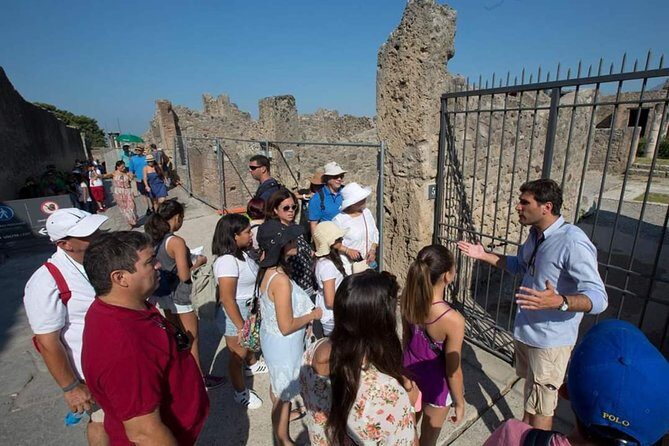
This is designed for small groups, with a maximum of 20. That size is big enough to feel social, but small enough that the guide can actually manage the walk, the timing, and the questions.
You meet your archaeologist guide at your selected starting point:
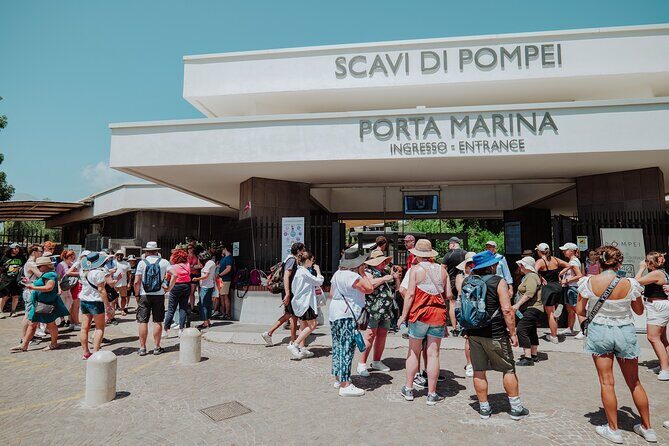
- Pompeii: Porta Marina Superiore
- Naples and Rome: Starhotels Terminus
- Sorrento: Piazza Angelina Lauro
In the field, headsets help a lot. Ruins are noisy, and sound carries unpredictably, so this setup makes the explanations easier to follow when you’re standing near busy paths or viewing large features like the theatres.
One more practical note: the guide’s job isn’t just reciting dates. Guides on this kind of tour often guide you toward “what to notice” in the plaster casts, mosaics, frescos, and house layouts—so you know what matters before you move on. Names you may hear include Michele, Diego, Tomas, Antonio, Gianni, and Alfredo, and multiple guides are praised for turning daily life into something you can picture.
Skip the ticket lines: what included admission really buys you
Admission for both Pompeii and Herculaneum is included. That matters more than it sounds, because it removes a common time sink in peak travel seasons: standing in line just to enter the site.
The tour also uses a ticket-entry approach in the way you’ll experience it on the ground—meaning you spend more of your limited daylight time inside the archaeological parks rather than waiting at gates.
You should still budget time for crowd flow, but the overall idea is clear: you’re paying for time-saving logistics, not just a narrated walk.
Pompeii morning: start where the city’s energy was
Your Pompeii portion is about two hours of guided highlights, built around big public spaces and standout houses. It’s not a “walk wherever you want” day. It’s more like a curated route through Pompeii’s most readable areas—so you can later connect the dots between squares, baths, homes, and theatres.
Basilica: the portico where commerce happened
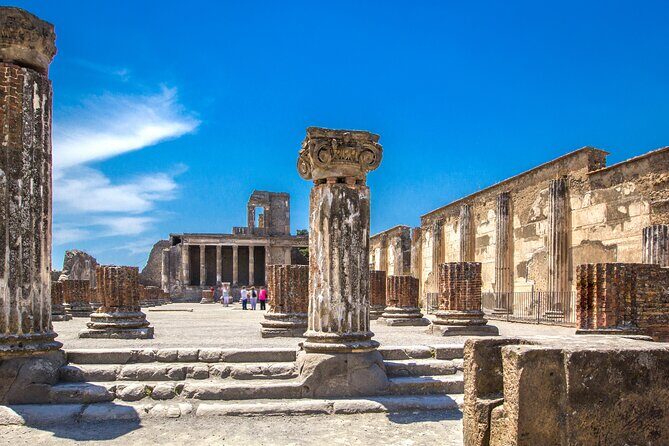
The morning begins at the Basilica, an open portico area that sheltered merchants and other activities. Even if you don’t know Roman legal language, this stop makes the Forum-area atmosphere click: you’re imagining stalls, foot traffic, and negotiations happening under an architectural canopy.
Expect this to be a quick orientation stop. It works as a primer for everything that comes after.


Forum (main square): the heart of Pompeii’s daily life
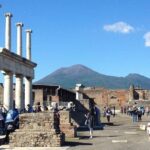
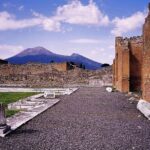
Next is the Foro de Pompeya, Pompeii’s main square. This is where you’ll understand why Pompeii feels like a “real city,” not just a set of buildings. Look for how the square functions visually and socially: public notice, movement, and the clustering of important structures.
Short stop time means you’ll focus on the big picture and the most meaningful cues, rather than reading every inscription.
Main street walk: quick way to learn the town’s rhythm
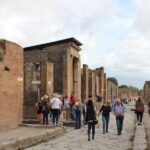
You also get a walk through Pompeii’s main street. This is one of those things that seems simple until you try it without a guide. With the group moving and the guide pointing out key patterns, you start to recognize how streets and storefront-style life fed the city’s rhythm.
This is where you’ll feel Pompeii shift from monuments to neighborhoods.
House of Menander: wealth expressed in rooms and decoration
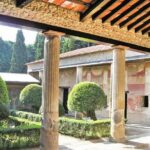
The House of Menander is one of Pompeii’s richer homes. This is a stop built for architecture and decoration lovers—think layout, indoor design, and the “this family had taste and money” feeling that comes through in the preserved remains.
If you’re the type who enjoys interpreting what people valued, this house helps you understand why Roman homes weren’t just shelters.
Granaries of the Forum: practical food storage with drama
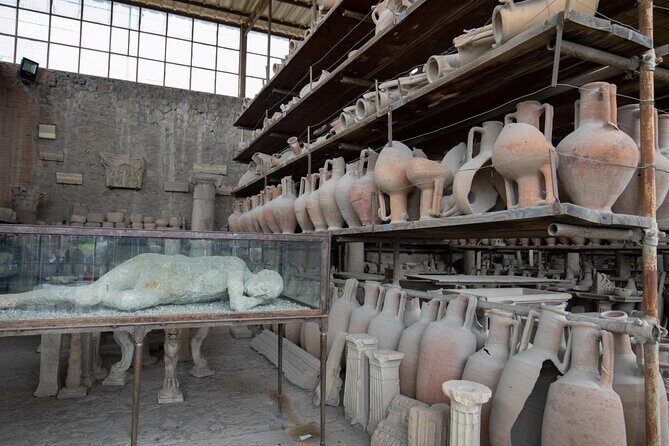
At the Granaries of the Forum, you’ll see marble tables and elements tied to fountain features near house entrances. You’ll also encounter casts connected to the eruption’s victims, plus a dog and a tree—details that make the tragedy feel specific and human rather than abstract.
This is a heavier stop. It’s also one of the reasons the Pompeii experience sticks with people: it adds story to stone.
Stabian Baths and the Lupanar: daily routine, mixed with the darker side
Next come two major “life and culture” stops:
- Stabian Baths (Terme Stabiane), described as the oldest thermal complex in the city
- Lupanar, the well-known brothel in the ruined Roman city
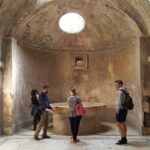
The baths help you grasp Roman hygiene and social behavior. Baths weren’t only about cleanliness; they were about meeting people, lounging, and spending time.
The Lupanar is a very different tone. It’s not there to shock you—it’s there because it’s part of the city’s social machinery. You’ll likely leave thinking harder about how Roman daily life worked across different social levels.
House of the Faun: one of Pompeii’s big private residences
The House of the Faun is highlighted as one of Pompeii’s largest and most impressive private residences. Stops like this are where you start noticing the difference between public space and private space: how the home is organized to control access, display status, and shape movement inside.
Teatro Piccolo (Odeon) and Teatro Grande: two theatre moods
Then you’ll hit two performance spaces:
- Odeon / Teatro Piccolo, Pompeii’s smaller theatre
- Teatro Grande, Pompeii’s main theatre
The quick timing means you won’t do a deep architectural study. But you’ll still get enough to understand why theatres mattered: gathering, entertainment, and civic identity in one package.
If you like Roman engineering, the theatre stops help you see how design created sound and crowd structure.
Lunch break and the Pompeii-to-Herculaneum transfer plan
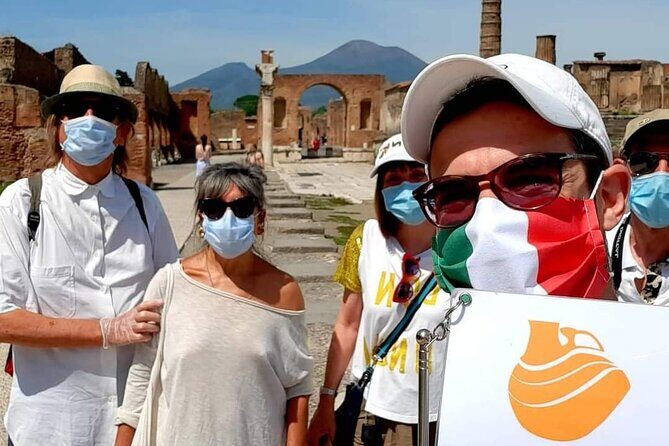
After your Pompeii time, you get a short lunch break before transfer. Meals and drinks aren’t included, so you’re choosing what works for you.
One practical consideration: some guided days include a mall-area lunch option. If you care about eating in a more atmospheric place, plan to bring snacks for the day or aim for quick food that doesn’t derail your ruin-time brain.
Then comes the move to Herculaneum, and the route depends on where you started.
If you start in Naples, Rome, or Sorrento: modern minibus
From Naples, Rome, and Sorrento, transport to Herculaneum happens by modern minibus directly to the archaeological site. This keeps your time simple: less ticket juggling and fewer “where is the station” moments.
If you start in Pompeii: Circumvesuviana train + short walk
If your itinerary starts in Pompeii, you’ll use an included Circumvesuviana one-way train ticket to Herculaneum. It’s roughly 30 minutes by train plus about a 10-minute walk.
This is the more “local transport” flavor. It can be fun, but it also means you’ll want to keep an eye on timing so nobody gets left behind when you’re transitioning from platform to street.
Herculaneum entry and first steps: where the guide drops you in
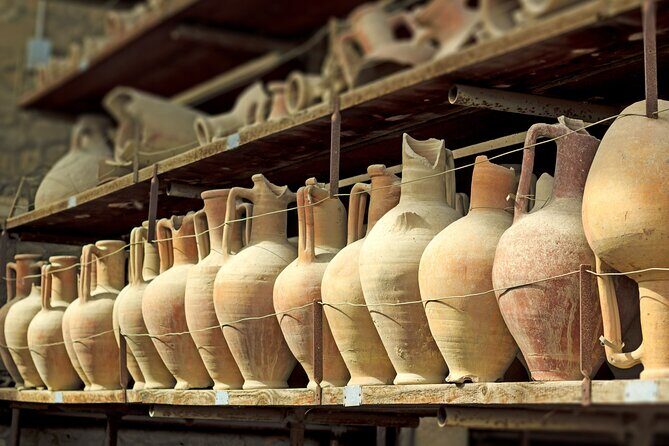
Once you arrive in Herculaneum, the guide leads you directly to the Ticket Office. From there, how you reach the ruins depends on the route you took:
- By minibus: you’re dropped close to the entrance
- By train (Circumvesuviana): you walk about 10 minutes from Ercolano Scavi station
This matters because Herculaneum is smaller than Pompeii, so every minute feels tighter. Getting you to the right spot quickly helps you start the guided walk while the momentum is still there.
Herculaneum is also allotted about two hours of guided exploration—enough time for multiple homes and key public spaces, but not enough time for deep self-guided wandering.
Herculaneum houses and baths: why this site feels so different
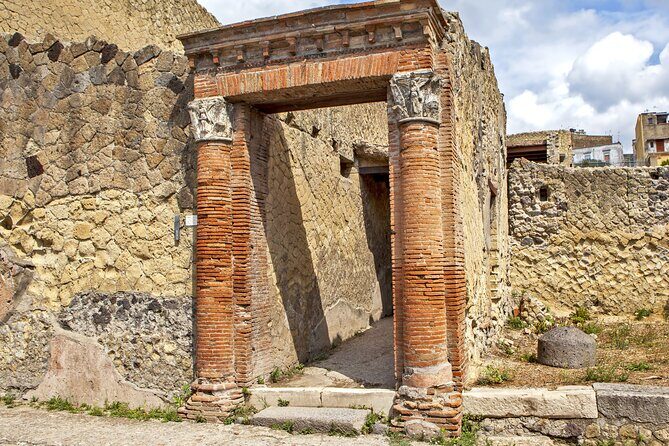
Herculaneum often wins people over because it reads like a town plan you can almost step into. Houses are detailed, and you’re seeing public and private architecture side by side.
Here are the key stops you’ll cover, with what to pay attention to at each one.
House of the Deer: the name you can spot in the details
The House of the Deer gets its name from marble statues of stags/deer found in the peristyle. Even on a rushed day, this is the kind of stop where the guide helps you connect decorative evidence to the room layout.
La Terrazza di M. Nonius Balbo: power and civic building
Next is La Terrazza di M. Nonius Balbo. This stop links architecture to a person—M. Nonius Balbus, described as the city’s major benefactor who restored and built public buildings, with honors recorded in an inscription.
This is one of those moments where you see how Romans used patronage as an identity, not just charity.
College of the Augustales: religion and politics in one building
The College of the Augustales is tied to the cult of Emperor Augustus, and it may have served as headquarters for a local organization (possibly the local curia).
The value here is interpretive. You’re not only seeing stone walls—you’re learning how civic life and religious practice were tangled together.
Casa del Rilievo di Telefo: a house with unusual access
Casa del Rilievo di Telefo is noted as likely belonging to a leading benefactor, with a special feature: it has private access to the adjoining Suburban Thermae to the south.
If you’re into daily-life logic, this helps you understand how convenient comfort worked for the well-off: you’re not just imagining leisure, you’re seeing the infrastructure that made it easy.
Partem Domus lignea (House with wooden partition fragments)
Then comes one of the stops that tends to make people pause: Partem Domus lignea – Casa del Tramezzo di Legno, a house important for an elegant wooden partition that survived as a remnant.
Herculaneum is famous for preservation, but this is the kind of specific detail that makes preservation feel real—something you can almost picture in use.
House of the Skeleton: why the name matters
The House of the Skeleton gets its name from human remains found in a second-floor room in 1831. It’s another reminder that these sites are both astonishing and heartbreaking.
The guide’s context is important here because otherwise the stop risks becoming just a spooky label. With framing, it becomes about what the eruption did and what archaeologists learned from the evidence.
Central Thermae: separate spaces for men and women
At the Central Thermae, you’ll learn that bath spaces were divided, with separate entrances for men and women. Built around the start of the first century AD, the baths show how everyday routines were structured with social rules.
Even if you only see a portion, the layout helps you understand how a city organized privacy and public life.
House of the Black Salon: monumental entry and charred traces
The House of the Black Salon is described as one of Herculaneum’s more luxurious mansions. You’ll see a monumental entrance with carbonised remains of the doorposts and lintel.
That charred detail is the kind of preservation that hits differently than “ruins.” It’s damage, but it also shows the material reality of what was there before the eruption.
Casa Sannitica and Casa del Bel Cortile: two more home styles
You’ll also see:
- Casa Sannitica, with a layout described as typical for the Samnites, plus an atrium and frescoed rooms
- Casa del Bel Cortile, known for being original: a courtyard with a stairway and a stone balcony instead of an atrium
These stops help you see variety in domestic design, not just a single “standard Roman house.”
House of the Grand Portal: frescos and charred remains
Finally, the House of the Grand Portal is highlighted as a beautiful central house with collonnati and frescos, plus charred remains of wooden parts around the structure.
It’s a fitting last stop because it brings together what Herculaneum does so well: architectural design, decorative ambition, and preserved evidence of daily materials.
How your start city changes your day (and your comfort level)
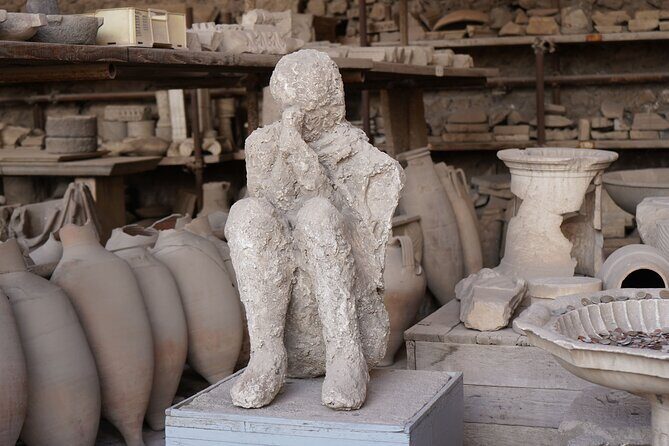
This tour is flexible, but your experience can feel different depending on where you begin.
Starting in Naples or Sorrento: fewer transfers, more straight driving
If you start in Naples or Sorrento, the day is structured around full-day transport by modern minibus. You’ll likely appreciate this if you prefer reducing transit stress.
Starting in Rome: you’ll drop at Naples station
For Rome travelers, the tour includes train tickets to/from Rome to Naples plus full-day transportation service. The end point described for Rome travelers is drop-off at Naples station.
Starting in Pompeii: you travel to Herculaneum by train
Starting in Pompeii includes that one-way Circumvesuviana train ticket to Herculaneum, and the tour concludes in Herculaneum ruins for departures from Pompeii.
This can work great if you’re already based near Pompeii and want to avoid backtracking. Just plan for the walk segments around stations.
Price and value: what you’re paying for
At $77.09 per person, the headline price can look almost too good for two famous archaeological sites with guided time. The value equation here is clearer when you consider what’s included:
- Herculaneum admission included (listed adult entry is 16 euros)
- Pompeii admission included (adult entry is 20 euros)
- Pompeii-to-Herculaneum Circumvesuviana ticket if you start in Pompeii
- Round-trip transportation where applicable (Naples or Sorrento options)
- Guided tour service in both Pompeii and Herculaneum
- Headsets
What’s not included is meals. Lunch is on your tab, with a break available before transfer.
So the question becomes: do you want a guided “high points” pass, or do you want a full independent day at one site? If you’re trying to see both Pompeii and Herculaneum without navigating ticket lines and transit, this price is easier to justify.
Who should book this Pompeii + Herculaneum tour?
This is a strong fit if you:
- Want a guided day with archaeological context at both sites
- Like seeing a lot of highlights without map stress
- Prefer small group size and headsets
- Want transportation handled, especially if you’re starting in Naples, Rome, or Sorrento
It may not be your best match if you’re:
- Hoping to spend hours in Pompeii only, at a slower pace (Pompeii can feel huge)
- Sensitive to a rushed feeling between short stops
- Looking for a fully “food-focused” break (lunch is on you, and a mall-area stop can shift the vibe)
Also, it’s not recommended for visually impaired guests unless accompanied by a dedicated personal assistant. The setting is a lot of walking on uneven ground in an active ruin environment.
Should you book? My practical call
I’d book this tour if you want the most sense per hour out of Pompeii and Herculaneum. The included tickets, the guided structure, and the fact that you’re handling transfers mean you spend your limited time inside the ruins—not sorting out logistics.
I’d think twice if you’re the kind of visitor who wants to linger in one place until it sinks in. Pompeii deserves more than a highlights pass for many people. Still, even on a faster day, a well-led route can show you the buildings and details you’d otherwise miss.
If you book, come prepared for a full walking day, and plan your lunch choices so you’re not mentally drained before Herculaneum starts. And if you’re given the chance, ask your guide which stops to pay extra attention to—you’ll feel your time sharpen fast.
FAQ
What’s included in the tour price?
Admission tickets are included for both Pompeii and Herculaneum, plus guided tours in both sites. Headsets are included for participants, and transport between Pompeii and Herculaneum is included according to your starting option. Meals and drinks are not included.
How do transfers work between Pompeii and Herculaneum?
If you start in Naples, Sorrento, or Rome, the group travels to Herculaneum with the guide by modern minibus. If you start in Pompeii, you use an included Circumvesuviana train ticket to reach Herculaneum, followed by a short walk.
Where do we meet the archaeologist guide?
Meeting points depend on your selected option: Porta Marina Superiore (Pompeii), Starhotels Terminus (Naples and Rome), or Piazza Angelina Lauro (Sorrento).
How long is the guided time at each site?
You spend about two hours exploring Pompeii with your archaeologist guide, then about two hours exploring Herculaneum with your archaeologist guide.
Does the tour include time for lunch?
Yes, there’s a quick lunch break available before the transfer. Lunch is your own expense.
Is the tour suitable for everyone?
Most travelers can participate, but it is not recommended for visually impaired guests unless accompanied by a dedicated personal assistant. The experience involves walking through archaeological sites.