REVIEW · POMPEII
Pompeii Private Tour with an Archaeologist and Skip The Line – 3 hours
Book on Viator →Operated by ELIANA SANDRETTI · Bookable on Viator
Pompeii clicks into place quickly. This private, English-language tour uses a focused route from Porta Marina Superiore to Porta Marina Inferiore, with an archaeologist guide bringing the city back to life as you move through the Forum, baths, theaters, and homes. You get a private 3-hour experience and skip-the-line ticket office assistance (when requested in advance).
What I like most is the way it balances big public sights with everyday Pompeii. You’ll spend time where people actually ate, shopped, bathed, laundered clothes, and visited entertainments, not just where Romans posed for photos. I also love that the route is paced for real viewing, not a race, so you can soak in details like the cave canem mosaic in Casa del Poeta Tragico.
One thing to consider: Pompeii entry itself is not included in the tour price for adults, and there’s a good chunk of walking with steps and uneven ground. Plan for entrance tickets extra, plus comfortable shoes and a bit of patience with crowds and stone surfaces.
In This Review
- Key highlights at a glance
- Pompeii in 3 hours: what this private route actually covers
- Skip-the-line that matters: tickets, mobile pass, and timing
- Meet your archaeologist guide: why the storytelling feels personal
- From Porta Marina to the Forum: stop-by-stop highlights
- Pompeii Archaeological Park (Porta Marina Superiore to Porta Marina Inferiore)
- Odeon / Teatro Piccolo
- Teatro Grande
- The Main Street of Pompeii
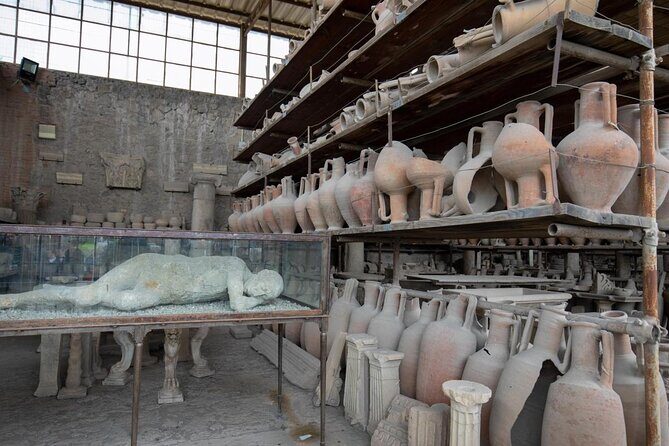
- Granai del Foro (archaeological deposit)
- Stabian Baths (Terme Stabiane)
- Forum (and Court of Justice area)
- Temple of Jupiter
- Quadriporticus of the theatres (gladiators’ barracks)
- Lupanar (brothel area)
- Temple of Venus
- Casa del Poeta Tragico (Casa of the Tragic Poet) and the cave canem mosaic
- Macellum (meat and fish market)
- Edificio di Eumachia (wool market)
- Casa del Menandro (frescoes and mosaics)
- Termopolio di Vetuzio Placido (take-away shop and fast food)
- Fullonica di Stephanus (laundry)
- Temple (final temple stop before wrapping)
- Everyday Pompeii: markets, baths, laundry, and quick meals
- Walking reality check: steps, slippery stone, and heat
- Value for your money: price vs. what’s extra
- Who should book this tour, and who might not
- Should you book this Pompeii private archaeologist tour?
- FAQ
- What’s the duration of the Pompeii private tour?
- Is this tour private or shared with other people?
- Does the tour include Pompeii entrance tickets?
- Is skip-the-line available for tickets?
- Where does the tour start and end?
- What languages is the tour offered in?
- What should I expect physically?
Key highlights at a glance
- Archaeologist-led storytelling that turns monuments into daily life in 79 AD
- Skip-the-line support at the ticket office, if you request it ahead of time
- A smart route that covers theaters, Forum areas, baths, markets, and homes
- Time for texture and details in key houses and shops, not just quick photo stops
- Stops built around real routines like laundry (Fullonica) and quick meals (termopolio)
- Flexible pacing from guides who’ve supported visitors with mobility limits
Pompeii in 3 hours: what this private route actually covers
If your Pompeii plan is just grab a guidebook and hope for the best, you’re going to miss the “why.” Pompeii is not one neat highlight after another. It’s a whole city, scattered across different areas, with ruins that don’t always explain themselves.
This tour gives you structure. You start at Porta Marina Superiore near Hortus Pompei and finish back at the meeting area after ending at Porta Marina Inferiore. Along the way, you move through an intentionally mixed set of spaces: performance venues, civic buildings, bathing areas, trade and food stops, and homes decorated with frescoes and mosaics.
The stops are short and targeted, roughly 5 to 20 minutes each, which is exactly right for a 3-hour tour. Pompeii rewards slow attention, but you also want to see enough that you can connect the dots. A private guide helps you do that faster than wandering on your own.
You can also read our reviews of more private tours in Pompeii
Skip-the-line that matters: tickets, mobile pass, and timing
Skip-the-line sounds simple until you run into the fine print. Here’s the practical version: the tour includes a skip-the-line at the ticket office, but it’s described as being available just on request in advanced. The tour also notes that there’s a link provided to buy the entrance tickets in advance, and you receive a mobile ticket.
So what should you do?
- Buy your Pompeii park entrance tickets in advance using the provided link.
- If you want the ticket-office skip-the-line help, request it when booking or as instructed.
Also note the mismatch that can cause frustration: the tour price does not include the site entry fee for adults. The data you have says adults pay 19 euros per person for Pompeii entry, while under-18 visitors are free. That means your total cost will usually be tour price plus entrance tickets.
If you’re the kind of traveler who likes to avoid stress at the gate, this is a good setup. Just don’t assume the tour price automatically covers entry.
Meet your archaeologist guide: why the storytelling feels personal
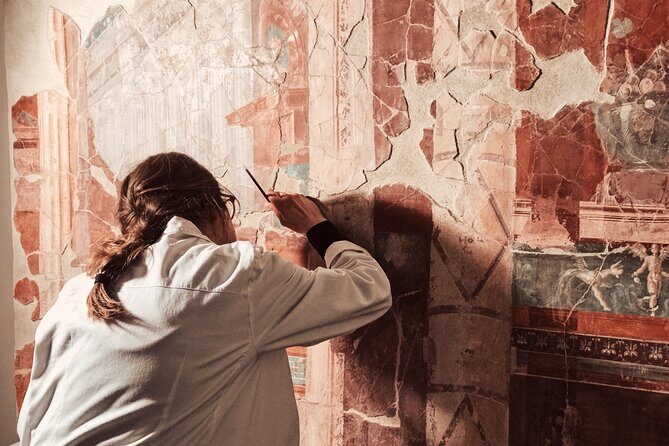
This is a private tour with a specialized archaeological guide. That’s the core value. Pompeii isn’t only about architecture; it’s about people’s habits, beliefs, and routines. A trained archaeologist guide can point out what matters in each building and explain why certain things were built the way they were.
The guide’s names vary by date, but the reviews strongly emphasize consistent strengths: guides who are friendly, funny, and able to answer questions, with architectural and historical knowledge presented in clear, human language. You’ll also see examples of guides tailoring the pace for physical limitations and steering people toward the best viewpoints without wasting time.
If you’re worried about getting stuck behind other groups, a private tour generally helps. You’re not trapped inside someone else’s schedule. The best guides also know when to pause so you can actually see details, not just walk past them.
And yes, you’ll hear references to the eruption of Vesuvius as context, but the more useful part is how it connects to daily life: where people gathered, how they worked, what they ate, and what their city meant to them.
From Porta Marina to the Forum: stop-by-stop highlights
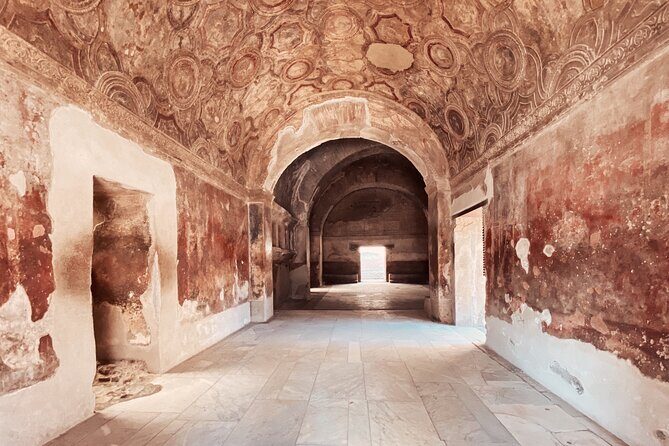
This tour moves in a way that makes Pompeii feel like a city, not a museum walk. Below are the main stops and what to expect from each, plus why each one is worth the time.
Pompeii Archaeological Park (Porta Marina Superiore to Porta Marina Inferiore)
You enter at Porta Marina Superiore and the experience ends back near Porta Marina Inferiore. Starting and ending at the edges helps you avoid a bunch of backtracking, which matters when you only have about 3 hours.
This opening segment sets the tone: your guide frames what you’re about to see, and you’ll start picking up patterns quickly, like where civic life happened compared with where people worked or relaxed.
You can also read our reviews of more tours and experiences in Pompeii
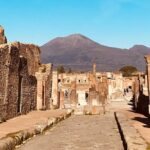
Odeon / Teatro Piccolo
The Odeon is a small theater, often overlooked if you only chase the “big” structures. A guide here helps you notice the scale and the audience experience: smaller venues change how people gathered and listened.
Even in a short stop, you can get a sense for Pompeii’s public culture and entertainment, not just its politics.
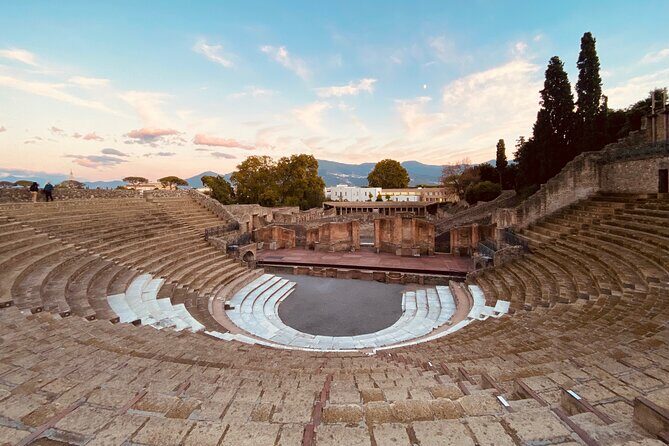
Teatro Grande
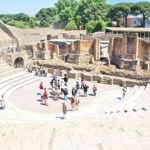
Then you shift to the larger theater, which gives you that classic Pompeii wow-factor. This is where it’s useful to have a guide. It’s easy to stare at stones and miss how the design shaped movement and performance.
In about 15 minutes, your guide should connect the space to how residents used theaters in daily civic life.
The Main Street of Pompeii
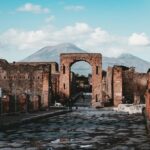
The “main street” stop matters because it shows you the city’s rhythm. Streets in Pompeii help you understand how buildings relate to each other in real terms: where foot traffic went, where storefronts lined up, and where public movement was expected.
A guide can also point out how views and sightlines work, so you’re not just walking and hoping you’re on the right mental map.
Granai del Foro (archaeological deposit)
The Granai del Foro is described as an archaeological deposit. This is the kind of stop that feels “less exciting” if you’re only after temples and theaters. But it can be very interesting if your guide explains Pompeii’s storage and supply systems and what that suggests about the city’s economy.
If you want a deeper read on how a city functioned day to day, a deposit or service-area stop can be a strong payoff.
Stabian Baths (Terme Stabiane)
The Stabian Baths are the “first baths” of Pompeii in this route. Bathing was not just about cleanliness. It was social time, and it shaped Roman routines.
With 15 minutes, you can usually see enough to understand layout and function, especially when your guide points out how spaces likely worked for different activities.
Forum (and Court of Justice area)
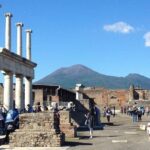
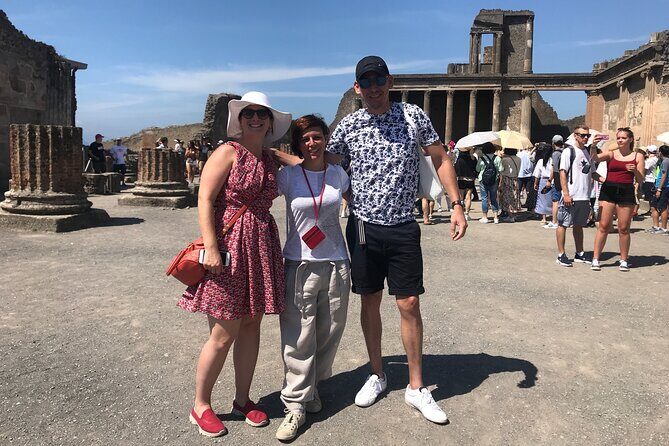
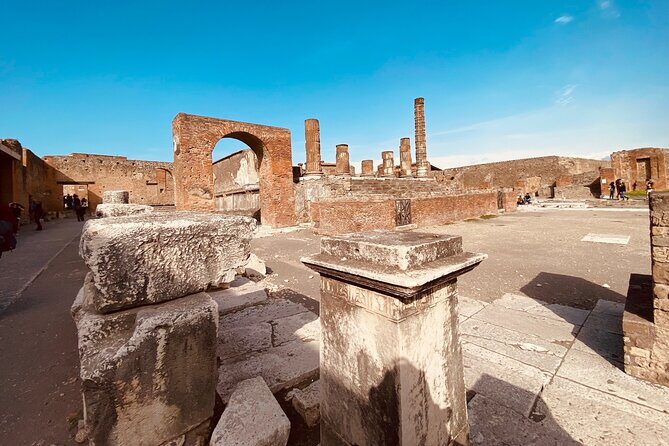
Next comes 1_Foro di Pompei, and then you’ll hit Pompei La Basilica, described as a court of justice. This is civic power in stone: where people would meet, argue, conduct business, and present public life.
A guide helps you translate what you’re seeing into what it meant for citizens, rather than treating it like a pile of columns.
Temple of Jupiter
You’ll also stop at a Temple: Jupiter. Temples can feel repetitive if you just move from one ruin to another. Here, the difference is context: your guide can connect the temple to civic identity and religious priorities that shaped how people acted.
Quadriporticus of the theatres (gladiators’ barracks)
This stop is labeled as a Quadriporticus of the theatres and described as the gladiators’ barracks area. That mix of “theaters” plus “gladiators” is where you start to understand Roman entertainment as a whole system, not a single show.
It’s also the kind of stop where archaeologists tend to be good at small details that make it click—like how you imagine daily training, preparation, and movement inside the complex.
Lupanar (brothel area)
You’ll see the Lupanar, described as the brothel/prostitution area. This is one of the most talked-about places in Pompeii, and it’s also one of the easiest to misunderstand if there’s no context.
With a private guide, the aim is to explain the setting without turning the stop into gossip. You should come away with a clearer sense of how sexuality and commerce were part of city life, and how the space functioned.
Temple of Venus
Then comes the Temple of Venus. Temples like this help round out the city’s belief system, so Pompeii feels complete rather than lopsided toward politics or entertainment.
Casa del Poeta Tragico (Casa of the Tragic Poet) and the cave canem mosaic
This is a quick but memorable stop: the cave canem mosaic is famously striking. You’re in a house setting here, which is a different lens than theaters and baths.
In about 5 minutes, I’d use it to slow down and look. The mosaic isn’t just decoration; a good guide will explain how imagery communicated meaning inside a home.
Macellum (meat and fish market)
The Macellum is your market stop: meat and fish. Markets are where a city’s daily supply chain shows up in concrete ways.
A guide can tie this to what people ate, how they purchased food, and how markets fit into the larger street network you saw earlier.
Edificio di Eumachia (wool market)
Next is Edificio di Eumachia, described as the wool market. This is a strong contrast to the food market: clothing and textiles were major pieces of urban life.
A guide helps you connect trade to status and civic patronage, which can add a surprising layer of meaning to a building you might otherwise just walk past.
Casa del Menandro (frescoes and mosaics)
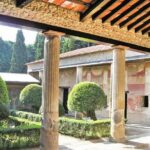
The house stop here is Casa del Menandro, noted for frescoes and mosaics. This is where Pompeii becomes personal. Household art tells you what owners valued, how they wanted to be seen, and how Roman homes communicated taste.
With around 20 minutes, you can actually look at multiple elements rather than speed-reading the walls.
Termopolio di Vetuzio Placido (take-away shop and fast food)
The termopolio is labeled as a takeaway shop and fast food. If you like the idea of eating in the real Pompeii timeline, this is the most “you are there” kind of stop.
A guide can explain how these places worked for quick meals and how they fit into the street life you already saw.
Fullonica di Stephanus (laundry)
The Fullonica di Stephanus is Pompeii’s laundry. Clothes mattered, and laundry was a job. This stop is useful because it keeps Pompeii anchored in labor, not just elites and temples.
A good guide can also help you see why certain rooms and tools would have existed where they did.
Temple (final temple stop before wrapping)
The tour includes another temple stop listed simply as Temple near the end of the route. Expect it to serve as a final religious/civic “bookend” before you head back toward the meeting point.
Everyday Pompeii: markets, baths, laundry, and quick meals
Here’s the secret sauce of this tour: the route includes enough “workday” stops that Pompeii doesn’t feel like a theme park for rich Romans only.
You get:
- Food and drink habits through the termopolio and the Macellum
- Trade and materials via the wool market
- Social routines with the Stabian Baths
- Real labor through the Fullonica (laundry)
This is why an archaeologist guide adds real value. Without context, these places can look like generic ruins. With context, they become a map of daily life: where people went, what they needed, and how the city supported them.
If your goal is to understand what living felt like, this mix is exactly what you want in just 3 hours.
Walking reality check: steps, slippery stone, and heat
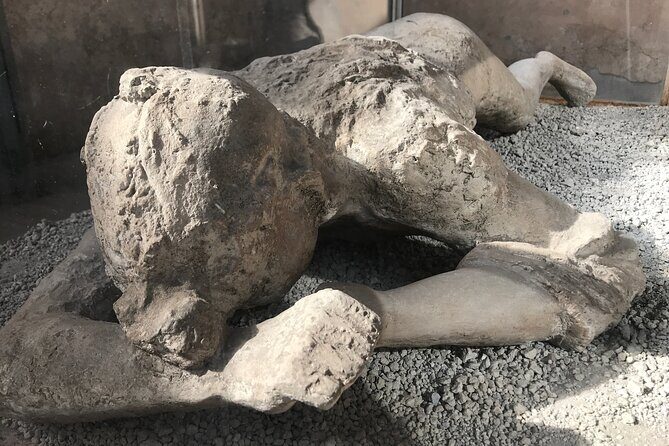
Pompeii is not flat, and it is not forgiving. The experience data you have includes the kind of practical warning you should take seriously: expect lots of walking, steps, and possibly slippery surfaces. Moderate balance helps.
This is where private tours can be better than group tours. Your guide can slow down, pause longer, or adjust the pace when needed. Reviews also mention guides being thoughtful with mobility challenges, which suggests you can expect some human-level problem solving rather than strict timing.
Your preparation checklist:
- Wear shoes with solid grip
- Bring water since meals and drinks aren’t included
- If it’s hot, plan to ask for shade stops when you can
If you’re traveling with kids or anyone who gets tired fast, this tour is still doable, but you’ll want to prioritize comfort and take breaks rather than treat it like a sprint.
Value for your money: price vs. what’s extra
At $302.32 per group (up to 1) for about 3 hours, the tour price is best seen as paying for two things: a private archaeologist guide and time-saving help with entry.
What’s included, based on your info:
- Assistance before and during the tour
- Private tour
- Main attractions of Pompeii
- Specialized archaeological tour guide
- Skip the line at the ticket office (on request in advanced)
- Mobile ticket
- Link to buy tickets entrance in advance
What’s not included:
- Meals and drinks
- Entrance fee for the park (adults 19 euros, under-18 free)
- Private transportation
Is it “worth it” compared with self-guided? Often, yes, if any of these are true:
- You want someone to explain what you’re seeing, not just point at it
- You have limited time and want the best density of highlights
- You care about everyday-life details like markets, baths, and household art
- You’d rather not deal with ticket-office confusion in a different language
If you’re the type who loves reading every sign and you have plenty of time, self-guided can work. But if you want Pompeii to feel legible fast, this private format is a smart trade.
Who should book this tour, and who might not
This tour fits best if you want:
- A private archaeologist experience rather than a big group
- A route that mixes theaters, Forum areas, bath culture, markets, and houses
- Enough context to understand Pompeii as daily life in 79 AD, not just famous ruins
It might be less ideal if you:
- Are very limited in walking on steps or uneven ground and need a fully accessible route. Private guides can adapt pace, but the site itself remains challenging.
- Want to cover a huge portion of Pompeii in one go. Three hours is great for focus, but it will not cover everything.
Should you book this Pompeii private archaeologist tour?
If you’re asking me to be practical: book it if you want Pompeii to make sense quickly and you’re willing to walk. The route is built around both the famous monuments and the daily-life stops that most self-guided visits miss. The archaeologist guide angle is the difference between seeing ruins and understanding a city.
I’d skip it only if you’re determined to cover Pompeii mostly on your own at a slow pace, or if mobility limitations make stairs and uneven surfaces too hard. Otherwise, this is one of the more efficient ways to get a high-impact Pompeii visit in a short window, without sacrificing the story.
FAQ
What’s the duration of the Pompeii private tour?
The tour is about 3 hours.
Is this tour private or shared with other people?
It’s a private tour. Only your group participates.
Does the tour include Pompeii entrance tickets?
No. Entrance tickets to Pompeii are not included. Adults are listed at 19 euros per person, and under-18 visitors are free.
Is skip-the-line available for tickets?
Skip-the-line at the ticket office is available on request in advance. The tour also mentions a link to buy entrance tickets in advance.
Where does the tour start and end?
It starts at Hortus Pompei, Restaurant & Garden Bar near Porta Marina Superiore and ends back at the meeting point, after ending the route at Porta Marina Inferiore.
What languages is the tour offered in?
The tour is offered in English.
What should I expect physically?
Expect lots of walking, steps, and slippery surfaces. Moderate balance is helpful. Service animals are allowed.