REVIEW · POMPEII
Pompei three hours with an expert guide
Book on Viator →Operated by Campaniaguide · Bookable on Viator
Pompeii makes more sense with a real guide. This private 3-hour visit is built to help you read the city like a story: what you’re looking at, why it mattered, and how it fit together right before Vesuvius buried everything. I especially like the flexible pacing for your group, and I love that the guide helps you spot the big sights without feeling rushed.
Two highlights I’d point out right away: you’ll walk key areas like the Street of Abundance and major venues such as the amphitheater, and you also get context for the less-obvious parts (theaters, baths/spas, and even the thermopolium). One consideration: the Pompeii entrance fee isn’t included, so you’ll want to budget for that on top of the tour price.
In This Review
- Key Points to Know Before You Go
- Pompeii in 3 Hours: What This Format Gets Right
- Meeting at Piazza Esedra and Timing Your Morning
- The Real Value: An Expert Guide Who Explains What You’re Seeing
- Walking the Main Street: Street of Abundance and the City’s Core
- Stop Inside Pompeii Archaeological Park: Big Sights in a Smart Order
- Private Homes and Everyday Spaces
- Two Theaters: Culture and Crowd Life
- Baths and Spas: Social Life in Stone
- Brothel and Thermopolis: The Less-Predictable Stops
- Street and Major Venues in One Flow
- Amphitheater Time: Up to 20,000 People, and Why It Lands
- Classic and Newer Discoveries: More Than the Same Old Route
- Price and Value: $416.34 Per Group for Up to 7
- What to Expect From the Guide Experience
- Who This Tour Fits Best
- Quick Practical Notes Before You Commit
- Should You Book the Pompeii Three Hours With an Expert Guide?
- FAQ
- How long is the Pompeii three hours with an expert guide tour?
- Where do we meet for the Pompeii tour?
- Is the Pompeii entrance fee included?
- Is this a private tour?
- How many people are included in a group?
- What language is the tour offered in?
- What if the weather is poor or the tour can’t run?
- What is the cancellation and refund policy?
Key Points to Know Before You Go
- Private group up to 7 people, so you’re not stuck with a slow, one-size-fits-all crowd pace
- Expert guide interpretation that connects everyday spaces to what life looked like in Roman Pompeii
- Route flexibility so your group can lean toward big monuments or focus on homes, baths, and streets
- Top stops in a tight time window: villas/private homes, theaters, baths/spas, brothel, thermopolis
- Focus on the classic and newer discovered areas, not just the most obvious core
- Mobile ticket with your booking, plus a meet-up at Piazza Esedra in Pompeii
Pompeii in 3 Hours: What This Format Gets Right
Pompeii is one of those places where it’s easy to feel overwhelmed. You see walls, arches, floors, and faded paint—then it’s hard to know what you’re actually standing in. This tour’s whole job is to remove that guesswork. In just about 3 hours, you get a guided path that points out the main story beats of the city’s daily life.
The “private” part matters more than you might think. With a group capped at up to 7, you can move at a sensible speed, ask questions, and adjust if someone needs a slower moment. In the guide feedback, people highlighted how the tour worked well even with older companions who needed extra time to maneuver through the site.
The other big win is the way the guide frames what you see. Instead of only pointing at stones, the guide helps you connect spaces—like a public street, a theater, a bath area, or a small commercial stop—to the rhythms of Roman life.
You can also read our reviews of more guided tours in Pompeii

Meeting at Piazza Esedra and Timing Your Morning

You start at 9:30 am at Piazza Esedra (80045 Pompeii NA, Italy). The activity returns you to the same meeting point, so you’re not scrambling to find your way afterward.
That timing is practical. If you’ve ever visited Pompeii on your own, you know how quickly the day can feel like a blur—especially when you’re trying to cover a huge site with limited time. A guided start helps you get your bearings fast and focus on the most meaningful pieces first, rather than wandering and hoping you bump into the classics.
Also, the meeting spot is near public transportation, which helps if you’re arriving by train or bus and want a straightforward start.
The Real Value: An Expert Guide Who Explains What You’re Seeing
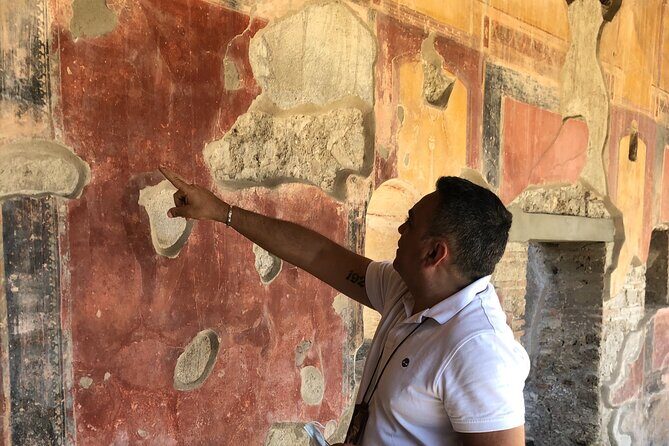
This is a “see it, understand it” tour. The guide is the main ingredient, and the feedback makes it clear that the best part is the interpretation: naming what you’re looking at and explaining why it mattered.
Two guides were specifically praised—Giovanna and Vincenzo—and both were described as detailed, kind, and effective at bringing the ruins to life. One person even mentioned getting history tied to what the spaces might have meant for the people who lived there, which is exactly the kind of context that makes the site stick in your mind.
If you’re trying to decide whether a guided experience is worth it, here’s the straightforward way to think about it: Pompeii is big, and signage isn’t always enough to make the layout meaningful. Paying for a guide is really buying time—time you’d otherwise spend figuring out what belongs where.
Walking the Main Street: Street of Abundance and the City’s Core

One of the tour’s main themes is the idea of everyday city life. You’ll walk along the so-called Street of Abundance, which is the city’s main road. Even if you’re not an archaeology expert, this is the kind of path where the guide can point out how movement through the city worked—where people likely shopped, gathered, and passed by important buildings.
This is also where flexibility shows up. If your group wants to focus on the big-picture feel of Pompeii—streets, venues, and the flow of the town—the route supports that. If your group’s more interested in private spaces and domestic life, the guide can steer the focus toward those areas.
The practical benefit for you: you’re not just collecting photos. You’re building a mental map.
Stop Inside Pompeii Archaeological Park: Big Sights in a Smart Order
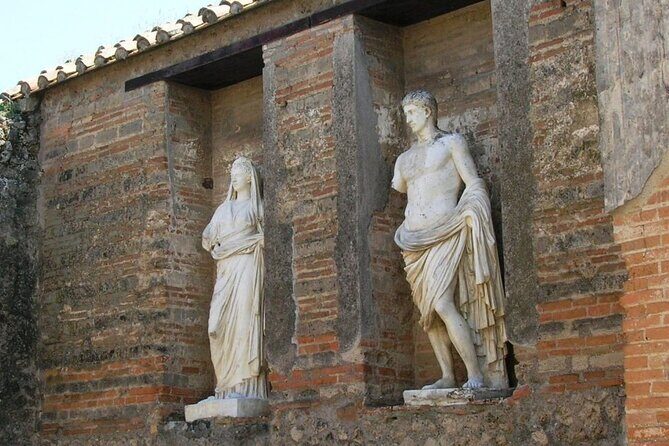
Your main time is spent inside the Pompeii Archaeological Park, guided for roughly 2 hours, with the tour total at about 3 hours. In that time, you’ll cover the key elements that help you understand the city fast.
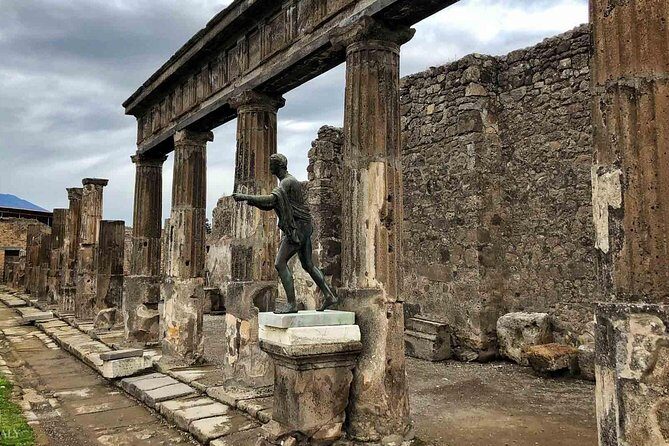
Here are the kinds of places you’ll see and why they matter:
You can also read our reviews of more tours and experiences in Pompeii



Private Homes and Everyday Spaces
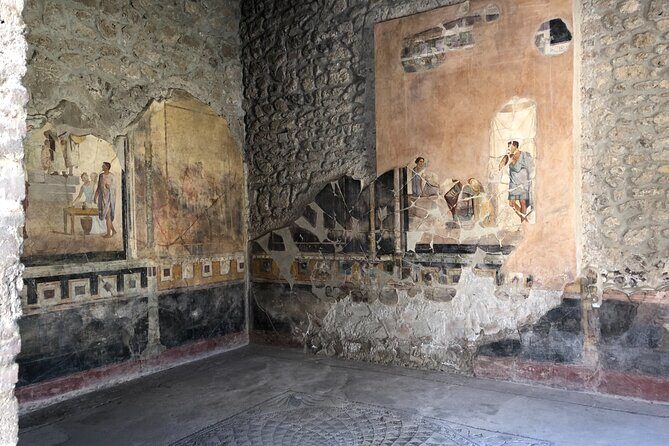
Pompeii isn’t only grand monuments. It’s also the story of houses and household life. Seeing private homes (and how they connect to the street and public areas) helps you understand Pompeii as a lived-in city, not just a museum of ruins.
Two Theaters: Culture and Crowd Life
You’ll visit two theaters. Even without advanced background, theaters are a strong way to grasp how entertainment worked and how large groups gathered. Pompeii’s scale can be hard to absorb alone; a guided comparison between theaters helps you make sense of what each space likely offered.
Baths and Spas: Social Life in Stone
The tour includes spas/baths. These spaces tell you something surprisingly emotional about ancient life: people didn’t just live in homes; they met, relaxed, and moved through daily routines in public or semi-public areas.
Brothel and Thermopolis: The Less-Predictable Stops
The route also includes a brothel and the famous Thermopolis (a well-known eating/drinking stop). These parts aren’t there just for shock value. They show you that Pompeii’s economy and everyday habits were diverse. The guide’s role is to explain what you’re seeing without turning it into a caricature.
Street and Major Venues in One Flow
As you move from the city’s main road to major structures, you get a sense of how Pompeii operated as a whole system. That connected thinking is what you usually miss with a basic self-guided walk.
Amphitheater Time: Up to 20,000 People, and Why It Lands
One of the tour highlights is the massive amphitheater, described as large enough to hold up to 20,000 people. Seeing this structure is impressive on its own, but the guide focus makes it meaningful.
Why it’s a high-value stop: amphitheaters help you understand how Pompeii handled public events on a scale that still feels modern. The sheer capacity changes how you read the rest of the city—suddenly, the street, theaters, and social spaces feel connected to a culture built around gatherings.
You also get a sense of the city’s layout logic: how people might travel from streets and neighborhoods to big event spaces.
Classic and Newer Discoveries: More Than the Same Old Route
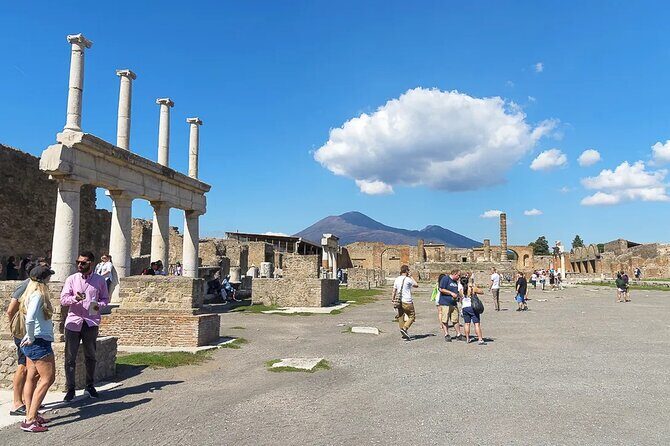
A big reason this tour gets strong feedback is that it doesn’t feel like the exact same script. The guide is set up to lead you between the classic areas and more recently discovered sections.
In plain terms, that means you’re more likely to see parts of Pompeii that other tours rush through—or skip entirely. One person specifically mentioned recent discoveries and routes that other tour groups didn’t spend time on. If you’re the type who hates doing the same highlights everyone posts online, this is a real advantage.
And if you do love the famous sites, the guide still gives you those, but with more context and fewer wasted minutes.
Price and Value: $416.34 Per Group for Up to 7
The tour costs $416.34 per group (up to 7) for about 3 hours, and the Pompeii entrance fee is not included.
That price can feel steep until you do the math. Because it’s priced per group (not per person), it often lands in a more reasonable range if you’re traveling with a small family or a couple of friends. You’re paying for:
- a private guide time block
- interpretation across multiple major sights
- a route that’s meant to fit your group’s needs rather than dragging you through a fixed circuit
Think of the entrance fee as the only extra mandatory cost. If you’re splitting the group cost, this starts looking like a smart way to buy back time and avoid the frustration of trying to make Pompeii understandable on your own.
What to Expect From the Guide Experience
Based on the most praised parts of the feedback, you can expect the guide to prioritize:
- detailed explanations that turn ruins into stories
- clear sight selection so you cover the key areas in the time you have
- pace control so older members or slower walkers can still enjoy the visit
- crowd management, including efforts to avoid the densest moments
One reason this works is that the guide is described as skilled at helping people notice things they would otherwise miss. That’s not a small difference in Pompeii. When you understand what you’re looking at, you don’t just see a wall—you see a function. You don’t just see a room—you picture how it was used.
Who This Tour Fits Best
This tour is a strong choice if you:
- want a private, not frantic experience
- are short on time and want the major sights tied together coherently
- care about understanding daily life, not only famous landmarks
- have mixed ages in your group and want a pace that can flex
It’s also a good match if you’re a planner who likes structured time. Pompeii can eat your day. This tour keeps it honest: three hours, the right stops, and the guide doing the translating.
If you prefer total independence and don’t want to pay for a guide, you can self-tour Pompeii. But you’ll need to accept that you might spend more time working out what each building is rather than enjoying the flow of the city.
Quick Practical Notes Before You Commit
- Entrance fee not included: you’ll need to plan for that separately.
- The tour is in English.
- You’ll use a mobile ticket.
- Confirmation happens at booking time.
- Weather matters: it requires good weather, and you’ll be offered another date or a full refund if it’s canceled due to poor conditions.
- There’s a minimum number of travelers, and if it doesn’t meet that threshold you’ll be offered another experience or a full refund.
Should You Book the Pompeii Three Hours With an Expert Guide?
My take: if you’re going to Pompeii once, or you want the visit to feel meaningful instead of just exhausting, book this. The private size, the tight 3-hour window, and the specific focus on key areas like two theaters, baths/spas, the thermopolis, the brothel, and the amphitheater make it a high-value way to see a lot without feeling like you’re sprinting.
The best reason to choose it is simple: the guide doesn’t just point. The guide helps you interpret the ruins so the city starts to make sense in real time—especially important at Pompeii, where the stones can otherwise look like unrelated fragments.
If you’re bringing family members with different walking needs, the reported ability to accommodate slower pace is a reassuring sign. Just remember the entrance fee is extra, so budget for that and you’ll go in with no surprises.
FAQ
How long is the Pompeii three hours with an expert guide tour?
It lasts about 3 hours.
Where do we meet for the Pompeii tour?
The meeting point is Piazza Esedra, 80045 Pompei NA, Italy.
Is the Pompeii entrance fee included?
No. The tour includes the guide service, but Pompeii admission is not included.
Is this a private tour?
Yes. It’s private, and only your group participates.
How many people are included in a group?
The tour is for up to 7 people per group.
What language is the tour offered in?
The guide provides the tour in English.
What if the weather is poor or the tour can’t run?
The experience requires good weather. If it’s canceled due to poor weather, you’ll be offered a different date or a full refund. It can also be canceled if a minimum number of travelers isn’t met, with the same options.
What is the cancellation and refund policy?
You can cancel for a full refund up to 24 hours before the start time. If you cancel less than 24 hours before, the amount paid isn’t refunded.