Roman villas outside the usual crowds. That is what grabbed my attention about this tour: you pair Oplontis and Stabiae in one smooth run, so you get more than postcards from the Vesuvius story. I like that the pace is built around rooms and wall art, not just quick stops at big names, and that you go with a professional archaeologist and licensed guide who can explain what you’re looking at as you go. I also love the practical setup: skip-the-line access and a route that finishes on the archaeological promenade in Stabiae.
Here’s the catch to consider. The day can shift if site hours change, and one reviewer had Stabiae disrupted due to timing. In that case, the company handled it by offering a more in-depth visit at Oplontis, but it’s still smart to double-check your time slot with the operator before you lock it in.
In This Review
- Key moments that make this tour worth your time
- Why these villas beat a Pompeii-only day
- Villa di Poppea at Oplontis: the fresco stop that anchors the day
- Villa San Marco in Stabiae: a short walk with real atmosphere
- Villa Arianna: the myth wall painting that ties the story together
- Price and value: what you’re really paying for at $226.37
- The 3-hour plan: timing, meeting points, and staying on schedule
- Who should book this tour (and who might not)
- What it feels like with a guide like Livio
- Should you book Villa Oplontis & Stabiae with an archaeologist?
- FAQ
- How long is the Villa Oplontis & Stabiae tour?
- What language is the tour offered in?
- Where does the tour start and end?
- What’s included in the price?
- Is transportation included?
- Can I cancel for a full refund?
Key moments that make this tour worth your time
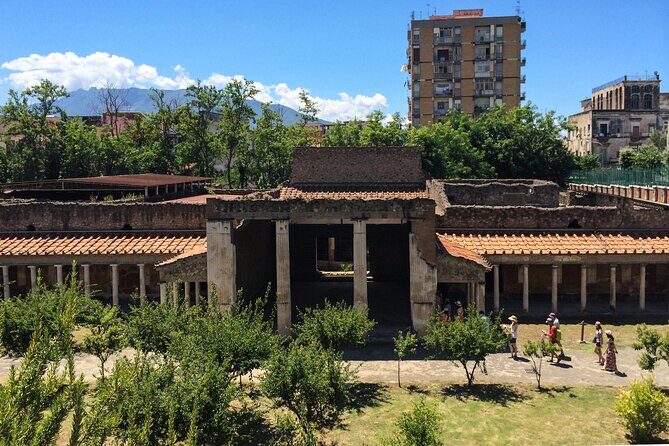
- Villa di Poppea (Oplontis) fresco focus: the kind of painted detail that usually needs a guide to decode.
- Two Stabiae stops in sequence: Villa San Marco and Villa Arianna, both tied to the myth-and-daily-life blend of Roman interiors.
- Skip-the-line entry included: you spend your time inside the villas, not in queues.
- Archaeologist-led explanations: small visual clues on walls and layouts get pointed out in plain language.
- Private tour feel for your group: you’re not competing with a long stream of unrelated people.
Why these villas beat a Pompeii-only day
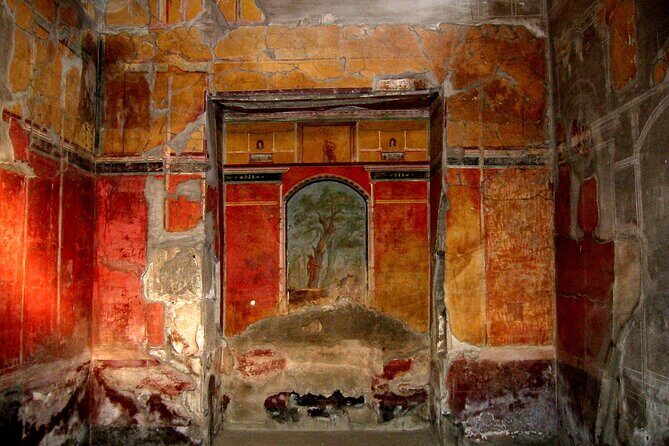
Pompeii gets most of the attention, and honestly, it’s not undeserved. But once you spend time with the city, you start craving context: how people lived in different houses, how art and design signaled wealth, taste, and routine, and how the same eruption shaped multiple nearby sites.
That’s where Oplontis and Stabiae shine. They’re Roman villas, not a single urban street grid. You walk through spaces meant for domestic life and display, so the experience feels more human. And because these are different sites rather than repeats of the same theme, the day adds texture: you’re not just seeing ruins, you’re comparing the way Roman art and architecture worked in separate places around Vesuvius.
I also like that the tour is short enough to stay sharp. With about 3 hours on the clock, you can focus on key rooms and fresco programs without turning your afternoon into a checklist workout.
You can also read our reviews of more tours and experiences in Pompeii.



Villa di Poppea at Oplontis: the fresco stop that anchors the day
The first stop is Villa di Poppea (Oplontis), and it’s built around one big reason people come: the frescoes. You’ll get about an hour here, which is exactly the right length for a villa interior. It gives your guide enough time to connect the big artistic themes with the physical space you’re standing in, instead of rushing like you’re passing through a museum hallway.
What I find especially valuable is how frescoes change the tone of a site. Floors and walls tell you what was built. Paintings tell you what people wanted to feel—comfort, status, myth, maybe even a little fantasy that made daily life brighter. A guide helps you notice details you’d otherwise gloss over: shifts in color and style, how painted scenes align with architectural elements, and what the images were doing in that particular room.
You should also know the entry mechanics here are handled by the tour package. The booking includes admission tickets for Oplontis and skip-the-line entry, so you’re not stuck trying to sort out entry rules mid-trip. That kind of hassle reduction matters on a tight schedule.
A small practical point: plan to arrive ready to look up and around. The most rewarding parts of villa art often live above eye level, and once you start noticing that, the whole place clicks.
Villa San Marco in Stabiae: a short walk with real atmosphere
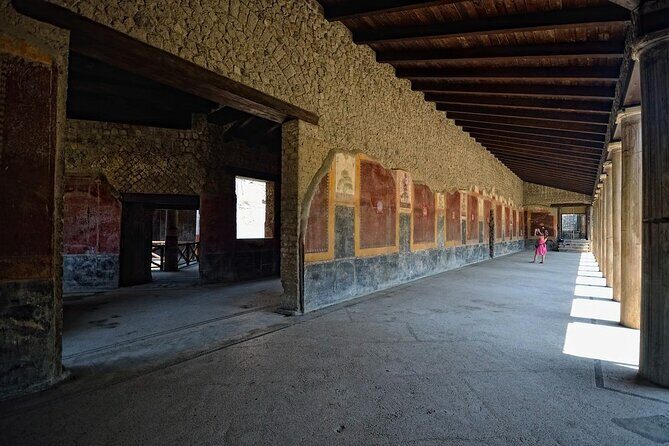
Next you head to Villa San Marco in Stabiae. The time on this stop is about 30 minutes, which sounds quick until you realize how villas are experienced best: you want to hit the most important rooms and views without exhausting yourself.
This is where I think the tour earns its structure. At this stage of the day, you’ve already seen the big fresco shocker at Oplontis. Now Villa San Marco works like a contrast—different layout, different feel, and a different slice of Roman domestic design. You’re literally walking along ancient rooms, not standing in front of a single restored object. That movement helps you build a mental map, so later, the murals at the final stop make more sense.
The entry for this stop is free, so you’re paying for the guided experience rather than an extra admission hurdle. What you gain is the explanation: why rooms are arranged the way they are, what parts of the villa matter most, and how to read the spaces as a lived-in environment.
Drawback to keep in mind: the 30 minutes format means you’ll need to stay present. If you drift into phone mode or keep stopping for long photos, it’s easy to miss the guide’s key visual pointers.
Villa Arianna: the myth wall painting that ties the story together
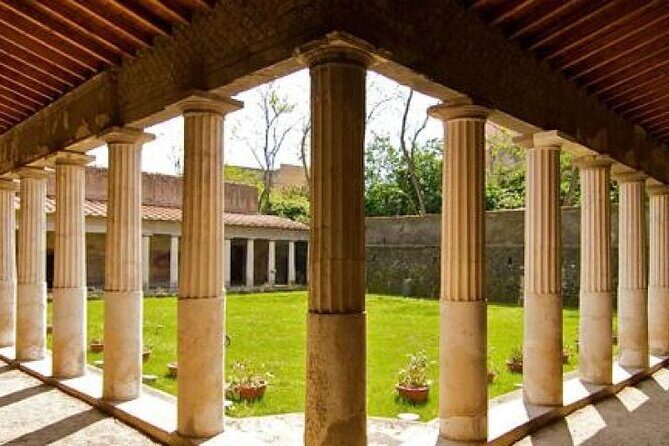
The last villa stop is Villa Arianna in Stabiae, also about 30 minutes. This one is memorable because the tour focuses on a Greek myth wall painting. Even if you don’t know the myth in advance, a guide can help you connect the image to the larger Roman habit of mixing storytelling, symbolism, and social status inside private homes.
I like the idea of closing the day on myth and art. It takes the morning’s fresco appreciation and gives it a narrative hook. Instead of only thinking in terms of decoration, you start thinking in terms of message. Roman villas weren’t just shelter; they were also cultural statements.
Again, the experience is built for walking and looking, not speed. You’ll move through the ancient rooms and get the guidance to notice what matters. Since this stop is free to enter, the value here is the interpretation—the why behind what you’re seeing.
Price and value: what you’re really paying for at $226.37
At $226.37 per person for a roughly 3-hour guided experience, it’s not a budget add-on. So the question is: what do you actually get that makes this money feel justified?
Here’s where the value shows up:
- Your guide is an archaeologist, not just a general tour guide. That matters because villa art is full of visual clues, and reading those clues correctly is the whole point.
- Skip-the-line entry is included. For a short tour, that can be the difference between enjoying the site and watching the clock.
- Admission tickets are part of the package for Oplontis and Stabiae villas. That reduces friction and keeps the day on track.
- It’s offered in English, so you can follow the explanations clearly without losing time.
I also like the private tour structure. You’re not packed into a massive group, and your guide can pace the walking and explanations for the people in your party. Even if you’re a solo traveler, the experience is designed for your group only.
If you’re comparing options, treat this as a deep-looking villa tour rather than a general Pompeii sightseeing supplement. If you enjoy archaeology and you want to understand the art, the price makes more sense.
If you’re only interested in quick photos and don’t care about interpretation, you might feel this is more than you need.


The 3-hour plan: timing, meeting points, and staying on schedule
You start at Scavi di Oplontis – Villa Poppea, at Via Sepolcri, in Torre Annunziata (near public transportation). The tour ends at Scavi di Stabia – Villa San Marco, at Passeggiata Archeologica in Castellammare di Stabia, and it finishes after the archaeological promenade of Stabiae.
That end detail matters. You’re not dropped in the middle of nowhere or suddenly cut off. The promenade finish gives you a natural closing walk through the Stabiae area, which helps the day feel connected instead of fragmented.
Because the whole experience is about 3 hours, build your plan around it:
- Arrive a bit early so you don’t rush the start.
- Wear shoes that handle uneven outdoor stone.
- Keep an eye on the day’s timing. One of the strongest pieces of advice from a real experience: confirm your time slot with the company, especially if you want both Stabiae stops without interruption.
The tour includes skip-the-line tickets and guided access, but it does not include private transportation. So you’ll want to handle getting between stops on your own as instructed by the provider.
Who should book this tour (and who might not)
This works best for you if you like Roman interiors, you’re drawn to frescoes, and you want explanations that connect art to how people lived. If you’re the type who zooms in on wall paintings and wonders what they meant, you’ll get a lot out of the archaeologist-led approach.
It also fits well if you already spent time in Pompeii and Herculaneum on your own and you’re ready for a second act. One reviewer described doing a week of exploring those areas first, then choosing this day to understand the villas more deeply. That logic makes sense: once you’ve got the broad Vesuvius picture, villa tours like this give you the emotional and artistic human layer.
It might be less ideal if:
- You want a slower day with long roaming time in each room.
- You don’t want explanations and prefer self-guided wandering.
- You’re very strict about seeing every planned stop no matter what. Site hours can shift, and while the operator may adjust, it’s not guaranteed.
What it feels like with a guide like Livio
One name came up strongly: Livio. In the experiences I read closely, the big themes were detail and generosity. The guide pointed out small parts people might otherwise miss, and took time with photos as the tour moved along. That matters more than it sounds. When a guide patiently helps you notice one overlooked detail, the whole room starts speaking.
Also, when Stabiae couldn’t be done at the scheduled time, the operator responded by offering a more in-depth Oplontis visit. That’s a smart form of damage control: you still leave with the main fresco payoff, and you don’t feel like the day was wasted.
So if you care about quality interpretation, this tour’s overall guide style is a big part of why the rating is so strong.
Should you book Villa Oplontis & Stabiae with an archaeologist?
I’d book it if you want a focused Roman-villa day with real context, not just ruined walls. The combination of Villa di Poppea’s frescoes and the pair of Stabiae villa stops gives you a complete picture of how art and domestic space worked outside Pompeii proper. With skip-the-line entry and tickets handled, you avoid the most common time sink.
Book it especially if you’re an archaeology-and-art person, or if you already did the major sites and want something that feels more intimate and interpretive. Just do one smart thing before you commit: confirm your time slot with the provider so you’re aiming for the hours that let you see both Stabiae villas.
If you want, I can also help you choose a departure time strategy based on how you’re getting to Torre Annunziata/Castellammare di Stabia and what you’ve already planned for Pompeii.
FAQ
How long is the Villa Oplontis & Stabiae tour?
It runs for about 3 hours.
What language is the tour offered in?
The tour is offered in English.
Where does the tour start and end?
It starts at Scavi di Oplontis – Villa Poppea (Via Sepolcri, Torre Annunziata) and ends at Scavi di Stabia – Villa San Marco (Passeggiata Archeologica, Castellammare di Stabia), after the archaeological promenade of Stabiae.
What’s included in the price?
You get a guided tour by a professional archaeologist and licensed guide, admission tickets to the Oplontis Villa and Stabia villas, and skip-the-line tickets.
Is transportation included?
No. Private transportation is not included.
Can I cancel for a full refund?
Yes. You can cancel for a full refund if you cancel at least 24 hours before the experience’s start time.