REVIEW · POMPEII
Pompeii Small Group Tour with an Archaeologist
Book on Viator →Operated by Askos Tours · Bookable on Viator
Pompeii starts to make sense fast. This small-group tour uses skip-the-line Pompeii Express tickets and an archaeologist’s storytelling to turn scattered ruins into a real town you can picture. I love how the route hits the Basilica and Forum early, so you get instant orientation, and I also love the pause at the victim plaster casts, where the site stops being just architecture and becomes human. One consideration: you’ll be walking uneven ground with steps and ramps, so it’s not a great match for anyone needing a mobility scooter.
You meet at the start point near Via Villa dei Misteri, then go straight into the archaeological park with your guide holding an Askos Tours sign at Porta Marina Superiore. The group stays small (up to 20), and when the group is larger (16+), you get headsets so you don’t strain to hear while you’re craning over mosaics and inscriptions. If you’ve seen guide names like Alessandra, Teresa, Paolo, or Vincenzo on past tours, you’ll get the same vibe: clear explanations, strong pacing, and real context, not just a list of monuments.
For the price (about $35.67 per person) you’re paying for time-saved entry, expert interpretation, and a tight route that fits into a couple of hours without feeling like you’re sprinting. It runs year-round in rain or shine, which matters because Pompeii doesn’t pause for weather.
In This Review
- Key things that make this Pompeii tour worth your time
- Entering Pompeii through Porta Marina Superiore (and getting your bearings)
- Basilica and Forum: learn the city’s daily rhythm first
- Basilica: where commerce and shelter met
- Forum: Pompeii’s main square
- Granaries of the Forum: the moment Pompeii gets personal
- House of Menander: how wealth shows up in art and layout
- Stabian Baths: oldest thermal complex, real city energy
- Lupanar brothel ruins: what you can learn from a place people feared and used
- House of the Faun and the Odeon: scale and sound
- Teatro Grande: end with Pompeii’s biggest stage
- Walking tips that make the whole tour easier
- How I’d judge the value of this Pompeii small-group tour
- Should you book this Pompeii tour with an archaeologist?
- FAQ
- Where is the meeting point?
- Where does the tour end?
- How long is the tour, and how large are the groups?
- What’s included in the ticket price?
- Is this tour in English?
- Is this a skip-the-line tour?
- What should I wear or bring?
- Is the tour suitable for mobility scooters or limited mobility?
- Are children or pets allowed?
- Can I cancel for a full refund?
Key things that make this Pompeii tour worth your time
- Skip-the-line entry with Pompeii Express tickets so you waste less time waiting at the gate
- An archaeologist with a licensed background, which changes how you read what you see
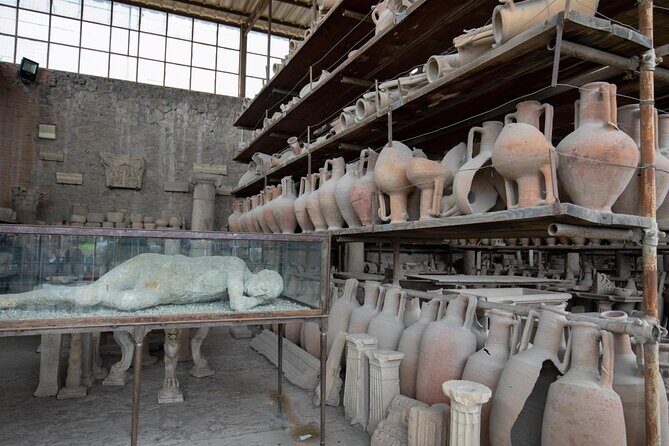
- Victim plaster casts and themed stops (dog and tree, plus the famous casts) that give emotional weight
- A smart hit list: Basilica, Forum, House of Menander, Stabian Baths, Lupanar, House of the Faun, Teatro Grande
- Small group size up to 20 for a smoother pace through a big site
- Headsets for groups of 16+, so you can actually hear the story while walking
Entering Pompeii through Porta Marina Superiore (and getting your bearings)
The tour begins at Porta Marina Superiore, right at the park entrance, with your guide holding a sign for Askos Tours. That matters because Pompeii is huge, and getting lost early is the fastest way to burn your limited time. With the tour leading you in right away, you’re not just stepping onto ancient stone—you’re stepping into a planned route.
You also get a Pompeii Express entrance ticket included, which is the practical part of the “skip-the-line” promise. When I’m choosing a Pompeii experience, I always prioritize the ones that reduce queues, because the whole site is timing-sensitive. A two-hour guided visit is especially tight, so shaving minutes at the entrance is real value.
The tour ends inside the ruins. That’s a nice detail because you’re not dragged back out for the last photos. Once you’re oriented, you’re better equipped to wander a bit on your own afterward if you want to keep exploring at your pace.
You can also read our reviews of more tours and experiences in Pompeii.

Basilica and Forum: learn the city’s daily rhythm first

Most people arrive at Pompeii thinking the highlight will be dramatic scenes. But the best guides start you with how the place functioned.
Basilica: where commerce and shelter met
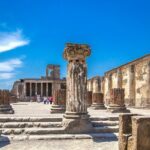
The Basilica was an open portico—a sheltered space where merchants and other activities happened. The ruins can look like “big leftover walls” until someone explains that this was a working public zone. Here, you’re taught to notice how Roman cities organized daily life: movement, business, social meetings, and crowd flow.
Forum: Pompeii’s main square
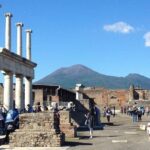
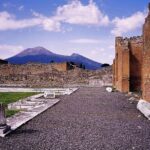
Next comes the Foro de Pompeya, the ancient main square. This stop is short, but it’s set up for impact. You’re learning how the city’s “center” worked—what the town used as its meeting point and civic stage. Once you understand the Forum, later houses and lanes feel less random. You start seeing relationships: where people walked, where they displayed status, and how public and private life overlapped.
A bonus here is pacing. Starting with these key civic spaces helps you avoid the common mistake of chasing houses randomly and then feeling overwhelmed.
Granaries of the Forum: the moment Pompeii gets personal
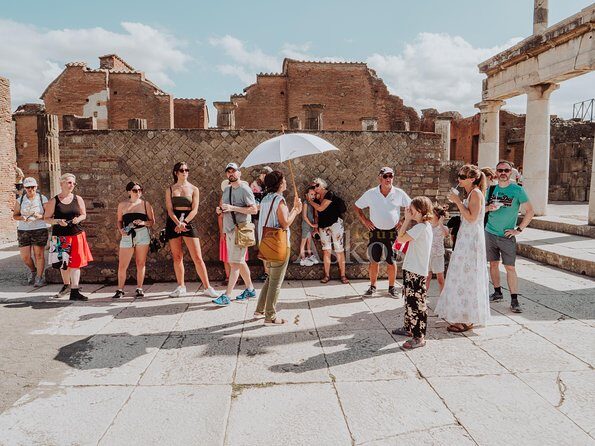
Then you slow down at the Granaries of the Forum. This is where the tour does something quietly powerful: it gives you time to ponder the plaster casts of victims from the eruption that destroyed the city.
In practical terms, this stop is valuable because it teaches you what you’re looking at. The granary area includes marble tables and features linked to fountains at entrances of houses. You also see casts of victims, plus a dog and a tree. That detail helps you understand the eruption’s reach. It wasn’t just a human tragedy—it trapped an entire environment in place.
Emotionally, this is the pivot point. Before, you’re reading civic buildings and wealth. After, you’re forced to read Pompeii as a moment in time—sudden, final, and deeply human.


House of Menander: how wealth shows up in art and layout
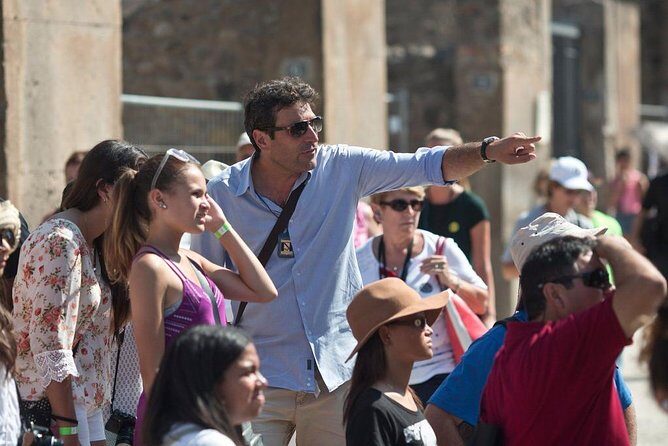
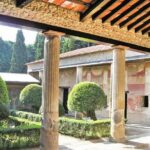
After the public spaces, the tour shifts into domestic life with the House of Menander. This is described as one of the richest and most magnificent houses in Pompeii in terms of architecture, decoration, and contents.
What makes this kind of stop work in a small group is that you’re not just shown rooms. You get a lens for why the house mattered. Wealth in Pompeii wasn’t only about having more space—it was about how the space was decorated and how it communicated status to visitors. When you see a showy interior with thoughtful layout, you start understanding what “home” meant in a Roman city where social life often spilled indoors.
If you’re the type who gets bored by “house tours,” this is still a good choice. It’s not a generic look; it’s a structured way to read elite life through design.
Stabian Baths: oldest thermal complex, real city energy
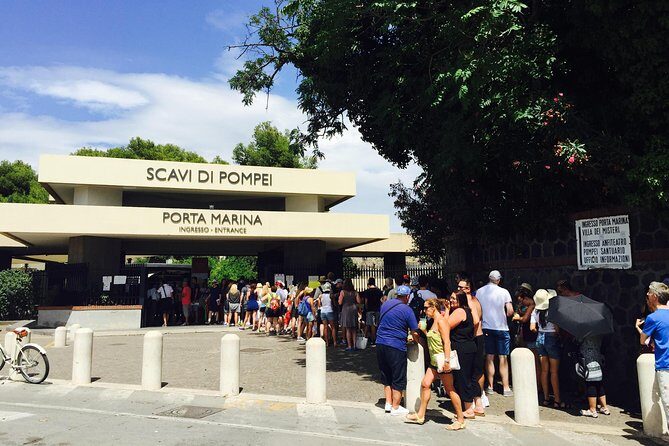
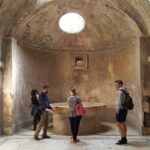
Next is the Stabian Baths (Terme Stabiane), one of the oldest thermal complexes in Pompeii, set across a large area between key street intersections.
Baths can sound like a throwaway stop if you’re expecting something modern. Here, they’re part of what made Pompeii social: routines, meeting points, and everyday leisure. The scale matters too. A bigger thermal complex means different rooms and different “beats” to the visit—places people moved through and gathered.
This stop is also a good reminder that Pompeii wasn’t frozen in time like a museum display. It was a living city with habits and public routines. Even if you only spend 15 minutes, the bath complex helps you connect private homes to the public systems that supported daily life.
Lupanar brothel ruins: what you can learn from a place people feared and used
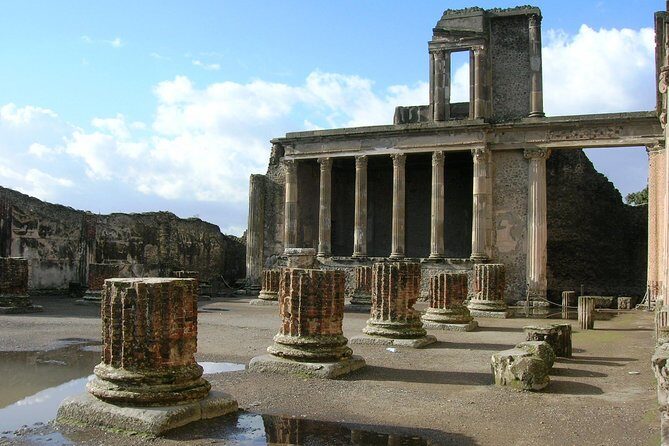
The Lupanar is the most famous brothel ruins in Pompeii. It’s also the kind of site where a good guide changes everything. Without context, people skim it like a curiosity. With context, you understand it as part of city life—where people worked, how the space was organized, and what the city’s social world looked like.
This stop is included for a reason. It gives you a fuller picture of Pompeii as a whole society, not only the “pretty houses” and “official buildings.” You’ll also see how Pompeii’s artistry shows up in everyday spaces—not just in elite residences.
If you prefer not to spend time on adult-themed ruins, it’s still worth knowing the tour includes it briefly. At least with a guide, you’re not left to interpret alone.
House of the Faun and the Odeon: scale and sound
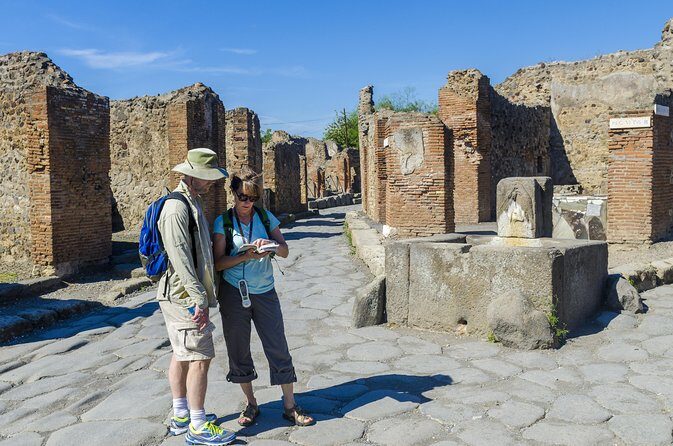
Then you move to the House of the Faun, one of the largest and most impressive private residences in Pompeii. This kind of house is a scale lesson. When you step into big elite homes, the size tells you wealth was visible in architecture, not just decoration.
After that, there’s a brief stop at the Odeon. The point here is to show how performances fit into daily life. Roman entertainment wasn’t always “grand spectacle.” Smaller venues existed too, and they shaped community culture.
Even in short time windows, these stops help you build a mental map: civic spaces, private wealth, then public entertainment.
Teatro Grande: end with Pompeii’s biggest stage
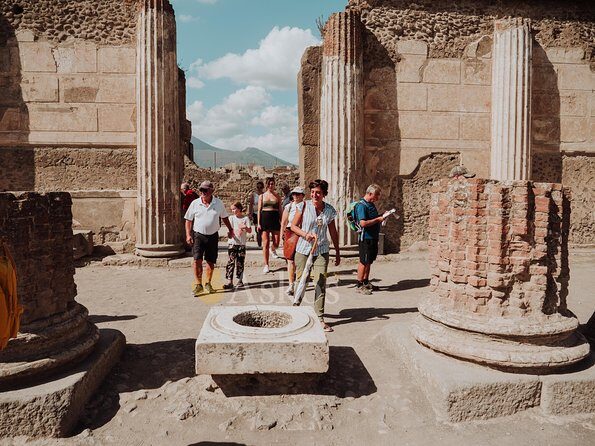
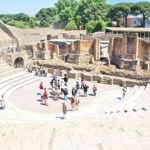
The tour finishes inside Pompeii’s largest theater, the Teatro Grande. This is the right closing note. Once you’ve seen public squares, elite homes, and neighborhood activity, the theater becomes more than a structure. It becomes where the city gathered and where social meaning was performed in front of crowds.
It also gives you a satisfying “wrap” because theaters are easy to visualize, even from ruins. When you’re done, you’ll likely feel like you can picture the city’s rhythm from morning to night.
If you love photo moments, this is a good one to remember. Don’t treat the final stop like a dash for pictures—take the time your guide gives you, because hearing what the space was for makes the ruins look different.
Walking tips that make the whole tour easier
Pompeii is walk-first, photo-second. Comfort matters here.
Wear comfortable shoes and bring sunscreen and sunglasses in summer. The ground is uneven, and there are steps and ramps along the route. That isn’t a small detail—it affects how much you can enjoy each stop because you’ll be constantly balancing while looking up at art.
Bring a small bottle of water. Heat plus uneven stone is not the combo you want on a two-hour walk.
If you’re traveling in cooler months, you still benefit from sturdy shoes, because the surfaces remain irregular year-round.
How I’d judge the value of this Pompeii small-group tour
At about $35.67 per person for around 2 hours, you’re not paying for a long “tour day.” You’re paying for the hard part: access, interpretation, and time management inside a site that can easily swallow your schedule.
The value improves if you want:
- Orientation fast (Basilica + Forum early)
- Expert context (licensed guide with archaeological background)
- Emotional depth (victim plaster casts plus themed details like the dog and tree)
- A practical hit list (key stops you’d otherwise miss)
It may be less ideal if you want a slow, self-paced wandering day with lots of lingering. Also, if mobility issues make steps and ramps a problem, you’ll probably feel stressed. The tour isn’t recommended for mobility scooters, and that’s not because of a “sniff test”—it’s because the route is built on ancient terrain.
Should you book this Pompeii tour with an archaeologist?
Book it if you want Pompeii to feel understandable in a short visit. This is a smart choice for first-timers, couples, and families who want the big landmarks plus the human side without spending half a day planning.
Skip it (or look for a different format) if you need a very gentle walking route, because uneven ground, steps, and ramps are part of the experience. And if you’re hoping for a completely adult-themed or completely kid-friendly route without any sensitive stops, this plan includes the Lupanar, so consider your comfort level.
FAQ
Where is the meeting point?
The tour start point is Via Villa dei Misteri, 2, 80045 Pompei NA, Italy.
Where does the tour end?
The tour ends inside the ruins of Pompeii at Pompei scavi 80045 Pompei, Metropolitan City of Naples, Italy.
How long is the tour, and how large are the groups?
It runs about 2 hours. The maximum group size is 20 people per guide.
What’s included in the ticket price?
You get guidance for the full duration and a Pompeii Express entrance ticket. The tour also includes a licensed guide with an archaeological background.
Is this tour in English?
Yes, the tour is offered in English.
Is this a skip-the-line tour?
Yes. You get skip-the-line tickets and you enter directly inside the ruins with your guide.
What should I wear or bring?
Wear comfortable shoes. Bring sunglasses and sunscreen in summer, and bring a small bottle of water.
Is the tour suitable for mobility scooters or limited mobility?
Mobility scooters are not allowed. It is not recommended for travelers with mobility issues or impairments due to steps, ramps, and some steep climbs.
Are children or pets allowed?
Children must be accompanied by an adult. For pets, service animals are allowed, and only dogs up to 10 kg with a maximum height of 40 cm are permitted, with leash rules and cleanup required.
Can I cancel for a full refund?
Yes. You can cancel up to 24 hours in advance for a full refund; cancellations within 24 hours are not refunded.
If you tell me when you’re visiting (morning vs afternoon, and season), I can help you pick the best time slot mindset—Pompeii changes its feel fast with weather and crowd levels.