REVIEW · POMPEII
Pompeii and Herculaneum small group tour – skip the line
Book on Viator →Operated by PompeiIn · Bookable on Viator
Two Roman cities, one long day. This small-group tour delivers skip-the-line access to Pompeii and Herculaneum, so you spend more time looking and less time standing. I love that the guide keeps the pace smart and answers real questions, and I love how you get the everyday details, not just the big monuments. The one watch-out: it’s a lot of walking on uneven ancient surfaces, and it’s not stroller-friendly.
What makes it feel special is the way the day moves. You start with Pompeii’s main public spaces, then step into elite homes with frescos and mosaics, and even pass by the city’s thermal areas and infamous brothel zone. In Herculaneum, the vibe shifts to cramped streets and carbonized rooms, so you see how differently these neighboring cities worked.
I also think the timing is both a strength and a tradeoff. You’ll cover a ton in about 5.5 hours, but it means quick stops in each site rather than long, slow roaming. If you’re sensitive to heat, bring water and plan for a strenuous day—especially if rain or crowds make the ground slick.
In This Review
- Key highlights worth booking
- Skip-the-line entry: why it matters more than you think
- Where you meet: Porta Marina Superiore and the Askos Tours sign
- Pompeii Archaeological Park: from merchants’ portico to Teatro Grande
- Porta Marina to the Basilica: the sheltered merchant world
- Foro de Pompeya: the main square energy
- Main street walk: how you start feeling the layout
- Casa del Menandro: wealthy home, heavy visual impact
- Granai del Foro: marble tables, fountains, and even casts
- Terme del Foro: oldest thermal complex on the block
- The famous brothel area: what fame is built on
- Casa del Fauno: a large private residence
- Teatro Piccolo to Teatro Grande: entertainment with a purpose
- Train transfer to Herculaneum: the Circumvesuviana rhythm
- Herculaneum ruins: mansions, thermals, and carbonized details
- Casa dei Cervi: stags in the peristyle
- La Terrazza di M. Nonio Balbo: a named terrace stop
- College of the Augustales: public role, private space
- Casa del Rilievo di Telefo: the odd one with a private connection
- Partem Domus lignea and Casa del Tramezzo di Legno: wood where you expect stone
- House of the Skeleton: unsettling, historically important
- Central Thermae: men’s and women’s bathing
- Casa del Salone Nero: black hall luxury and charred door remains
- Casa Sannitica: frescoed atrium and Samnite layout
- Casa del Bel Cortile: a courtyard stair and stone balcony
- House of the Grand Portal: the core area feeling
- Walking reality: timing, uneven ground, water, and rain
- Price and value at about $119.85 per person
- Who should book this small-group Pompeii and Herculaneum tour
- Should you book it or plan differently?
- FAQ
- How long is the Pompeii and Herculaneum small group tour?
- Does this tour include skip-the-line tickets?
- Is there a train included between Pompeii and Herculaneum?
- What is included in the price?
- Are meals included?
- Where do I meet the guide, and where does the tour end?
- How big is the group?
- Is cancellation free?
Key highlights worth booking
- Skip-the-line in both Pompeii and Herculaneum, which saves your best sightseeing hours
- Small group capped at 20, so you can ask questions and not get lost in the crowd
- One-way Circumvesuviana train from Pompeii to Herculaneum, plus a short walk to the ruins meeting point
- Pompeii sights that go beyond temples: baths, theaters, granaries, major houses, and more
- Herculaneum details you can’t fake: stags in Casa dei Cervi, men’s and women’s baths, and charred wooden door remains
Skip-the-line entry: why it matters more than you think
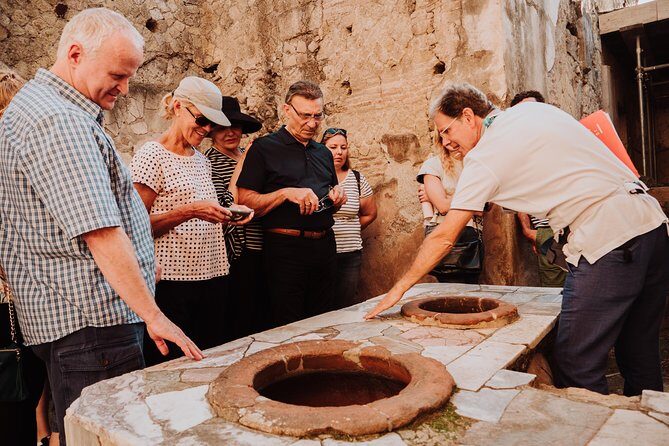
When you book a guided plan with skip-the-line tickets in both Pompeii and Herculaneum, you’re buying back time. These sites can eat hours if you hit peak arrival waves, and once you lose that time, you start rushing through the parts you actually came for.
On this tour, Pompeii entry is handled as part of the experience, and Herculaneum entry is also included. You also get a mobile ticket, so you’re not hunting for paper in your daypack. For a 5.5-hour day, those details add up to a smoother rhythm.
There’s another quiet benefit: guided pacing. Instead of you trying to read your way through the map, the guide sets the order, which helps you “connect” Pompeii’s streets and public spaces, then do the same in Herculaneum.
You can also read our reviews of more tours and experiences in Pompeii
Where you meet: Porta Marina Superiore and the Askos Tours sign
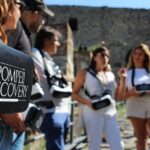
Your tour starts at Piazza Esedra, 4, in Pompeii. From there, the guide meets the group at the Pompeii Archaeological Park main entrance called Porta Marina Superiore. The guide holds a sign with Askos Tours on it, which is helpful if you’re arriving a bit early and want an easy visual check.
This matters because Pompeii is big and the entrances aren’t obvious if it’s your first time. If you show up with a little breathing room, you’ll feel less stressed before you even start walking.
The tour language is English, and the group stays small enough that you’re usually not just watching the guide vanish into a wall of shoulders. It’s the kind of setup where you can ask something as you go and actually get an answer.
Pompeii Archaeological Park: from merchants’ portico to Teatro Grande
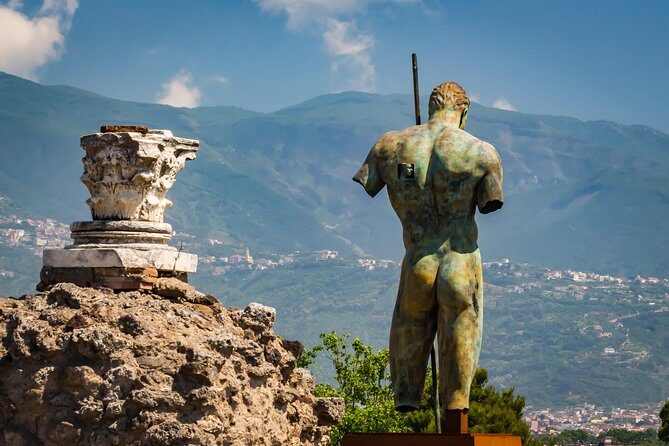
Pompeii is where the “city as a machine” story really clicks. The stops are designed to show you how people lived day to day: where they met, shopped, bathed, ate, worked, and entertained themselves.
Porta Marina to the Basilica: the sheltered merchant world
After you enter, the first look is at the Basilica. This wasn’t just a church-like building—it was a public portico area offering shelter, where merchants and other activities could happen even when the weather turned.
This is a smart early stop because it sets the tone. You’re not only seeing ruins. You’re learning the purpose of the spaces that structured daily routines.
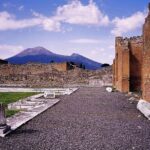
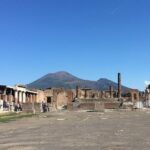
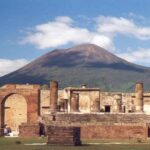
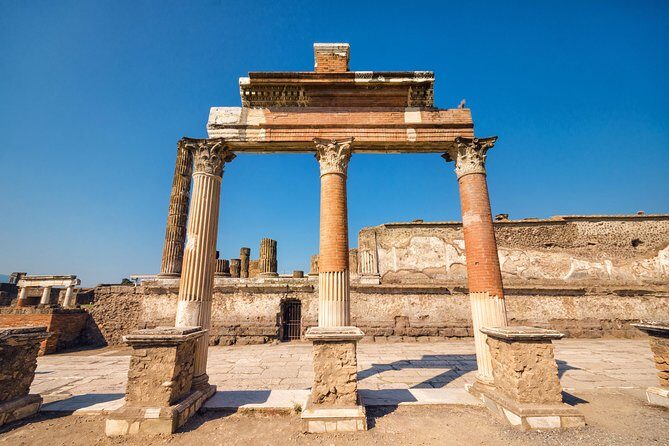
Foro de Pompeya: the main square energy
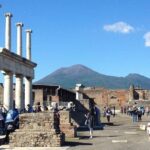
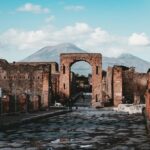
Next comes the Foro de Pompeya, the ancient main square. Think of it as the city’s social and civic center: a place where people gathered, watched, and moved between different parts of town.
In a guided format, this also helps you orient yourself. Once you understand the square, the surrounding streets and buildings stop feeling random.

Main street walk: how you start feeling the layout
You’ll then walk through the main street. It’s brief, but it’s important. Pompeii is easier to enjoy when you can picture movement through the city—how you would pass by storefronts, homes, and public corners.
Casa del Menandro: wealthy home, heavy visual impact
Casa del Menandro is one of the richest residences in Pompeii for architecture, decoration, and what’s preserved. Even with limited time at each stop, this is where you see how private luxury worked—especially through decoration that survives.
If you like architecture and floor-level details, this stop usually feels worth it because the house material is among the most vivid in Pompeii.
Granai del Foro: marble tables, fountains, and even casts
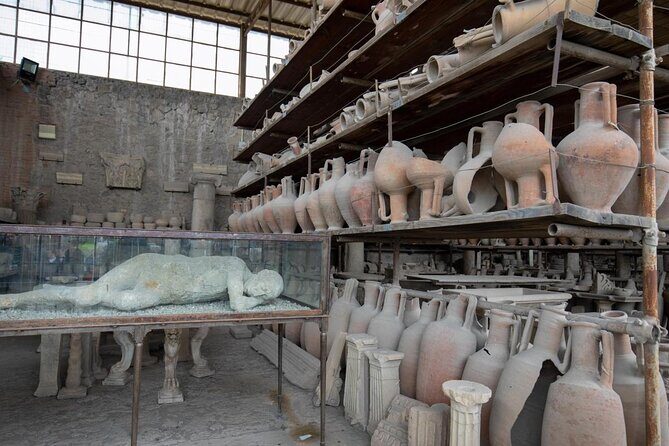
The granary area is a standout because it connects food storage with public infrastructure. You’ll see marble tables and baths for fountains that once adorned entrances to houses.
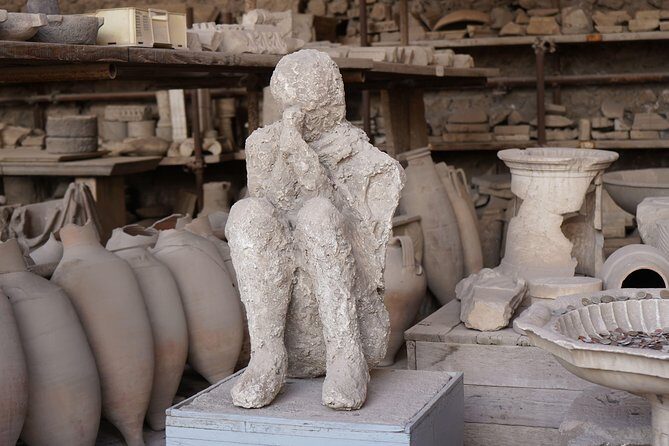
One of the most striking parts here is the presence of casts of victims of the eruption, plus a dog and a tree. It’s heavy, real, and not the sort of thing you forget after the tour finishes.
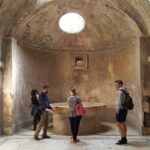
Terme del Foro: oldest thermal complex on the block
Then you hit Terme del Foro, an early thermal complex covering a vast area. This is where the tour reminds you that bathing was a major social habit, not just hygiene.
It also helps to break the day into variety: public spaces, homes, storage and water features, then baths and leisure.
The famous brothel area: what fame is built on
You’ll also pass by the most famous brothel in the Roman city of Pompeii. This isn’t presented as scandal. It’s presented as part of how the city worked economically and socially.
If you’re curious about daily life in all its forms, this stop adds context that many one-stop Pompeii visits skip.
Casa del Fauno: a large private residence
Casa del Fauno is among the biggest and most impressive private residences in Pompeii. This is a prime house stop for scale and layout, especially if you enjoy understanding how status showed up in architecture and decoration.
Teatro Piccolo to Teatro Grande: entertainment with a purpose
You’ll see the Teatro Piccolo, then visit Teatro Grande, the most important theater in Pompeii. The small-to-big sequence makes sense: it shows the idea of performance spaces before you scale up to the major venue.
If you’ve ever wondered how Romans used entertainment, this is one of the best ways to get the answer in a single day.
Train transfer to Herculaneum: the Circumvesuviana rhythm
After Pompeii, you transfer by Circumvesuviana train to Herculaneum. The ride is about 30 minutes, plus roughly 10 minutes of walking to reach the ruins meeting point.
This transfer is part of the value because it saves you the headache of coordinating transport yourself. It also adds a natural break in the walking, which helps you keep your legs for the second half.
There’s also time allowed for a quick lunch break if you need it. Meals are not included, so if you know you’ll get hungry, plan to buy something on your schedule rather than hoping the timing lines up perfectly.
One practical thing: the station area and the route can change. One review noted that the station was under renovation at one point, so keep an eye on on-site signs and don’t assume the path is always the same.
Herculaneum ruins: mansions, thermals, and carbonized details
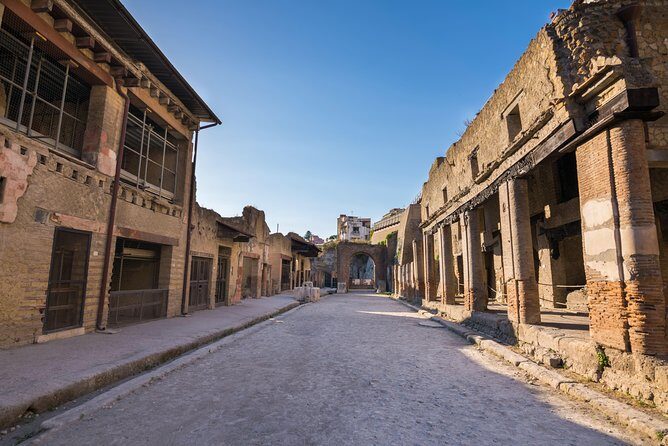
Herculaneum feels different from Pompeii in a good way. The pace is still fast, but the details can feel more immediate: rooms, doorways, and charred remains that help you picture the last moments.
You’ll start in Herculaneum at the ticket office meeting point within the ruins area. From there, you move through a series of houses and public spaces.
Casa dei Cervi: stags in the peristyle
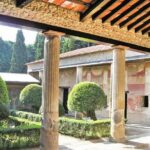
Casa dei Cervi gets its name from marble statues of stags/deer found in the peristyle. It’s an easy-to-love stop because it’s specific: you’re looking for a named element, not just scanning for general decoration.
La Terrazza di M. Nonio Balbo: a named terrace stop
You’ll also see La Terrazza di M. Nonio Balbo, another house with a named identity tied to the architectural focus of the stop. This part of Herculaneum helps you see how varied domus design could be, even within the same city.
College of the Augustales: public role, private space
The College of the Augustales is a different kind of stop than the houses. It helps balance the day so you’re not only in domestic spaces.
Even if you don’t catch every term, the guided explanation usually makes the role of these spaces clearer.
Casa del Rilievo di Telefo: the odd one with a private connection
Casa del Rilievo di Telefo is described as unusual for its private access to the adjoining Suburban Thermae. That detail tells you Herculaneum wasn’t only about what people did outside. It was also about how elite residents structured convenience.
Partem Domus lignea and Casa del Tramezzo di Legno: wood where you expect stone
Partem Domus lignea, Casa del Tramezzo di Legno is important because of an elegant wooden partition that remained. Seeing something tied to wood matters, since so much of the everyday material in these cities is gone or transformed.
House of the Skeleton: unsettling, historically important
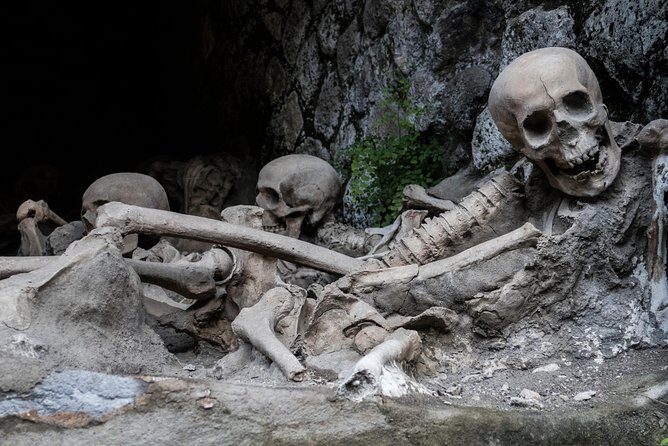
House of the Skeleton is named after human remains discovered in a second-floor room in 1831. It’s a tough stop, but it’s part of the historical record that shaped modern understanding of the eruption.
If you’re the type who prefers lighter sightseeing, this is the point where you’ll want to mentally brace yourself.
Central Thermae: men’s and women’s bathing
Central Thermae is a major stop. It was built around the beginning of the 1st century AD and was divided into men’s and women’s baths with separate entrances.
That detail gives you a concrete feel for how social rules showed up in architecture.
Casa del Salone Nero: black hall luxury and charred door remains
Casa del Salone Nero, the House of the Black Hall, stands out for its luxury and monumental entrance. The tour also points out carbonized remains from doorposts and lintel—charred timber evidence that helps you imagine how built-in spaces worked.
Casa Sannitica: frescoed atrium and Samnite layout
Casa Sannitica is known for an atrium with a gallery using Ionic columns, plus frescoed rooms. It’s also described as typical of the Samnites, which helps you think beyond one culture as a single unit.
Casa del Bel Cortile: a courtyard stair and stone balcony
Casa del Bel Cortile is one of Herculaneum’s more original houses. You’ll see a courtyard with a stairway and a stone balcony instead of a typical atrium.
It’s a useful stop for understanding how design wasn’t always cookie-cutter.
House of the Grand Portal: the core area feeling
The House of the Grand Portal rounds out the set of domestic spaces. Expect collonnati, frescos in various environments, everywhere at Herculaneum with charred remains of wooden parts highlighted by the guide.
Even with quick timing, this stop helps your brain tie the pieces together: houses weren’t just shelters. They were social stages and identity statements.
Walking reality: timing, uneven ground, water, and rain
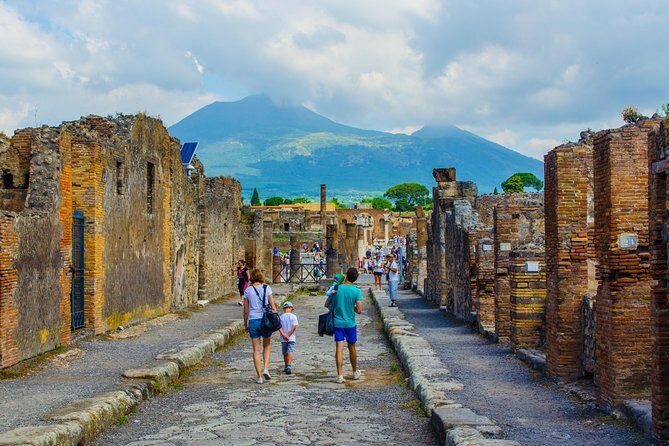
This is a day for sturdy shoes. You’re moving through ruins where surfaces can be uneven, and you’ll be on your feet for a long stretch. One clear review point was that it is not stroller friendly, and you’d likely be carrying anyway.
If you’re mobility limited, go in knowing that you’ll need flexibility in how you move and rest. The tour can work for many people, but the ground isn’t designed for comfort.
Heat is another factor. Bring water and actually drink it. One helpful tip from a guide-led experience was to use the restroom before you start and bring water because you can fill your bottle at an ancient Roman water spring during the day.
Weather can also change fast. One review mentioned that it was raining and the guide handled it thoughtfully. In other words: bring a small rain layer or umbrella if you use one, but don’t assume rain will ruin the experience.
Price and value at about $119.85 per person
At $119.85 per person, this isn’t a cheap whim. It’s priced as a guided, ticket-included day that covers two major sites plus train transport one-way.
Here’s how I think about value:
- You get guidance for the entire duration, not just a quick intro
- You get skip-the-line entry in Pompeii and Herculaneum
- You get the one-way train ticket from Pompeii to Herculaneum
Those are the costs that can quietly balloon when you travel independently. The parts not included are meals and personal expenses, plus you handle your own transport to Pompeii and your own return at the end.
If you want to maximize your time on-site and reduce stress, the price starts to make sense fast. If you’re traveling super-budget and enjoy planning every detail yourself, you might find cheaper options—but you’ll spend more time managing logistics.
Who should book this small-group Pompeii and Herculaneum tour
Book this if you want a guided one-day hit that still feels structured and human. The group size capped at 20 keeps it manageable, and the tone of the best guides seems to blend humor with real explanation.
It also fits well if:
- You want both Pompeii and Herculaneum without switching gears for multiple days
- You like seeing houses, baths, and public spaces—not only big statues
- You appreciate an expert who can answer questions on the spot
It may not fit as well if:
- You need stroller access or very flat, easy routes
- You want slow, independent roaming with zero schedule pressure
- You get overwhelmed by a heavy amount of walking in a single day
Guides named in past departures include Amadeau, Vince, Sergio, Paulo, Vincenzo, Diego, Michele, and Alfredo. That mix matters because it signals this isn’t a generic audio tour. The strongest versions of this experience are run with energy, organization, and patience.
Should you book it or plan differently?
I’d book this tour if your priority is time well spent—two UNESCO sites, guided context, and fewer lines. The pace is intense, but the structure helps you see why Pompeii and Herculaneum are different, and it helps you notice details you might miss on your own.
Skip it only if you know you won’t handle uneven ground or long walking, or if you want a relaxed day with lots of sitting. In that case, you’re better off choosing one site per day and moving slower.
FAQ
How long is the Pompeii and Herculaneum small group tour?
It runs about 5 hours 30 minutes (approx.).
Does this tour include skip-the-line tickets?
Yes. Skip-the-line tickets are included for Pompeii and for Herculaneum.
Is there a train included between Pompeii and Herculaneum?
Yes. One-way Circumvesuviana train tickets from Pompeii to Herculaneum are included.
What is included in the price?
Guidance throughout the duration, skip-the-line tickets for both ruins, and one-way train tickets from Pompeii to Herculaneum.
Are meals included?
No. Meals and personal expenses are not included. There is a quick lunch break if required.
Where do I meet the guide, and where does the tour end?
Start: Piazza Esedra, 4, 80045 Pompei NA, Italy.
End: Archaeological Park of Herculaneum, Corso Resina, 187, 80056 Ercolano NA, Italy.
How big is the group?
The tour has a maximum of 20 travelers.
Is cancellation free?
Yes, free cancellation is available. You can cancel up to 24 hours in advance for a full refund.
If you tell me your travel dates (and whether you’re doing Pompeii first or Herculaneum first on your own), I can help you choose the best plan for heat, timing, and walking comfort.