REVIEW · HISTORICAL TOURS
Pompeii Walking Tour: The Real History of the Ruins
Book on Viator →Bookable on Viator
Two hours in Pompeii can change how you see ruins. This walking tour moves through the city buried in volcanic ash in AD 79, turning scattered stones into a Roman street scene with theaters, homes, baths, and civic buildings. I especially liked the way the guide connects the sights to how Romans lived, and I liked the pace: short, focused stops that still cover the major beats. One caution: start timing can feel touchy on busy days, so I’d plan to arrive early and confirm the exact start you’re given.
You also get admission tickets included for the key sites, which helps value a lot on a 2-hour visit. The group size stays small (max 35), so you’re not just herded through. And if you land with a guide like Grace, Vincenzo, or Igor—names that have shown up in past groups—you’ll get stories delivered with energy and humor, not a dry lecture.
That said, this is still Pompeii: uneven ground, crowds, and real walking. If you want to linger for hours in each house or keep a slow, unhurried rhythm, you might feel the clock. But if you want the essentials explained clearly, this tour hits a sweet spot.
In This Review
- Key highlights at a glance
- Entering Pompeii through Porta Anfiteatro: the “real city” feeling
- Price and value: $42.05 for tickets plus a guided walk
- Timing reality: departures, pace, and why you should arrive early
- Teatro Grande and Odeon: how Roman entertainment worked
- Via Stabiana and the preserved street effect
- Casa del Menandro: the wealthy domus behind the famous bas-relief name
- Stabian Baths (Terme Stabiane): daily hygiene as a social system
- Lupanar: what you’ll see, and how to decide if it fits you
- The Forum of Pompeii: crossroads, rebuilt power, and trade
- Temple of Jupiter and the Forum’s religious power
- Basilica: indoor law, the judge’s elevated spot, and a clever security detail
- Temple of Apollo: where Greek influence meets Rome’s changing worship
- Granaries area: market life, unfinished construction clues, and trade math
- The guide is the difference: humor, clarity, and keeping the group moving
- What to wear and how to pace yourself
- Who this tour suits best
- Should you book this Pompeii Walking Tour?
- FAQ
- How long is the Pompeii walking tour?
- What time does the tour start?
- Where do I meet, and where does it end?
- Is the tour in English?
- What’s included in the price?
- What is not included?
- How many people are in the group?
- Which sites does the tour include?
- Is the tour dependent on weather?
- Are service animals allowed?
Key highlights at a glance
- Teatro Grande and Odeon for Roman performance life, explained fast and clearly
- Casa del Menandro (about 1,800 m²) with Hellenistic home details tied to Menander imagery
- Stabian Baths (Terme Stabiane), described as the oldest bath complex in the city
- Lupanar stop to understand the mercenary sex-work reality Rome left behind
- Forum + Temple of Jupiter + Basilica for politics, religion, and how justice worked indoors
- Apollo Temple and the granaries area for cult shifts and how trade measurements worked
Entering Pompeii through Porta Anfiteatro: the “real city” feeling
The best Pompeii tours don’t start with the ruins—they start with orientation. This one begins at the InStazione help desk in Pompeii (80045 Pompei), where you register and then head in together with your guide to the entrance near Porta Anfiteatro. That little “together as a group” start matters. Pompeii is big, signage isn’t always intuitive, and a guided route helps you avoid zig-zagging while your motivation melts.
Once you’re inside, you get a straight run at the heart of what makes Pompeii so special: the way daily life is still legible. You see the performance spaces, the street layout, the public buildings, and the private domestic world in succession. The route doesn’t treat the city like a museum. It treats it like a working place where people laughed, shopped, went to baths, argued in court settings, and worshipped—then the eruption froze it all in time.
I also like that the tour is designed for a 2-hour window. That keeps the walk purposeful. You’re not stuck trying to decide between ten “must-sees.” You get the key pieces and explanations that connect them.
Price and value: $42.05 for tickets plus a guided walk
At $42.05 per person for about two hours, the value depends on one thing: what’s included. Here, the tour includes an entrance ticket plus guided time, and the main stops have admission ticket coverage built in. That matters because Pompeii site costs add up if you try to DIY everything in one morning.
This is also a price that works for a quick Naples/Pompeii trip. If you’re already spending time traveling out, you can justify the cost as part of the day’s “time purchase.” The guide basically buys you understanding. Without that, you’ll still see impressive ruins—but you’ll miss a lot of what they meant.
The other side of value is your attention span. Two hours is tight. The stops are short (often around 5–15 minutes), so you’ll get the essentials. If you love slow exploration, you’ll still want extra time after the tour.
Timing reality: departures, pace, and why you should arrive early
The tour departs daily at 10:30 am from the InStazione help desk, and you’ll move from there into the park with your guide. Most of the time this is straightforward, but Pompeii has a way of testing schedules: crowds, transit hiccups, and simple delays. There have been real instances of groups experiencing confusion around pickup or seeing late starts in the morning window.
So here’s my practical advice: show up early enough that being 10–20 minutes early doesn’t stress you. If your itinerary is built tightly around trains or other timed plans, give yourself a buffer. This isn’t the kind of activity where you want to gamble with a tight connection.
Good weather is also required. If conditions are poor, the tour can be moved to another date or you may get a full refund. That’s common-sense for an outdoor walking plan.
Teatro Grande and Odeon: how Roman entertainment worked
The first big “wow” moment comes through the performance world of Pompeii. You’ll visit the Teatro Grande and the Odeon as part of the early route. The Teatro Grande is a Roman theater buried by the AD 79 eruption and later found through excavation.
What I like about this stop is the explanation of what happened inside: performances included comedies, mimes, pantomimes, and atellane. That’s not just trivia. It helps you imagine how crowds moved through the city for events and how entertainment fit into the daily rhythm.
The Odeon is included in the early stop too, and the tour ties it to the period around the deduction of the Samnite city and Pompeii’s shift into Rome’s orbit. You’ll also walk through Via Stabiana afterward—an old cobbled street with sidewalks and pedestrian walkways, lined with shops and houses. That street stretch does a lot of work. It reminds you the theater wasn’t an isolated “attraction.” It was surrounded by ordinary life.
Reality check: this first cluster is close to the start of the day, so it can feel energetic and crowded. Wear shoes with traction and expect uneven stone.
Via Stabiana and the preserved street effect
The “perfectly preserved cobblestone street” part isn’t just a bragging point. It’s one of the quickest ways to understand Pompeii’s texture. Walking Via Stabiana, you start to see how the city flowed: movement patterns, edges of buildings, pedestrian areas, and the placement of small commercial spaces.
This is where you can connect the scale. A theater is big, but streets tell you how people actually lived their lives between big moments. You also see shop fronts and domestic spaces lining the walkway, and that’s where Pompeii stops feeling like a pile of buildings and starts feeling like a town you could get lost in—even though the town is frozen.
Casa del Menandro: the wealthy domus behind the famous bas-relief name
Next comes Casa del Menandro, a large urban domus of nearly 1,800 m². It was excavated in the years 1926–1932. That excavation timeframe matters because it explains why you see a combination of detailed interior surfaces and areas where restoration wasn’t always possible.
Here’s the key detail: the house is named not for its owner, but for an image of the Greek poet Menander found there. That gives you a way to “read” the house. You’re not just looking at pretty rooms. You’re looking at how Hellenistic culture seeped into Roman elite life.
This is a relatively short stop, around 15 minutes, so don’t expect to roam every room. Instead, use the guide’s pointers to focus on what makes this home valuable: scale, decoration, and the cultural connections baked into the naming.
If you’re someone who loves houses, you might want to return on your own later. But for a 2-hour overview tour, this stop is a strong anchor.
Stabian Baths (Terme Stabiane): daily hygiene as a social system
After the domestic world, you shift to public routine at the Stabian Baths. The tour describes these as a Roman bath complex and says they’re the oldest building of their kind in the city.
You’ll see the bath setup with male and female sectors preserved. That detail is useful because it stops the baths from feeling like a generic “Roman ruins” stop. It shows you the city had structured spaces for different groups, even in something as everyday as bathing.
This stop is also around 15 minutes. The challenge with baths is that they can be easy to skim without context. The guide helps you interpret what you’re looking at—where people would have moved, how spaces might have functioned, and why these buildings mattered to daily life.
If you’re traveling in warmer months, baths are a good mental break too. Even if you’re walking in the heat outside, this kind of structured indoor/outdoor layout can feel like a rhythm reset.
Lupanar: what you’ll see, and how to decide if it fits you
The next stop is the Lupanar, the brothel area. The tour describes lupanari as places dedicated to mercenary sexual pleasure—real houses of tolerance in the Roman era—with some still visible in Pompeii’s ruins.
Let’s be honest: this part isn’t for everyone. But it’s also part of what makes Pompeii historically sharp. Pompeii doesn’t sanitize. If you go, go knowing you’re looking at the infrastructure of sex work as Rome practiced it.
The stop is short (about 10 minutes), so you’ll get context without lingering. If this is uncomfortable for you, you can brace yourself mentally at the entrance and treat it as a “historical context” stop rather than a spectacle.
The Forum of Pompeii: crossroads, rebuilt power, and trade
Now you step into civic life. The Forum of Pompeii was built around the 4th century BC in the Samnite era near an important road junction. Roads went toward Neapolis, Nola, and Stabiae. The space itself was an open area with shops around it, built mostly in lava and tuff with cemented clay.
After Rome conquered Pompeii, the Forum was rebuilt and enlarged—especially in the 2nd century BC. The tour highlights that shops and a perimeter wall with the nearby Temple of Apollo were demolished, then political and religious buildings went up around the square. That change is the whole story of how power shifts after conquest.
You’ll also see how commerce and religion share space in the Forum world. It’s not one-dimensional. Even in ruins, you can feel that the Forum was where people handled daily business and public rituals in the same breathing zone.
Temple of Jupiter and the Forum’s religious power
Right in the Forum area, you’ll visit the Temple of Jupiter. The tour connects it to the later Capitolium and names the three main divinities of Rome’s Eternal City: Jupiter, Juno, and Minerva.
There’s an important practical detail inside this stop. In the temple basement, sacred furnishings and votive gifts were kept, along with the public treasure called erarium. That’s not just spiritual stuff—it’s money, civic responsibility, and religion blended into one site.
The stop itself is brief (around 5 minutes). That’s enough to orient you: where worship happened, how it connected to civic identity, and why a “temple” wasn’t separate from everyday governance.
Basilica: indoor law, the judge’s elevated spot, and a clever security detail
Next is the Basilica, an imposing public building dating to the second century B.C. The tour describes it as a kind of indoor forum. Basically: when weather pushed people indoors, legal and civic activities moved inside.
One of the most memorable details here is the judge’s tribunal location—elevated above the parties. And there’s a specific security idea: the place reserved for judges was only reachable via a mobile wooden staircase, to prevent the condemned from attacking the judges.
I love this kind of detail because it’s not just architecture talk. It shows how Romans expected conflict and designed space for it. It’s also a reminder that “public buildings” were about controlling order, not just looking impressive.
This stop is also short (around 5 minutes), so you’ll want to listen for the guide’s explanation about function. If you’re the type who likes to read stonework with your eyes only, the Basilica still works—but you’ll get more from the quick practical context.
Temple of Apollo: where Greek influence meets Rome’s changing worship
The tour then moves to the Temple of Apollo, and it uses a clear cultural frame: Apollo’s cult reached Italic populations through the Greek world. Shortly before the AD 79 eruption, the tour notes that this cult had lost followers as Jupiter’s importance grew in what became the Capitolium period.
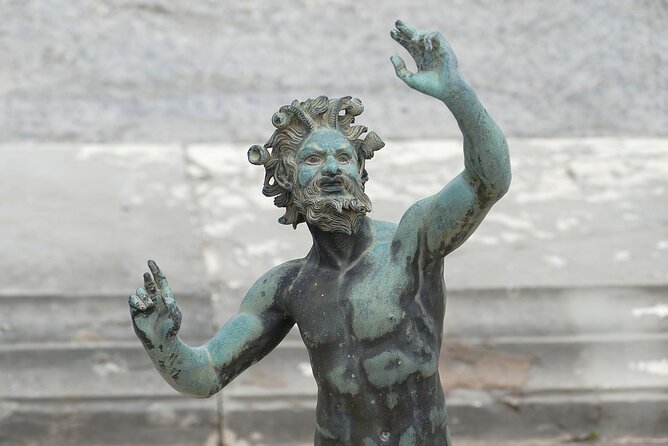
What you can actually see matters. The tour says a bronze statue of Apollo depicted as an archer is clearly visible, and in front of it you can observe the statue of Diana. That’s the kind of sight-specific detail that makes a short stop worthwhile. You know what to look for, instead of wandering.
Granaries area: market life, unfinished construction clues, and trade math
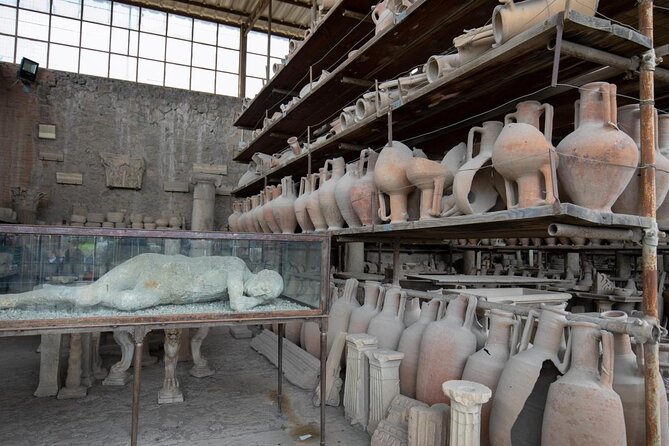
The final stop area centers on the granaries, described as a past market for cereals and legumes. You’ll also hear that the area is now used as a deposit of materials found during excavations.
One subtle, fascinating point: the tour says no traces of plaster were found there, which led to the belief the structure wasn’t finished at the time of the eruption. That kind of clue makes Pompeii feel less like a finished postcard. It feels like a city caught mid-construction.
Another highlight is the ponderary table, where tools were kept to guarantee correct exchanges and conversions between measurement units. The tour notes it helped traders from different corners of the empire convert into Pompeii’s valid units. That means the Forum world wasn’t just religious and political. It was procedural. People needed rules for fairness—and those rules depended on physical standards.
This stop is short (around 5 minutes). But if you catch the guide explaining what the table was for, you’ll come away with a real sense of how trade worked under Rome’s network.
The guide is the difference: humor, clarity, and keeping the group moving
This tour’s quality often comes down to the guide, and past guides named in similar groups include Grace, Frederica, Vincenzo, and Igor. The common thread is clarity plus personality. You’ll hear stories with humor, not just dates and names.
Even when the stops are time-limited, a great guide makes the short time count. They do it by turning each ruin into a question you can answer. What was this for? Who used it? How would it shape daily life? Then you walk to the next stop with your brain already switched on.
Also, the group stays small (up to 35). That means the guide has a better chance to keep an eye on everyone and make sure you can actually see what’s being pointed out.
What to wear and how to pace yourself
Pompeii walking is real walking. Wear comfortable shoes with grip. Keep water with you, even if lunch isn’t included. And set expectations: this is a tight overview, not a slow day of “stare at that one detail for 45 minutes.”
If you’re traveling with kids or people who get restless quickly, this format can work because it keeps changing scenes—street, theater, home, baths, brothel, Forum, temple, basilica, Apollo, granaries. The tradeoff is that not everyone will feel satisfied if they wanted longer time in one area.
For best results, plan one extra hour before or after the tour for casual roaming. You’ll get more value from what you learned.
Who this tour suits best
This is a good match if you:
- want a 2-hour overview that covers the major pillars of Pompeii life
- care more about interpretation than just photos
- appreciate a guide who explains with energy and humor
- want tickets handled with the tour instead of piecing it together yourself
It’s less ideal if you:
- need a fully unhurried pace
- hate stops that involve mature subject matter (the Lupanar)
- expect a start time that perfectly matches a tight schedule with zero buffer
Should you book this Pompeii Walking Tour?
If you want Pompeii explained in a way that feels like real Roman life—performance, baths, home wealth, civic power, and trade rules—this tour is a solid buy. The combination of short stops, admission ticket coverage, and strong guide storytelling makes it one of the more efficient ways to get meaning from the ruins.
My call: book it if your schedule is limited and you want clarity fast. If you have the luxury of a long Pompeii day, you can still book this as your “primer” and then return on your own for the spots that hook you most.
FAQ
How long is the Pompeii walking tour?
The tour is about 2 hours.
What time does the tour start?
It departs every day at 10.30 am from the InStazione help desk.
Where do I meet, and where does it end?
You start at 80045 Pompei, Metropolitan City of Naples, Italy, at the InStazione help desk area. The tour ends at Scavi di Pompei, Viale delle Ginestre, 80045 Pompei NA, Italy.
Is the tour in English?
Yes, the tour is offered in English.
What’s included in the price?
Entrance ticket and guided tour are included.
What is not included?
Lunch is not included.
How many people are in the group?
The maximum group size is 35 travelers.
Which sites does the tour include?
You visit Teatro Grande and the Odeon, Casa del Menandro, Stabian Baths (Terme Stabiane), Lupanar, the Forum of Pompeii, the Temple of Jupiter, the Basilica, the Temple of Apollo, and the granaries area.
Is the tour dependent on weather?
Yes. The tour requires good weather. If canceled due to poor weather, you’ll be offered a different date or a full refund.
Are service animals allowed?
Yes, service animals are allowed.