REVIEW · NAPLES
Pompeii and Herculaneum led by an Archaeologist with private transport
Book on Viator →Operated by Askos Tours · Bookable on Viator
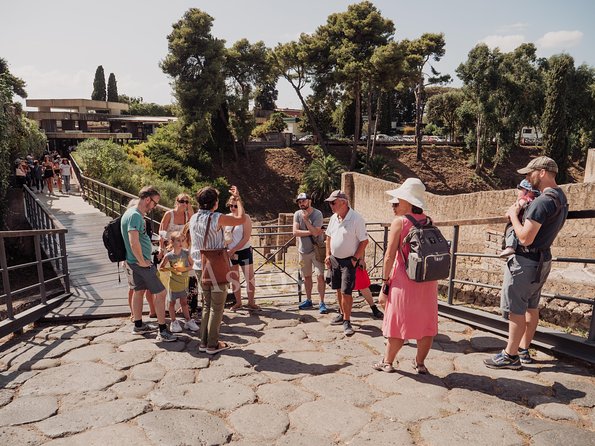
Seeing two ruined cities in one day is wild. This private tour is built for it: you move between Herculaneum and Pompeii with air-conditioned Mercedes transport, then walk the site highlights with an archaeologist guide who helps you spot what matters fast. I love the way the day balances big-picture context (how people lived, how the eruption hit) with concrete details at specific buildings like the House of the Black Salon and Pompeii’s Teatro Grande. I also like that pickup and drop-off work across the Campania coast, so you’re not coordinating buses or stressing about timing. The one drawback: it’s a long, full day of walking—comfortable shoes are not optional, and in summer you’ll want to dress to handle the heat.
You’ll start in Herculaneum, which is smaller and often feels more human-scaled than Pompeii. Then you switch gears in Pompeii for the city’s main street energy, public buildings, and the dramatic set pieces—like the Lupanar and the forum area. If you prefer slow wandering with lots of independent exploring, you may want to plan a separate half-day or add-on for extra time after this tour.
In This Review
- Key reasons this works well
- A One-Day Two-City Plan in About Seven Hours
- Private Mercedes Transport From Naples and the Amalfi Coast
- How the Archaeologist Guide Makes the Ruins Click
- Herculaneum: Stags, Thermas, and Carbonized Doorposts
- House of the Deer and the art in plain sight
- M. Nonius Balbo and the power behind the restoration
- The College of the Augustales and public religion
- Central Thermae: separate entrances for men and women
- Casa del Rilievo di Telefo and private access
- The House of the Skeleton and a 19th-century discovery
- House of the Black Salon and burned-in evidence
- Wood mattered: the elegant partition at Casa del Tramezzo di Legno
- Casa Sannitica and typical Samnite-style layout
- Bel Cortile and the courtyard that changes the flow
- House of the Grand Portal and charred wooden remains
- Pompeii: Lupanar, Forum Granaries, and Teatro Grande
- Lupanar and the forum’s everyday edge
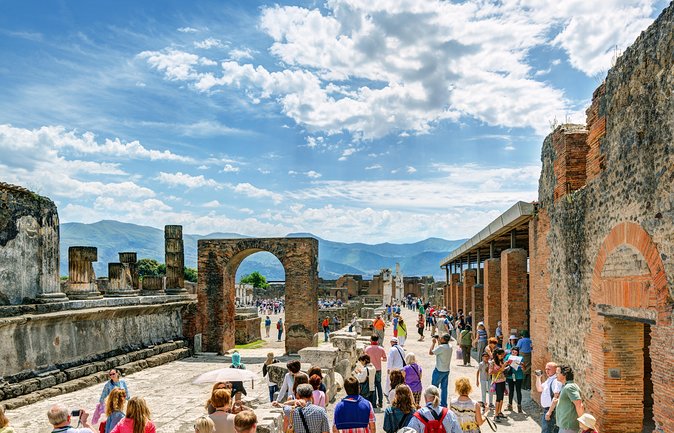
- Main street walk: how the city feels in motion
- Granaries of the Forum and casts of what didn’t survive
- Basilica and Stabian Baths: public life and the oldest thermal complex
- Houses of Menander and Faun: wealth you can feel
- Teatro Grande and Teatro Piccolo: entertainment as a civic heartbeat
- Pace, Breaks, and What to Do With a Full Walking Day
- Tickets, Inclusions, and Why the Price Can Make Sense
- Who This Tour Fits Best (and Who Might Want Something Else)
- Should You Book This Pompeii and Herculaneum Private Tour?
- FAQ
- How long is the Pompeii and Herculaneum tour?
- Where can I get picked up?
- Is this a private tour?
- What language is the tour offered in?
- Are admission tickets included?
- What transportation is included?
- Is lunch included?
- What should I bring for the day?
- Are mobile tickets used?
- Is free cancellation available?
Key reasons this works well
- Two sites, one guided day: Herculaneum first, Pompeii second, so you don’t spend half your trip just getting oriented.
- Archaeologist-led walking: you’re not just looking at stones; you’re learning why specific rooms, inscriptions, and structures survived.
- Air-conditioned Mercedes transport: comfort matters when you’re moving between the sites in one day.
- A stop-by-stop highlight route: you’ll hit major buildings without feeling stuck in a slow, meandering loop.
- Pickup and drop-off across Campania: Naples, Salerno, Sorrento, and the Amalfi Coast are covered, plus cruise/train/airport pickup options.
A One-Day Two-City Plan in About Seven Hours
This tour is designed around one goal: get you from Herculaneum to Pompeii with minimal friction and maximum payoff. Expect roughly 7 hours total, and a route that packs in major points of interest without pretending you can see everything.
The timing also matters psychologically. Herculaneum tends to feel calmer when you arrive, and Pompeii’s bigger scale hits you right after. That order helps you compare the two places while the contrasts are still fresh in your mind.
You can also read our reviews of more tours and experiences in Naples.

Private Mercedes Transport From Naples and the Amalfi Coast
The biggest practical win is the ride. You’ll travel in a private Mercedes minivan with a professional driver, and you can use pickup from your accommodation in Naples, Salerno, Sorrento, or the Amalfi Coast. If you’re coming by cruise ship or train, you can also use pickup from the cruise port, train station, or airport.
This is the kind of service that reduces the “stand in line with everyone” feeling. It also helps you keep a stable schedule, which is important because both sites can be crowded, and you don’t want to lose your best viewing time.
How the Archaeologist Guide Makes the Ruins Click
This is led by an archaeologist guide (not just a general storyteller). The difference is subtle but real: you spend time learning how buildings were used, why layouts look the way they do, and what survived—and what didn’t.
You’ll get short guided stops throughout the day, with time to look around and absorb the details. The structure is helpful because Pompeii and Herculaneum are huge. With a guide, you’re not guessing what you’re supposed to notice.
Also, it’s a private tour. Only your group goes along, so you can ask questions without worrying about slowing down a big bus group.
Herculaneum: Stags, Thermas, and Carbonized Doorposts
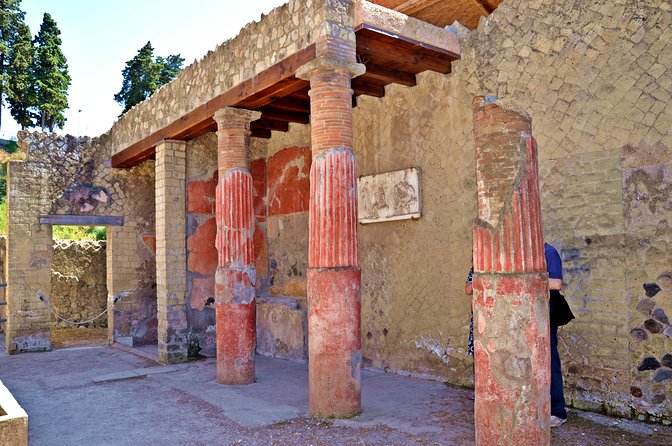
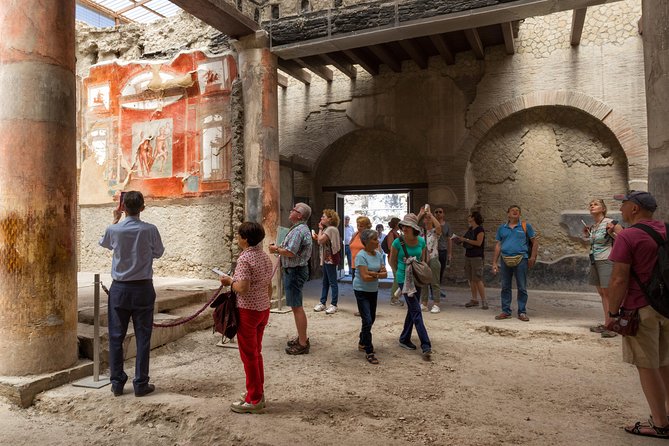
Herculaneum is where you start, meeting your guide at the ruins ticket area. The tour is paced so you can see a string of standout rooms and landmarks in a logical walk.
House of the Deer and the art in plain sight
Early on, you’ll visit the House of the Deer, named for marble statues of stags/deer in the peristyle area. Even if you don’t read Latin inscriptions, you can feel what this means: wealthy residents filled their homes with art and symbols, not just furniture.


M. Nonius Balbo and the power behind the restoration
Next comes La Terrazza di M. Nonio Balbo. The focus here is the city’s major benefactor and the honors connected to his public role, explained through the long inscription tied to his funeral altar. This stop is a reminder that ruins aren’t just domestic scenes—people funded public life too.
The College of the Augustales and public religion
You’ll then step into the College of the Augustales, thought to connect with the cult of Emperor Augustus and possibly local civic administration. It’s a great stop if you like understanding how religion, politics, and community roles blurred in Roman life.
Central Thermae: separate entrances for men and women
At Central Thermae, you’ll learn that the bath complex was split into men’s and women’s baths with separate entrances. It’s a small detail, but it makes the site feel more real. You’re not looking at “old pools”—you’re seeing a system people followed in daily routine.
Casa del Rilievo di Telefo and private access
The Casa del Rilievo di Telefo is notable for its private access to the adjoining Suburban Thermae to the south. Even the stop length matters here because the point is clear: this house wasn’t just comfortable; it was built to connect with leisure infrastructure.
The House of the Skeleton and a 19th-century discovery
The House of the Skeleton gets its name from human remains found in a second-floor room in 1831. That story brings the eruption out of the abstract and into a specific, human place.
House of the Black Salon and burned-in evidence
One of the day’s most striking stops is the House of the Black Salon. You’ll see the monumental entrance with carbonised remains of the doorposts and lintel. This is where the site does something rare: it preserves traces of a moment, not just an era.
Wood mattered: the elegant partition at Casa del Tramezzo di Legno
At Partem Domus lignea – Casa del Tramezzo di Legno, you’ll focus on an important element of the wooden partition. It’s a reminder that Roman houses weren’t static boxes—woodwork shaped space, privacy, and how rooms interacted.
Casa Sannitica and typical Samnite-style layout
You’ll also visit Casa Sannitica, described as typical of the Samnites (from inland central Italy). Expect to see its splendid atrium and a gallery with Ionic columns, plus fresco decorations. It’s a useful stop for spotting regional influences in the same Roman world.
Bel Cortile and the courtyard that changes the flow
The House of the Grand Portal and Casa del Bel Cortile bring variety to what homes could look like. Bel Cortile is original because it has a courtyard with a stairway and a stone balcony instead of the typical atrium arrangement. The tour uses this kind of contrast to help you “read” homes, not just pass them.
House of the Grand Portal and charred wooden remains
Finally, you’ll end the Herculaneum set at the House of the Grand Portal, with charred remains of wooden parts and a mix of environments and fresco elements. This stop ties the whole morning together: the buildings aren’t just pretty—they’re evidence.
Pompeii: Lupanar, Forum Granaries, and Teatro Grande
After Herculaneum, you’ll break for a lunch option between the two sites (not required). Then you head to Pompeii, where the tour includes time for you to handle lunch on your own if you choose, followed by guided exploration of the core highlights.
Lupanar and the forum’s everyday edge
In Pompeii, one of the first named stops is the Lupanar, the city’s most famous brothel. It’s famous for a reason, but it also works well as a historical anchor: it shows that ancient cities held services and trades alongside temples and theaters.
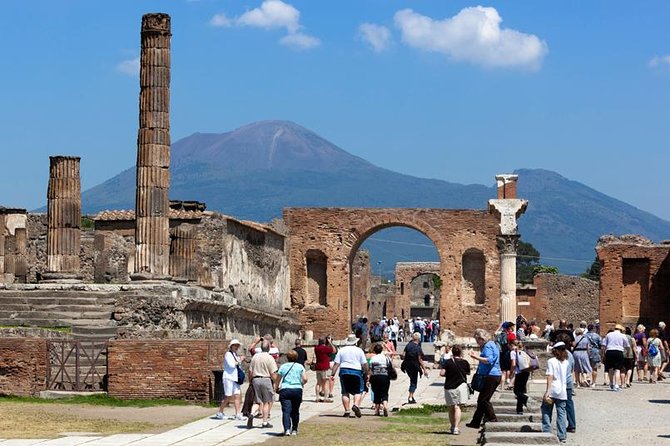
Then you’ll move toward the Foro de Pompeya, the main square. This is where Roman city life gathered, and the tour frames it as the center of movement, commerce, and public events.
Main street walk: how the city feels in motion
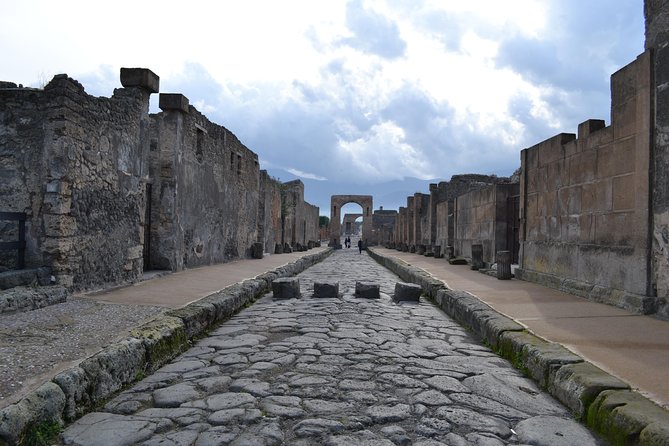
You’ll also walk through Pompeii’s main street, which helps you connect individual buildings into one street-level picture. Even short walking segments matter here because Pompeii is all about scale and layout.
Granaries of the Forum and casts of what didn’t survive
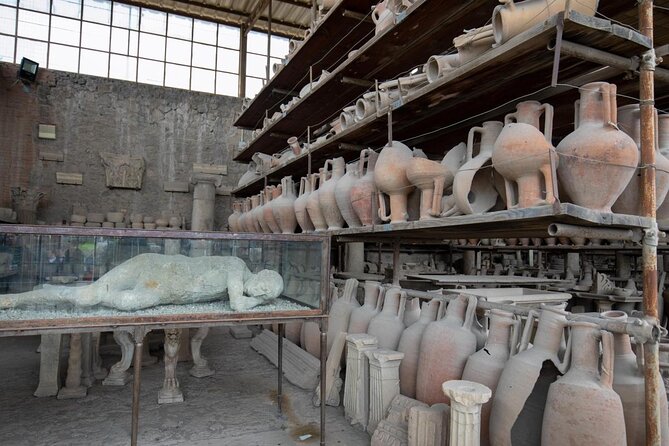
At the Granaries of the Forum, you’ll see marble tables and fountain-adjacent features at entrances of houses. The stop also includes casts of victims of the eruption, plus casts of a dog and a tree. It’s heavy subject matter, but it gives you a concrete sense of what the catastrophe looked like from the ground.
Basilica and Stabian Baths: public life and the oldest thermal complex
You’ll see the Basilica, an open portico area that sheltered merchants and daily activities. Then you’ll head to the Stabian Baths (Terme Stabiane), noted as the oldest thermal complex in the city. This is another “small detail becomes big meaning” stop: baths weren’t just for hygiene; they were social infrastructure.
Houses of Menander and Faun: wealth you can feel
Two standout domestic stops follow: the House of Menander and the House of the Faun. Menander is highlighted as one of Pompeii’s richest homes for architecture and decoration, while the House of the Faun is described as one of the largest and most impressive private residences.
If you like comparing wealth across the two cities, you’ll feel the contrast quickly. Herculaneum’s luxury often reads as “compact and refined.” Pompeii’s luxury reads more like scale and display.
Teatro Grande and Teatro Piccolo: entertainment as a civic heartbeat
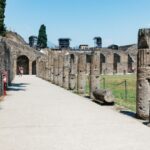
The tour wraps the Pompeii highlights with the Teatro Grande, the most important theater, and then a look at the Teatro Piccolo. Theater stops work because they remind you that Roman cities ran on events. People didn’t just eat and bathe; they watched, performed, and gathered.
Pace, Breaks, and What to Do With a Full Walking Day
This is a highlight route with short visits at many sites. That’s efficient, but it also means you’re spending more time walking than sitting in museums.
The tour suggests comfortable shoes, and I agree. Pompeii and Herculaneum are uneven in places, and your feet will judge you by the end of the day. In summer, the guidance also says no flip-flops—that’s not being picky. It’s about grip, protection, and not regretting it halfway to the next stop.
Bring sunglasses, sunscreen, and water. Those basics aren’t optional with this schedule, especially if you’re doing both cities back to back.
If you want a more relaxed pace, use the lunch window wisely. There’s a lunch stop between Herculaneum and Pompeii where you can eat on your own if you like. Skipping lunch can sometimes help you see more before crowds build, but you’ll still want energy for the afternoon.
Tickets, Inclusions, and Why the Price Can Make Sense
The price is $666.75 per person, and it may feel high at first glance. Here’s the practical math: you’re paying for private transport, a guided archaeologist experience, and entry tied to the Pompeii Express package (including Herculaneum entry tickets).
What you’re avoiding is the time and hassle of figuring out transit and tickets yourself, especially if you’re staying along the coast and not right in the center of Naples. For many people, that time-saving is worth real money.
Also, the tour includes hotel/port pickup and drop-off, and it uses a mobile ticket. That reduces day-of stress because you’re not juggling paper confirmations or coordinating multiple vendors.
As a confidence check, the overall rating is 5/5, with 100% recommended and 78 reviews. That doesn’t mean it’s perfect for everyone, but it does mean this format is working for a lot of people.
Who This Tour Fits Best (and Who Might Want Something Else)
This is best for you if you:
- Want Pompeii and Herculaneum together without planning a route yourself
- Appreciate an archaeologist-led approach that explains why specific buildings matter
- Like a structured highlight plan when you only have one day
It may be less ideal if you:
- Want long, independent wandering with lots of silent time
- Have limited tolerance for walking on uneven surfaces
- Are hoping for a slow museum-style experience
That said, the tour notes that most travelers can participate, and service animals are allowed.
Should You Book This Pompeii and Herculaneum Private Tour?
If your goal is a smart, high-impact day—two ruins, one guided storyline, and private transport—then yes, this is a strong choice. You’re paying for reduced logistics and real guidance at key spots, including major public buildings in Pompeii and the preserved luxury and carbonized evidence in Herculaneum.
My advice: wear your most supportive shoes, bring water, and treat the day like a guided “best-of” route rather than a chance to casually linger everywhere. If you do that, you’ll walk away with a clearer sense of how two nearby towns fell in dramatically different ways—and how Roman daily life looked before the eruption.
FAQ
How long is the Pompeii and Herculaneum tour?
The tour is approximately 7 hours.
Where can I get picked up?
Pickup is offered from Naples, Salerno, Sorrento, and the Amalfi Coast, and you can also be picked up at cruise ports, train stations, or airports.
Is this a private tour?
Yes. It’s listed as a private tour/activity, so only your group participates.
What language is the tour offered in?
The tour is offered in English.
Are admission tickets included?
The tour includes entry tickets for the Pompeii Express package and Herculaneum entry tickets.
What transportation is included?
You travel by private Minivan with a professional driver, described as a Mercedes vehicle, and it is air-conditioned.
Is lunch included?
Meals are not included, and lunch is offered as a stop between Herculaneum and Pompeii (not required).
What should I bring for the day?
The guidance recommends comfortable shoes, plus sunglasses, sunscreen, and water. It also notes that in summer you should not wear flip-flops.
Are mobile tickets used?
Yes, the tour includes a mobile ticket.
Is free cancellation available?
Yes. Free cancellation is offered up to 24 hours in advance for a full refund.