REVIEW · POMPEII
Private Pompeii & Amalfi Coast Tour: Sorrento & Positano -Tickets
Book on Viator →Operated by Leisure Italy · Bookable on Viator
Two stops in one day can work.
This private Pompeii and Amalfi Coast tour strings together priority access to Pompeii with panoramic coastal driving, then hands you time to roam Sorrento and Positano at your own pace. I like the way the day is paced so you’re not stuck for hours listening in a vehicle; the on-site guide (with Pompeii highlights and an optional guide setup) helps you hit the big moments fast without turning ruins into homework. I also like the human touch in the Pompeii part, especially if you’re traveling with kids, where the experience is built to keep attention and answer questions without rush.
One thing to think about: it’s a long, mostly on-your-feet day.
Pompeii includes a lot of walking (even if you can take breaks and step into cafés or shops near the entrance), and the Amalfi drive is scenic but still time on the road.
In This Review
- Key highlights at a glance
- Why this Pompeii + Amalfi day trip works as one plan
- Entering Pompeii with priority access and a plan for your feet
- Pompeii highlights you’ll actually understand: Porta Marina to the Forum
- Porta Marina and the city walls
- The Basilica: public life in 2nd-century BC form
- Temple of Apollo: religion near the Forum
- The Forum: Pompeii’s civic center, seen from practical angles
- Pompeii’s food market, baths, and neighborhoods you can picture
- Macellum: the covered food market
- Terme del Foro: baths with a real engineering story
- Casa dei Vettii: wealthy Roman taste in frescoes
- Insula dei Casti Amanti: a neighborhood caught mid-routine
- Teatro Grande: drama, acoustics, and crowd energy
- The Antiquarium: why you’ll understand more after this room
- The SS145 route to Sorrento: cliff views before the first espresso
- Sorrento at your pace: Piazza Tasso, Corso Italia, and San Francesco
- Amalfi Drive photo stops, then Positano’s stairway-to-the-sea drama
- Spiaggia Grande and Chiesa di Santa Maria Assunta
- Transport, timing, and what you should bring
- Price and value: is $486.47 per person worth it?
- Who should book this Pompeii & Amalfi tour
- Should you book it?
- FAQ
- Is pickup included?
- How long is the tour?
- Do I get skip-the-line tickets for Pompeii?
- Is Pompeii admission included?
- Will there be a guide in Pompeii?
- How much time do I get in Sorrento and Positano?
- Is lunch included?
- What level of walking or fitness is required?
- Do I need my passport?
- Can I cancel for a full refund?
- Is this a private tour?
Key highlights at a glance
- Priority access to Pompeii with Pompeii Express skip-the-line tickets
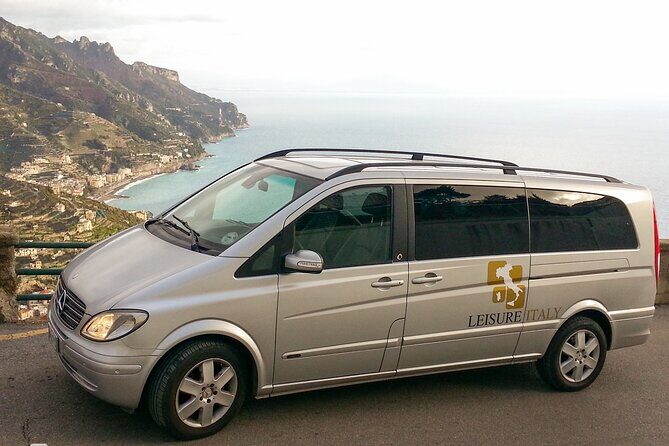
- Private Mercedes Minivan with A/C and live English commentary
- A guided Pompeii walk focused on real landmarks like the Forum, Casa dei Vettii, and Teatro Grande
- Family-friendly Pompeii options geared to kids (not just adults with a checklist)
- Time to explore Sorrento and Positano independently—coffee, gelato, views, and photos
- Flexible pacing so you can slow down or move faster depending on your group
Why this Pompeii + Amalfi day trip works as one plan
This is the kind of day trip that makes sense geographically and logically. You start in Pompeii with skip-the-line access, then the road experience takes over: winding cliffside views, photo stops, and two well-known towns where you can actually slow down and do your own exploring.
The value here is the combination. Yes, Pompeii is the star. But you also get Sorrento and Positano time without having to figure out separate tickets, ferries, or transfers. The transport is handled in a Mercedes Minivan with an English-speaking driver, A/C, and live commentary while you’re in transit.
It’s also booked well in advance (on average, about 123 days), and that tells me demand stays high. Pompeii timing matters, and so does getting a comfortable pickup and a workable schedule. This tour is private, meaning you’re not sharing the whole day with strangers who move at a different speed than you do.
You can also read our reviews of more tours and experiences in Pompeii


Entering Pompeii with priority access and a plan for your feet
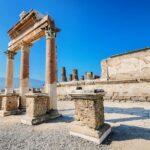
Pompeii can be overwhelming in the best way—huge, emotional, and full of details. The smart move is not trying to see everything. This tour gives you a curated route through the parts that explain how Pompeii functioned: civic life, religion, markets, entertainment, and elite residences.
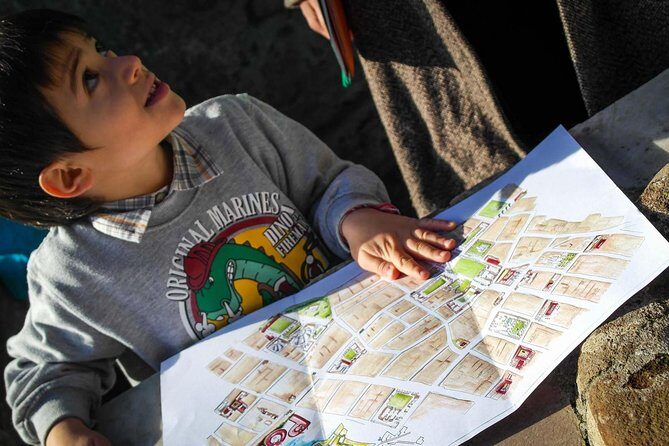
You start at the Archaeological Park of Pompeii with a private guide who selects highlights. If you’re traveling with kids, the approach is designed to keep it fun and understandable—games and story-style explanations are part of the setup. One family experience described Giuseppe as especially patient, with a great balance of games, stories, and the right amount of guidance so kids could ask questions without feeling shut down.
If you’re the type who gets heat-sick or tired quickly, the itinerary is still workable. The tour notes you can skip the full walk inside Pompeii and use cafés and gift shops right outside the entrance as a breather. In other words: you’re not locked into suffering to make the day “count.”
Time reality check: several stops are brief (often 5 minutes), so you’ll see the main idea of each place rather than lingering forever at every wall painting.
Pompeii highlights you’ll actually understand: Porta Marina to the Forum
Here’s what the Pompeii portion feels like as you move through it.
Porta Marina and the city walls
You begin near Porta Marina, one of the main gates where travelers first entered Pompeii from the port area. The best part isn’t just the gate itself—it’s that you can connect it to movement: merchants, sailors, and visitors coming in and out, with the defensive walls shaping who got access.
This is a quick stop, but it’s a strong “set the stage” moment. It helps you picture Pompeii as a living city with controlled entry points rather than only a frozen archaeological site.
The Basilica: public life in 2nd-century BC form
Next is the Basilica, the city’s public hall for business, justice, and politics. Tall columns and an open rectangular space make the purpose easy to visualize. You also get a sense of influence over time, since the basilica layout later shaped early Christian basilicas.
If you like architecture that tells a story, this stop pays off. It also gives your legs a short break before the next cluster of religious and civic landmarks.
You can also read our reviews of more private tours in Pompeii



Temple of Apollo: religion near the Forum
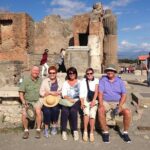
The Temple of Apollo sits in an open courtyard near the Forum area. It’s dedicated to Apollo, tied to the sun, music, and prophecy. You’ll hear how worship here included offerings and guidance-seeking, with this temple functioning as an active spiritual hub.
This stop is short, but it’s one of those places where learning the context makes the stones feel purposeful.
The Forum: Pompeii’s civic center, seen from practical angles
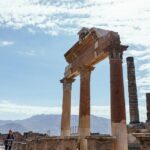
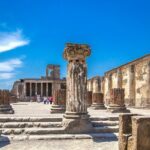
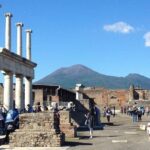
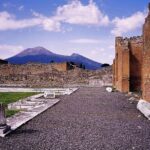
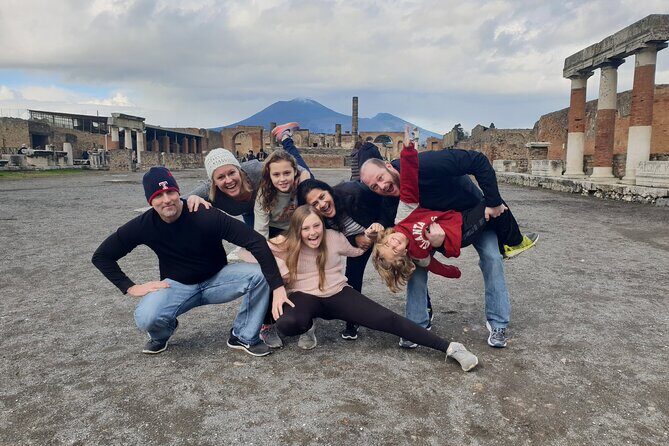
At the Forum of Pompeii, you see the square as the city’s stage: civic decisions, religious spaces, markets, and announcements all orbiting the same monumental area with Mount Vesuvius looming behind.
The itinerary’s elevated viewpoints help a lot. They make it easier to understand how the city’s components relate—Capitolium, Basilica, and Macellum are described in a way that makes the whole layout click rather than feeling like random ruins.
Pompeii’s food market, baths, and neighborhoods you can picture
After the civic heart, the day becomes more human: how people ate, met up, bathed, and lived.
Macellum: the covered food market
The Macellum was Pompeii’s main food market, a covered complex where vendors sold fish, meat, fruit, and imported goods. Even if you’re not a “markets” person, this stop helps explain urban life. You’ll see how stalls, storerooms, and central shrine space organized commerce and daily routines.
A quick tip: if you like photography, this is one of the best places to frame shots because the market layout is easy to read, even in ruins.
Terme del Foro: baths with a real engineering story
The Forum Baths (Terme del Foro) bring you to one of Pompeii’s most elegant public spaces. It includes men’s and women’s sections, changing rooms, warm and hot bathing halls, and a cold plunge pool—heated by an advanced hypocaust system (the kind of underfloor heating that shows how seriously the Romans treated comfort).
This is a short stop, but it’s a major “oh right, this was a full lifestyle” moment. The ruins here still show stucco reliefs and vaulted ceilings that convey what daily bathing meant socially and practically.
Casa dei Vettii: wealthy Roman taste in frescoes
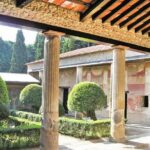
Then you get into elite life with Casa dei Vettii, one of Pompeii’s finest aristocratic residences. Expect frescoes and an elegant layout built around atria and a peristyle garden. This is where Pompeii shifts from public systems to private aspiration.
If you enjoy art, this is a highlight. If you prefer stories over details, it still works because the house structure helps you understand what wealthy owners wanted to display.
Insula dei Casti Amanti: a neighborhood caught mid-routine
The Insula dei Casti Amanti takes you into a residential and commercial block named after a fresco of lovers. You’ll see this neighborhood from elevated ramps designed to avoid disturbing fragile surfaces, giving you a panoramic view into workshops, storerooms, and domestic rooms.
This stop is especially good for imagination. Signs, preserved frescoes, and signs of half-finished renovations help you picture craftsmen working and families moving through spaces right before AD 79.
Teatro Grande: drama, acoustics, and crowd energy
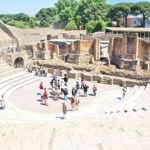
Finally, Teatro Grande lets you picture Pompeii’s entertainment world. You look down onto semicircular seating tiers, the stage building, and the orchestra area where performances happened. The theatre’s acoustics and views toward the city and Vesuvius help explain why people gathered for comedies, tragedies, and public ceremonies.
Even with a short time allocation, it’s one of the most emotionally readable ruins. You can almost hear the crowd energy.
The Antiquarium: why you’ll understand more after this room

Between the big outdoor stops, you pass through the Antiquarium di Pompei, which acts like a briefing room. Here you move through galleries of statues, household objects, inscriptions, jewelry, and artifacts recovered during excavations. Since many delicate items don’t survive outdoors, the indoor presentation is part of why this stop matters.
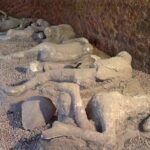
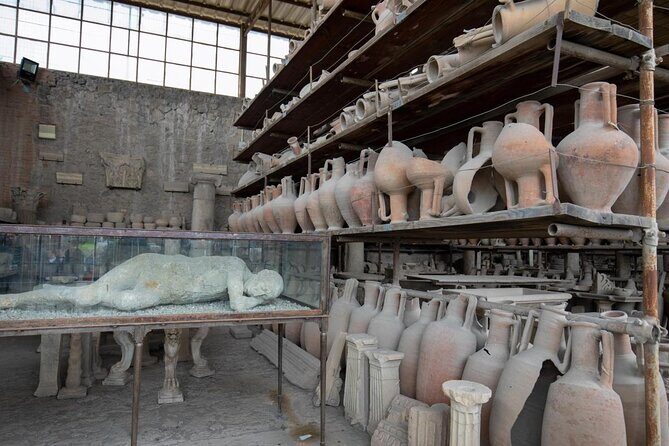
What I like about the Antiquarium is that it gives you context before you walk back into the open-air chaos. You also see plaster casts of victims and dramatic eruption material at the end, which frames the ruins outside in a direct, emotional way.
Plan to spend a little extra attention here. Even if your legs want to rush, your brain usually benefits from the “why this looks like this” explanations.
The SS145 route to Sorrento: cliff views before the first espresso
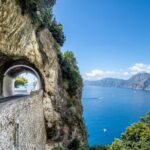
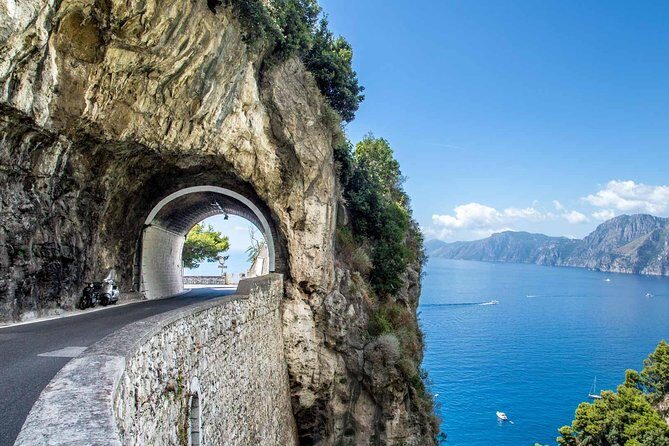
After Pompeii, you travel along Strada Statale 145 toward Sorrento. This road is famous for a reason: it winds along the cliffs with iconic views over the Bay of Naples. From the vehicle, you can look down on terraced lemon groves, small ports, and fishing villages, with Mount Vesuvius visible across the water.
This leg of the trip works as a mental transition. Pompeii is heavy. Then the coast opens up and you get visual space again. It also helps you settle into the day’s tempo: sit back, take photos when the road lines up with a turnout, and let the scenery reset you.
When you arrive in Sorrento, you’ll feel that anticipation shift. You’re not rushing to another “site.” You’re heading into cafés, piazzas, and sea views.
Sorrento at your pace: Piazza Tasso, Corso Italia, and San Francesco
Sorrento is a classic seaside base, perched high on tufa cliffs above the Bay of Naples, with views toward Vesuvius and the islands of Capri and Ischia. The historic center is full of narrow lanes, boutiques, cafés, and artisan workshops. The atmosphere is relaxed in the best way: you can do things slowly without feeling like you’re falling behind.
Your tour time here is about one hour, and that’s plenty if you pick one or two priorities.
- Piazza Tasso is the social heart. It’s lined with cafés and patisseries, and it’s a natural meeting point to orient yourself fast.
- Corso Italia is the main promenade. If you want people-watching and shopping, this is where you do it.
- Cloister of San Francesco offers a quiet break from the streets. The portico and courtyard make a nice pause, especially if you want shade.
And yes, you’ll likely pass thoughts about limoncello and citrus everywhere. This is one of those towns where the smells and street energy match the postcard look.
Amalfi Drive photo stops, then Positano’s stairway-to-the-sea drama
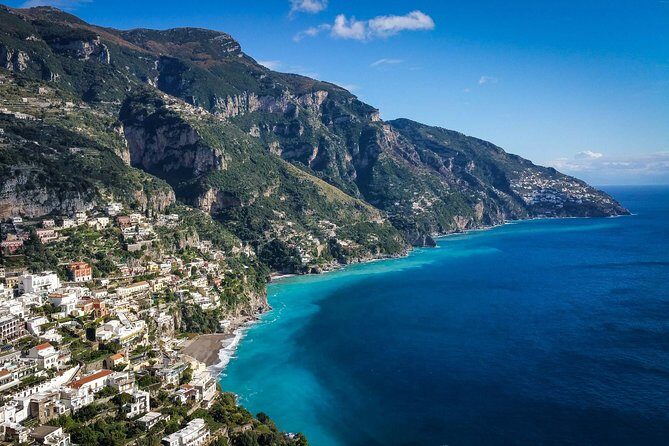
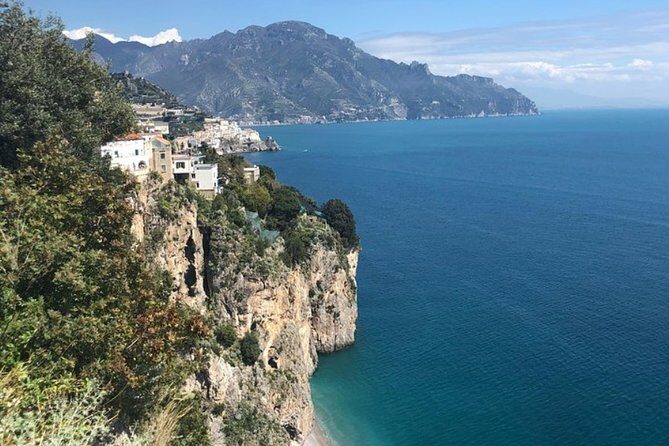
From Sorrento, the tour shifts to the Amalfi Coast road experience, traveling along the famed SS163. You get sweeping views of rugged headlands, valleys planted with lemon groves, and pastel towns clinging to the mountainside. Expect curves and photo pull-offs that make the drive itself feel like an attraction.
What’s practical here is that you’re not forced into a rigid walking schedule on the coast. The driving and photo stops give you big views without the effort of changing hillside plans on your own.
Then you arrive in Positano, which rises almost vertically from the sea. It’s the town of steep stairways, pastel houses, and quick bursts of color around every corner. Approaching by road gives you that postcard silhouette, and then descending into the streets turns it into a maze of shops, cafés, and artisan stops (linen clothing, leather sandals, and ceramics are the common finds).
Spiaggia Grande and Chiesa di Santa Maria Assunta
Your Positano time is also about one hour. Two places help you get oriented fast:
- Spiaggia Grande, the main beach area. It’s also a hub for ferries and seasonal boat trips, so it’s a functional place, not only a pretty one.
- Chiesa di Santa Maria Assunta, the iconic church with the colorful majolica dome above the waterfront. The interior includes marble altars and the Black Madonna icon, a detail people often connect to local legends involving storms and pirates.
If you only do one thing besides wandering, I’d do the church area and then walk down toward the beach viewpoints. You’ll come away with the classic Positano framing: the town layered above the sea.
Transport, timing, and what you should bring
This is a private tour with pickup offered from Naples, Sorrento, Pompeii, hotels, vacation rentals, train station, airport, and cruise terminals/ports (you just specify your pickup place). That flexibility is a big deal if you don’t want to hustle on your own with public transit.
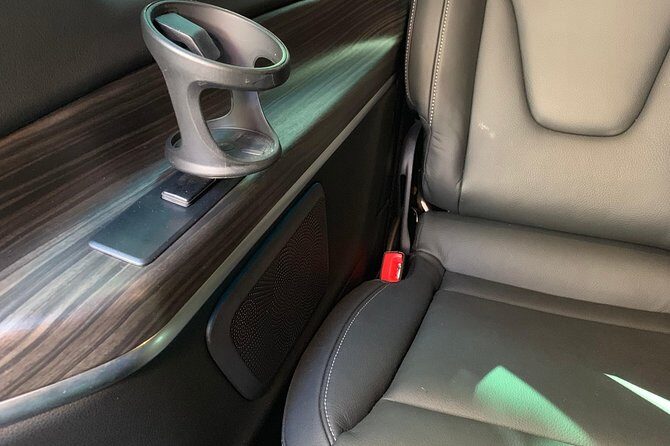
Inside the minivan, you get live commentary in English, plus A/C. That matters because a long day without a cooled-off break can drain energy before you even reach Pompeii.
For the day itself:
- Wear comfortable walking shoes. Pompeii involves uneven surfaces and lots of steps and walking.
- Bring sun gear. There’s sun exposure inside Pompeii and on coastal viewpoints.
- If you’re picky about meals, note that lunch is not included (though it’s described as available if requested). Packing a snack can save your mood between stops.
Also keep your documents handy: a current valid passport (or a picture of it) is required on the day of travel.
Price and value: is $486.47 per person worth it?
At $486.47 per person for about 8 to 9 hours, this is not a cheap day. But it’s built around time-saving and stress-reducing benefits that add up.
You’re paying for:
- Skip-the-line Pompeii Express tickets, which can make a real difference in how smoothly your day starts
- A private Mercedes van with English-speaking driver and live commentary
- A private Pompeii guide experience built around highlights rather than random wandering
- Time in two towns that are harder to stitch together efficiently on your own, especially if you’re starting from Naples or a cruise port
So the question isn’t only cost—it’s whether you value convenience plus curated storytelling. If you want maximum control and you already know how you’ll reach Pompeii and then transfer to the Amalfi Coast, you could DIY it. But if you want the route managed and your time protected, this price is easier to justify.
One practical angle: this tour can be especially worth it for families, because kid-focused storytelling can turn Pompeii from a long lecture into an active day with patience built in.
Who should book this Pompeii & Amalfi tour
This tour fits best if you want:
- A private, guided Pompeii visit without spending your whole day sorting logistics
- Scenic Amalfi Coast road views plus real town time in Sorrento and Positano
- A day that can work for families, including kids around the 6 to 11 range (based on the family-focused approach noted)
- A group that prefers a guided highlights plan rather than trying to see every single corner of Pompeii
It may feel like too much if you:
- Want a slow, very deep Pompeii experience where you linger for long periods at every site
- Have mobility limitations that make lots of walking and uneven terrain hard (the tour lists moderate physical fitness level as a guideline)
Should you book it?
I’d book this if your “must” list includes Pompeii plus Amalfi Coast scenery, and you want the whole day to run with a driver, tickets, and a guide doing the planning work for you. The priority access and the guided Pompeii focus make the time feel efficient, while the Sorrento and Positano blocks give you a break from ruins.
If your budget allows and you’re okay with a full day, this is a smart way to do the big names without turning the trip into transit marathons.
FAQ
Is pickup included?
Pickup is offered. The tour can pick you up from Naples, Sorrento, Pompeii, hotels, vacation rentals, train station, airport, and cruise terminal/port. You’ll specify your pickup place when booking.
How long is the tour?
The duration is listed as about 8 to 9 hours.
Do I get skip-the-line tickets for Pompeii?
Yes. The tour includes Pompeii Express skip-the-line tickets.
Is Pompeii admission included?
Yes. Admission tickets are included for the Pompeii stops listed in the experience.
Will there be a guide in Pompeii?
There is a private guide for Pompeii, with the walking tour selecting highlights. The tour also notes an optional guide setup.
How much time do I get in Sorrento and Positano?
You get about 1 hour in Sorrento and about 1 hour in Positano, with time to explore on your own.
Is lunch included?
No. Lunch is not included if requested.
What level of walking or fitness is required?
The tour notes a moderate physical fitness level. It also suggests that if you don’t want to take the entire walk inside Pompeii, there are cafés and gift shops right outside the entrance.
Do I need my passport?
A current valid passport is required on the day of travel, or you can bring a picture of it.
Can I cancel for a full refund?
Yes. Free cancellation is available up to 24 hours in advance for a full refund.
Is this a private tour?
Yes. It is a private tour/activity, and only your group participates.