REVIEW · POMPEI CAMPANIA
Pompei tickets and Audioguide in the office
Book on GetYourGuide →Operated by QUO VADIS TOUR · Bookable on GetYourGuide
Pompeii rewards your own pace. With skip-the-line entry plus an audioguide and map, you can get moving fast and then wander with purpose instead of getting lost in the stones. The audio adds meaning to what you’re seeing, from public spaces down to the messy details of daily life.
I also like that you’re not locked into a strict group schedule. You’re free to stop for photos, read inscriptions where you find them, and pace the site to your energy level during the 2.5-hour window. The main drawback is the office voucher exchange step: if you don’t handle the pickup at the start, you can lose time (and sometimes end up figuring things out on the fly).
In This Review
- Key highlights
- Getting Your Pompeii Tickets and Audioguide From the Office
- Skip-the-Line Entry: When Time Actually Pays Off
- Your Self-Guided Route in 2.5 Hours: Forum, Houses, Food, and Brothels
- The Forum: Where Public Life Happened
- Street-Level Businesses: Food Stands and Other Shops
- Brothels and the Private Side of City Life
- Roman Residences: How People Lived at Home
- What the Audioguide Helps You Notice (and How Not to Get Stuck)
- Comfort and Timing: Rain or Shine, Lots of Walking
- Price and Value: Is $58 Worth It?
- Who This Tour Suits Best (and Who Should Skip It)
- Should You Book This Pompeii Audioguide Ticket?
- FAQ
- Where do I start the experience?
- Is a live guide included?
- What’s included in the tour?
- How long does the Pompeii visit last?
- Which languages are available for the audioguide?
- What should I bring to Pompeii?
- Is the tour wheelchair accessible?
- Does the experience run in rain?
- What is not allowed during the visit?
Key highlights
- Skip-the-line entry helps you start Pompeii sooner, not later
- Office pickup with map + audioguide gives you a workable route right away
- Audioguide languages include English and many others (check what you need)
- Forum + street-level sites cover commerce, public life, and everyday businesses
- Roman residences and home life add context beyond the big landmarks
- Self-guided pace lets you slow down when something catches your eye
Getting Your Pompeii Tickets and Audioguide From the Office

Your tour begins at the provider’s office, where you exchange your voucher before entering Pompeii. This matters more than it sounds. The office is where you’ll actually collect the map and the audioguide setup that makes the rest of the visit click.
One thing to plan for: the office location can be easy to miss at first glance. If you arrive rushed, you may waste minutes trying to find it. I’d treat this like a mini mission—give yourself a little buffer, and use the map or ask the staff for exact directions before you head toward the ticket area.
Also, audio handling can make or break your comfort level. The standard approach is you pick up an audio device and then return it later. If you strongly prefer not to walk back for any return step, ask staff at pickup about alternatives. In at least one real-world scenario, the team offered a QR-code option so you could keep going without a return detour.
Finally, don’t assume you can grab everything at the entrance. Make sure you complete the exchange and audioguide pickup at the office before you enter. When people skip that step or go to the wrong starting point, they can end up without the audio at the moment they most want it.
You can also read our reviews of more tours and experiences in Pompei Campania



Skip-the-Line Entry: When Time Actually Pays Off

Pompeii can feel like it’s stretching forever. Even when you only have 2.5 hours, the site still demands smart time use, and that’s where skip-the-line entry becomes real value.
Without it, you spend your visit waiting. With it, you spend your visit looking—at doorways, street layouts, and the way buildings relate to each other. That’s the kind of payoff you feel immediately, because your brain gets to stay in the moment instead of bouncing between frustration and sightseeing.
Skip-the-line also helps if you’re visiting during busier periods or right after lunch. You’re still limited by the physical size of the ruins, but you’re less likely to feel like you’re falling behind on your own plan.
One practical note: skip-the-line doesn’t mean skip the rules. You still need to exchange your voucher at the office first. Think of skip-the-line as time saved at the entry point, not as a shortcut around the required pickup.
Your Self-Guided Route in 2.5 Hours: Forum, Houses, Food, and Brothels

This is a self-guided visit. That’s a feature, but it means you’ll want a route that’s built for your time limit.
You start by grabbing your map and audioguide at the office and getting staff help to plan your route. That planning step is crucial at Pompeii. The ruins are spread out, and even with skip-the-line access, you can burn time zigzagging if you don’t decide on what to prioritize.
The Forum: Where Public Life Happened
Your route should include the Forum, the center of commerce and public life. This is one of those areas where Pompeii shifts from “cool ruins” into “how the city worked.” Look for the spaces that feel civic and open, then use the audio to connect architecture with everyday behavior.
Even without a live guide, the audioguide helps you read the space: where people likely gathered, how movement worked, and what the buildings were used for. This is where you start seeing Pompeii as a functional city instead of a museum display of stones.
Street-Level Businesses: Food Stands and Other Shops
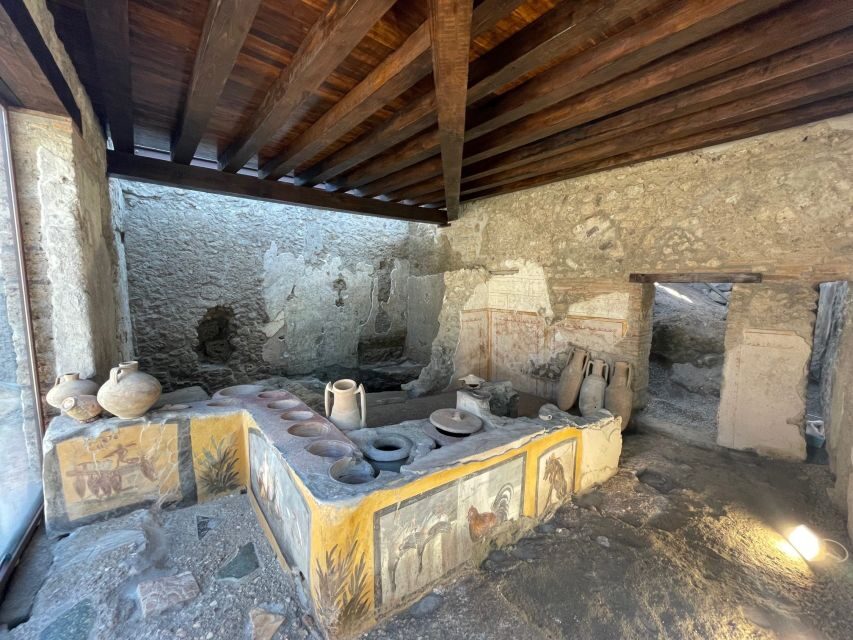
After the Forum, shift your attention to the street-level economy—food stands and other businesses that show how locals spent their time and money. This portion is often the most surprising because it’s so ordinary. You’re not only looking at temples or grand views; you’re seeing the practical parts of life.
The audio helps you connect small details to bigger patterns. You’ll likely come away with a better sense of daily rhythms: people moving through streets, stopping for bites, browsing services, and living in close quarters.




Brothels and the Private Side of City Life
Pompeii doesn’t shy away from the real world, and that includes brothels. When you reach these areas, expect the tour to guide you through what remains and what it suggests about relationships, transactions, and social behavior.
This is a good section to slow down. Take a moment to see how the spaces are arranged. Even if you’re not an architecture person, the layout tells the story better than a single fact ever could.
Roman Residences: How People Lived at Home
A highlight for many people is getting into an ancient Roman house and seeing what remains of residential life. This part is where you get contrast. Public areas show how people interacted as a community; houses show how they lived when the city noises faded.
Use your audioguide to pay attention to how rooms relate to courtyards and entrances. It’s an instant way to understand the difference between a city street and the lived-in privacy of a home. In a short visit, this contrast is what keeps the experience from feeling repetitive.
What the Audioguide Helps You Notice (and How Not to Get Stuck)
The audioguide is the backbone of a good self-guided Pompeii visit. It gives you context as you move through different building types: public centers, everyday business spots, and residential spaces.
This is where you’ll feel the difference between walking through ruins and learning from them. With the audio, you’re more likely to notice the function behind what you see—how spaces were designed for people, not just for display.
Also, the tour supports a wide range of languages. Audioguide availability includes French, Dutch, English, Italian, Portuguese, Russian, Spanish, German, and Chinese. Pick the language that matches your comfort level, because it affects how much you actually absorb in those 2.5 hours.
Now for the practical side: navigation matters. One common frustration is relying on phone directions when you’re already dealing with a complex site. I’d treat any app guidance as optional, not primary. Use the provided map and follow the route plan from the office staff. If the site directions in an app point you somewhere else, you can lose precious time quickly.
If you do end up with a missing audio device at the start, don’t push too far on your own assumptions. Go back and sort it early, before you’ve walked half the route without the context. In at least one situation, people were later contacted to return for the audioguide, but by the time the message arrived, it was already too late for an efficient fix.
Comfort and Timing: Rain or Shine, Lots of Walking
This tour happens rain or shine, so plan your clothing and footwear like you mean it. Pompeii is made for comfortable shoes, not pretty shoes. Expect uneven ground, lots of stairs or ramps in places, and steady walking.
Bring a FFP2 mask as required. It’s small, but it’s one of those essentials that’s easy to forget when you’re thinking only about tickets and photos.
Since this visit is not suitable for wheelchair users, it’s best to go in expecting mobility demands. Even if you can manage long walks, you’ll want to think about how you’ll handle breaks. Self-guided means you control the pace, but you still have to keep moving through the site to hit the key stops within the time window.
One more comfort tip: if you want photos, plan your stops so you don’t accidentally spend your whole tour lining up shots. Pompeii rewards short pauses with good framing, then moving on while you still have audio and energy.
Price and Value: Is $58 Worth It?

At $58 per person, this works out best when you value two things: time saved and interpretation included.
You’re paying for skip-the-line entry plus an audioguide and map. In a place like Pompeii, that combination is practical. Skip-the-line protects your schedule, and the audioguide protects your understanding. Without audio, you can still see Pompeii, but it’s easier to miss the meaning behind what you’re looking at.
The value also depends on your style. If you like structure without a live guide, this fits well. If you want a back-and-forth conversation, context on demand, or answers to your specific questions, you may prefer a format with a live guide. This is self-guided—solid, but not interactive.
One logistics consideration: make sure you exchange your voucher at the office before entering. There have been cases where people ended up paying again at the entrance because the voucher exchange step didn’t go smoothly. You can reduce that risk by handling pickup early and keeping your documentation clear.
Who This Tour Suits Best (and Who Should Skip It)
This experience is best for you if you:
- Want to explore Pompeii on your own schedule within 2.5 hours
- Like using an audioguide to learn while you walk
- Prefer map-based planning instead of depending on a live group
- Appreciate a route that includes both public spaces and more everyday, human parts of city life
It may be less ideal if:
- You need step-by-step assistance and don’t want to manage the office pickup process
- You’re expecting a live guide to answer questions
- You rely on wheelchair-friendly access (this one is not suitable)
Should You Book This Pompeii Audioguide Ticket?

Book it if you want a smooth start and a guided-by-audio experience that helps you see the Forum, homes, and everyday street life in a short visit. The skip-the-line entry and included map are exactly the kind of value that turns Pompeii from overwhelming into workable.
Hold off (or consider a different format) if you know you’ll struggle with the office pickup step. If you’re the type who panics when a meeting point is hard to find, build extra time before entry and double-check that you’ve collected everything at the office.
If you do book, give yourself a little buffer for the office exchange, and be proactive about the audioguide setup. That small bit of planning is what turns this from a ticket into a satisfying Pompeii visit.
FAQ
Where do I start the experience?
You start at the activity provider’s office, where you must exchange your voucher before entering Pompeii.
Is a live guide included?
No. This is a self-guided experience with an audioguide. A live guide is not included.
What’s included in the tour?
You get skip-the-line entry, an audioguide, and a map.
How long does the Pompeii visit last?
The duration is 2.5 hours.
Which languages are available for the audioguide?
The audioguide is available in French, Dutch, English, Italian, Portuguese, Russian, Spanish, German, and Chinese.
What should I bring to Pompeii?
Bring comfortable shoes and a FFP2 mask.
Is the tour wheelchair accessible?
No. It is not suitable for wheelchair users.
Does the experience run in rain?
Yes. The tour takes place rain or shine.
What is not allowed during the visit?
Alcohol and drugs are not allowed, and fireworks and explosive substances are also not allowed.