REVIEW · POMPEI CAMPANIA
From Naples: Pompeii Wheelchair-accessible with a Guide
Book on GetYourGuide →Operated by WORLDTOURS S.r.l. · Bookable on GetYourGuide
Pompeii gets busy fast, so this version helps you arrive ready. You get a wheelchair-accessible route inside the excavations, guided by a pro who explains what you’re seeing, not just where to stand. I also like the door-to-ruins setup: you meet your guide at the Pompeii Entrance and use a ramp-equipped vehicle with driver help. One drawback to plan for: Pompeii is still hilly and uneven in places, and some spots may call for short standing/walking even if you’re in a wheelchair.
What makes this outing especially workable is the mix of logistics and real on-the-ground guidance. You’re not trying to figure out ramps and entrances on your own. You also get a skip-the-line experience through a separate entrance, and the stop at Piazza Anfiteatro helps you start in the right place with tickets in hand. If you want a smoother day, bring or use an all-terrain wheelchair with rugged wheels, since the terrain can be bumpy.
In This Review
- Key things that make this Pompeii tour practical
- A wheelchair-friendly way into Pompeii from Naples
- Getting tickets sorted at Piazza Anfiteatro (not at the last second)
- The ramp van transfer: what changes when mobility matters
- Inside Pompeii: what the accessible route really gives you
- Meeting the guide and using the entrance correctly
- How much of Pompeii can you expect to see?
- Value: the $88 price makes sense if you factor in tickets and access
- Private options if your group needs more control
- Practical tips that make the day smoother
- Who should book this Pompeii accessible tour?
- Should you book? My honest take
- FAQ
- FAQ
- How long is the Pompeii tour?
- Where do we meet the guide and get tickets?
- Is pickup available from Naples?
- Is the route wheelchair accessible?
- What kind of wheelchair transport is used?
- Are Pompeii entry fees included?
- What languages does the guide speak?
- What should I bring?
- Are there any restrictions on bags or food?
Key things that make this Pompeii tour practical
- Ramp van + driver assistance for getting in and out comfortably
- Tickets handled for you when you meet at the Pompeii Anfiteatro entrance
- Accessible paths inside Pompeii, designed with ramps to reduce architectural barriers
- Skip-the-line entry via a separate entrance
- Free Pompeii admission rules for wheelchair users and a personal assistant (with proper ID)
- Flexible tour format if you choose private options with guide only or guide plus private car
A wheelchair-friendly way into Pompeii from Naples
Pompeii is one of those places where you’ll instantly feel the scale, even if you only see part of it. The city was buried by Vesuvius’ eruption in 79 A.D., and the ruins still read like a snapshot of everyday Roman life. The big challenge is that most self-guided visits assume you can handle uneven stone, slopes, and crowds.
This tour attacks the hard parts up front. You start from Naples with a wheelchair-accessible van (the operator calls it a special vehicle) and you’re taken toward the Pompeii site in a way that doesn’t leave you struggling at the curb. From there, you meet your guide and tickets at the entrance, then follow an itinerary built to be more wheelchair-realistic than a standard walking route.
The experience is designed to last about 3 hours on-site with total timing around 3–4 hours, which is a good length for a major site. Long enough to understand what you’re looking at, short enough that you’re not fried by mid-afternoon fatigue.
You can also read our reviews of more guided tours in Pompei Campania


Getting tickets sorted at Piazza Anfiteatro (not at the last second)

The tour starts the important part at the Pompeii Entrance near Piazza Anfiteatro. Your guide is waiting for you there with tickets, so you can skip the chaos of figuring out lines and entrances while managing mobility needs.
This detail matters. Pompeii is famous, so ticket lines and bottlenecks are normal. Having your spot set in advance and meeting the guide at the right point helps you get moving sooner. It also keeps your day calmer, which sounds obvious until you’ve watched someone burn energy just to reach the first doorway.
Your guided walk then follows a wheelchair-accessible itinerary within the excavations. That means ramps are part of the plan, and the route is meant to reduce the worst barriers you’d meet on your own. You’re not just touring; you’re learning how the site works and where to focus your attention.
The ramp van transfer: what changes when mobility matters
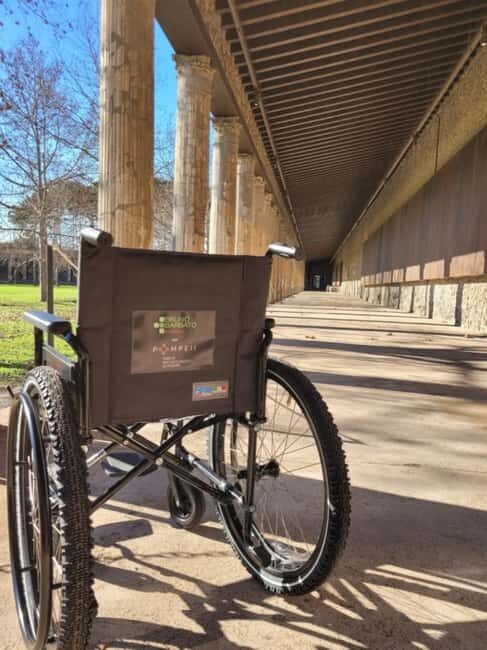
From Naples, the transfer is part of the value, not just a commute. The vehicle described for this tour can handle 4 passengers plus 1 wheelchair, and it includes a ramp. The driver also assists with getting you in and out.
That matters more than people expect. At many European landmarks, the pain point isn’t the attraction—it’s the moments around the van door: stepping, lifting, awkward positioning, and waiting. Here, the setup is built for that reality.
Two things to keep in mind:
- The tour allows pickup from places like your hotel, cruise terminal, train station, or airport if you choose the option with transfer from Naples.
- Your total transit time is listed as 45 hours in the itinerary details, which looks like a typo rather than real travel time. What’s clear is that this is a Naples-to-Pompeii round-trip with organized transport.
Also, Pompeii access can be weather-sensitive. If the day is wet or muddy, rugged wheels help. Even if the path is designed for access, the surface may still be uneven in spots.
Inside Pompeii: what the accessible route really gives you
Pompeii can feel like a list of streets and rooms—until you have someone explain what they mean. That’s the whole point of a guided visit here. A professional guide walks you through the ruins and connects the dots to Roman daily life: where people lived, how buildings were laid out, and what daily routines might have looked like in 79 A.D.
The accessible route is designed with ramps to navigate architectural barriers. In plain terms: you’re meant to roll along a path inside the excavations rather than fighting stairs or major grade changes. The tour is also described as offering a way to access areas where excavation is happening.
One real-world tip that comes through strongly in feedback: the paved paths through Pompeii are reasonably wheelchair friendly, but not every corner is equally easy. For instance, some areas may involve sections where standing or walking is required for short distances. If you can do that briefly, it will expand what you can comfortably see. If you cannot, you should plan to focus on the paved, accessible portions and accept that there may be limitations.
I like that this tour doesn’t pretend Pompeii is flat. It’s better to know the reality up front than to hope for miracles.
Meeting the guide and using the entrance correctly
You’ll meet your guide at the Pompeii Anfiteatro entrance to pick up your tickets and start. That’s usually the moment that sets the pace for the whole day. With the tour organized, you get to the site prepared and start with an explanation instead of wandering.
The meeting point is also connected to the “where you start” idea. Piazza Anfiteatro is a practical launch pad: it gets you into the heart of the ruins quickly, which is helpful when you have limited energy or time for detours.
Your guide can provide tours in multiple languages: English, Spanish, Italian, French, and German. That’s especially useful if your group includes more than one native language or if you prefer a particular option.


How much of Pompeii can you expect to see?
This tour isn’t a promise of seeing every building or every street. It’s an accessible route that aims to show you the highlights with enough context to make the site click.
The on-site visit is about 1 hour in the itinerary section, while the experience description says the ruins tour lasts around 3 hours with ramps and guided explanations. In practice, you should expect a paced, guided experience where you spend meaningful time at key points rather than rushing through everything.
The upside: you’ll likely leave with a better understanding of how Pompeii functioned daily. The Roman world is easier to grasp when you’re told what you’re looking at: domestic spaces versus public spaces, street layouts, and how the city’s design shaped life.
A helpful clue from feedback: having a guide makes the difference between wandering and understanding. Pompeii is big. Without guidance, it can turn into a photo stop circuit. With guidance, you learn what to pay attention to and how the site connects.
Value: the $88 price makes sense if you factor in tickets and access
At $88 per person, the obvious question is whether you’re paying for a guide and transport—or just paying for convenience.
Here’s the value logic that holds up:
- You get a professional guide for the Pompeii excavations.
- You get tickets included for the Pompeii visit.
- You get wheelchair-accessible transport with a ramp and driver assistance.
- Wheelchair users (and a personal assistant) can qualify for free admission with proof of identification from their home country.
That last point can significantly change the math. If you’re traveling with a personal assistant, the free admission rule can reduce out-of-pocket costs compared with paying standard entry fees for everyone. The tour fee still covers guidance and logistics, but it can feel more balanced when admission rules apply.
You also skip some friction. The tour offers skip-the-line entry through a separate entrance. Time has a cost, especially when mobility and stamina are part of your equation.
Private options if your group needs more control
This experience is offered as a private group, which is already a big plus for accessibility. In addition, you can choose:
- A private tour with a private car and guide, meeting at the entrance of the Pompeii Amphitheater
- A private tour with only a guide, meeting at the entrance of the Pompeii Amphitheater
Those options matter if your group’s needs are specific. If you need to move at a slower pace, adjust timing, or spend extra moments at a particular stop, private format usually gives you better control than a fixed group schedule.
I’d choose the private setup if you’re traveling with family members who have different mobility levels or if you prefer a more tailored conversation with the guide.
Practical tips that make the day smoother
Here’s what you should do before you go so you don’t waste energy on avoidable problems.
Bring
- Your passport or ID card (needed for entry)
- Sunglasses and a hat for sun and glare
- Any required identification for admission rules (especially if you’re using the wheelchair/free admission setup)
Plan for the wheelchair reality
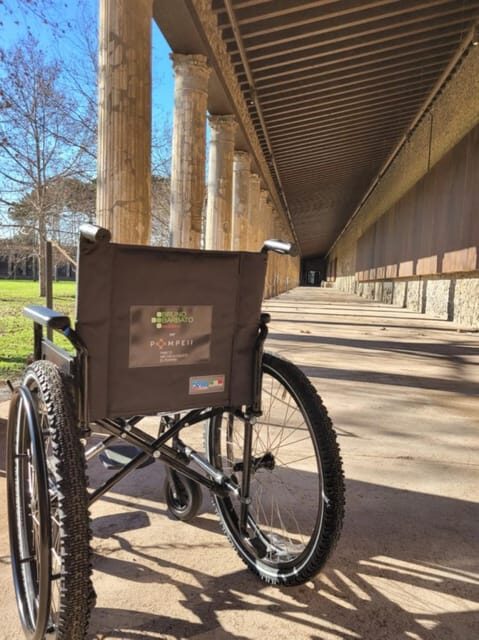
- The tour recommends all-terrain wheelchairs with rugged wheels because the terrain inside the route can be steep and uneven.
- If your chair has smooth indoor tires, expect more resistance on uneven surfaces.
Know the boundaries
- No smoking in the vehicle
- No alcohol and drugs
- No bags allowed
- No food or drinks in the vehicle
That bag restriction is the one that surprises people most. It’s worth packing light and figuring out what you’ll carry once you’re in Pompeii, not just what you bring from Naples.
Also, after booking, you’ll be asked for wheelchair size and needs so they can make the experience fit better. That’s not just paperwork; it helps match your day to the right vehicle setup.
Who should book this Pompeii accessible tour?
This is a strong choice if:
- You want Pompeii without the stress of managing the logistics alone
- Your group includes someone who uses a wheelchair full-time, and you want an itinerary that uses ramps and accessible paths
- You value a guide who can explain what you’re seeing, so your time isn’t spent guessing
It may not be the best match if:
- You can’t handle any short standing/walking moments at all and you’re expecting a completely flat, fully level route everywhere. The tour is accessible, but Pompeii can still force compromises in certain spots.
- You prefer fully independent exploration and don’t want a structured route.
If you can do brief transfers or short periods of assisted standing, you’ll likely get the most out of the highlights.
Should you book? My honest take
Book this tour if accessibility and guidance are your top priorities. The ramp transport, the organized entrance meeting point, and the guided explanations make this feel like a way to experience Pompeii rather than a test of your limits.
I’d especially lean toward it if you’re worried you might not see Pompeii due to physical circumstances. A helpful guide experience can turn the day from stressful to actually enjoyable. Feedback also points to guides like Jasmine offering real support and adjusting to needs, which is exactly what you want in a historic site with uneven ground.
If you’re on the fence, the deciding factor should be this: Pompeii is big and not perfectly level, so choose a route that admits that reality and helps you work with it. This tour does that.
FAQ
FAQ
How long is the Pompeii tour?
The visit is listed as 3–4 hours total, with about 3 hours described for the guided time at the ruins.
Where do we meet the guide and get tickets?
Meet at the Pompeii entrance, specifically at the Pompeii Anfiteatro entrance / Piazza Anfiteatro area, where the guide provides tickets.
Is pickup available from Naples?
Yes. Pickup can be arranged from your hotel, Naples cruise terminal, train station, or airport if you select the option with transfer.
Is the route wheelchair accessible?
Yes. The tour uses a wheelchair-accessible itinerary within the excavations, including ramps designed to reduce architectural barriers.
What kind of wheelchair transport is used?
A wheelchair-suitable vehicle with a ramp is used. It can accommodate 4 passengers plus 1 wheelchair, and the driver assists with getting in and out.
Are Pompeii entry fees included?
Yes. Pompeii fees are included, and wheelchair users can qualify for free admission for themselves and a personal assistant with proof of identification.
What languages does the guide speak?
The guide is available in English, Spanish, Italian, French, and German.
What should I bring?
Bring your passport or ID card, sunglasses, and a hat.
Are there any restrictions on bags or food?
Yes. Bags, food, and drinks are not allowed in the vehicle. Smoking and alcohol/drugs are also not allowed.