REVIEW · POMPEII
Pompeii: Guided Tour with Priority Entrance
Book on Viator →Operated by IAMME IA! - Gray Line Amalfi Coast · Bookable on Viator
Pompeii gets crowded fast. This guided tour tackles that head-on with priority entrance and a clear, headset-supported commentary across the big must-sees. You’ll focus on key spaces tied to everyday Roman life, from the Forum to the baths, plus a couple of stops people often miss.
I especially like the skip-the-line admission focus. In a site this large, saving time at the entrance is real value, not a marketing line. I also like the way the tour uses a licensed guide and headsets so you’re not constantly craning your neck in the busiest squares, including when groups get larger.
The main drawback is simple: you’re on an outdoor archaeological site with uneven surfaces and plenty of walking. Add Pompeii heat and you’ll want to plan for standing and moving on a tight schedule.
In This Review
- Key things you’ll notice right away
- Priority Entry and Headsets: the Real Reason This Tour Is Worth It
- Where You Meet and How the 2.5 Hours Actually Feels
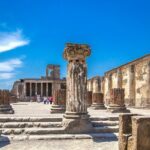
- Entering the Ancient Forum Zone: Daily Life in Stone
- Macellum and Via dell’Abbondanza: Food, Shops, and Street Noise
- Stabian Baths: The Most Useful Stop for Real Daily Life
- Lupanar and the House of the Faun: Two Stops That Change the Mood
- The Large Theater and the Basilica: Public Space Made Visible
- Price and Value: Why $59.13 Can Be a Smart Spend
- Practical Tips for Pompeii Heat and Uneven Ground
- Who This Tour Suits Best (And Who Might Want to Skip It)
- Should You Book This Pompeii Priority Entrance Guided Tour?
- FAQ
- How much does the Pompeii guided tour with priority entrance cost?
- How long is the tour?
- Is the tour offered in English?
- Does this tour include priority entrance to the Pompeii site?
- Are headsets included so I can hear the guide?
- Where do I meet the guide?
- What’s included in the price?
- What’s not included?
- How many people are in the group?
Key things you’ll notice right away
- Priority entrance means less time stuck near the gates and more time inside the ruins.
- Headsets in Pompeii help you hear the guide even when you’re not pressed right next to them.
- A Forum-heavy route gives you the story behind major landmarks like the Temple of Jupiter and the Basilica.
- Stabian Baths stop adds human-scale detail about daily routines, not just big monuments.
- Lupanar and House of the Faun bring the “everyday but shocking” side of Pompeii into view.
- Max 25 people keeps the pacing manageable compared with huge bus tours.
Priority Entry and Headsets: the Real Reason This Tour Is Worth It
At Pompeii, timing is everything. The ruins are spread out, so once you’re inside, you can make progress fast. What this tour buys you is the ability to start sooner thanks to priority admission, so you’re not wasting your limited visit time waiting to get in.
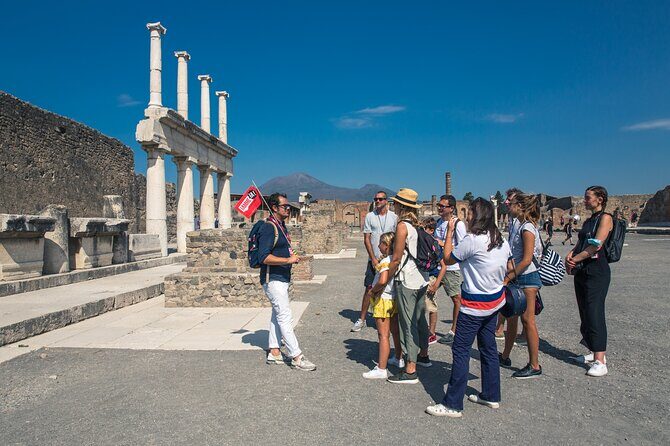
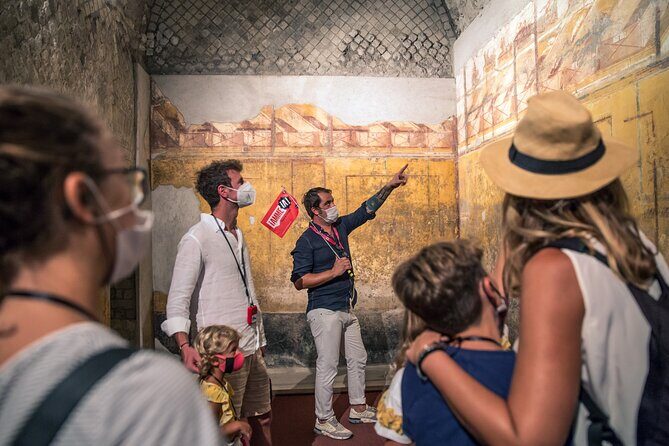
Then there’s the sound. Pompeii is noisy in the way only famous outdoor sites can be: wind, footsteps, and lots of voices competing. With headsets (provided for groups over 10 passengers), you get guided commentary that stays audible even if the group shifts around to see different angles of the Forum and street life.
I also like that you’re not just handed a map and told good luck. An official guide can connect what you’re seeing to what it meant, especially in the Forum area where buildings overlap and details can feel confusing if you’re going solo.
You can also read our reviews of more guided tours in Pompeii
Where You Meet and How the 2.5 Hours Actually Feels
You meet at the Camping Zeus meeting point (Zeus Car Park area, Via Villa dei Misteri, 3, 80045 Pompei, NA). The tour ends back at the same meeting point, so you don’t have to figure out a second pickup spot after you’re done.
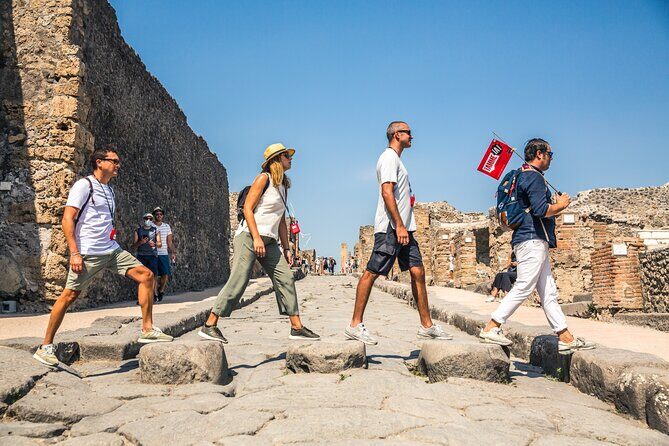
Expect the day to feel like a focused highlight route. This isn’t a slow “linger everywhere” visit. You’re walking between major zones, then pausing long enough to understand what you’re looking at before moving on again. That’s why the headset matters: in a fast-paced tour, you need the explanation to land quickly while you’re still standing in front of the real thing.
The tour length is about 2 hours 30 minutes, which is a good match for a first visit when you want strong orientation. If you already know Pompeii well and want to spend a lot of time on the details that most highlights miss, you might want more than this.
Entering the Ancient Forum Zone: Daily Life in Stone
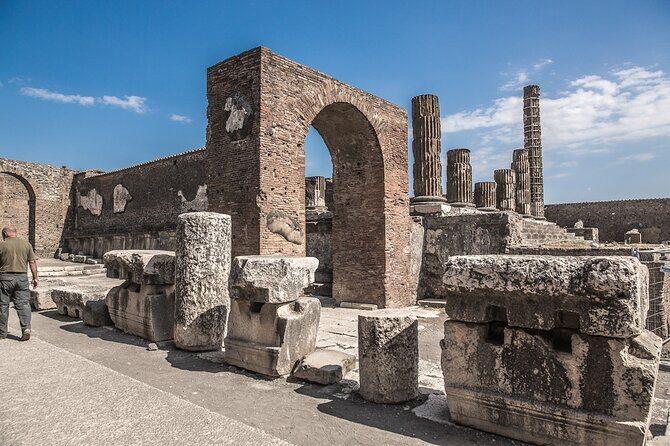
The heart of the tour is the Forum area, where Pompeii concentrated public life. You start by heading through the central spaces that show how the city ran: civic decisions, justice, business, trade, and worship all mixed into the same day.
One stop you’ll reach in this zone is the Civil Forum, described as the focal point for major public buildings. This is where you learn to read Pompeii not like a list of ruins, but like a functioning city layout.
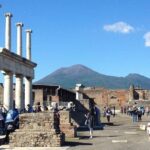
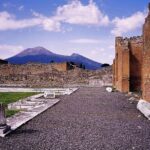
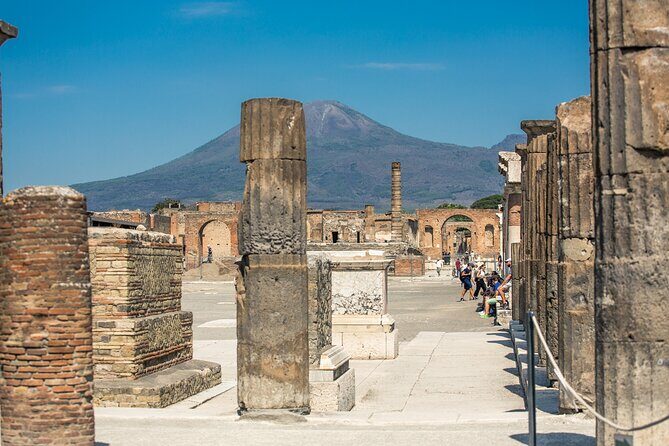
Then the route pushes north toward the Temple of Jupiter. This is the kind of landmark that makes the Forum “click” because it has a clear visual relationship to the landscape. Mount Vesuvius rises behind the temple, and the story gets more specific: when the colony was founded (80 BC), the temple was renovated into a Capitolium-style setup. You’re looking at a place tied to the cult statues of Jupiter, Juno, and Minerva, displayed so they were visible across the Forum square.
If you’re wondering why a guide matters here, it’s because these structures overlap visually. On your own, it’s easy to see impressive ruins without understanding why they were arranged the way they were.
Macellum and Via dell’Abbondanza: Food, Shops, and Street Noise
After the big civic monuments, you shift into the “where people shopped and ate” part of Pompeii.
The Macellum is a key stop. It’s laid out as a tuff quadriporticus with an elevated worship hall on the eastern side. You also get details that make it feel like a real marketplace, not just a set of broken walls. Statues and fragments in niches point toward an imperial cult connection, and there are spaces tied to meetings of a sacred board. Even a room with a masonry counter is described as potentially used for fish sales.
What I like about including the Macellum is that it helps you balance Pompeii’s big public story with the everyday economy. The Forum makes you think politics and religion. The Macellum brings you back to money, food, and social routines.
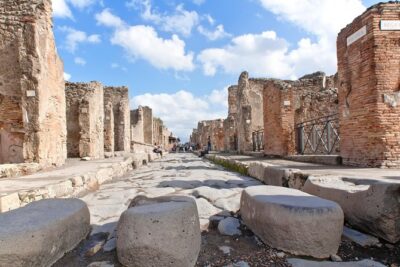
From there, you walk along Via dell’Abbondanza, Pompeii’s main street (the decumanus maximus). It ran east to west from the Forum toward Porta Sarno, and it was crowded in ancient times with shops, workshops (officinae), cafes, and snack bars. In other words: this is a street tour inside a ruin city. When you can place the buildings along the road into that street-life context, Pompeii feels much less like a museum and more like a place that was alive.
Stabian Baths: The Most Useful Stop for Real Daily Life
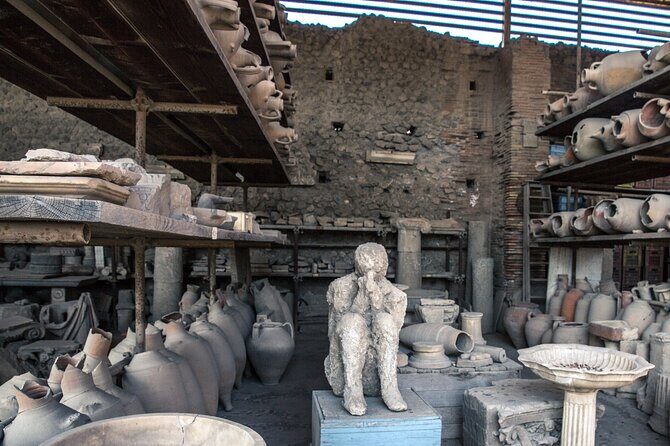
If you only visit Pompeii highlights, you can miss what made Romans Roman: their routines. That’s why the stop at the Stabian Baths (Terme Stabiane) is such a smart inclusion.
These baths sit behind the Temple of Jupiter and are dated to years after the colony founding by General Silla (80 BC). You also get a clear gender separation in entrances, which is a detail many people don’t expect until they see the layout.
The tour explains the bathing sequence by name: apodyterium (dressing room), then tepidarium (medium temperature), frigidarium (cold), and calidarium (hot). And it’s not just “here are rooms,” because Pompeii’s walls carry a history of damage. The baths were heavily damaged in the earthquake of 62 AD, so you’re standing in a space shaped by both human routine and catastrophe.
This stop is also practical for your expectations. It’s a good reminder that Pompeii isn’t only temples and courts. There were places for bodies to meet the day-to-day world.



Lupanar and the House of the Faun: Two Stops That Change the Mood
The tour then adds two very different, very memorable “shock value” stops: the Lupanar and the House of the Faun.
The Lupanar of Pompeii is famous as the city’s most known brothel, also called Lupanare Grande. The details here are specific: the wall paintings were erotic, and the prostitutes were described as mostly Greek and Oriental slaves. The tour notes their pay range in Asses, with a glass of wine costing one As. That kind of detail turns the space from scandalous trivia into a glimpse of how money and social power worked in the city.
After that, you step into the House of the Faun, one of Pompeii’s grand villas, known especially for mosaics. The star is the Alexander Mosaic, a major artwork tied to storytelling, not just decoration.
These stops work best when you let them shift your thinking. Pompeii wasn’t uniform. It had civic ceremony and religious formality in one zone, and then commerce, street life, and complicated social realities just nearby.
The Large Theater and the Basilica: Public Space Made Visible
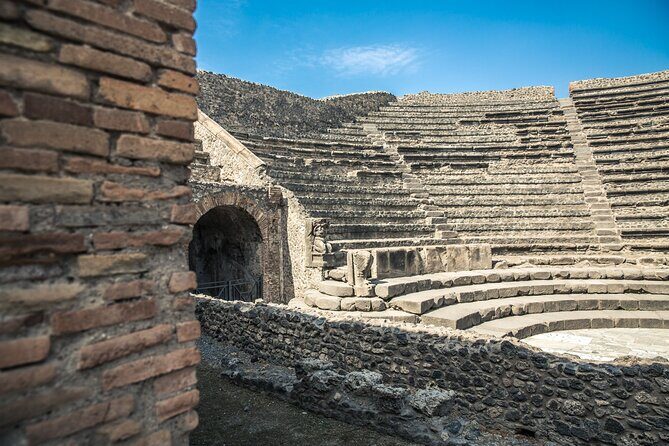
Later, you reach the Large Theater, an open-air venue where crowds once gathered for comedies, dramas, and musical performances. This is where you see Pompeii as an entertainment and community machine, not only a tragedy in a textbook.
Then comes the Basilica, one of the Forum’s biggest buildings. The Basilica covers about 1,500 square metres and is described as the most sumptuous Forum structure, with space used for business and administration of justice. It connects to the Forum through five entrances divided by tuff pillars, and once inside it’s organized into three naves with rows of brick columns with Ionic capitals.
I like this pairing because it gives you two kinds of “public power.” The theater suggests culture and social gathering. The Basilica suggests law, negotiations, and the system behind the daily grind. When you can see both in one tour block, Pompeii feels more coherent.
Price and Value: Why $59.13 Can Be a Smart Spend
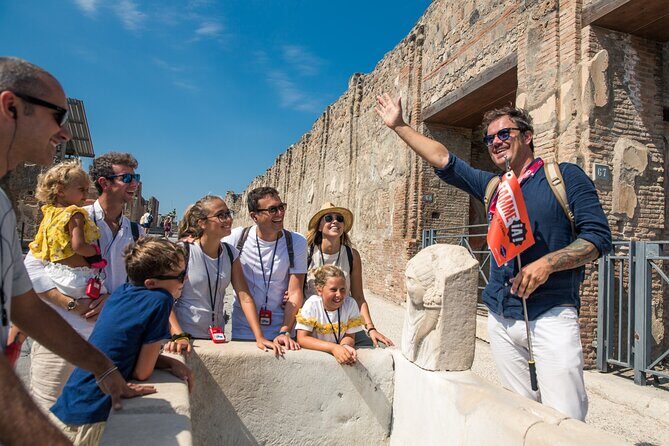
At $59.13 per person, this isn’t a low-cost stroll. But it packs in three things that add up quickly at Pompeii: a licensed guide, admission tied to priority access, and headset support in the ruins.
Here’s the value logic I use when deciding on a Pompeii tour like this:
- Priority entrance reduces wasted time at the gate. With only a few hours, that time matters.
- Guiding helps you understand the layout, especially in the Forum where the buildings are close and the meanings can get tangled.
- Headsets make the experience usable when the group is not tiny and you’re standing in crowded outdoor spaces.
If your goal is just to collect photos of famous facades, self-exploring might feel cheaper. But if your goal is to walk into Pompeii and have it make sense in a limited window, this price can be fair.
Practical Tips for Pompeii Heat and Uneven Ground
Pompeii is outdoors, and the ground is not designed for flip-flops. The tour itself advises comfortable shoes and sunscreen, and that advice matches what you’ll likely feel on the day. Surfaces can be uneven, so plan your pace like you’re walking a historic site, not a sidewalk.
I’d also travel light. This kind of tour is calmer when you’re not juggling heavy bags while trying to follow the group through narrow ancient lanes and open Forum plazas. Water helps too, and the site has fountains you can use to top up if you’re mindful about staying hydrated.
If you can choose a time of day, consider an earlier start. One guide-led experience shared that a morning slot like 9:00 can help you move through faster with fewer crowd slowdowns and less brutal heat.
Who This Tour Suits Best (And Who Might Want to Skip It)
This guided priority tour is a strong fit if:
- You’re doing Pompeii as a first-time visit and want orientation.
- You care about hearing the explanation clearly through headsets.
- You want a structured route that hits major zones without you planning every turn.
It may feel less ideal if:
- You want a long, slow walk with lots of free time in one area.
- You’re very sensitive to standing around in heat while waiting for the group.
- You’re traveling with young kids who need constant control in crowds. In tight spaces, group pacing can be stressful even when the tour tries to keep things organized.
Also, this experience works best in good weather. If conditions are poor, you might be offered a different date or a full refund.
Should You Book This Pompeii Priority Entrance Guided Tour?
Book it if you want to maximize your time inside Pompeii with priority admission, a licensed guide, and headsets that make the explanations practical in busy outdoor spaces. The route is built to give you the big anchors of Roman public life: the Forum, the Temple of Jupiter, marketplace energy at the Macellum, street life on Via dell’Abbondanza, and daily routines at the Stabian Baths.
Skip it if you’re the type who enjoys wandering without time pressure and you’re happy handling entrance waits and reading everything on your own. Pompeii can reward independent exploring, but this tour is for when you want the site to make sense quickly.
FAQ
How much does the Pompeii guided tour with priority entrance cost?
The price is $59.13 per person.
How long is the tour?
It runs about 2 hours 30 minutes.
Is the tour offered in English?
Yes, the tour is offered in English.
Does this tour include priority entrance to the Pompeii site?
Yes. It includes skip-the-line admission fees to the Pompeii ruins.
Are headsets included so I can hear the guide?
Yes. Headphones are provided in Pompeii so you can hear the guide clearly for groups bigger than 10 passengers.
Where do I meet the guide?
Meet at Camping Zeus, Via Villa dei Misteri, 3, 80045 Pompei NA, Italy.
What’s included in the price?
A 2.5-hour guided tour, skip-the-line admission fees, headphones in Pompeii for larger groups, and an official licensed guide.
What’s not included?
Lunch and transportation are not included.
How many people are in the group?
The tour has a maximum of 25 travelers.