REVIEW · POMPEII
PompeiI Exclusive Tour with your Archaeologist in a Small Group
Book on Viator →Operated by Grand Tour Experience · Bookable on Viator
Pompeii clicks into place fast. This small-group Pompeii tour helps you read the ruins like a story, with an archaeologist guide pointing out what mattered and why. I like the separate priority line that reduces gate delays, and I like the tight 2-hour route that hits Pompeii’s big “how people lived” highlights. The main thing to plan for: the Pompeii Archaeological Park entrance ticket is not included in the $30.25 price, so your total cost will be higher once you buy admission.
You’ll start in a specific spot near Porta Marina Superiore, where the guide meets you outside with a sign (often labeled Pompeii Vip). Guides I’ve seen described in the mix include archaeologist Antonio, and guides like Ornella, Ricardo, Raffaele, Rafael, PierLuigi, and Raphael Romano, so expect clear English and plenty of time to ask questions. With only up to 15 people, the pace feels human, not like a stampede through stones.
In This Review
- The big idea: why this 2-hour Pompeii route is worth it
- Key points to know before you go
- Where the tour starts: Porta Marina Superiore and your meeting point
- Priority line logistics: how this saves time at the gate
- Stop by stop: what each Pompeii highlight teaches you
- Temple of Venus (Tempio di Venere)
- Basilica in the Forum
- Sanctuary of Apollo
- Forum Main Square (Foro)
- Temple of Jupiter, with Vesuvius in the backdrop
- Macellum, baths, and a thermopolium: seeing daily life, not just big buildings
- Macellum (market building) and plaster casts
- Forum Baths (Terme del Foro)
- Thermopolium of Vetuzio Placido (old diner)
- Houses and the main street: House of the Faun, Vettii, and Via dell’Abbondanza
- House of the Faun (large home, big signals)
- House of the Vettii (Priapus and prosperity)
- Via dell’Abbondanza (the decumanus maximus)
- Teatro Grande: how the city staged performances
- Guides and group size: what the best moments tend to have in common
- Price and tickets: what you should budget in real money
- Weather, pacing, and what you may not see
- Who this Pompeii tour fits best
- Should you book this Pompeii archaeologist tour?
- FAQ
- FAQ
- Is the Pompeii Archaeological Park entrance ticket included in the $30.25 tour price?
- How long is the Pompeii exclusive small-group tour?
- What language is the tour offered in?
- Where do I meet, and does the tour end there?
- How large is the group?
- What happens if the weather is poor?
The big idea: why this 2-hour Pompeii route is worth it
Pompeii can feel like a random pile of ruins if you wander on your own. Even if you’ve watched movies about volcanoes, the real power here is in structure: temples, civic buildings, shops, baths, homes, and street life all woven into one daily routine. With an archaeologist guide, you’re not just looking at carvings and walls—you’re learning how the pieces connect.
The route is built for first-timers. In about two hours you cover the parts that teach you the city’s rhythm: where people worshipped, where money and justice happened, where food and products were sold, where neighbors met to talk, and which neighborhoods belonged to wealth. It’s not meant to replace a long, do-everything Pompeii day. It’s meant to help you get oriented fast, then leave with a mental map you can use for the rest of your visit.
The small-group format matters more than it sounds. Pompeii has crowds at the gate and bottlenecks inside, but a group of up to 15 can slow down at key spots and still keep the timing smooth. You also get enough personal attention to ask the question that’s been nagging you since you walked in—like how archaeologists know what’s under the plaster, or why certain streets and buildings are where they are.
Key points to know before you go
- Archaeologist-led explanations: you’ll learn what you’re seeing and how it was studied, not just names on signs.
- Priority access at the entrance: less waiting before you start seeing the good stuff.
- A tight hit list of Pompeii essentials: Forum sights, temples, baths, and everyday-life stops in about two hours.
- Daily life details, not only monuments: markets, a thermopolium (old diner), and homes give context.
- Seasonal openings apply to the houses: House of the Faun and House of the Vettii may depend on the season.
You can also read our reviews of more tours and experiences in Pompeii.

Where the tour starts: Porta Marina Superiore and your meeting point
The meeting point is Via Villa dei Misteri, 1, 80045 Pompei NA, Italy. The good news is that it’s near public transportation, so you’re not forced into a long scramble with luggage or heavy shoes in hand.
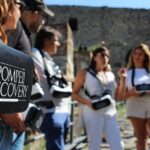
From there, you’re set up for a sensible Pompeii entrance. The first stop is at the Archaeological Park of Pompeii, specifically Porta Marina Superiore—the western entrance. Your guide will meet you outside the park with a sign reading Pompeii Vip, which saves you the awkward moment of trying to match faces to photos while everyone else crowds the entrance.
Why start here? Porta Marina Superiore helps you understand Pompeii’s layout right away. The name “Marina” connects to the fact that the outgoing road led toward the sea. So even before you reach the Forum, you get a sense of how movement worked: how people entered, where they went next, and how the city’s public core lined up.
Priority line logistics: how this saves time at the gate
Pompeii gates can turn into a time tax. This tour includes entry via a separate priority line, so you’re less likely to spend your limited visit time standing around.
One caution, though, because it trips people up: the price you pay for the tour is not the same thing as the Pompeii park admission. The tour provides links to help you get skip-the-line access, but the Viator ticket you buy to join the tour is not your entry ticket for the archaeological site. The entrance ticket is something you purchase for the park itself, with the tour helping you navigate it on site or via an email link sent the afternoon before.
If you want to make this easy on yourself, do the ticket planning early. Pompeii admission is €19 per adult (free for under 18). Having that sorted ahead of time keeps you in “watching ruins” mode instead of “where do I swipe?” mode.
Stop by stop: what each Pompeii highlight teaches you
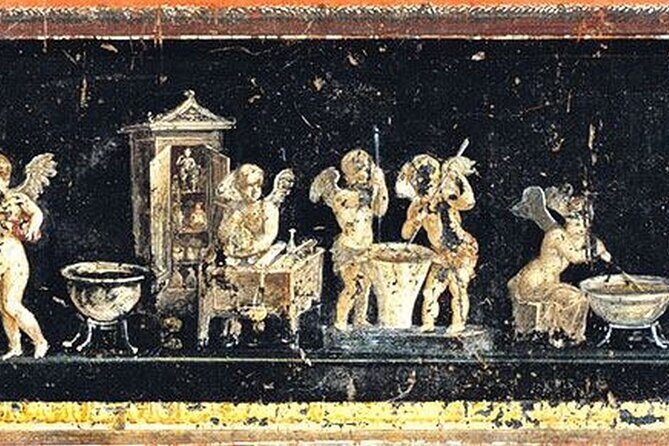
This is a guided walk through Pompeii’s core story. Each stop is short—around 10 minutes—so think of this as a guided tasting menu: enough time to learn, not enough to get lost.
Temple of Venus (Tempio di Venere)
You begin with the Temple of Venus, tied to Pompeii’s patron goddess. This kind of stop matters because it sets the religious baseline. When you see where worship sat in the city plan, you start understanding why people gathered where they did, and why temples weren’t tucked away in quiet corners.
Even in a short visit, you’ll learn to notice how religious sites shape pedestrian flow. Where a temple sits affects the streets around it. In Pompeii, that link between sacred space and daily movement is visible.


Basilica in the Forum
Next up is the Basilica, described as the most lavish building in the Forum. This wasn’t just “pretty architecture.” It served business and administration of justice, which means people came here for practical life, not only ceremonial moments.
This stop is a cheat code for first-timers. Once you understand the Forum as a work-and-law hub, other buildings feel less random. You’ll start seeing Pompeii as a functioning city, not a museum of fallen walls.
Sanctuary of Apollo
Then you reach the Sanctuary of Apollo, one of the oldest worship sites in Pompeii. Its placement along the street leading from Porta Marina to the public heart of the city is the point. You’re seeing how older sacred sites anchored movement over time.
The lesson here is planning: Pompeii’s religious and civic spaces line up with routes people use every day. You don’t just walk through ruins—you trace a route a real person once followed.
Forum Main Square (Foro)
Now you’re in the Forum’s main square, the center of daily life. This is where the city’s “public room” energy shows up. Streets funnel in, people gather, and key civic and religious buildings create a kind of urban stage.
If you come to Pompeii hoping for atmosphere, the Forum is the place that makes the city feel like it had a pulse. A good guide helps you picture roles: who would have been here, what they might have been doing, and how the built environment shapes behavior.
Temple of Jupiter, with Vesuvius in the backdrop
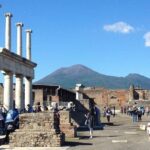
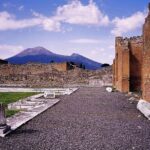
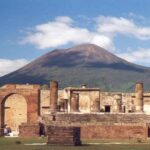
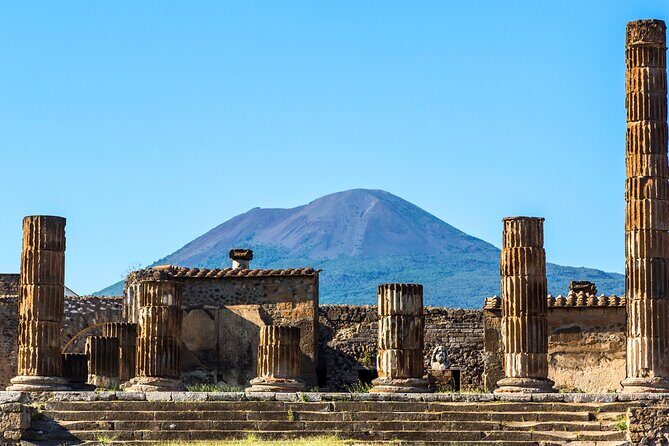
On the northern side of the Forum sits the Temple of Jupiter, and behind it rises Vesuvius. That sightline is not just scenic; it’s symbolic. Your guide will help you connect geography to mindset—how living with a looming volcano shaped the way people thought and organized their city.
If you’ve ever wondered how Romans managed fear and faith at the same time, this is the kind of stop that answers it without preaching. It’s right there in the layout.
Macellum, baths, and a thermopolium: seeing daily life, not just big buildings
Pompeii hits hardest when you understand routine. This tour leans into that.
Macellum (market building) and plaster casts
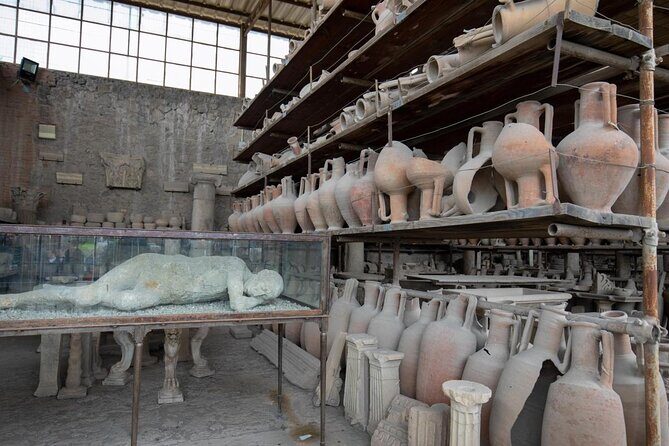
At the Macellum you’ll see a monumental food and consumer-products marketplace. This is where daily buying and eating becomes physical. Pompeii wasn’t only temples and statues; it was groceries, tools, and routines.
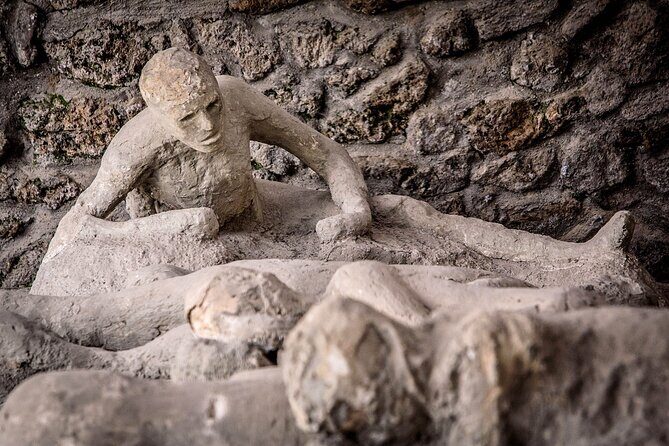
There are also plaster casts of the famous bodies from the eruption area—an archaeological method used to reconstruct what happened. Even if you’ve seen photos online, seeing it in context inside Pompeii makes the tragedy feel immediate and personal.
Forum Baths (Terme del Foro)
Next: the Forum Baths, one of the best-preserved parts of the city. They had separate entrances for women and men, which is a detail you can only really appreciate when a guide points it out. It turns “bathhouse ruins” into evidence of social structure.
Baths were also news and conversation hubs. When you grasp that, it becomes easier to imagine Pompeii alive—even with the silence.
Thermopolium of Vetuzio Placido (old diner)
A thermopolium was basically a street-side diner, where locals could grab food and drink. This stop is valuable because it gives you the everyday menu logic of Roman street life.
It also helps you connect the city’s social behavior. People needed quick meals between work and errands. Pompeii’s commercial spots aren’t background noise; they’re part of how the city functioned minute to minute.
Houses and the main street: House of the Faun, Vettii, and Via dell’Abbondanza
The tour includes two important houses, but it’s smart to keep an expectation flexible. Both the House of the Faun and the House of the Vettii can be subject to seasonal openings and closings.
House of the Faun (large home, big signals)
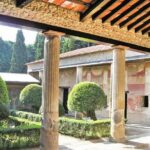
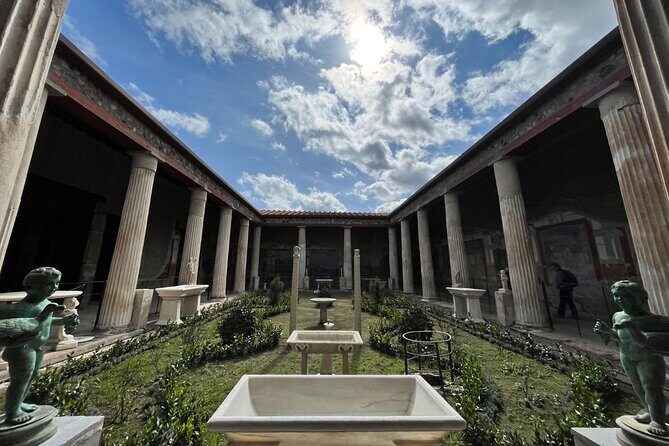
The House of the Faun is one of Pompeii’s largest. The sidewalk welcome inscription (HAVE) in Latin is the kind of detail that makes it feel less like a ruin and more like a place where someone once lived and received people.
This stop teaches you about scale and status. Pompeii’s wealthy didn’t just have more rooms. They had different kinds of public-facing spaces and signals.
House of the Vettii (Priapus and prosperity)
The House of the Vettii is described as one of the richest and most famous homes in Pompeii. It’s associated with Priapus, linked to prosperity. Your guide will help you understand how religious symbolism and wealth language show up in domestic spaces.
Via dell’Abbondanza (the decumanus maximus)
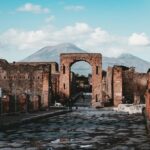
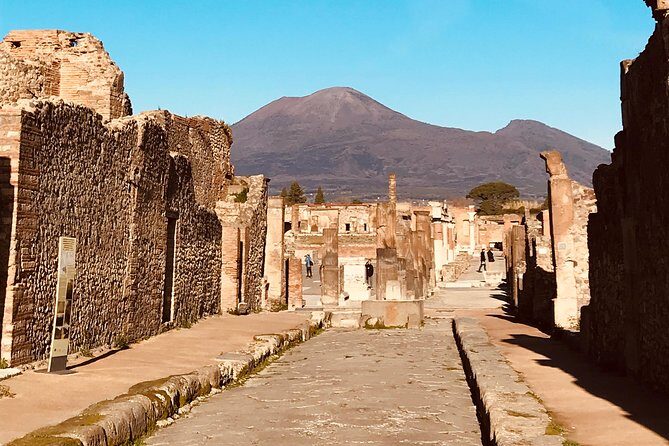
Then you walk Via dell’Abbondanza, the ancient main street (decumanus maximus). This is the street that ties the “why” of the route together. It’s where you can feel how movement, shops, and neighborhoods interacted.
Once you’ve walked a main artery like this, other ruined streets make more sense. You stop thinking in isolated landmarks and start thinking in connections.
Teatro Grande: how the city staged performances
You finish at Teatro Grande, where comedies and tragedies in the Greco-Roman tradition were performed. A theater stop is a good final anchor because it rounds out the city’s “public life” beyond commerce, worship, and law.
The practical takeaway: by the time you reach the theater, you’ve already covered civic spaces (Forum), belief spaces (temples), and daily spaces (market, baths, diner). Now you see leisure. Pompeii was still a place where people watched stories and argued about life in public.
Also, this kind of finish helps you remember the tour route afterward. People can forget temple names, but they remember the street-to-theater arc.
Guides and group size: what the best moments tend to have in common
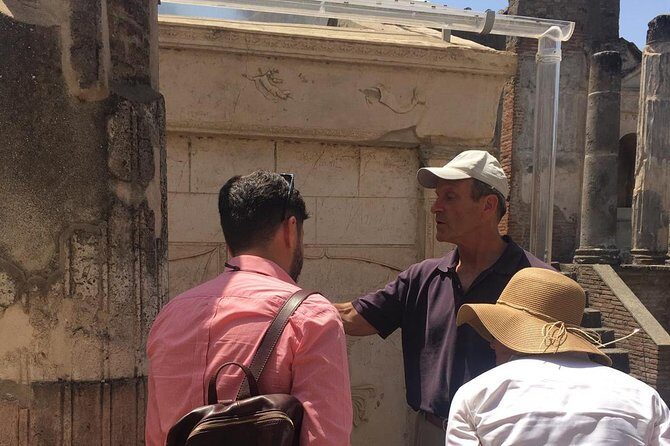
A big reason this tour earns such strong ratings is the human factor. The guides in the mix are described as passionate and willing to answer questions, with clear English and lots of time for curiosity.
For example, Antonio is specifically described as an archaeologist and as a guide who keeps things interesting. Ornella is described as engaging, with storytelling that makes Pompeii feel human. Ricardo and Raffaele come up for strong explanations and friendly energy. Raphael Romano is even mentioned for skill navigating wet or windy weather by finding covered spots while still teaching.
Here’s how you can use this to your advantage. Come with one question you actually care about, like how archaeologists interpret evidence when only parts of buildings survive, or why certain rooms mattered. Then let the guide do what tour guides are best at: turn your question into a mini lesson you can carry into your own exploration after the tour ends.
Group size also helps. With up to 15 people, you’re not stuck waiting for the person in front to finish taking selfies before the guide moves on.
Price and tickets: what you should budget in real money
The tour price is $30.25 per person for about two hours. Then you add Pompeii Archaeological Park admission: €19 per adult, free for under 18.
So for an adult, you’re looking at roughly $30.25 + €19 (currency conversion depends on the day). That makes it a “not-cheap, but fair” value. The difference is that you’re paying for trained interpretation and a smarter route, not just access to stones.
Also, the tour includes a help link for skip-the-line access, plus an entrance ticket purchasing link sent the afternoon before. Still, it’s your responsibility to buy the park entry ticket. The tour ticket is for joining the guided group, not for site admission.
If you want the smoothest experience, do this in the right order:
- Buy the tour booking.
- Buy the Pompeii park entry ticket separately for admission.
- Use the provided link info so you can handle the process with less friction.
Weather, pacing, and what you may not see
This tour requires good weather. If the weather doesn’t cooperate, you’ll be offered a different date or a full refund.
Pacing is another practical point. With stops around 10 minutes each, you’ll cover key sites, but you won’t get every major attraction in Pompeii in two hours. If you’re hoping to check off everything like the amphitheater or the most distant corners, this tour is the “start smart” option, not the “see the whole park” option.
The upside is clarity. After this walk, you’ll know where things are and what to target on your own for the rest of the day.
Who this Pompeii tour fits best
This works well if you’re:
- Visiting Pompeii for the first time and want a guided map of the city’s daily life.
- Short on time but still want more than a quick photo loop.
- Interested in archaeology and how evidence connects to what daily life likely looked like.
- Traveling with family members (including teens), as long as everyone is comfortable with walking.
It’s also a good fit for people who know they’ll need explanations to “read” what they’re seeing. Pompeii rewards attention. A guide turns that attention into understanding.
Should you book this Pompeii archaeologist tour?
Yes, if you want Pompeii to make sense quickly. The priority entry helps, the small-group pace makes it easier to ask questions, and the route focuses on the places that show how people lived: Forum life, worship, food markets, baths, street diners, homes, and the main street.
Skip it only if you’re trying to cover the entire park in one go. Two hours is a focused tour, not a full Pompeii marathon. If you want to roam every major area, plan for extra self-guided time afterward.
FAQ
FAQ
Is the Pompeii Archaeological Park entrance ticket included in the $30.25 tour price?
No. The Pompeii Archaeological Park admission ticket is not included. Adult admission is listed as €19 per person, and it’s free under 18. The tour provides help and links so you can buy your entry ticket correctly.
How long is the Pompeii exclusive small-group tour?
The duration is about 2 hours.
What language is the tour offered in?
The tour is offered in English.
Where do I meet, and does the tour end there?
You meet at Via Villa dei Misteri, 1, 80045 Pompei NA, Italy. The tour ends back at the meeting point.
How large is the group?
This experience has a maximum of 15 travelers.
What happens if the weather is poor?
This tour requires good weather. If it’s canceled due to poor weather, you’ll be offered a different date or a full refund.