REVIEW · POMPEII
Pompeii and Mount Vesuvius Small Group Tour
Book on Viator →Operated by Askos Tours · Bookable on Viator
Two big icons in one packed day. I love that Pompeii comes with real archaeologist interpretation, and I love that Vesuvius includes a licensed hike guide who keeps the climb organized and the volcano explained as you walk. The one drawback to plan for: weather can slam visibility on the crater, and the hike has real steep sections.
You start at Via Villa dei Misteri, then you look for the Askos Tours sign at Porta Marina Superiore. This setup is great if you want a smart day plan through major sites like the Forum and the big theaters, but you should also budget for your own lunch and water since food and drinks aren’t included.
In This Review
- Key highlights I’d put on your radar
- Starting at Porta Marina Superiore: the day’s pace and meeting spot
- Pompeii with an archaeologist: how the ruins make sense fast
- Forum to theaters: what you’ll actually see at each Pompeii stop
- The ancient main square: Foro de Pompeya
- Granaries of the Forum: marble tables, fountain basins, and casts
- House of Menander: a top-tier private residence
- Stabian Baths (Terme Stabiane): the oldest thermal complex
- Lupanar: Pompeii’s most famous brothel
- House of the Faun: big private residence energy
- Teatro Piccolo and Teatro Grande: entertainment in stone
- A time reality check
- The transfer that saves your sanity: minibus and practical flow
- Vesuvius crater walk: smoking edge, steep steps, and weather’s big role
- What you’re promised at the top
- The walk details that matter for your body
- Weather reality: when visibility drops fast
- Herculaneum as the backup plan: a smarter use of a weather change
- Timing, stamina, and what to pack for this 8-hour hit
- Price and value: what $119.77 gets you, plus the small extra you should expect
- Who should book this Pompeii and Vesuvius tour
- Should you book it? A quick decision checklist
- FAQ
- How long is the Pompeii and Mount Vesuvius small group tour?
- Is the tour offered in English?
- Where do we meet, and where does the tour end?
- What is included for Pompeii?
- How difficult is the Vesuvius portion?
- What happens if Vesuvius is not accessible?
- Is food and drinks included?
- Extra: free cancellation
- Can I cancel and get a full refund?
Key highlights I’d put on your radar
- Pompeii with an archaeologist: a guided 2-hour walk through the sites that make ancient city life click.
- Small group logistics: max 14 people on the minibus, with a Pompeii archaeologist group size up to 20.
- Crater trail is hiking, not strolling: first stretch includes steps, and the last 500m is steep uphill.
- Big views when the sky cooperates: Bay of Naples plus Capri, Ischia, and the Sorrento coast can show up clearly.
- Built-in weather backup: if Vesuvius can’t be accessed due to force majeure, the plan switches to Herculaneum.
- English speaking guides: including examples like Teresa, Nicoletta, Raffaela, Benedetto, Mario, Simona, and Luciano leading different parts.
Starting at Porta Marina Superiore: the day’s pace and meeting spot
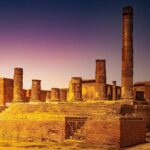
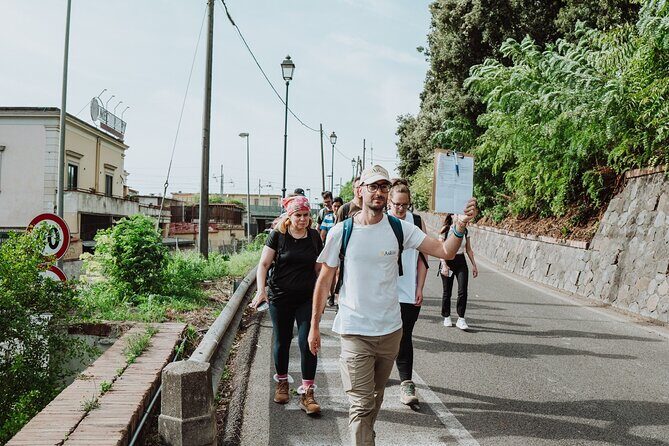
This is an 8-hour style day, built to cover two major places without wasting half your trip in transit. You meet at Via Villa dei Misteri, 2, then you’ll spot your guide holding an Askos Tours sign at the main entrance of the Pompeii ruins called Porta Marina Superiore.
The pacing matters. Pompeii is huge, and you can easily waste time wandering around trying to figure out what you’re actually looking at. This tour keeps you moving along a route that hits major structures quickly, with short site stops that still give you context.
One more practical point: the group on the minibus is capped at 14, which helps with crowding at the sites and keeps the volcano hike from turning into a long bottleneck line. Pompeii’s archaeologist guidance is up to 20 people, but the minibus size is still smaller than most big tours.
You can also read our reviews of more tours and experiences in Pompeii.

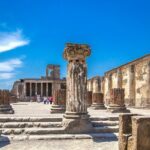
Pompeii with an archaeologist: how the ruins make sense fast
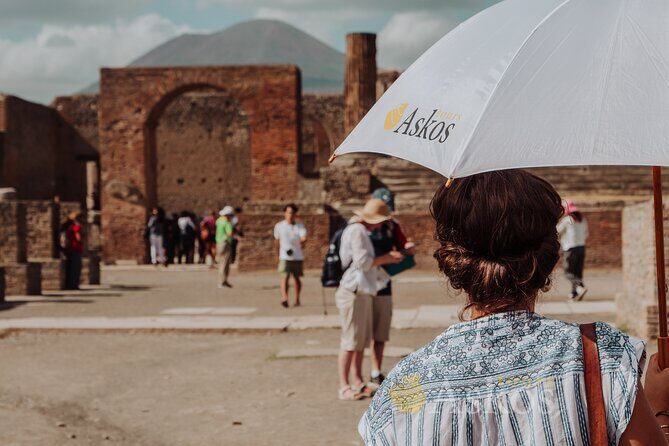
Pompeii isn’t hard to enter. The hard part is understanding what you’re seeing. That’s where the archaeologist-led portion earns its keep.
During the Pompeii time, you get 2 hours of interpretation by an archaeologist guide. In real departures, guides have included people like Teresa, Nicoletta, Raffaela, Anna, Benedetto, and Antonella—each bringing the ruins alive with stories tied to layout, daily routines, art, and what life may have looked like before the eruption.
What I like about this format is that it prevents the common problem of you seeing impressive walls and then leaving with vague impressions. With an archaeologist steering you, you’re not just taking pictures of rooms—you’re learning what the buildings were for, and why certain details show up in the street and courtyard spaces.
And because the day then moves to Vesuvius, you don’t have time to get lost in perfection. That’s a feature for many people: you leave Pompeii with a clear mental map, not just a pile of photos.
Forum to theaters: what you’ll actually see at each Pompeii stop
You’ll pass through several headline areas that explain how Pompeii worked as a town—public life, commerce, bathing, entertainment, and elite homes. The stops are short (often around 10 to 15 minutes for the smaller sights), but each one is chosen for meaning.
The ancient main square: Foro de Pompeya
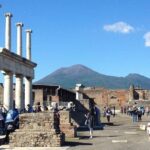
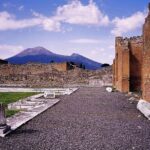
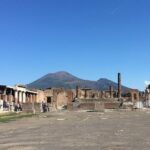
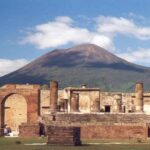
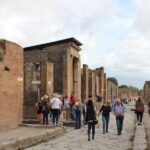
You get a look at the ancient main square, where civic life would have centered. Even if you only have a few minutes, this stop helps you anchor the city’s layout: you start to recognize how streets connect to major public spaces.
Granaries of the Forum: marble tables, fountain basins, and casts
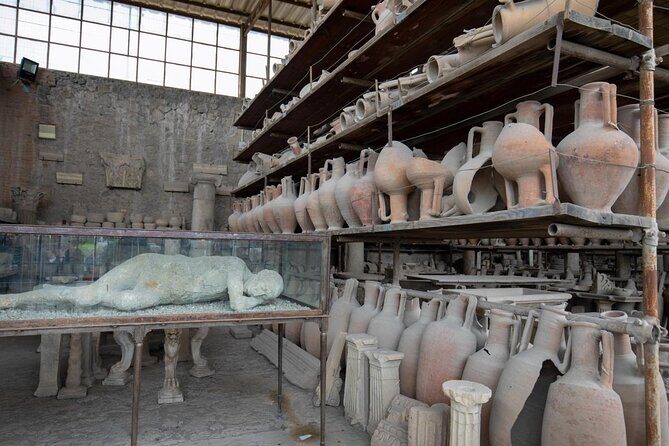
This is one of the more memorable stops because it combines infrastructure and human stories. You’ll see marble tables and bath-like basins linked to fountains at house entrances. You also see casts of victims from the eruption, including a dog and even a tree cast—details that make the tragedy feel painfully specific rather than abstract.
If you’re the type who likes specifics, this is a good place to slow your pace. Even with a quick stop, you can focus on one or two features and really read the setting.


House of Menander: a top-tier private residence
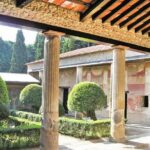
This house is described as one of the richest Pompeii residences for architecture, decoration, and contents. You’re not going to tour it like a museum with an hour of roaming, but the point here is to show you what elite domestic life could look like—where art and design signaled status.
Stabian Baths (Terme Stabiane): the oldest thermal complex
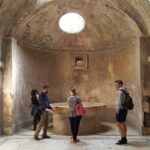
The Stabian Baths cover a vast area and are presented as the oldest thermal complex in the city. You’ll get a fast orientation to the bathing culture—why baths mattered socially, not just hygienically.
Lupanar: Pompeii’s most famous brothel
This is the stop that makes a lot of people sit up, because it’s not a vague ruins-in-the-distance moment. The Lupanar is singled out as the most famous brothel in Pompeii. It’s a jarring subject, but that’s part of why guided interpretation helps: you’re seeing evidence of ordinary human behavior and social realities, not just grand temples and fancy homes.
House of the Faun: big private residence energy
The House of the Faun is one of the largest and most impressive private residences. This stop is useful if you want to compare elite space to public space. You start to feel how different Pompeii life could be depending on who you were and what you owned.
Teatro Piccolo and Teatro Grande: entertainment in stone
You’ll get looks at Teatro Piccolo and then the Teatro Grande, identified as Pompeii’s most important theater. Even short stops work because the theaters show you how the city structured leisure and public gathering.
If you want one “wow” building among the ruins, Teatro Grande is the place to pay extra attention to how the space is shaped for viewing and sound.
A time reality check
Because you’re also hiking Vesuvius, you won’t see all of Pompeii in one day. The value is that you’ll see the major anchors and leave with a stronger sense of what each type of building reveals about the city.
The transfer that saves your sanity: minibus and practical flow
Pompeii to Vesuvius can turn into a logistics headache if you’re trying to DIY with buses and connections. This tour uses a modern minibus transfer, keeping the day controlled.
You’re also not carrying the worry of timing between Pompeii and the volcano. The plan runs the Pompeii portion first, then transitions you toward Vesuvius National Park, and later brings you back to Porta Marina Superiore to end the day.
A couple small things to keep in mind based on what I’ve learned from real trip experiences: long drives up winding roads can feel intense for some people, so if motion sickness is an issue, you’ll want your go-to remedy ready. Also, make sure you use restroom stops when the timing allows, because the day is structured and the next segment moves on.
Vesuvius crater walk: smoking edge, steep steps, and weather’s big role
This is the part you’ll talk about later—if you prepare for it.
What you’re promised at the top
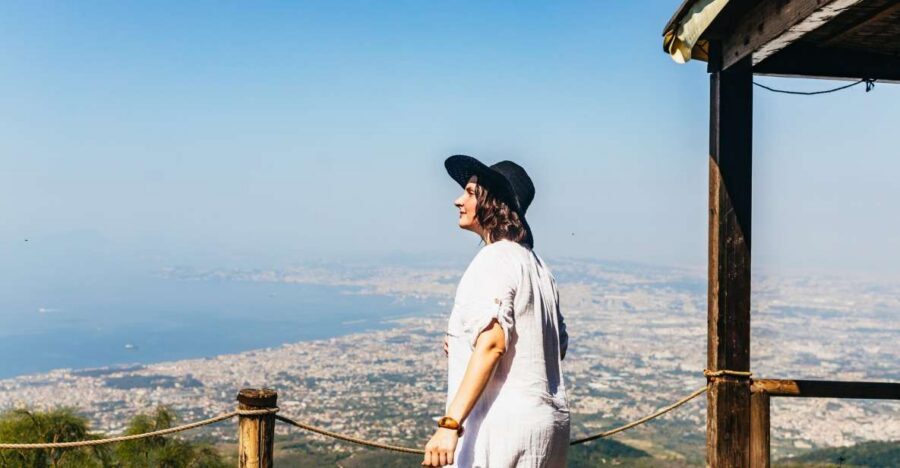
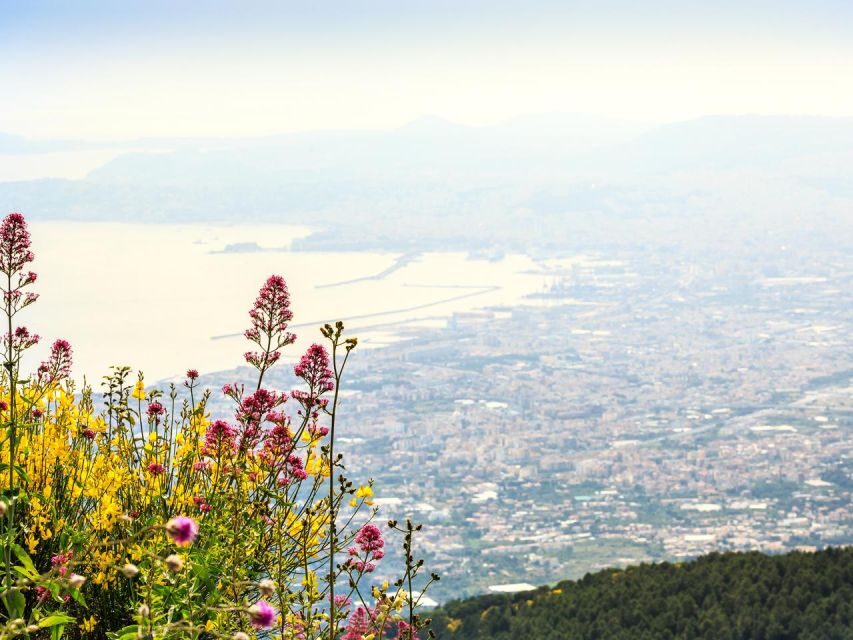
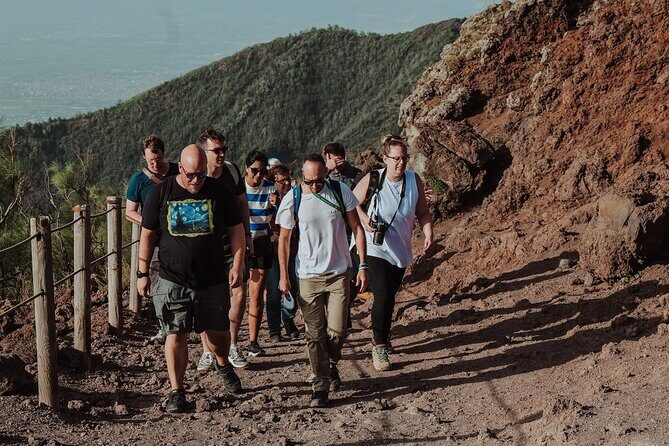
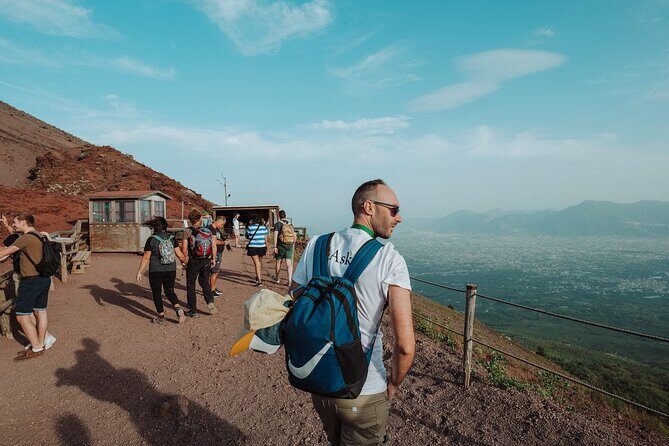
In good conditions, you’ll reach the crater area and see it still smoking slightly. You’ll also get a panorama of the Bay of Naples, with views that can extend to Capri, Ischia, and parts of the Sorrento coast.
The walk details that matter for your body
The tour notes two key physical realities:
- From the Vesuvius entrance, the first 30 minutes involve steps to reach the crater area.
- The last 500m is a very steep uphill walk.
That’s why closed-in shoes are strongly emphasized. And it’s why “comfortable shoes” alone may not be enough if you’re not used to steep uphill on loose rock. If you’ve done hills in flat city shoes, you already know how quickly your feet get unhappy.
Also, the summit can be windy. One guide named Mario has been praised for pacing the climb to match the group, and another guide named Simona has been highlighted for encouragement for people who struggled a little on the ascent. That support matters when the terrain gets steep.
Weather reality: when visibility drops fast
Even when the day is moving, conditions can change quickly at altitude. Dense fog, wind, or rain can shrink your view to a few meters—making the crater feel unreachable even when you’re standing right at it.
This tour’s big advantage is its built-in response: if Vesuvius isn’t accessible due to force majeure, you’ll visit Herculaneum instead.
That backup isn’t a downgrade if you’re okay with the change. Herculaneum is closer in feel and often more intimate in what’s preserved, and it helps you complete the story of the region after Pompeii.
Herculaneum as the backup plan: a smarter use of a weather change
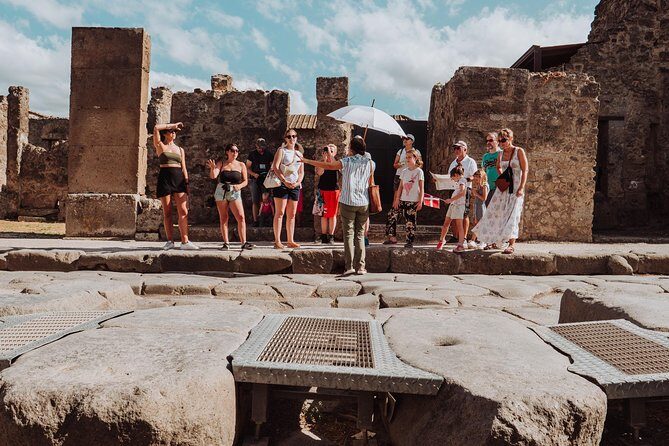
The tour explicitly states a weather plan: if Vesuvius can’t be visited due to force majeure, the day includes Herculaneum instead.
On at least some departures, Herculaneum has been led by guides like Luciano, described as funny and entertaining while still keeping the day meaningful. Even if the crater is hidden, the switch keeps the outing from turning into a wasted hike.
From a decision-making standpoint, I like this approach. You’re still spending time with historical interpretation rather than being stuck on-site. And you’re still getting your eruption-region context, which is the real scientific and historical theme tying Pompeii and Vesuvius together.
Timing, stamina, and what to pack for this 8-hour hit
This is listed as needing moderate physical fitness. It’s not framed as extreme, but the volcano walk has steep segments, and the first part involves stepping. It’s also not recommended for mobility or walking issues.
Here’s what you should plan to bring:
- Closed-in shoes with grip for loose rock and steep uphill stretches.
- Sunglasses and sunscreen in summer.
- Water and snacks are on you, since food and drinks aren’t included.
If you’re traveling in hot months, expect heat to play a role. One trip account flagged the difficulty during intense heat, with many people choosing to turn back before reaching the top. That’s your cue to go in honest about your endurance, not to treat the hike like a casual stroll.
Also pack one weather-minded layer. Even in warm seasons, the summit can feel colder and windier than lower ground. A light jacket can be the difference between “fine” and “miserable” once you stop moving.
Price and value: what $119.77 gets you, plus the small extra you should expect
The listed price is $119.77 per person. Here’s what you’re paying for that makes the value feel real:
- 2-hour Pompeii guidance by an archaeologist.
- Mount Vesuvius admission fees handled as part of the tour inclusions.
- Transportation by modern minibus from Pompeii and back.
- Mount Vesuvius hike support by a licensed hiking guide.
- Small group structure (max 14 people).
Food and drinks are not included, so you should budget for lunch and any water you’ll want on the day.
One detail to understand: the tour notes a Mount Vesuvius entry ticket amount of 11.00 euros. The inclusions say Vesuvius admission fees are included, so in practice you likely won’t need to pay that at the gate—but it’s still smart to check your booking confirmation so there’s no surprise on the day.
Who should book this Pompeii and Vesuvius tour
This tour fits well if you want:
- A guided Pompeii experience that helps you connect the dots fast.
- The chance to hike up to the crater area for the views when conditions allow.
- A structured day with transfers handled, in English, with a small-group feel.
It might not be your best match if:
- You have mobility limitations or trouble with uphill climbs and steps.
- You want a slow, unhurried tour of every corner of Pompeii. This is a strong highlight route, not a full deep exploration.
- You’re traveling with very young kids. Children under 6 aren’t allowed.
If you’re a history person, a geology person, or just someone who wants the eruption story explained with both ruins in one day, it’s a solid fit.
Should you book it? A quick decision checklist
Book it if you’re okay with a steep hike and you want your day to be organized around Pompeii’s biggest anchors plus the crater trail. I’d also book it if you like having experts steer your attention—especially in Pompeii, where an archaeologist makes the structures feel legible instead of random.
Skip it if steep walking is a deal-breaker for you, or if you’re hoping for a full-day “roam and discover” style experience inside Pompeii alone. This tour is built to cover both places, so you get fewer hours in Pompeii than you might want—but you gain a volcano crater experience that many people don’t manage at all.
FAQ
How long is the Pompeii and Mount Vesuvius small group tour?
It runs about 8 hours.
Is the tour offered in English?
Yes, it is offered in English.
Where do we meet, and where does the tour end?
You meet at Via Villa dei Misteri, 2, 80045 Pompei NA, Italy. The tour ends back at the same meeting point.
What is included for Pompeii?
You get 2 hours of guidance at the Pompeii archaeological park by an archaeologist, and the Pompeii admission ticket is included.
How difficult is the Vesuvius portion?
It’s not recommended for people with mobility or walking impairments. The tour notes moderate physical fitness, includes steps during the first 30 minutes, and has a very steep last 500m uphill section, so you should wear closed-in shoes.
What happens if Vesuvius is not accessible?
If Vesuvius is not accessible due to force majeure, the tour includes a visit to Herculaneum instead of Vesuvius.
Is food and drinks included?
No. Food and drinks are not included.
Extra: free cancellation
Can I cancel and get a full refund?
Yes. Free cancellation is available, and you can cancel up to 24 hours in advance for a full refund.