REVIEW · POMPEII
Fast Access Exclusive Private Ancient Pompeii Half Day Tour with Local Guide
Book on Viator →Operated by Private Tours of Pompeii · Bookable on Viator
Pompeii, minus the chaos. This fast-access private tour is designed to get you into the UNESCO site smartly, then keep you moving with a local who can explain what you’re actually seeing. I love the skip-the-line advantage and the way the guide can steer the visit toward your interests, whether that’s mosaics, plaster casts, or daily Roman life.
You also get a tight, efficient route—2 hours that cover the big sights without turning your day into a slog. One possible drawback: it’s a whirlwind format, so if you’re the type who wants to read every sign slowly and linger for long photo stops, you may feel slightly rushed.
In This Review
- Key highlights that make this tour work
- Skip-the-line momentum from Piazza Esedra
- UNESCO Pompeii: what you should look for right away
- Teatro Grande: Rome’s entertainment in a 5,000-seat shell
- Odeon / Teatro Piccolo: a smaller stage with big contrasts
- Via dell’Abbondanza: the main street where daily life had shape
- Terme del Foro: Roman bathing routines in the heart of the city
- Lupanar: a frank look at social life and surviving frescoes
- Value check: does $203.95 make sense for a private 2-hour tour?
- Who this tour is best for
- Practical tips that make the morning or afternoon smoother
- Should you book this fast-access private Pompeii tour?
- FAQ
- How long is the Pompeii half-day private tour?
- Is this tour private or shared?
- What language is the tour offered in?
- Does the tour include admission tickets?
- Where does the tour start and end?
- Is hotel pickup or drop-off included?
- Is the tour okay for kids?
- What fitness level do I need?
- What if it rains?
- Is there free cancellation?
Key highlights that make this tour work
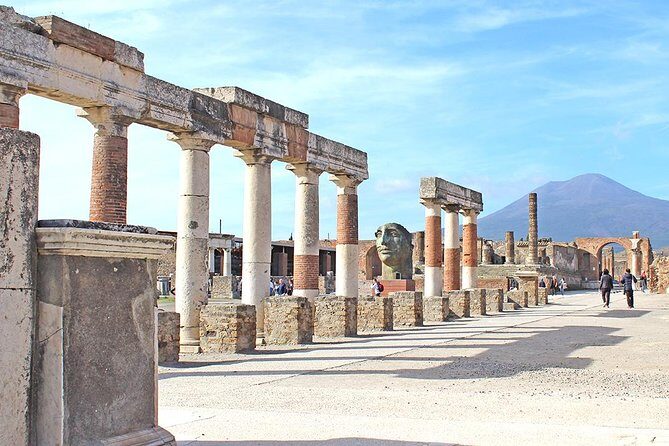
- Fast-access entry that helps you beat the busiest moments
- An art-historian-style approach to what’s on the walls and floors
- Two theatres in the open air, perfect for understanding Roman entertainment
- Via dell’Abbondanza for street-level context on shops and major homes
- Terme del Foro, where bathing routines come to life in ruins
- Lupanar, for a direct look at Roman social life and surviving fresco detail
Skip-the-line momentum from Piazza Esedra
The best thing about this tour is simple: it’s built for time. Pompeii can eat your morning (or your afternoon) with queues, bottlenecks, and dead time. Here, you’re set up with a guide and priority access so you spend more minutes inside the site and fewer minutes standing around.
Your starting point is Piazza Esedra (80045 Pompei NA), and the tour ends back there. That matters more than it sounds. You’re not figuring out transit from one end of the ruins to the other. You’re following a plan, with your guide handling the pacing.
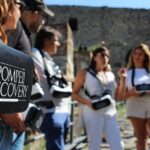
In guides you might meet, names like Anna, Livio, and Lello show up in past experiences—and you can expect that kind of energy. One guide-led tip that really lands: starting early means you often pass through gates before the thick crowds form, so the first rooms and streets feel more human-sized. Another helpful detail is that the guide can assist with photos while keeping everyone moving. That sounds minor until you’re holding a camera and trying not to block someone else’s view.
If you want to get your bearings fast, this tour format does that job.
You can also read our reviews of more guided tours in Pompeii
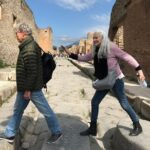
UNESCO Pompeii: what you should look for right away
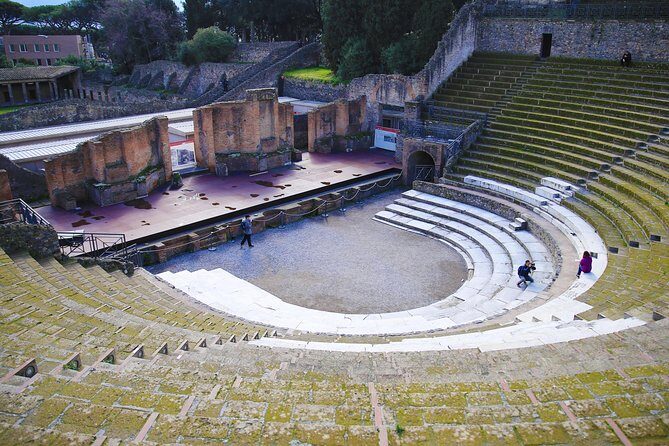
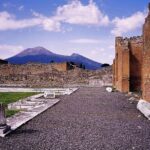
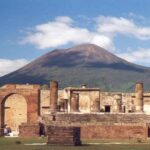
Pompeii isn’t one monument. It’s a whole city, and it can feel overwhelming at first glance. In a short tour, your guide’s job is to give you a framework—so the ruins stop looking like random piles and start behaving like places with a routine.
You’ll begin with access to one of Pompeii’s UNESCO areas, then move into major landmarks. The big advantage of a private guide is interpretation. A local can point out the details that are easy to miss on your own: where street flow likely directed people, how buildings relate to each other, and why certain spaces matter for everyday life.
A practical way to use the early minutes:
- Look for thresholds and doorways first. They tell you how people entered rooms and moved between spaces.
- Then shift to floors and wall decoration. That’s where Roman taste and wealth show up quickly.
Even if you’re not a classics person, you’ll start connecting the dots. The eruption becomes more than a date—you see how the city worked right up to the moment it stopped.
Teatro Grande: Rome’s entertainment in a 5,000-seat shell
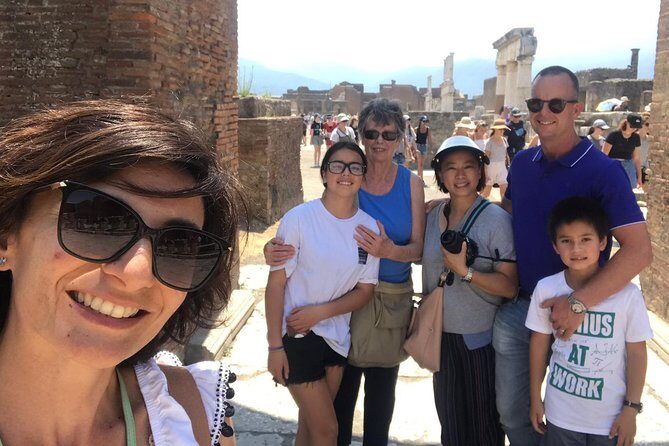
Next comes Teatro Grande, an outdoor theatre designed for serious audience capacity—about 5,000 seats. The main thing you’ll notice is how Roman entertainment was built for the sun, the wind, and crowds. This is not an indoor hush kind of venue. It’s an open-air stage where acoustics and sightlines were part of the design.
A good guide here will help you understand the theatre as a social machine:
- People gathered.
- News and status played out.
- Performances weren’t separate from daily life—they were a big public event.
The challenge for visitors is that theatres can feel visually similar from a distance if you don’t know what to look at. In a short tour, your guide’s commentary helps you pick out why this specific theatre layout mattered.
One small downside: because it’s open air, you’ll feel weather fast. It’s great on a clear day. If it’s cold or rainy, dress accordingly.
Odeon / Teatro Piccolo: a smaller stage with big contrasts
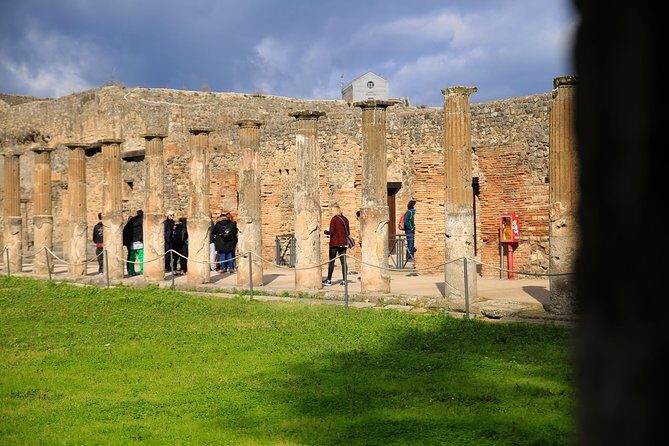
From the big theatre, you’ll move to Odeon / Teatro Piccolo, the smaller open-air theatre for about 800 seats. This size difference changes the vibe. It’s a reminder that Roman entertainment came in levels—public spectacle on one end, more intimate performances on the other.
What I like about pairing these two stops is the contrast. You’re not just ticking boxes. You’re learning how the Romans scaled culture for different audiences and purposes.
If you enjoy architecture or how spaces shape behavior, this is a strong segment. You can compare the feel of the spaces without needing a long lecture. Your guide can also point out how these theatres connect to surrounding streets and how they fit into the city’s overall plan.
Via dell’Abbondanza: the main street where daily life had shape
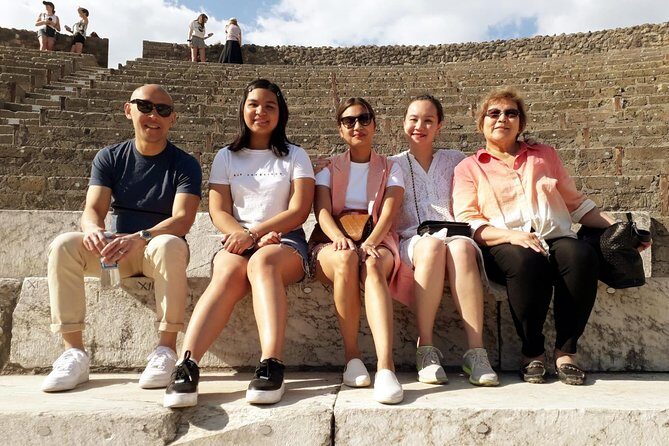
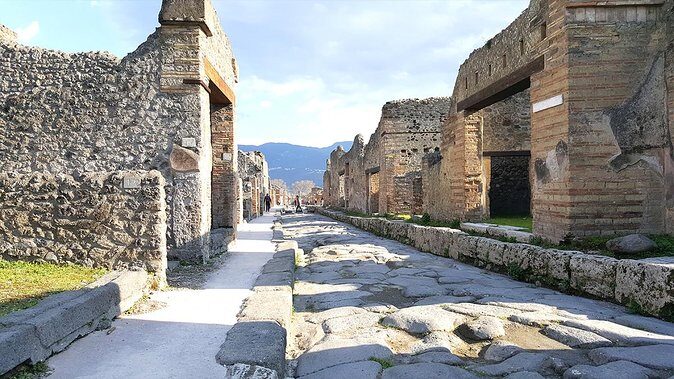
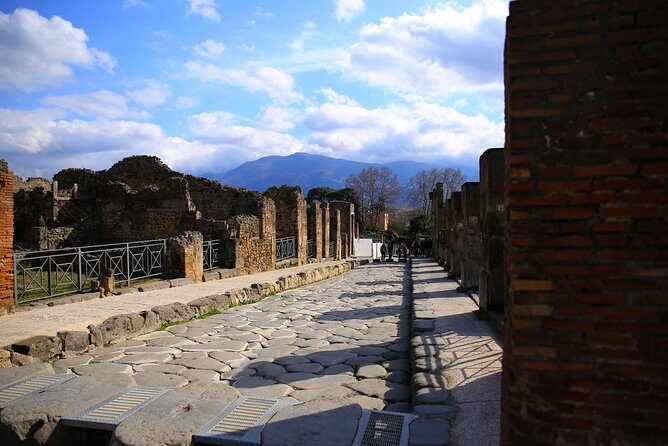
Then you’ll walk along Via dell’Abbondanza, Pompeii’s major street lined with major villas and ancient Roman shops. This is where Pompeii stops being about big public venues and starts feeling like a working town.
Walking this main street is valuable because it gives you scale. From a distance, ruins can look flat or disconnected. Up close, you begin to sense how people moved—how storefronts likely faced foot traffic, and how homes positioned themselves relative to the street.
For shoppers-at-heart, this is where you can picture what commerce looked like:
- People living above or near business spaces.
- Visitors passing by.
- Goods and services flowing down a main artery.
A drawback of a walking street stop is that your time can shrink if the group slows down for pictures. If you’re photographing, keep it efficient: grab the shot, then move on. Your guide’s pacing is part of the value.
You can also read our reviews of more private tours in Pompeii
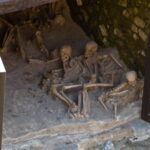
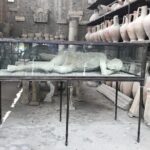
Terme del Foro: Roman bathing routines in the heart of the city
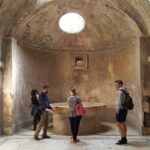
Next is Terme del Foro, the Roman bath complex buried by the eruption in 79 A.D. Baths in Pompeii are more than a bathroom stop. They’re a window into routine, community, and status.
You’ll see how the bath complex was built for different stages and spaces, and how people spent time there—not just to get clean, but to socialize and unwind. A private guide helps you understand the layout without you needing to decode it alone.
In practical terms, this stop is ideal if you want the daily-life side of Pompeii. The theatre tells you about public culture. The bath complex tells you about the rhythm of ordinary days.
One consideration: ruins surfaces can be uneven. Even with moderate fitness, keep your footing steady and take your time on transitions.
Lupanar: a frank look at social life and surviving frescoes
Finally, you’ll visit the Lupanar, an ancient Roman brothel. This stop is often the one people talk about later, mostly because it’s direct and specific. Some frescoes still show visible detail, and they relate to the specialization of the women working.
This is not a comfortable topic for everyone, and you may find it emotionally jarring if you prefer purely heroic archaeology. But as a historical snapshot, it’s powerful because it shows that Pompeii wasn’t only temples and mansions. It included human needs, commerce, and the kinds of jobs that existed in real cities.
What makes it work in a guided format is context. A good guide can keep the conversation from becoming gossip and instead frame what the imagery and layout likely meant in its time.
Value check: does $203.95 make sense for a private 2-hour tour?
At $203.95 per person for about 2 hours, this isn’t a budget activity. So the key question is value per minute—and per hassle avoided.
Here’s what you’re paying for, in concrete terms:
- Private tour with only your group.
- A local guide plus professional art historian guidance style support.
- Guaranteed skip-the-long-lines access.
- Admission tickets included for the sites you visit on the route.
When Pompeii is crowded, line time can quietly wreck a half-day plan. If you’d rather spend money to buy back your day, this is the logic behind this tour.
This is also good value if you’re traveling with a couple or small group and you want the kind of explanation you won’t get from a simple audio app. The guide’s job—especially in a short time window—is to point out the right details fast.
If you’re a solo visitor with lots of patience and you don’t mind navigating crowds on your own, you might choose a lower-cost self-guided route. But if your time is limited, paying for access and interpretation often feels fair.
Who this tour is best for
This tour is a strong fit for people who:
- Want a time-efficient Pompeii visit without getting stuck in lines.
- Like learning the meaning behind what they see, not only the dates.
- Are traveling as a couple, family, or small group who benefit from private pacing.
It also suits you if you want morning or afternoon flexibility. The tour offers either morning or afternoon options, so you can match your energy and the rest of your day on the Naples/Pompeii circuit.
The main limitation is physical tempo. You should have moderate physical fitness for walking between stops and moving at a brisk pace. Also, if you’re bringing kids, they must be accompanied by an adult.
Practical tips that make the morning or afternoon smoother
Pompeii runs on real-world conditions: sun, wind, mud, and uneven ground. A few things help you get the most from the tour:
- Dress for weather. The tour operates in all weather conditions, so plan for rain or shine.
- Wear stable shoes. You’ll be walking inside a ruin site with uneven surfaces.
- Bring your passport. A current valid passport is required on the day of travel.
- Use the mobile ticket. You’ll have a mobile ticket, which keeps check-in simpler.
- Meet right on time at Piazza Esedra. You’ll start there and return there, so don’t plan to wander first.
If you’re coordinating transit, the meeting area is near public transportation, which is handy if you’re not doing a hotel pickup. Hotel pickup and drop-off are not included, so factor in how you’ll reach Piazza Esedra.
Should you book this fast-access private Pompeii tour?
I’d book it if your priority is getting into Pompeii quickly and making a 2-hour window feel like a real guided experience, not a hurried stampede. The combination of priority access, art-historian-style interpretation, and a route that moves from public entertainment (theatres) to daily life (street shops and baths) to frank social reality (the Lupanar) is a smart mix.
Skip this one if you’re planning a slow, solo read of every corner, or if you know you won’t like being steered through a tight schedule. In that case, you might prefer more time on your own.
If you want Pompeii with direction and less waiting, this tour is a strong call.
FAQ
How long is the Pompeii half-day private tour?
The duration is about 2 hours.
Is this tour private or shared?
It’s a private tour. Only your group participates.
What language is the tour offered in?
The tour is offered in English.
Does the tour include admission tickets?
Yes. Admission tickets are included for the Pompeii sights you visit on this route.
Where does the tour start and end?
It starts at Piazza Esedra, 80045 Pompei NA, Italy, and ends back at the same meeting point.
Is hotel pickup or drop-off included?
No. Hotel pickup and drop-off are not included.
Is the tour okay for kids?
Children must be accompanied by an adult.
What fitness level do I need?
Moderate physical fitness is recommended due to walking through the site.
What if it rains?
The tour operates in all weather conditions. Dress appropriately.
Is there free cancellation?
Yes. You can cancel for a full refund up to 24 hours in advance of the experience start time.