REVIEW · POMPEII ARCHAEOLOGICAL SITE
Pompeii: Entry Ticket with Optional Audio Guide
Book on GetYourGuide →Operated by GetYourGuide Tours & Tickets GmbH · Bookable on GetYourGuide
Pompeii makes the past feel right under your feet. With a reserved ticket and an optional audio guide, you get to wander this UNESCO site at your own pace, from preserved Roman streets to the places people used for daily life. I especially like the reserved entry setup and the way the audio guide can act like a practical orientation aid once you’re inside. One thing to watch: the audio guide pickup/return happens at the official desk near Porta Marina Superiore, and the first-time signage can be a little confusing.
This is also a ticket that lets you match Pompeii to your time. If you choose Pompei Express, you focus on the ancient city core; pick Pompei+ if you want the famous suburban villas too. Bonus: there’s free luggage storage, so you’re not playing bag Tetris all day on uneven ground.
In This Review
- Key things to know before you go
- Pompeii Ticket Value: Why Reserved Entry Plus an Audio Guide Works
- Choosing Pompei Express vs Pompei+: Pick Your Pompeii Style
- Entering Pompeii at Porta Marina Superiore: Get Your Audio Guide Set Up Fast
- How the Audio Guide Helps You Actually See Pompeii
- Pompeii Highlights That Make a Self-Paced Day Worth It
- Roman streets and the lived-in city feel
- The Forum-like energy: markets and everyday stops
- Baths and mosaics
- Villas and fresco-filled rooms (especially with Pompei+)
- Temples, theaters, and the amphitheater
- Vesuvius context and the eruption story
- Route Planning for a One-Day Ticket (So You Don’t Lose the Day)
- Timing tips that actually help
- Practicalities: What Makes This Ticket Feel Easy (and Where It Can Feel Messy)
- What works well
- What you should plan for
- Who This Pompeii Audio Ticket Is For
- Should You Book This Pompeii Entry Ticket With Optional Audio Guide?
- FAQ
- What’s included with the Pompeii entry ticket and optional audio guide?
- What’s the difference between Pompei Express and Pompei+?
- Where do I pick up the audio guide?
- What languages are available for the audio guide?
- Can I use Bluetooth headphones with the audio guide?
- What do I need to bring for entry and for the audio device deposit?
- Is luggage storage available?
- Is the site wheelchair accessible?
- What are the last entry times for the Pompei+ option?
Key things to know before you go

- Pompei Express vs Pompei+ matters: Plus includes the Villa of the Mysteries area (and more suburban sites), while Express keeps it to the ancient city.
- Audio guide pickup is specific: Collect and return the device at the audio guide desk inside the archaeological site near Porta Marina Superiore.
- Headphones aren’t included and Bluetooth won’t work with the audio device, so plan accordingly.
- The site is big and hilly: you’ll want a route plan if you only have a few hours.
- You’ll need an ID deposit to rent the audio guide device (and bring your passport/ID for the visit).
Pompeii Ticket Value: Why Reserved Entry Plus an Audio Guide Works

For many big European ruins, the hard part isn’t seeing the place. It’s the friction: lines, uncertainty, and trying to figure out what matters most before your energy runs out. This Pompeii entry ticket is built to reduce that stress. You select a one-day time window, show your voucher at the entrance, and then go straight into self-paced exploring.
At $26 per person, the value is strongest for people who want independence but still want context. The audio guide adds the missing layer: names, dates, and what you’re actually looking at. Without that, Pompeii can feel like a really beautiful stone maze. With it, the ruins start to behave like a real neighborhood.
The reserved approach also helps with one of Pompeii’s biggest practical issues: timing. If you show up with no plan during peak hours, you can burn energy waiting. Here, you’re trying to avoid the “stand around and hope” version of Pompeii.
You can also read our reviews of more tours and experiences in Pompeii Archaeological Site



Choosing Pompei Express vs Pompei+: Pick Your Pompeii Style

This ticket comes in two formats, and the difference affects how your day will feel.
Pompei Express is the simpler choice. It includes the ancient city of Pompeii, without the suburban villas such as the Villa of the Mysteries. If you’re short on time or you know you want the classic streets and big public spaces, Express keeps things focused.
Pompei+ includes everything in Express plus the suburban villas and the Antiquarium in Boscoreale, specifically:
- Villa of the Mysteries
- Villa of Diomedes
- Villa Regina (in Boscoreale)
- Antiquarium
If you care about the villa frescoes and the side of Pompeii that feels more like a lived-in Roman estate, Plus is usually the better match. It costs a bit more, but you’re paying for extra sites you would otherwise have to prioritize (or track down later). For many first-timers, the villas are what make Pompeii go from impressive to personal.
One more timing consideration: Pompeii+ has a later shutoff feel but still a hard last entry time. In winter (Nov 1–Mar 31), the last entry is 3:30 p.m. In summer (Apr 1–Oct 31), it’s 5:30 p.m. If you’re arriving later in the day, Express can be the safer bet.
Entering Pompeii at Porta Marina Superiore: Get Your Audio Guide Set Up Fast

Your smoothest experience starts before you even start walking.
After you arrive, you show your ticket/voucher at the door and begin exploring. The audio guide pickup and return work differently than a lot of attractions. Audio guides can only be handled at the park’s official audio guide desk near the ticket office, inside Pompeii’s site area, at Porta Marina Superiore.
Here’s what that means for your planning:
- If you selected the audio guide, don’t treat it like a quick add-on. Treat it like the start of your route.
- If you’re arriving hungry or tired, you’ll want to get the audio sorted first, then explore while your focus is still sharp.
A few audio-guide practical notes matter a lot:
- Headphones aren’t included.
- Bluetooth headphones don’t work with the audio device. Plan on using the type of headphones that are compatible with the device.
- You’ll need a valid ID as a deposit to rent the audio device.
- The audio guide system is available in multiple languages (including English, Italian, Chinese, Japanese, Portuguese, Russian, German, and French).
Also, don’t assume the first gate entrance is always the best one. When lines are long, you might find there’s a better lane further along, so keep your eyes open and follow posted directions.
How the Audio Guide Helps You Actually See Pompeii

The main benefit of an audio guide at Pompeii isn’t just narration. It’s what I call the “don’t waste your brain” factor. Pompeii is massive, and many buildings look similar from a distance. The audio helps you connect what you hear to where you’re standing.
You can use it as:
- A way to learn what the space was for (market, baths, temples, theaters)
- A way to remember why a building matters
- A way to keep moving so you don’t get stuck in “okay, which way now?” mode
That said, Pompeii has some friction built in. Some spots are spread farther apart than your instincts expect. The audio guide will likely send you toward big highlights like the amphitheater and the dramatic preserved areas such as the places associated with the Vesuvius eruption context. One smart tactic is to expect a long walking day, then use audio to break it into chapters instead of trying to do everything at once.
If you run into device/map quirks, don’t panic. Re-check where the audio is pointing you, because the site layout can make it easy to feel like you’re “not in the right place” even when you are. The audio desk is there for a reason—use it if you need clarification.
Pompeii Highlights That Make a Self-Paced Day Worth It

Pompeii’s appeal is that it’s not just ruins. It’s daily life frozen in volcanic ash. This ticket lets you explore that at your own speed, which is ideal because Pompeii rewards lingering.
Here are the big zones and what they’re like:
You can also read our reviews of more guided tours in Pompeii Archaeological Site



Roman streets and the lived-in city feel
You’ll walk streets preserved by volcanic ash, which is a kind of time travel that’s hard to explain until you see it. The city layout makes it easy to imagine where people walked to work, where they stopped for food, and where they gathered.
This is also where the audio guide earns its keep: it helps you connect the architecture to routine. When you understand what you’re looking at, the ruins don’t stay silent.
The Forum-like energy: markets and everyday stops
In Pompeii, “shopping” is a real concept even though the stalls are long gone. You can picture Romans picking up lunch in the market area. It’s one of those moments where the scale and the location combine to make it feel oddly modern.
Baths and mosaics
Public baths and their mosaics add a different kind of beauty: polished, patterned, and made for human bodies—not just ceremonies. If you like details, take your time here. You’ll often find mosaics that hold up well and give you a sense of how much Romans valued design even in utilitarian spaces.
Villas and fresco-filled rooms (especially with Pompei+)
With Pompei+, you get access to suburban villa sites where Pompeii turns from city into household life. The Villa of the Mysteries is a standout among these stops, known for its preserved frescoes. If you’re the kind of traveler who wants more than streets and amphitheater views, the villas are where your day gets extra texture.
Temples, theaters, and the amphitheater
Pompeii has religious spaces, performance spaces, and civic buildings that show Roman culture at full volume. You can stroll to temples of Venus, Apollo, and Jupiter, then shift your mood when you reach theaters and the amphitheater.
One of the most powerful experiences is simply imagining the crowd. Sit in your head for a minute: audience in front, actors or speakers in the center, Pompeii’s eruption story looming in the background like a heavy second plot.
Vesuvius context and the eruption story
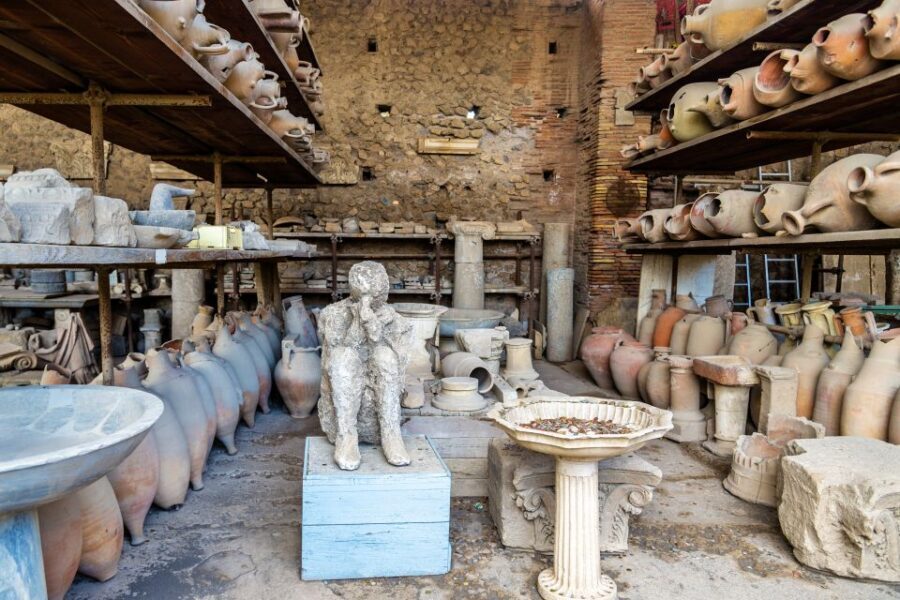
On the morning of August 24, AD 79, Vesuvius erupted and took Pompeii’s residents by surprise. The event killed inhabitants and buried the city under ash. This ticket doesn’t just give you structures; it gives you the context that makes the structures matter.
Route Planning for a One-Day Ticket (So You Don’t Lose the Day)

You’ll get a one-day validity, but the actual experience depends on your pacing and the option you chose.
A good mindset:
- Do the main ancient-city core first if you bought Express.
- If you bought Plus, decide early whether you’re going to prioritize the villa stops or the ancient city core and let the other be the bonus.
Also remember:
- Some highlights can be farther apart than you expect.
- Pompeii is big, and you’ll likely walk a lot on uneven stone.
If you’re going with kids or you just want a manageable day, you can use the audio to choose a few “must hit” clusters (amphitheater + baths + a temple area, for example) and then fill in the gaps.
Timing tips that actually help
- Aim to arrive earlier if you can. Cooler walking and fewer crowds make it easier to focus on ruins, not queues.
- If you’re doing Pompeii+ in summer, don’t treat the last entry time like a suggestion. Plan backwards from 5:30 p.m. last entry.
- In winter, the 3:30 p.m. last entry for Plus is the kind of detail that decides whether you’ll feel rushed.
Practicalities: What Makes This Ticket Feel Easy (and Where It Can Feel Messy)
This is one of those experiences where the “system” matters as much as the “site.”
What works well
- Phone vouchers: you don’t need to guess about printing right away.
- Free luggage storage: you can travel lighter and explore more comfortably.
- Wheelchair accessible: the ticket/entry is described as wheelchair accessible, which helps with planning.
- More autonomy: no guided-lecture schedule, so you can slow down when something catches your eye.
What you should plan for
- Audio guide setup has steps: you’ll need to rent/collect and return the audio device at the specific desk near Porta Marina Superiore.
- Headphones matter: Bluetooth won’t work with the audio device, and headphones aren’t included.
- Not every stop may match the audio perfectly: some buildings can be closed or not accessible at certain times, and you might end up hearing about places you can’t fully view.
- Signposting at the start can be unclear: if you feel pulled between entrances, step back, read the signs, and aim for the correct access path for your voucher and audio desk needs.
Who This Pompeii Audio Ticket Is For

This ticket fits best if you:
- Want a self-paced Pompeii day (not a rigid guided tour).
- Like using context to make sense of ruins.
- Prefer paying for a ticket plan rather than gambling on lines and on-the-spot logistics.
It’s also a good choice for mixed groups:
- Adults who want history but also want freedom
- Families who can move at kid-speed
- Anyone who wants the ability to stop often without feeling guilty about it
If you absolutely love guided interpretation and want every building explained in real time, you might prefer a guided tour instead. But if your goal is “I want to see a lot and understand what I’m seeing,” the optional audio approach is a strong middle ground.
Should You Book This Pompeii Entry Ticket With Optional Audio Guide?

Book it if you want a smooth, independent Pompeii day with context built in. The reserved entry reduces wasted time, and the audio guide gives you the sense-making that Pompeii really needs.
Choose Pompei Express if you’re short on time and mainly want the ancient city core. Choose Pompei+ if the villas are a priority and you’re comfortable planning around last entry times.
Skip (or reconsider) this exact format if you’re expecting a fully guided walk-through with a live guide in every area, or if you’re not willing to manage audio-guide equipment basics like ID deposits and non-Bluetooth headphone requirements.
If you can handle that, this is one of the most practical ways to do Pompeii: structured enough to feel easy, flexible enough to feel like your own day.
FAQ
What’s included with the Pompeii entry ticket and optional audio guide?
The ticket includes a reserved entry, plus an audio guide if you select that option. You get a physical audio guide (if selected) and also a digital audio guide option in supported languages. Headphones are not included.
What’s the difference between Pompei Express and Pompei+?
Pompei Express includes only the ancient city of Pompeii. Pompei+ includes the ancient city plus suburban villas: Villa of the Mysteries, Villa of Diomedes, Villa Regina in Boscoreale with Antiquarium.
Where do I pick up the audio guide?
You collect audio guides inside the Pompeii archaeological site at the official audio guide desk near the ticket office, at Porta Marina Superiore.
What languages are available for the audio guide?
The audio guide is available in multiple languages including English, Italian, Chinese, Japanese, Portuguese, Russian, German, and French.
Can I use Bluetooth headphones with the audio guide?
No. Bluetooth headphones don’t work with the audio guide device.
What do I need to bring for entry and for the audio device deposit?
You should bring a passport or ID card. A valid ID is required as a deposit to rent the audio guide device.
Is luggage storage available?
Yes, there is free luggage storage.
Is the site wheelchair accessible?
Yes, the activity is described as wheelchair accessible.
What are the last entry times for the Pompei+ option?
Last entry for Pompei+ is 3:30 p.m. in winter (Nov 1 to Mar 31) and 5:30 p.m. in summer (Apr 1 to Oct 31).