REVIEW · POMPEII
Pompeii from Afternoon to Sunset
Book on Viator →Operated by Enjoy Pompeii · Bookable on Viator
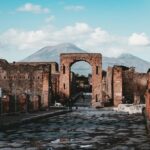
Pompeii looks best when the day softens. This afternoon-to-sunset tour uses the quieter hours to help you spot the big sights and understand what daily life meant in a Roman city frozen in 79 AD. You’ll get skip-the-line Pompeii admission (so you don’t burn time at the turnstiles), plus a guided walk that connects the Forum, Basilica, thermal baths, theaters, and even smaller details like a bakery and residential houses.
Two things I like a lot: you move through the site with a guide who keeps the story clear as you walk, and you end with time inside the archaeological park instead of rushing out at the first stop. One watch-out: you’re aiming for sunset, but the site can close before the real sunset time depending on the season—so don’t build your whole photo plan on the clock alone.
Key things to know before you go
- Skip-the-line entry: get in faster with your mobile ticket.
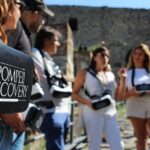
- Small group size (max 10): easier pacing and more room for questions.
- Must-see Pompeii stops: Forum, Basilica, thermal baths, theaters, bakery, and homes.
- Late-day lighting: warmer light and thinner crowds than peak hours.
- Stay until closing: the tour ends at the Forum, but you can keep exploring.
- Weather matters: the tour is only run in good weather.
In This Review
- Late Afternoon Timing: Why This Slot Works at Pompeii
- Meeting at Ristorante Bar Sgambati and Getting In Fast
- Pompeii’s Main Sights: Forum, Basilica, and the Street-Level Story
- Thermal Baths and Theaters: Public Life You Can Still Picture
- Your Guide Makes or Breaks the Experience
- End at the Forum: How to Use Your Extra Time Until Closing
- Price and Value: Is $65.31 a Good Deal for This Tour?
- When This Tour Fits Best (and When It Doesn’t)
- Should You Book Pompeii From Afternoon to Sunset?
- FAQ
- How long is the Pompeii from afternoon to sunset tour?
- How much does the tour cost?
- Is skip-the-line admission included?
- Is the entry ticket included in the price?
- What language is the tour offered in?
- What are the meeting and ending points?
- Can I stay in Pompeii after the guided portion ends?
- What isn’t included in the tour price?
Late Afternoon Timing: Why This Slot Works at Pompeii
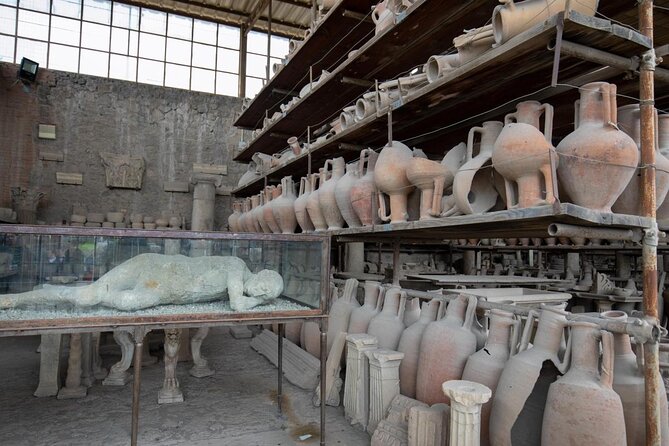
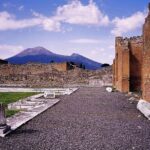
Picking Pompeii at the end of the day is not just about photos. Late afternoon is when the ruins start to feel less like an item on a checklist and more like a place you can read. The light turns angled and forgiving, and that helps you make sense of the big public buildings (the Forum and Basilica) and the places that feel more human (homes, the bakery, and the everyday street layout).
This tour also runs as a small group (up to 10), which matters more at Pompeii than at most sites. When you’re in a bigger crowd, you spend your energy dodging people instead of looking at details. Here, the pacing is designed so you can actually connect the dots: how Romans lived, worked, ate, prayed, and relaxed before the eruption of Vesuvius changed everything.
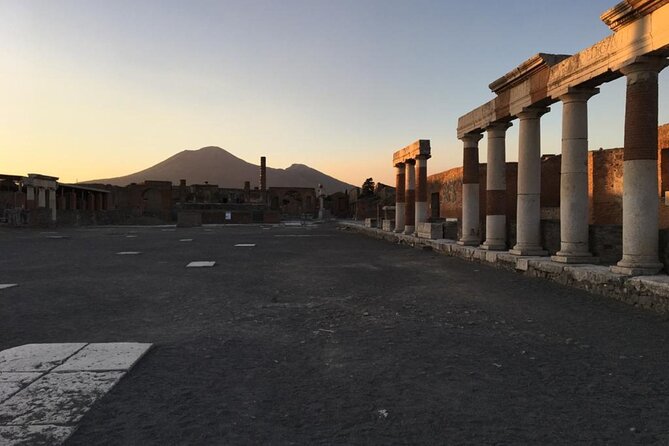
One more practical point: you’re “from afternoon to sunset,” but Pompeii doesn’t always cooperate with the idea of sunset. The site may close earlier than the sky does, especially depending on the time of year. The upside is still real—late day usually means fewer people—but it’s smart to treat sunset as a bonus, not a guarantee.
Meeting at Ristorante Bar Sgambati and Getting In Fast
Your start point is at Ristorante Bar Sgambati, Via Villa dei Misteri 1, Pompei. The end is at the Forum of Pompeii, Via Villa dei Misteri 2, right where you can continue exploring on your own.
The “fast start” is built in. You get a mobile ticket and skip the line admission, which is a big deal at Pompeii. When you’re losing 30–60 minutes to entry lines, the whole day plan shifts. With skip-the-line, you trade that waiting time for actual ruins time.
The tour also notes it’s near public transportation, which is helpful if you’re coming from Naples or the area without wanting to fight for parking. Parking isn’t included, so if you’re driving, you’ll want to plan that on your own.
Because the tour is only about 2 hours 30 minutes, arriving on time matters. You don’t want to start late and lose the whole rhythm of the walk. If you’re the type who likes to wander your first five minutes on your own, you’ll still get that later—since the guided portion ends and you can remain inside the site until closing.
You can also read our reviews of more tours and experiences in Pompeii.

Pompeii’s Main Sights: Forum, Basilica, and the Street-Level Story
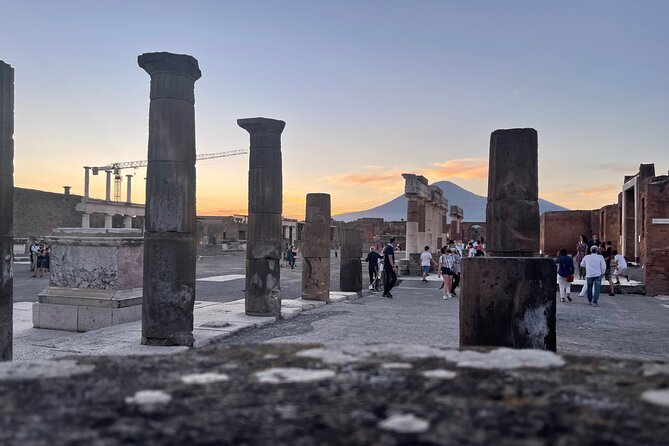
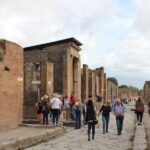
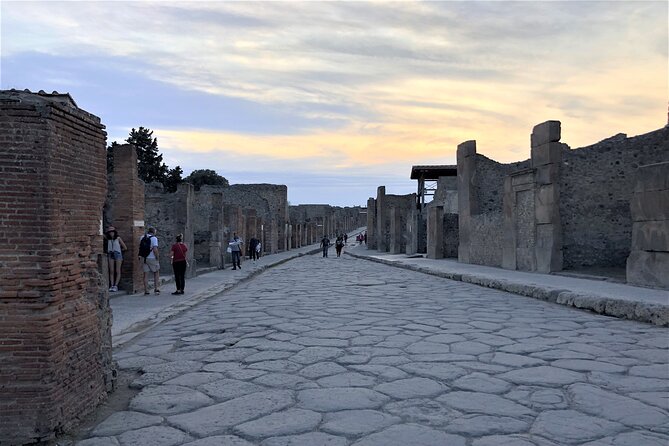
Once you’re through the entrance, the guide focuses on the Roman town as a living place, not just scattered ruins. Expect to walk through key parts and get help spotting how the city functioned—politics and religion in the big center, daily life in the streets and neighborhoods around it.
Here’s what you can look for during the walk:
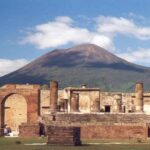
- The Forum: the civic heartbeat of the city, where public life happened.
- The Basilica: a major building that shaped how people moved through business and community matters.
- Important streets and structures: the guide ties these together so you’re not just looking at walls—you’re understanding layout.
- Residential houses: enough detail to picture how ordinary people lived day to day.
- A bakery: a small but satisfying stop that makes the city feel less abstract.
What makes this kind of guided route so valuable is the way it changes your interpretation. Without context, Pompeii can feel like “fascinating remains.” With a good guide, you start asking better questions: Why is this here? How would traffic work? What would this space have meant to a family living nearby?
The tour’s core promise is also time-based. You’re visiting from afternoon toward sunset, so you’re working with lighting that’s often kinder to outdoor ruins—and with a crowd level that typically drops compared to earlier in the day.
Thermal Baths and Theaters: Public Life You Can Still Picture
Not every stop at Pompeii feels equally “story-ready,” but the thermal baths and theaters tend to. These are the places where you can sense the social energy of a city—people gathering, chatting, performing, and relaxing in shared spaces.
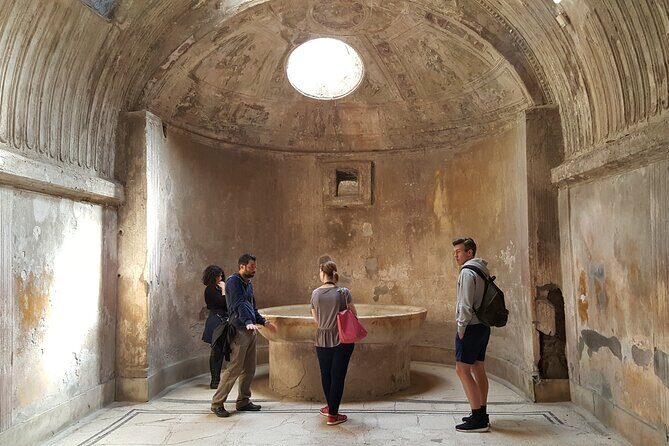
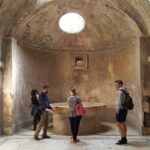
On this tour you’ll include the thermal baths and the theaters, along with other highlights like major civic areas. The thermal baths are especially good for comprehension because they show how Romans treated everyday comfort as part of public life. Even if your feet are tired, the design of the baths helps you understand routine: bathing wasn’t just hygiene; it was a social habit.
The theaters do something different. They show entertainment and public culture in physical form. When you visit near late-day light, the stone surfaces tend to look more textured and less gray, which makes it easier to imagine how crowds once filled the spaces.
One thing I’d keep in mind: the “best” stops are also the stops where time can run fast. The guide’s job here is pacing. With a small group, you can slow down enough to get meaning, not just photos. If you like asking questions, this is one of the better Pompeii setups because you’re not locked into a rushing line.
Your Guide Makes or Breaks the Experience
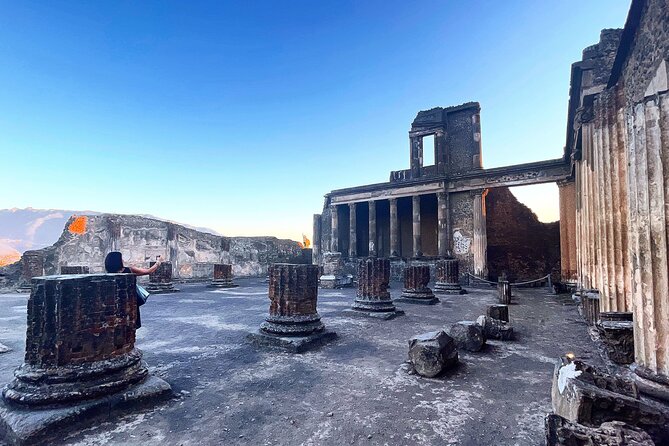
Pompeii can’t hide its scale, but it can overwhelm you if the narrative stays vague. What stands out in the past tours with this operator is that the guides focus on making the city readable as you walk, not dumping dates on you while you’re moving.
You may meet guides such as Frankie, Angelo, Francesco, Sasa, Melania, or Ornella—names that come up repeatedly—each praised for bringing Pompeii to life with clear storytelling and strong English. A few specific patterns show up in the feedback:
- Humor that keeps the tour from feeling like a lecture.
- Practical guidance on moving through the site so you’re not constantly stuck in the thickest crowd pockets.
- Good pacing and a willingness to answer questions beyond the main path.
Shade and comfort also show up in the comments. Late afternoon helps, but Pompeii still has exposed stretches. When a guide actively finds calmer spots or shadier pauses, the whole walk feels more manageable.
There’s also a subtle benefit to small-group tours: if your group is tiny—sometimes it can be just a couple people—the guide can adjust. That often turns the tour from a fixed script into a more tailored experience, where you can ask what you actually care about.
End at the Forum: How to Use Your Extra Time Until Closing
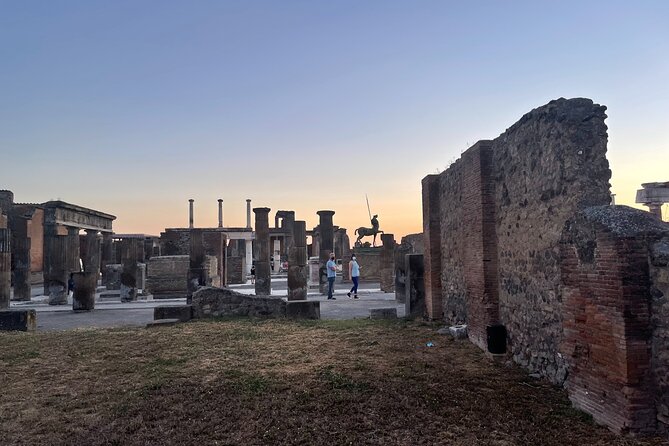
This tour ends at the Forum of Pompeii, but you’re not forced to exit immediately. You can stay inside the archaeological site until closing time. That changes the day in a practical way: you can use the guided route to get oriented, then return to the parts you want to linger on.
This is also where you can fix one of the most common Pompeii problems: seeing the big highlights but still feeling like your brain is overloaded. After the guided portion, your job is simpler:
- revisit the stops you liked most,
- take photos without checking your watch every ten seconds,
- and slow down enough to recognize details the guide already helped you notice.
One note from real-world planning: on-site restaurants don’t always run forever, so if you’re depending on food nearby, plan around the closing time. Even if you’re not a “snacks person,” packing a small option (and water) can save your mood later in the afternoon.
And remember the timing reality: the tour is designed for the late day vibe, but the site can close before true sunset. If you’re chasing that exact moment, ask yourself what matters more—sunset light, or finishing your walk with time to breathe. Most people come away happiest when they treat the “sunset” part as likely and the “closing time” part as certain.

Price and Value: Is $65.31 a Good Deal for This Tour?
At $65.31 per person, you’re paying for more than a guide. You’re paying for three key value drivers that matter at Pompeii:
- Skip-the-line admission: time saved at the entrance is real vacation money.
- Guided small-group route: you’re not just walking through ruins; you’re learning how to read them.
- Time inside until closing: you get a guided orientation plus free exploration afterward.
If you were to visit Pompeii on your own, you’d still see plenty. But you’d likely lose time at entry, and you might struggle to prioritize without a structure. With this tour, the highlights are already chosen—Forum, Basilica, thermal baths, theaters, bakery, and residential houses—so you don’t have to play “what do I pick?” for hours.
Also consider the group size. Pompeii doesn’t scale well with large groups. A max of 10 keeps it more human. If you prefer quieter experiences and less stop-and-start chaos, that’s where the price starts to feel fair.
The “not included” items are mostly what you’d expect: transportation and parking. If you’re already handling transit or staying nearby, this doesn’t sting.
When This Tour Fits Best (and When It Doesn’t)
I’d book this if you want:
- a guided orientation that helps you understand what you’re seeing,
- a route built around the big Pompeii highlights,
- and the late-day bonus of thinner crowds and warmer light.
It’s also a good match if you like asking questions. Multiple guides named in feedback are praised for handling curiosity, jokes included, while still keeping the walk moving.
It might not fit if:
- you only care about one niche topic and are determined to spend lots of time hunting it down independently,
- or you’re deeply dependent on an exact sunset moment for photos, given that the site can close earlier depending on the season.
Should You Book Pompeii From Afternoon to Sunset?
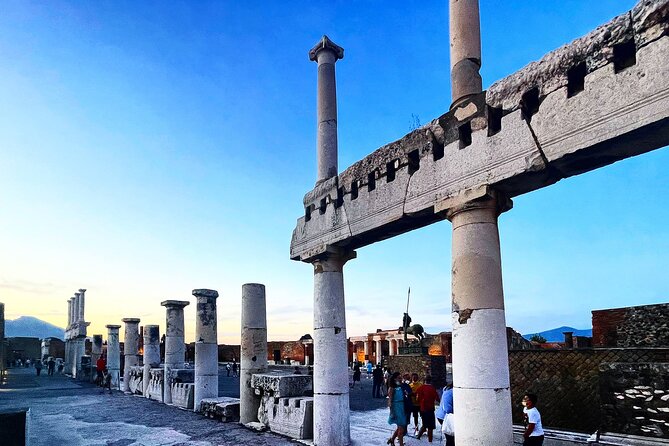
Yes—if you want Pompeii to feel understandable, not just impressive. The combination of skip-the-line entry, small-group pacing, and a route that covers the Forum/Basilica area plus major public-life sites like the thermal baths and theaters is a strong value. Add the chance to stay inside until closing, and you get a guided start plus flexible time to linger where it clicks.
If you do book it, plan like a realist: arrive a bit earlier, bring water, and treat sunset as a bonus rather than a contract. Then lean into the guide-led walk—you’ll leave with a clearer picture of how people lived in a city that basically froze in place.
FAQ
How long is the Pompeii from afternoon to sunset tour?
It runs for about 2 hours 30 minutes.
How much does the tour cost?
The price is $65.31 per person.
Is skip-the-line admission included?
Yes. The tour includes skip the line Pompeii admission along with a guided small-group experience.
Is the entry ticket included in the price?
Yes. Your entry ticket to the Pompeii site is included.
What language is the tour offered in?
The tour is offered in English.
What are the meeting and ending points?
You start at Ristorante Bar Sgambati, Via Villa dei Misteri, 1, 80045 Pompei. You end at the Forum of Pompeii, Via Villa dei Misteri, 2, 80045 Pompei.
Can I stay in Pompeii after the guided portion ends?
Yes. After the guided tour ends at the Forum, you can remain inside the archaeological site until closing time.
What isn’t included in the tour price?
Transportation and parking are not included.