Pompeii moves fast when you know where to go. This wheelchair-friendly tour is built around a special 2 km path through the most important ruins, plus skip-the-line entry so you spend your time inside Pompeii, not in queues. I like that it’s timed to a tight, manageable 2-hour visit, and I also like that the guide focuses on real daily life, not just big stones. The main drawback is simple: getting to the start area can be tricky if you rely on public transport or need extra help for transfers.
What makes this tour especially practical is the way it’s shaped for accessibility. Instead of hoping you can navigate the site on your own, you’re led along a route designed to be doable, with time spent where the highlights actually are. It’s also a private setup for your group, which usually means you get more patience, more questions answered, and less rushing.
One more thing to keep in mind: the highlights are spread across a lot of Pompeii’s story—thermal baths, neighborhoods, public spaces, and places that show a darker, wilder side of Roman life. If you want Pompeii at a slower museum pace, this may feel like a strong sprint.
In This Review
- Key highlights at a glance
- Pompeii’s Story in 79 AD: What You’re Really Looking At
- Amphitheatre Start and How the 2-Hour Plan Keeps You Moving
- Wheelchair-Accessible Route: The 2 Kilometers That Matter
- Main Streets to the Forum: How the Tour Walks Through Roman Daily Life
- Thermal Baths, Domus, and Mills: The Practical Pompeii Stops
- Pleasure Houses and the Lupanare: What You’ll See and How It’s Framed
- What Guides Like Mariano and Momma Add to the Ruins
- Price and Value: Is $254.67 Worth It?
- Who This Pompeii Tour Suits Best (and Who Should Reconsider)
- Should You Book This Wheelchair Accessible Pompeii Tour?
- FAQ
- How long is the Pompeii tour?
- Where does the tour start and where does it end?
- Is skip-the-line entry included?
- Is the tour wheelchair accessible?
- Is this a private tour?
- Are service animals allowed?
- Can I get a refund if I cancel?
Key highlights at a glance
- Skip-the-line entry so you can get to the ruins quickly
- Wheelchair-accessible route mapped to about 2 km
- A tight, 2-hour guided route covering the major Pompeii stops
- Major Roman-life sites like baths, homes, and the forum area
- Not just temples and towers: you also see mills, a gym, and the theater zone
- Small-group feel since it’s private for your group only
Pompeii’s Story in 79 AD: What You’re Really Looking At
Pompeii isn’t just an archaeological park. It’s a preserved snapshot of Roman life caught mid-routine. In 79 AD, Vesuvius erupted and buried the city under ash and rubble, and centuries later, excavation finally brought it back into view.
That context changes how you see everything on the ground. When you look at a street, you aren’t just looking at a street. You’re looking at the route people walked for errands, work, and nightlife—suddenly frozen by disaster. A good guide helps you connect the physical layout to daily habits, so the ruins stop feeling like a checklist and start feeling like a lived-in town.
The tour’s focus on everyday details is a big part of why it works. You’re not only shown famous buildings; you’re guided through the spaces that explain how Romans ate, trained, cooled off, relaxed, and conducted business.
You can also read our reviews of more tours and experiences in Pompeii.


Amphitheatre Start and How the 2-Hour Plan Keeps You Moving
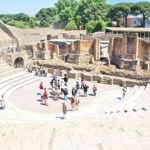
Your meeting point is the Amphitheatre of Pompeii in Piazza Immacolata, 80045 Pompei NA, Italy, and you finish back at the same place. Starting near the amphitheatre is smart because it helps you get your bearings fast in a site that can feel huge once you’re inside.
The tour runs about 2 hours, and that time structure matters for accessibility. You’re not trying to “cover Pompeii” in one day. Instead, you get a curated route through the most meaningful zones—guided, paced, and shaped around the accessible path length.
A skip-the-line ticket also changes the vibe. It means you’re more likely to arrive with energy rather than frustration, and you’re more likely to stay focused once you’re inside. In a site this big, arriving stressed can make even a great guide feel rushed.
Wheelchair-Accessible Route: The 2 Kilometers That Matter
This is the core idea here: a special path of about 2 km that makes Pompeii accessible to more people. That doesn’t mean every surface is effortless, but it does mean the tour isn’t asking you to improvise your way through the park.
Two things I appreciate about this approach are pacing and intention. A mapped route helps your guide manage turns, stops, and the time you spend viewing each highlight. And it helps you plan for the kind of effort (or time seated) that works for you and your crew.
The reviews reinforce that the right access setup can make the difference between seeing Pompeii and just reaching the start. One positive review credits the guide for helping a guest in a wheelchair and another in a scooter, with the guide making sure key sights were actually visible. On the flip side, there’s at least one cautionary experience about the trip to the starting area being harder than expected. Translation: once you’re at the amphitheatre meeting point, the route concept is strong, but do not ignore the getting-there part.
If you’re planning from outside Pompeii, give yourself extra time for transit and consider whether you might need help moving between connections.
Main Streets to the Forum: How the Tour Walks Through Roman Daily Life
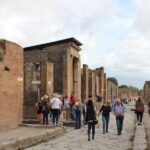
The walk is designed to make Pompeii feel like a town again. You’re taken through the main street layout and shown how Romans moved through daily life. The guide uses anecdotes and stories to explain how places functioned, so you’re not just looking at walls—you’re learning the rhythm of the city.
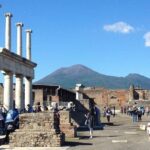
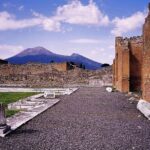
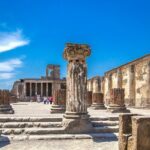
One of the biggest “aha” moments in Pompeii is usually the forum area. When you see the public space and understand its role, the ruins become a social engine rather than scattered buildings. It’s where civic life happened, and your guide helps you picture the flow of people and activity in a way that’s hard to achieve alone.
The tour also includes the Theater zone. That’s not just a photo stop. The theater connects to entertainment and community life, and it helps you understand how Romans spent time when they weren’t working or shopping.
The overall route gives you a mix of public and private spaces. That balance is important: Pompeii is most memorable when you can see how different parts of life fit together.
Thermal Baths, Domus, and Mills: The Practical Pompeii Stops
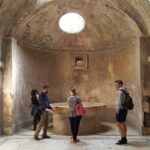
A standout part of this tour is the emphasis on places Romans used for comfort and routine. You visit the Thermal Baths, and that matters because baths weren’t just about hygiene. They were social spaces, and they tell you a lot about comfort, leisure, and urban planning.
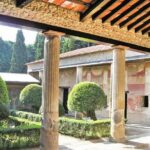
You’ll also see a domus, a type of Roman home. Even in ruins, the domus layout helps you understand what people valued indoors and how homes connected to street life. It’s a key contrast to the public forum and the theater, and your guide helps put those differences into plain language.
Then there are the mills—one of those stops that sounds minor until you realize it explains food production at ground level. Watching (or imagining) how grain became flour makes the daily-life story feel real. This is where the guide’s anecdotes become useful: you start seeing systems, not just monuments.
The tour also includes the Gladiators’ Gym, which helps fill out the city’s entertainment-and-training world. Pompeii wasn’t only passive viewing. It had training culture, exercise spaces, and structured public spectacle—another piece of the puzzle in how Romans spent their free time.


Pleasure Houses and the Lupanare: What You’ll See and How It’s Framed
One of Pompeii’s most talked-about ruins is the Lupanare, associated with prostitution and known for famous erotic frescoes. This stop can feel awkward if you approach it as shock value, so it helps that the tour is guided and context-based.
In a guided format, the key is that you’re not left alone to interpret markings and murals without a framework. Your guide can explain how these spaces fit into Roman street life, including how sexuality, commerce, and public visibility overlapped in the ancient city.
You’ll also visit Pleasure Houses, which broadens the story beyond one single building. This makes the Lupanare less isolated and more connected to a neighborhood-level understanding of Pompeii’s economy and entertainment.
If you’re traveling with teens or someone who dislikes sexual content, this is the one stop to flag in advance. You’ll still be able to enjoy the wider Pompeii story, but knowing what’s ahead helps you decide how much you want to linger at this specific highlight.
What Guides Like Mariano and Momma Add to the Ruins
A major reason this kind of tour works is the guide. The route is important, but the guide turns the route into a story you can follow. One review praises a guide named Mariano for being especially helpful for a guest in a scooter, with extra attention to making sure the guest could see everything possible. Another review credits a guide named Momma for making the time feel fun and friendly, with lots of walking and a feeling that the guide treated the group like friends.
Those details matter because Pompeii can be visually confusing. Stone layers, repeated building patterns, and half-structures can make it hard to know what you’re looking at. When the guide explains how people lived—why a space mattered, what purpose it served, and how it connects to Roman culture—the ruins start clicking into place.
The “anecdotes, secrets, and stories” approach also helps keep the pacing comfortable. Instead of only reading about Pompeii, you get real-time narration that gives you a reason to keep moving.
Price and Value: Is $254.67 Worth It?
At $254.67 per person, this is not a budget add-on. But value here isn’t just cost—it’s what you save in time and stress.
You get:
- Skip-the-line ticket
- A guided tour
- Admission ticket included
- A route designed for accessibility across roughly 2 km
- A private format for your group only
When you compare that to doing Pompeii on your own, the biggest “value” factor is friction reduction. Skip-the-line is the obvious part, but the larger one is having someone organize the experience into a workable route with context. If you’re using a wheelchair or scooter, the ability to follow a planned path with a guide can be worth a lot more than the difference between random entry tickets and a structured tour.
Is it for everyone? Not necessarily. If you want lots of free time, long museum-style pauses, or you’re the type who loves wandering without structure, you might feel constrained by a 2-hour plan.
But if you want Pompeii’s biggest highlights delivered in a format that’s more accessible than self-navigation, the price starts to make sense.
Who This Pompeii Tour Suits Best (and Who Should Reconsider)
I think this is a strong fit if you want:
- A wheelchair-accessible Pompeii route with a guided structure
- Skip-the-line entry so you can focus on ruins, not queues
- A focused route that hits major stops within about 2 hours
- Context about daily Roman life, including the baths, homes, forum area, and entertainment zones
It may be less ideal if:
- You’re hoping for a slow, stop-and-stare experience with lots of independent exploration
- You want to spend the whole day deeply on one single building
- You need a very specific accommodation that depends on the approach to the meeting point (transit to the amphitheatre is worth checking carefully)
If you’re traveling with mobility needs, I’d treat the “getting to the start” piece as part of your plan. The tour itself is designed for accessibility, but your day starts before the guide meets you.
Should You Book This Wheelchair Accessible Pompeii Tour?
Yes, I’d book it if your main goal is to see Pompeii’s top highlights in a guided, accessibility-focused format without losing half your day to navigation and lines. The combination of a dedicated route around 2 km, skip-the-line entry, and a guide-driven Roman-life story is a solid match for many travelers with mobility needs.
I’d think twice if you’re looking for a long, independent exploration day or if transit logistics to the amphitheatre are complicated for your group. If that’s you, still consider booking, but plan your arrival carefully so you’re not stressed at the very start.
If your priority is a smooth, guided route with real context, this tour is the kind of practical Pompeii day that makes the ruins feel understandable fast.
FAQ
How long is the Pompeii tour?
The tour lasts about 2 hours.
Where does the tour start and where does it end?
It starts at the Amphitheatre of Pompeii in Piazza Immacolata, 80045 Pompei NA, Italy, and it ends back at the meeting point.
Is skip-the-line entry included?
Yes. The tour includes a skip-the-line ticket and the guided tour.
Is the tour wheelchair accessible?
Yes. The experience is tailored along a special accessible path of about 2 kilometers.
Is this a private tour?
Yes. It is private, meaning only your group participates.
Are service animals allowed?
Yes. Service animals are allowed.
Can I get a refund if I cancel?
Yes. You can cancel for a full refund if you cancel at least 24 hours before the experience starts.