REVIEW · NAPLES
Skip-the-Line Pompeii Guided Tour from Naples
Book on Viator →Operated by IAMME IA! - Gray Line Amalfi Coast · Bookable on Viator
Pompeii, minus the chaos. This skip-the-line tour gets you into one of Italy’s most dramatic ruins without burning your time standing in heat-drenched lines. The payoff is that your guide helps you read the site, so you’re not just walking through piles of stone.
I especially like two things: the air-conditioned round-trip coach from central Naples, and the fact you get official guidance with priority admission so the day stays focused. Group size caps at 29, and headphones may kick in for larger groups, which matters when you’re trying to hear facts over foot traffic.
One drawback to plan around: the meeting spot and pickup timing can feel a little confusing in a crowded area, so I’d show up a bit early and double-check you’re boarding the right bus.
In This Review
- Key things that make this tour work
- Why skip-the-line really matters at Pompeii
- Naples meet point and the coach ride to Pompeii
- Priority entry and the first big lesson: Pompeii’s story
- The Civil Forum: where politics, religion, and business blended
- Basilica + Macellum: seeing the city’s civic machine
- Via dell’Abbondanza: the main drag that tells you what everyday noise sounded like
- Stabian Baths: the best place to picture hot water, cold water, and gossip
- House of the Faun: luxury inside a city that didn’t stand a chance
- Via delle Ville and the Villa of the Mysteries approach
- Teatro Grande: Roman entertainment on a hillside
- How long is enough in Pompeii for your style?
- Value for $72.01: what you’re paying for
- Guides you might get (and why it can matter)
- Practical tips so you enjoy it instead of suffering
- Should you book this Pompeii skip-the-line tour from Naples?
- FAQ
- How long is the Skip-the-Line Pompeii Guided Tour from Naples?
- Where is the meeting point in Naples?
- Does the tour include admission to Pompeii?
- Is skip-the-line access included?
- Is transportation included, and is it air-conditioned?
- What language is the tour offered in?
- Are food and drinks included?
- Will I be able to hear the guide clearly?
- How many people are in the group?
- What is the cancellation policy?
Key things that make this tour work
- Priority admission helps you dodge the longest entrance lines
- Official guide time turns scattered ruins into a clear story of Roman life
- Air-conditioned round-trip transport keeps the travel part from stealing your energy
- Pompeii in a time-boxed route: Forum, main street, baths, homes, and theatre
- Headphones for bigger groups can make a big difference in audibility
- Small enough to manage (max 29) but big enough to keep it lively
Why skip-the-line really matters at Pompeii
Pompeii is famous for a reason, but that fame comes with crowds. If you arrive at the wrong moment, you can lose a huge chunk of your day just waiting to get inside. This tour is built to protect your time with skip-the-line access and priority admission tickets, so you start seeing the city sooner.
The other win is simple: you’re not sightseeing in a fog. The Pompeii ruins are spread out and visually similar in places. A good guide points out the small clues—what a space was used for, where people walked, and why certain buildings mattered. Without that help, you can end up moving from highlight to highlight without fully understanding what you’re looking at.
This is also an efficient format if your Naples trip is tight. At roughly 4 hours, you’ll hit a lot of “big impact” areas without needing a full day of wandering.
You can also read our reviews of more guided tours in Naples


Naples meet point and the coach ride to Pompeii
You meet at P.za Giuseppe Garibaldi, 91, 80142 Napoli. The tour ends back at the same spot. That round-trip setup is genuinely helpful because you don’t have to solve trains, buses, or parking with a clock ticking.
You’ll ride in an air-conditioned vehicle, which is not a small detail in southern Italy during warmer months. Still, I’d keep an eye on comfort expectations: one account noted the coach air-conditioning wasn’t ideal. That’s not the norm for the tour as described, but it’s enough of a reminder that you’ll feel the heat outside the vehicle.
The group size is capped at 29 travelers, which is large enough to keep the energy up and small enough that the guide can still manage the route. In practice, that matters when you’re moving quickly between major areas of Pompeii.
Priority entry and the first big lesson: Pompeii’s story
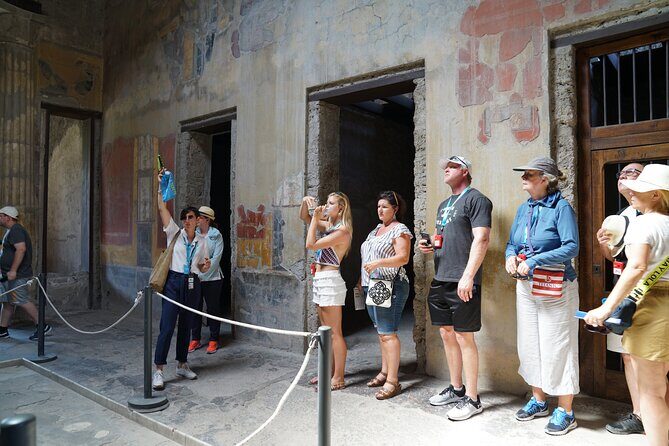
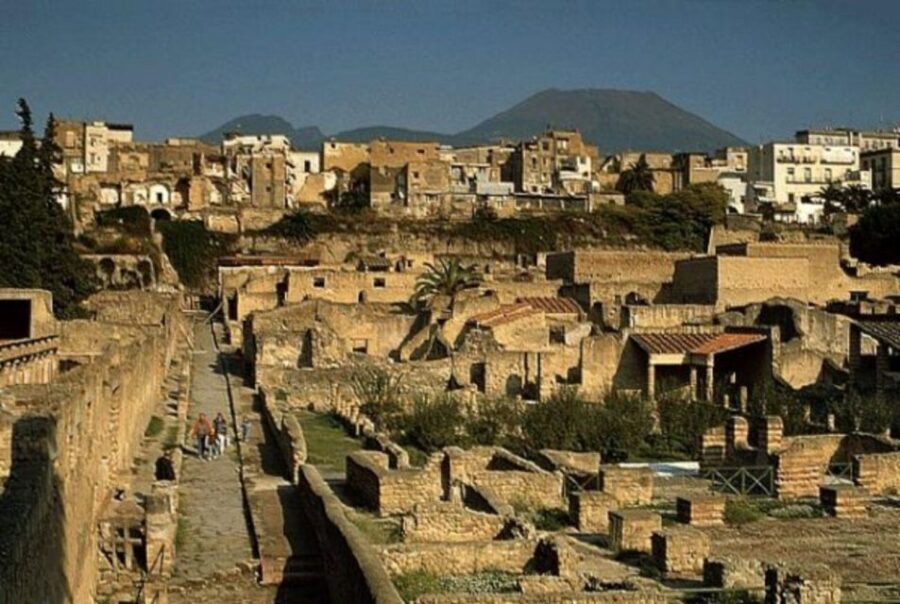
Once you enter, you’re stepping into a city frozen at the moment the volcano exploded. Pompeii was buried after Mount Vesuvius erupted in 79 A.D., with meters of ash and pumice covering the streets and buildings. That accident turned everyday Roman life into something we can walk through today.
Your guide spends time helping you connect architecture to daily behavior—where people gathered, how public justice worked, where commerce happened, and what people did for entertainment. It’s the difference between seeing ruins and understanding the city as a functioning place.
The first major block of time is centered on the archaeological park, with about 2 hours built for Pompeii exploration and admission included. This is where the route logic is strongest: you start in the civic core, then move outward along major streets and through key building types.
The Civil Forum: where politics, religion, and business blended
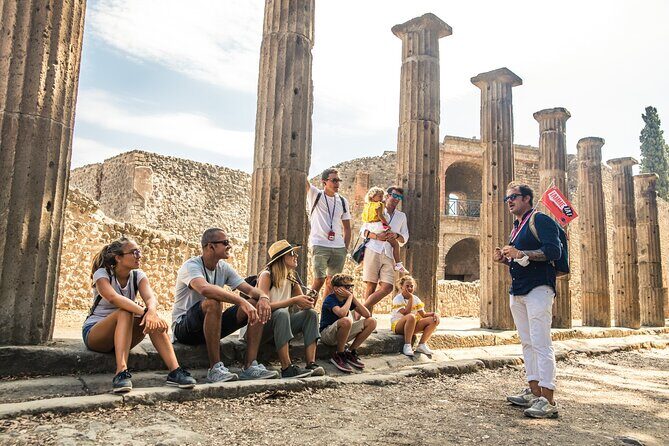
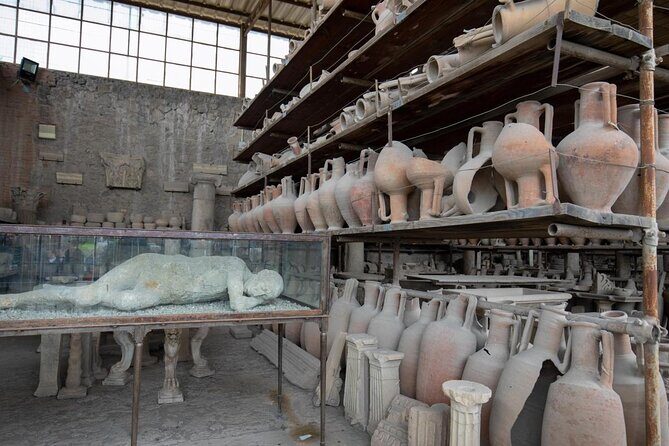
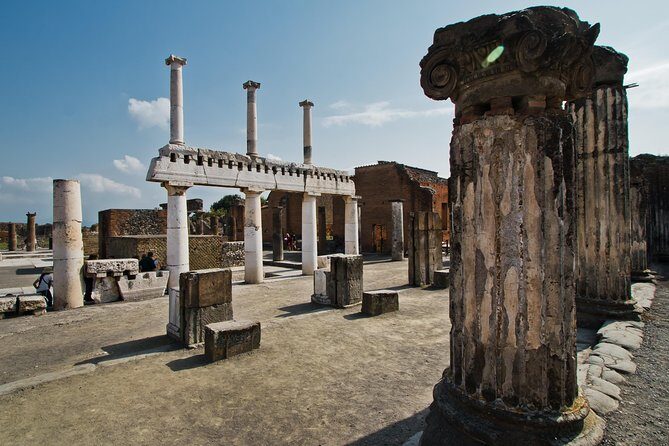
If you want one area to explain what Pompeii felt like, start in the Civil Forum. This is the city’s core—where administration and justice happened, business ran, markets operated, and worship took place. In other words: it’s the Roman “downtown center,” not just a monument zone.
You’ll see the Forum Basilica, an enormous building described as about 1,500 square meters. It was used for business and legal hearings. Standing in the Forum area, it helps to imagine the noise: traders calling out, citizens arriving for cases, and religious life happening in the same broader square space.
The Temple of Jupiter anchors the north side of the Forum, with Mount Vesuvius rising behind it like a dramatic backdrop you can’t script. After the colony was founded in 80 BC, the temple was renovated into a Capitolium style setup, with cult statues of Jupiter, Juno, and Minerva placed on a high base so they were visible across the Forum square.
Two small but meaningful details make this stop click:
- You’re not just looking at one building; you’re reading a whole system of public life.
- The views line up—especially with Vesuvius in the background—which makes photos feel less random.
Basilica + Macellum: seeing the city’s civic machine
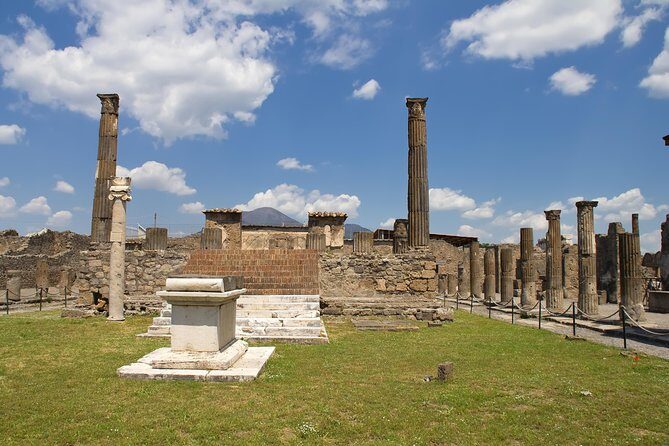
Near the Forum, the Basilica functions as a core justice-and-commerce hub. It’s designed as a monumental hall with a central nave, columns, and a raised tribunal area where hearings took place. Even if you’ve never cared about Roman law, the layout helps you understand how authority was staged.
Then comes the Macellum, the market center. It’s described as a tuff quadriporticus (a courtyard-like complex with a colonnaded shape) and an elevated hall aligned with the entrance. This is where you can picture structured trade, including niches holding copies of marble statues (one female and one male armed) and clues suggesting imperial cult use.
One side detail you may find most surprising: there are spaces that suggest practical selling areas—like a room with a masonry counter that may have served fish sellers. Markets weren’t an informal add-on. They were woven into civic identity.
This part of Pompeii rewards a guided format. A self-paced walk can skim right past the “why,” while a guide helps you connect the dots fast.
You can also read our reviews of more tours and experiences in Naples

Via dell’Abbondanza: the main drag that tells you what everyday noise sounded like
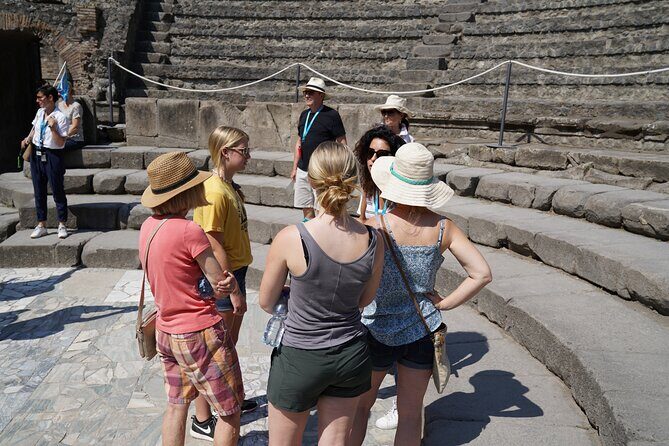
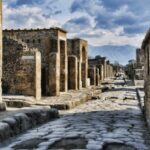
Next you’ll walk along Via dell’Abbondanza, the ancient main street (a decumanus maximus) running east/west from the Forum toward Porta Sarno. The name says it: this road was built for movement and commerce, not quiet strolling.
In ancient times, it was crowded and loud, lined with shops, workshops (officinae), snack-bars, cafes, and restaurants serving food and drink. So yes, this is where you should expect your brain to switch from “ruins mode” to “street life mode.”
The stop here is short—about 10 minutes—so the goal isn’t to linger. It’s to get the street’s shape and role in your head, so later rooms and buildings feel connected instead of random.
If you’re a photo person, this is a good segment to grab quick shots while the group is still moving. If you pause too long, the route clock can pressure you to rush elsewhere.
Stabian Baths: the best place to picture hot water, cold water, and gossip
Behind the Temple of Jupiter, you’ll visit the Stabian Baths (Terme Stabiane), dating to shortly after the colony of veterans was established. The Baths are set up with separate entrances for women and men, and that alone makes this more than a “Roman gym ruin.”
The men’s circuit includes spaces like:
- Apodyterium (dressing room), also used as a tepidarium
- Tepidarium for medium-temperature bathing
- Frigidarium for cold baths
- Calidarium for hot baths
You’ll also learn the site had damage from the earthquake in 62 A.D., which helps you understand that Pompeii wasn’t perfect even before the eruption. It had problems already—then Vesuvius finished the job.
This stop is about 10 minutes, so don’t expect a slow soak. Still, if you’ve ever wondered what “public bathing” meant, this is one of the best places to visualize the routine and the social side of it.
House of the Faun: luxury inside a city that didn’t stand a chance
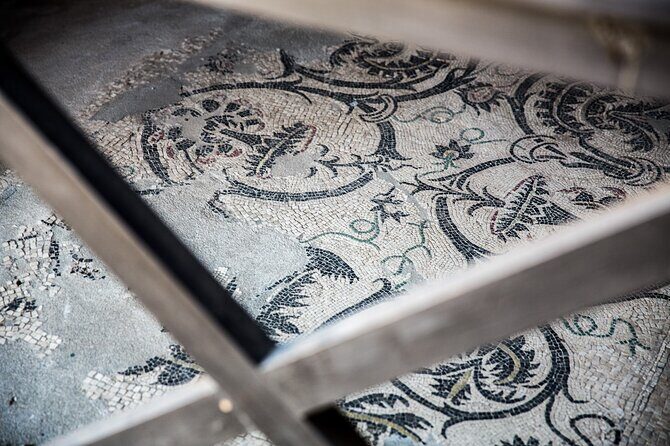
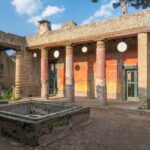
Pompeii does not only show everyday life. It also shows extreme wealth. The House of the Faun (Casa del Fauno) is one of the largest luxury residences in Pompeii, occupying an entire city block. It’s named for a bronze statue of a dancing faun found in the main atrium.
What you’ll want to know here is the Alexander Mosaic, famous for depicting the battle between Alexander the Great and Darius III. It’s not just a decorative floor—it’s a statement of status, taste, and cultural reach.
This stop gives you a contrast: you go from civic spaces and street commerce to elite private living. That shift helps you understand Pompeii as a full social ladder, not a single “class” of people.
Because it’s timed within a shorter tour, you might not see every room in depth. But even a brief look inside this kind of house can recalibrate how you interpret the city.
Via delle Ville and the Villa of the Mysteries approach
After the urban core, the tour follows Via delle Ville, also called the path toward the Villa of the Mysteries. This road runs outside Pompeii’s city walls and links the downtown area to the suburbs. It passes through a necropolis lined with tombs, which changes the mood.
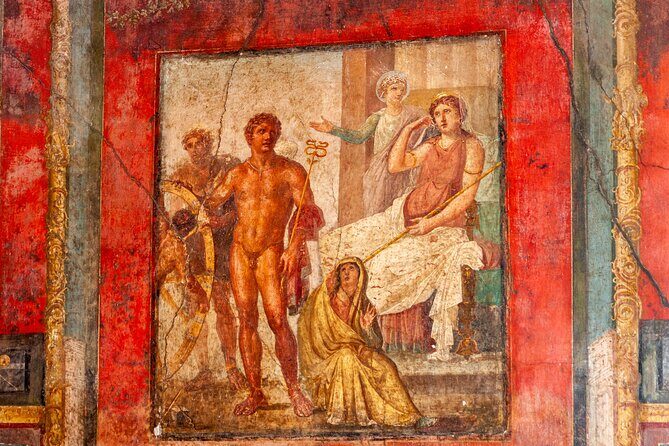
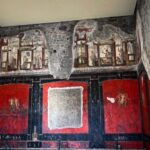
The Villa of the Mysteries is known for its frescoes depicting Dionysian rites. This is a great example of why a guide is useful: fresco programs are dense and symbolic. Even if you don’t memorize every scene, you’ll understand why this place feels more quiet and atmospheric than the main streets.
This part of the route is less about “how fast can you cover ground” and more about atmosphere. If you’re prone to rushing, tell yourself to slow down just enough to read the setting.
Teatro Grande: Roman entertainment on a hillside
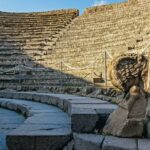
Then you’ll reach Teatro Grande, a horseshoe-shaped auditorium built into a natural hillside, designed for roughly 5,000 spectators. Dating back to the 2nd century BC, it’s described as the first Greek-style stone theatre in Pompeii, used for comedies, tragedies, and pantomimes.
This stop also gives you a sense of how entertainment fit into Roman life. It wasn’t just for elites. The size tells you public performance was built for mass attendance.
The scenery angle matters here too: theatres were architectural and social stages. Even a short stop lets you picture crowds funneling in, people finding seats, and the performance space framing the audience.
In a time-boxed tour, this is where good guides shine. A quick explanation of seating layout and stage design can make the space feel almost restored.
How long is enough in Pompeii for your style?
The tour is timed around a route that prioritizes major landmarks. The Pompeii portion includes structured stops—Forum core areas, street life, baths, a luxury house, a suburban path, and the theatre—then you return to Naples.
In reality, the experience can feel like two different lengths depending on the day and group flow. One account mentioned a guide covering Pompeii in about 2 hours, and that created a useful overview even if it’s not enough to see everything. Pompeii is the kind of place where you could spend weeks if you wanted. So your real question is: do you want an overview, or do you want deep wandering?
This tour is best for you if:
- You want a clear, guided route without full-day commitment
- You like being told what you’re looking at while you walk
- You’re okay with short stops at each highlight
If you crave long pauses, detailed museum-style reading, or a slow circuit with minimal structure, you’ll probably want a different plan. Pompeii can reward that kind of patience, but it doesn’t usually fit into a half-day or four-hour format.
Value for $72.01: what you’re paying for
At about $72.01 per person, you’re paying for several “time savers” bundled together:
- Round-trip coach from central Naples (with air-conditioning as promised)
- Official guide
- Skip-the-line / priority admission
- Headphones when needed for clearer listening
- Pompeii site admission
If you were to piece this together yourself, the cost often rises once you add transport, entry tickets, and a guide. Here, the price feels more like buying protection from wasted hours than buying entrance to stones.
The trade-off is that you’re buying efficiency. You won’t cover everything in Pompeii at a slow pace. But if your goal is to get oriented fast and see the essentials with context, this is a solid value.
One extra note from experience in the broader program: some departures have included a cap at a vineyard with a walk through vines and a lunch or wine tasting. Since that isn’t spelled out in the core schedule here, I’d confirm what’s included on the exact option you book. If it is included, it can turn a good day into a very memorable one.
Guides you might get (and why it can matter)
You’ll be led by an official Pompeii guide in English. Some departures are mentioned as run by multi-lingual guides, and the tone seems to vary by person.
Names you may see referenced include Simone, Valeria (as a welcome host), Vincenzo, Andrew, Josephine, and Fabrizio. The common thread in those accounts is that the guide keeps things understandable without rushing you through every stop.
That’s worth paying attention to. In a place as large as Pompeii, a guide’s pacing and ability to explain the “why” can make the difference between seeing ruins and learning the city.
Practical tips so you enjoy it instead of suffering
This part is not optional. Pompeii in summer can get very hot. Wear comfortable shoes that can handle uneven ground. Bring sunscreen. And don’t be shy about water. Even if it isn’t listed as included, bring enough so you’re not rationing drinks while trying to enjoy the Forum-to-theatre rhythm.
Also consider audibility. Headphones are included when the group is bigger than 10 passengers. If you’re in a larger group, keep your headphones handy and don’t take them off during key explanations. Short stops mean you’ll miss the most helpful context if you’re not listening.
Finally, treat the schedule like a plan, not a suggestion. If you wander off on your own during timed segments, you can end up stressing to catch the group again. Pompeii rewards calm walking and good timing.
Should you book this Pompeii skip-the-line tour from Naples?
Book it if you want priority entry, an official guide, and an efficient route that covers the biggest “Roman life” landmarks in about half a day to four hours. It’s a strong choice when your Naples time is limited and you’d rather spend your energy inside Pompeii than fighting for entry outside it.
Skip it if you want a long, slow, do-it-yourself day where you can linger in houses, read every inscription, and meander without structure. Pompeii is big enough that a guided overview may feel too short if you’re the type who takes notes and wants depth on every building.
If you do book, show up a little early at P.za Giuseppe Garibaldi and keep water and sunscreen in your bag. Do that, and you’ll get the best version of the day: less waiting, more understanding, and a Pompeii you can actually picture.
FAQ
How long is the Skip-the-Line Pompeii Guided Tour from Naples?
The tour lasts about 4 hours (approx.).
Where is the meeting point in Naples?
The meeting point is P.za Giuseppe Garibaldi, 91, 80142 Napoli NA, Italy.
Does the tour include admission to Pompeii?
Yes. Entry/Admission – Pompeii Archeological Site is included.
Is skip-the-line access included?
Yes. The tour includes Skip The Line Access with priority admission tickets.
Is transportation included, and is it air-conditioned?
Yes. The tour includes round trip transportation with air-conditioning vehicle.
What language is the tour offered in?
The tour is offered in English.
Are food and drinks included?
No. Food & Drinks are not included.
Will I be able to hear the guide clearly?
The tour includes headphones in Pompeii to hear the guide clearly for groups bigger than 10 passengers.
How many people are in the group?
The tour has a maximum of 29 travelers.
What is the cancellation policy?
Free cancellation is available. You can cancel up to 24 hours in advance for a full refund.