REVIEW · NAPLES
Private Pompeii Tour With Guide and Transfer Included
Book on Viator →Operated by Naples bay tour · Bookable on Viator
Pompeii feels personal when someone plans it for you. A private setup means you’re not stuck with a herd—you get pickup from Naples and a licensed guide who talks you through the city’s food, homes, and public life. In about four hours, the ruins go from spooky stones to working neighborhoods you can actually picture.
I love that the tour is organized around the big, memorable parts of Pompeii. You’ll hit the Macellum (main market), the Forum, baths, the Lupanar, and a top elite home without wasting time guessing where to go. I also like the practical transport + tickets included bundle, because it removes a lot of the usual planning hassle. The one catch: many stops are timed to about 10 minutes, so if you like slow wandering and long photo breaks, you’ll have to manage your expectations.
In This Review
- Key highlights you’ll feel right away
- Why private Pompeii pacing makes the ruins make sense
- Getting from Naples to Pompeii smoothly (and not wasting your morning)
- Macellum: the market where Roman life showed up in real time
- Granai del Foro: grain storage and the weight of what came after
- Anfiteatro Romano: oldest surviving amphitheater energy, minus the crowd
- Foro de Pompeya (Forum): the city’s center, where decisions got made
- Terme del Foro: the Forum Baths and what bathing said about daily life
- Lupanar: vivid frescoes, adult life, and careful interpretation
- Casa del Fauno: elite life, mosaics, and the dancing faun
- Price and value: is $358.86 per person worth it?
- Communication, timing, and the one thing to double-check
- Who this private Pompeii tour is best for
- Should you book this private Pompeii tour?
- FAQ
- How long is the Pompeii private tour?
- What is included in the price?
- Where does the tour start and end?
- Do I need to buy Pompeii tickets separately?
- Is the tour private?
- Is pickup offered from my accommodation?
- Do I get a mobile ticket?
- Are tips or food included?
- What’s the cancellation policy?
- Are service animals allowed?
Key highlights you’ll feel right away
- Pickup and private transport from your Naples area starting point to Pompeii, then back again
- A licensed guide guiding you through major sectors of the ancient city
- Fast access to top sights like the Forum, Forum Baths, Lupanar frescoes, and Casa del Fauno
- Pompeii admission tickets included, so you’re not dealing with separate lines
- Clear on-the-ground structure, which helps you get your bearings fast at a huge site
Why private Pompeii pacing makes the ruins make sense

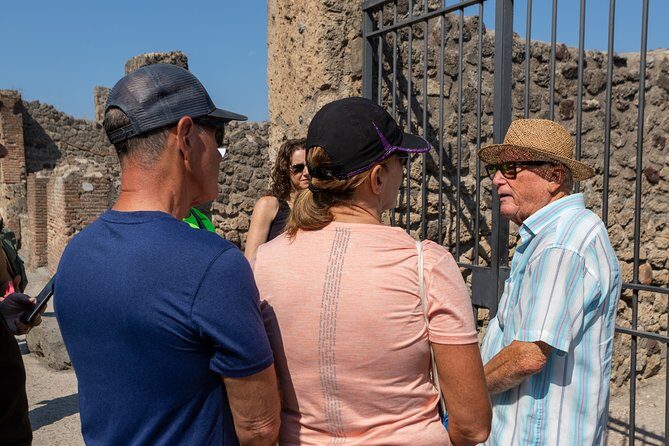
Pompeii is famous, which also means it can feel chaotic. The streets sprawl, the buildings repeat, and it’s easy to end up staring at rocks while the real story happens in your guide’s head. A private tour fixes that. Instead of picking from a menu of monuments, you walk a line that tells you how the city worked: food, storage, entertainment, religion and government, public bathing, and everyday life inside ordinary homes and elite villas.
I like that your time is organized around key “systems” of the city. You don’t just see what exists; you learn why each place mattered. That’s the difference between collecting photos and actually understanding the place.
Also, Pompeii rewards attention. Small details like doorways, street layouts, and decorative wall scenes become obvious when someone points them out and gives you the context to notice them.
You can also read our reviews of more guided tours in Naples



Getting from Naples to Pompeii smoothly (and not wasting your morning)
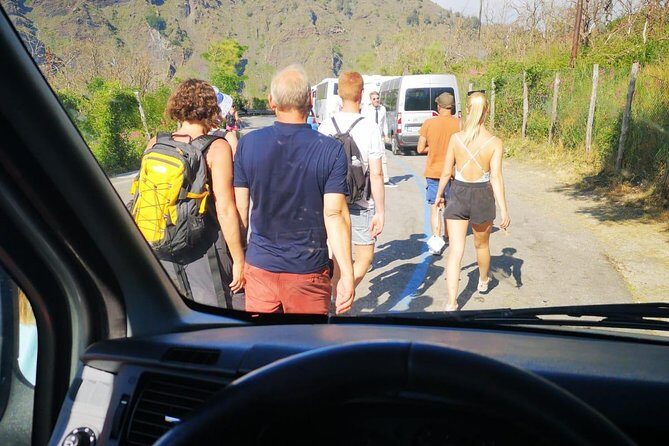
You start at Molo Beverello, Naples. From there, the experience includes private transport and pickup from your accommodation, with the tour ending back at the meeting point. That matters more than people think. Pompeii isn’t close, and travel time can chew up your day. Having a driver handling the transfer gives you one less logistics problem and more time for the walking part.
The tour is listed as approximately 4 hours, which is a realistic window for a guided circuit of the most important areas without sprinting through them. If you’re visiting Naples as a short-stay traveler, that time frame is a win.
One more practical note: the experience uses mobile tickets, which can make entry smoother if you’re trying to keep everything organized in one place.
Macellum: the market where Roman life showed up in real time
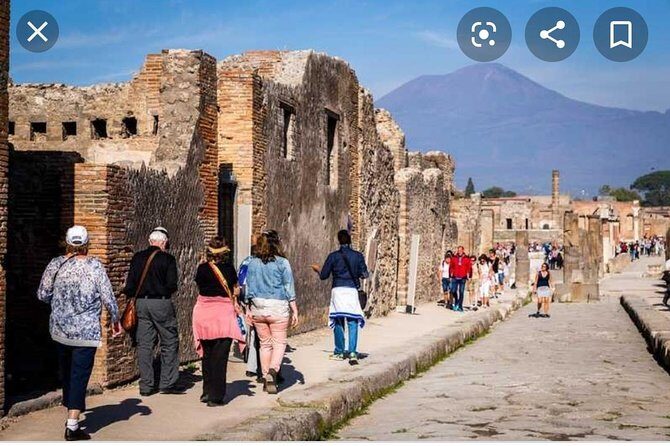
Your first stop is the Macellum, Pompeii’s main food market. Think meat and fish sales, plus the social rhythm of trade. Markets were not just for buying dinner. They were where neighbors bumped into each other, where prices and supplies shaped daily choices, and where the city’s economic pulse showed.
A good guide at the Macellum helps you “read” the space: where vendors likely worked, how the market layout supported movement, and how trade tied Pompeii into the wider world. You’ll also get why this kind of place feels grounding. It’s not a ceremonial site. It’s practical. You’re seeing the city the way most residents actually experienced it.
Time feel: this stop is short—around 10 minutes—so don’t expect a long linger to study every corner. Treat it as your orientation to what came next: how Pompeii fed itself and moved goods.
Granai del Foro: grain storage and the weight of what came after
Next up is Granai del Foro, the ancient warehouses where Pompeii stored grain and supplies. This is one of those stops where the building function matters. Grain storage tells you about the city’s planning, its dependence on steady supply, and the scale needed to keep a dense population running.
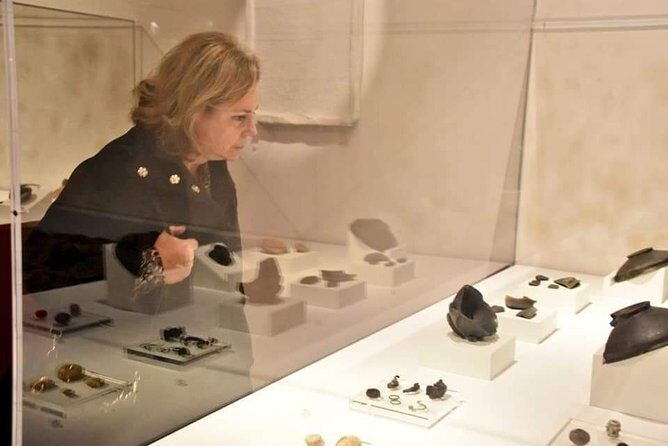
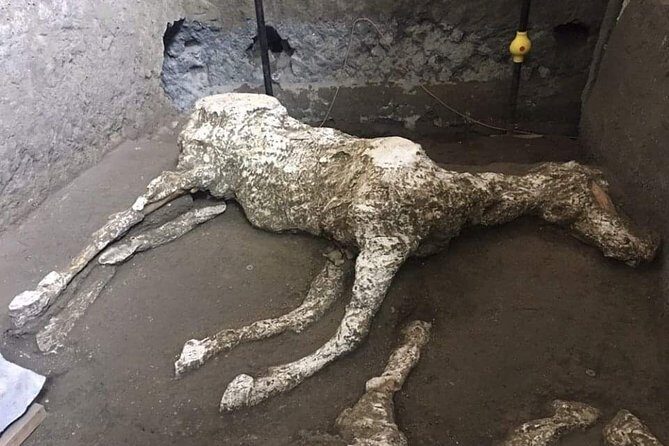
What makes this area especially haunting is how later archaeology has treated the site. Here, the space is used to display casts of victims of the eruption and other archaeological finds. That shift—from storage to memorial—changes how the room feels as soon as you understand what you’re standing in.
If you’re someone who prefers emotional distance, be aware: this is the kind of stop that lands. You may want to ask your guide what they recommend for timing—whether to pause quietly or keep moving so it doesn’t swallow the rest of your visit.
Time feel: also about 10 minutes, so you’ll likely get the story plus a quick look, not an extended contemplation session.
Anfiteatro Romano: oldest surviving amphitheater energy, minus the crowd
You’ll visit the Anfiteatro Romano, described as the oldest surviving Roman amphitheater, built around 70 BC. Even if you already know the basics of gladiatorial games and public entertainment, Pompeii’s amphitheater site gives you something tangible: you can see the venue that shaped Roman leisure.
The guide’s job here is to connect the structure to public life—why entertainment pulled people in, how it fit into status and politics, and what it says about everyday priorities in the city.
If you like street-level history, this works well. It’s not only about emperors and temples. It’s about people gathering, watching, and taking a break from the realities of work.
Time feel: about 10 minutes, which means you’ll mostly get the highlights: what to look at and why.
You can also read our reviews of more private tours in Naples






Foro de Pompeya (Forum): the city’s center, where decisions got made
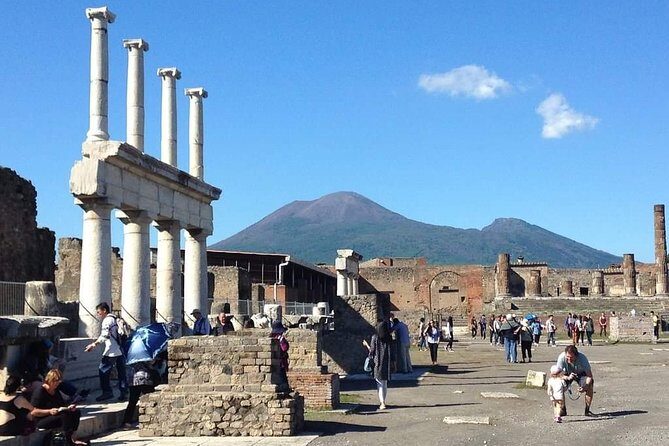
Then you’re at the Foro de Pompeya, Pompeii’s central square. This is where the city’s public identity shows. The Forum is surrounded by temples and administrative buildings, plus markets. It’s the kind of place where multiple aspects of Roman life overlap: government, worship, commerce, and the constant flow of people.
This is one of the best areas to slow your brain down, even if your legs stay moving. Your guide should help you understand the order of spaces and what each building likely did, so the Forum stops feeling like a big open courtyard and starts looking like a working civic map.
If you’re traveling with kids or family members who get bored easily, this is also a place where you can ask questions that keep them engaged. It’s a natural “where would you stand” kind of setting.
Time feel: about 20 minutes here, the longest stop in the circuit. That extra time is well used for orientation and storytelling.
Terme del Foro: the Forum Baths and what bathing said about daily life
Right after the Forum comes Terme del Foro, the Forum Baths. Baths weren’t just hygiene. They were community space, social time, and an expression of culture and design. Roman bathing included changing areas, heated pools, and decorative elements like frescoes.
This stop helps you shift from politics and markets to routine life. You start imagining a resident’s day: where they might stop, what it felt like to move through heated spaces, and how decoration and architecture made public bathing more than a quick wash.
If you love art and interior details, keep your eyes open. Frescoes can be small on first glance, but once you know they’re there, you’ll spot them faster.
Time feel: about 10 minutes. You’ll likely get the main rooms and key explanations rather than a full architectural walkthrough.
Lupanar: vivid frescoes, adult life, and careful interpretation
The Lupanar is one of Pompeii’s best-preserved buildings, famous for its vivid fresco cycle. It’s the kind of place that makes Pompeii feel intensely human—people lived messy, normal lives, not only grand ceremonies.
The information you’ll get here includes interpretation of the artwork. The fresco program may be linked to Dionysian rites, and your guide should explain the idea behind that theory. Even if you don’t remember the Greek terms later, you’ll come away with the point: art in Pompeii served multiple purposes, including religious symbolism and coded messaging.
This stop is a great one for thoughtful travelers, but it’s also a reason to consider who you’re touring with. If you’re bringing younger kids, you might decide in advance what level of detail you’re comfortable with, and you can use your guide to steer the conversation.
Time feel: about 10 minutes. Expect a focused look at why the frescos matter.
Casa del Fauno: elite life, mosaics, and the dancing faun
You finish with Casa del Fauno, one of the most famous luxury homes in Pompeii. It’s known for the statue of the dancing faun and the Alexander Mosaic. This is the stop where Pompeii shifts from “city of daily life” to “world of wealth, taste, and art.”
Elite homes like this helped define identity. The scale and decoration show what money could buy and what residents wanted visitors and neighbors to notice. The guide’s job is to connect the artwork to the household’s personality and status, not just describe it as impressive.
If you like art history, the mosaic is a huge anchor. If you like storytelling, the dancing faun statue makes Pompeii feel theatrical—like the house had a sense of mood even in antiquity.
Time feel: about 10 minutes, so don’t expect deep museum-style viewing. But you’ll get the signature pieces so the big takeaway sticks.
Price and value: is $358.86 per person worth it?
At $358.86 per person for a roughly 4-hour private experience, you’re not paying only for a walk. You’re paying for three things working together:
- Private transport with pickup and return
- Private guide time in a huge site where speed without guidance can become confusion
- Pompeii admission tickets included, plus a structured route across key sectors
This can be good value if you compare it to the real cost of piecing together transport, tickets, and timed entry yourself—especially if your schedule is tight or you want a smooth experience from the start.
You can also look for group discounts if your party qualifies, since the listing mentions them. If you’re traveling as a small group, you may feel the value more strongly than if you’re alone, because the private costs spread out.
One thing I’d keep in mind: a private tour still has time limits. Many stops are around 10 minutes, so the value is in guidance and access, not in spending hours in each building.
Communication, timing, and the one thing to double-check
One reason private tours can feel great is simple: clear communication and punctual service. There’s a positive theme around that, including feedback that the process felt coordinated and that service was on time.
That said, I always advise you to take five minutes before departure to verify your pickup details and where your guide will meet you. Even when service is generally smooth, the biggest risk in Pompeii day trips is miscommunication about meeting spots and timing—especially when you’re starting at Molo Beverello and your pickup may be tied to your lodging.
If you prefer everything locked in, ask for confirmation of the meeting point and the planned timing window before you go. It’s a small step that prevents a lot of stress.
Who this private Pompeii tour is best for
This tour fits best if you want structure and storytelling more than unguided exploring. It’s a strong choice for:
- Couples who want a high-impact Pompeii visit without decision fatigue
- Families who benefit from a guide keeping the visit moving and making it understandable
- Culture lovers who want the big anchors—Forum, baths, market, elite home—connected into one city story
- Anyone who values a seamless transfer instead of figuring out logistics mid-trip
The experience is also described as something most travelers can participate in, and service animals are allowed. It’s noted as near public transportation, which can matter if you’re planning a backup option.
Should you book this private Pompeii tour?
If you want Pompeii to feel like a coherent story in a short time window, I’d book this kind of private, transfer-included tour. The best part is that you’re not just seeing famous spots—you’re getting the “why” for each one, from the market and grain storage to entertainment, civic space, bathing, and elite homes with the dancing faun and Alexander Mosaic.
I’d think twice only if your travel style is slow and you hate timed stops. With many areas around 10 minutes, you’re trading length at each site for clarity across the whole visit.
If your priority is convenience, ticket inclusion, and a guide-led route that hits Pompeii’s strongest scenes in about four hours, this is an easy yes.
FAQ
How long is the Pompeii private tour?
The tour duration is approximately 4 hours.
What is included in the price?
It includes private transport, private guides, pickup at your accommodation, and Pompeii tickets.
Where does the tour start and end?
It starts at Molo Beverello, Naples and ends back at the meeting point.
Do I need to buy Pompeii tickets separately?
No. Pompeii admission tickets are included.
Is the tour private?
Yes. This is a private tour/activity, and only your group participates.
Is pickup offered from my accommodation?
Yes, pickup at your accommodation is included.
Do I get a mobile ticket?
Yes. The experience includes a mobile ticket.
Are tips or food included?
No. Tips and food and drink are not included.
What’s the cancellation policy?
Free cancellation is available. You can cancel up to 24 hours in advance for a full refund.
Are service animals allowed?
Yes, service animals are allowed.