REVIEW · PAESTUM
Paestum Tour: Best Preserved Temples in the World (UNESCO)
Book on GetYourGuide →Operated by Italygonia Travel T.O. · Bookable on GetYourGuide
Paestum hits hard in just two hours. This guided UNESCO-focused walk through the archaeological park pairs three jaw-dropping Doric temples with time in the National Archaeological Museum, including the celebrated Tomb of the Diver. I love that the guide explains what you’re looking at, down to why the temples feel so solid and well-proportioned. I also love the museum add-on, because it puts the ruins into a clearer human story.
One thing to factor in: the entrance tickets to the archaeological park and the museum are not included, and there’s no transportation or hotel pickup—so you’ll want to plan your own arrival and ticketing before you meet your guide at the museum entrance.
In This Review
- Key things to know before you go
- Paestum’s Doric temples: Hera, Poseidon, and Ceres in plain sight
- Via Sacra moments: the Roman forum and amphitheater stop
- National Archaeological Museum: the Tomb of the Diver and the temple finds
- What the 2-hour schedule feels like on the ground
- Price and value: $325.13 per group up to 25 (what’s included and what isn’t)
- Languages, private-group feel, and how to prepare
- Should you book this Paestum tour?
- FAQ
- How long is the Paestum tour?
- Where does the tour start and end?
- Is a guide included?
- Are entrance tickets included for the park and museum?
- What languages are available for the tour guide?
- Is this tour private?
- Can I cancel for a full refund?
Key things to know before you go
- Three temples in one route: Hera (the Basilica), Poseidon (Neptune), and Ceres—each with distinct size and style.
- Real architectural measuring: you’ll hear specific dimensions and style notes, not just broad history.
- Via Sacra highlights: you’ll see the Roman forum and the amphitheater along the main Sacred Way area.
- Museum payoff: the stop includes major finds tied to the temples, plus the famous Tomb of the Diver.
- Good for a tight schedule: the whole experience is built around a focused 2-hour format.
- Multiple languages: live guide in English, Spanish, French, German, and Italian.
Paestum’s Doric temples: Hera, Poseidon, and Ceres in plain sight
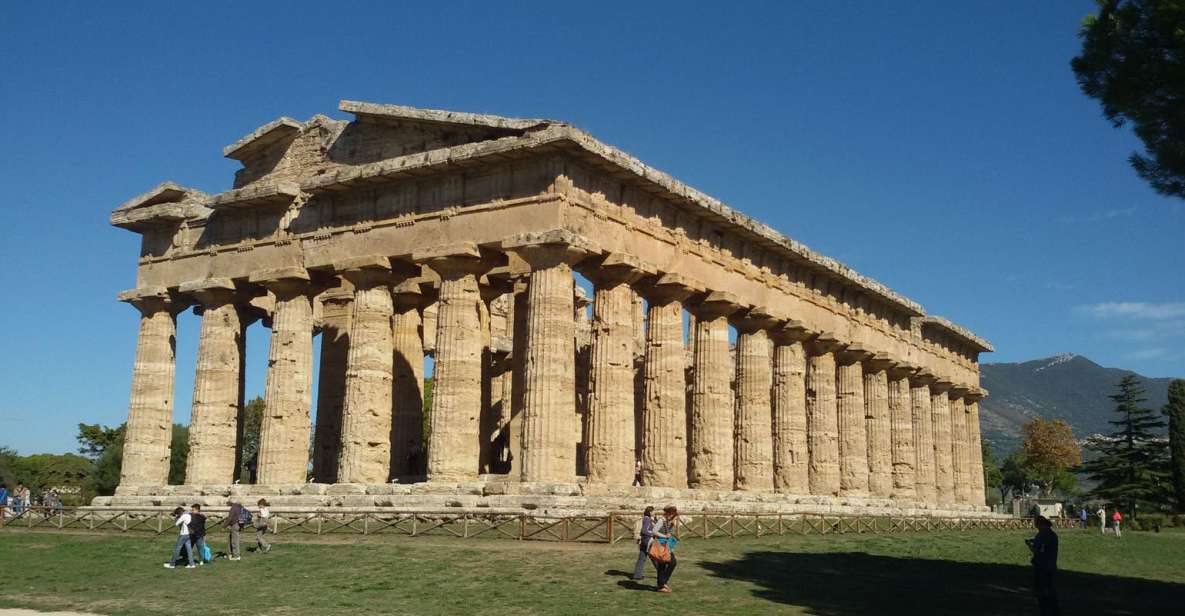
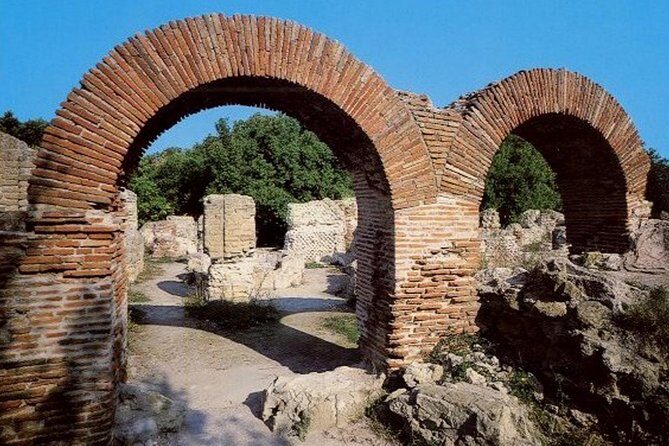
Paestum is one of those rare places where the buildings don’t feel like ruins—you can still read their shape. Your guide’s job is to help you see that shape fast, without making you memorize dates. The tour centers on three temples, all preserved well enough that their details still tell the story of how they were meant to look and feel.
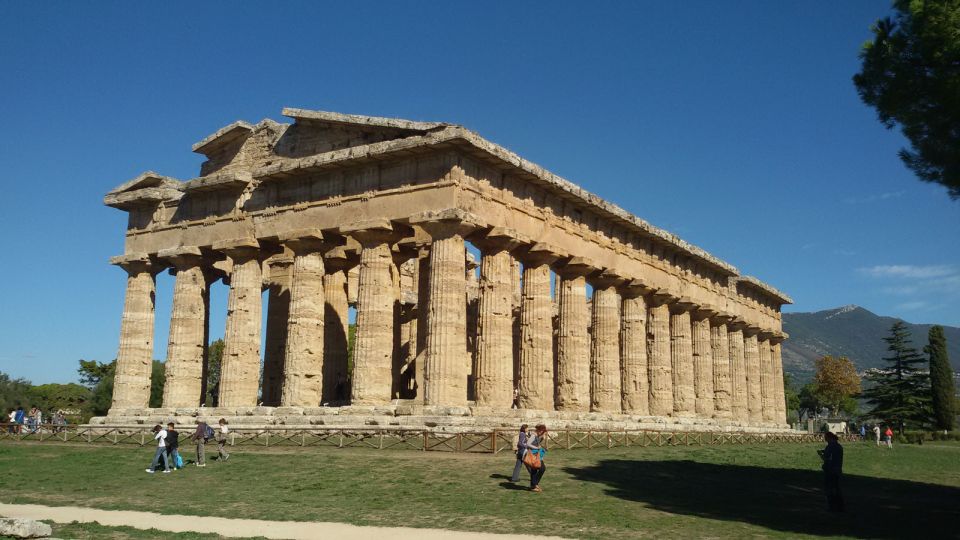
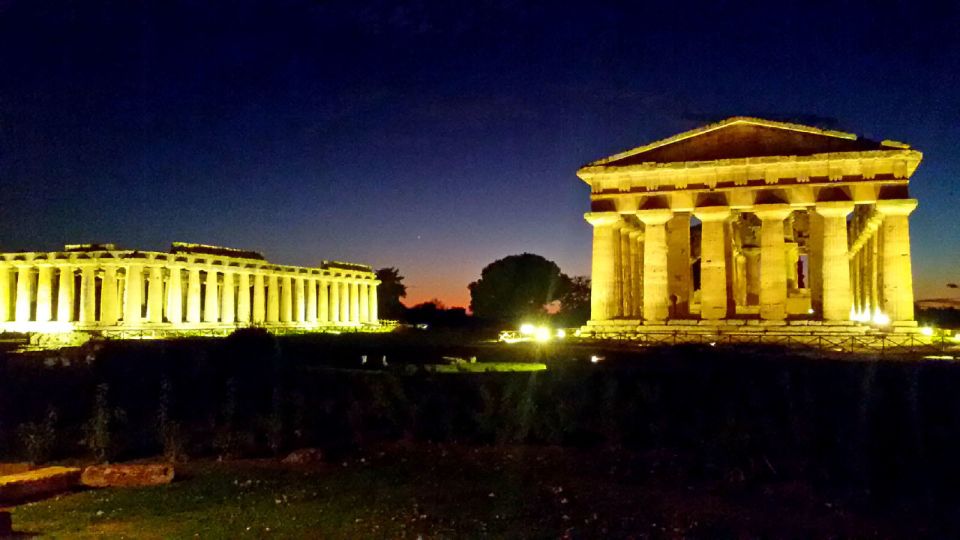
First up is the Temple of Hera, also called the Basilica. The guide focuses on its Doric style and on why it feels like an anchor for the whole site. You’ll get a concrete sense of scale too: it’s described as twenty-six meters wide and fifty-five in length. That kind of number matters here. It stops the temples from being vague “big old things” and turns them into something you can actually compare.
Next comes the Temple of Poseidon, also called Neptune. This is the largest on the tour, and the guide points you toward what makes it feel monumental. It’s built in Doric style and dated to 460 B.C.E. The description also compares it to the Temple of Zeus in Olympia, which gives you a useful mental benchmark for why people talk about this site with such respect. Even if you’re not an architecture person, you’ll feel the difference between “large” and “largest” when you’re standing in front of it.
Then you’ll visit the Temple of Ceres, tied to a sanctuary dedicated to Athena. Here, the tone shifts a bit: the guide presents it as more modest in size, but still exceptional. That contrast is one of the best parts of the structure of this tour. You’re not just seeing the biggest winners; you’re learning how the site balanced different sacred spaces.
Why this works for you: many archaeological tours rush past temples like they’re photo backdrops. This one slows you down just enough to understand why Doric architecture looks the way it does—and why Paestum is considered special for preservation.
You can also read our reviews of more tours and experiences in Paestum.
Via Sacra moments: the Roman forum and amphitheater stop
After the temples, the tour moves along the Via Sacra area, where you can connect the Greek sacred landscape to the later Roman additions. You’ll have opportunities to see the Roman forum and the amphitheater during this stretch.
This is where I like the pacing. Temples can dominate your attention, so adding the forum and amphitheater gives you a different angle: not just worship spaces, but public life and gatherings. The amphitheater also helps you shift from “standing and staring” into “imagining how people moved through the site.”
The key is how your guide links these structures visually and conceptually. Even with just two hours, you get a sense that Paestum wasn’t frozen in time. Sacred architecture was adapted, used, and reinterpreted, first in Magna Grecia and later under Roman influence.
Possible consideration: if you’re hoping for a long, slow explore where you wander off-script and linger in every corner, this 2-hour format will feel tight. Think of it as a focused “see the essentials with context” tour, not a self-paced meander.
National Archaeological Museum: the Tomb of the Diver and the temple finds
The best part of this experience is that it doesn’t stop at outdoor ruins. You end at the National Archaeological Museum, and that’s where a lot of the emotional punch lands.
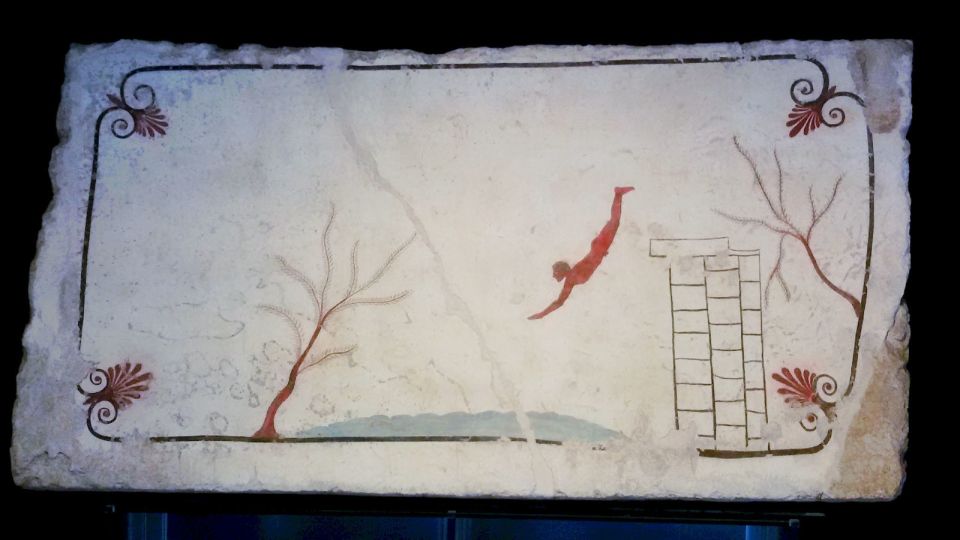
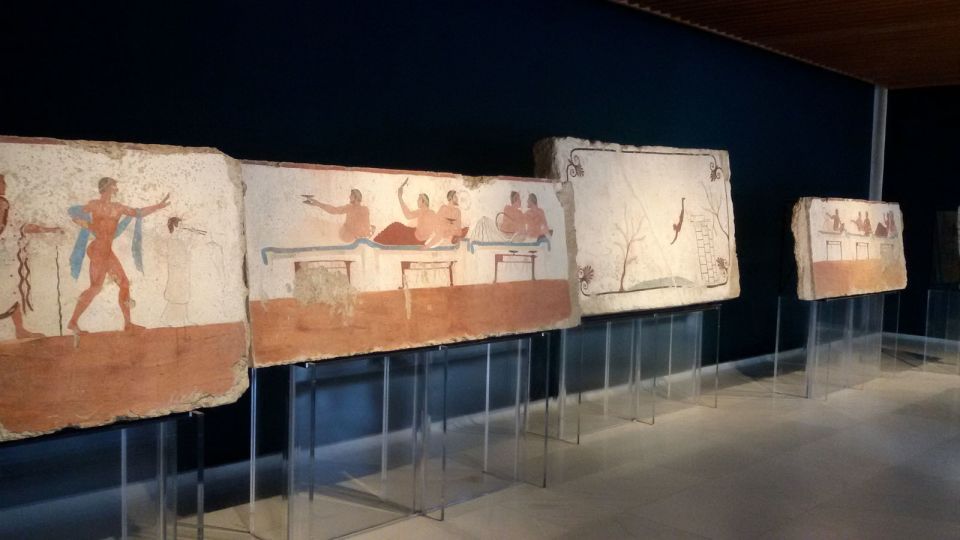
Your museum visit highlights several major items tied directly to Paestum’s temple world. You’ll see the thirty-three metopes from the temple of Hera Argiva. You’ll also see a statue of Zeus. There’s a crater with the rat of Europe (the guide includes it as a standout object), and then comes the big star: the Tomb of the Diver.
The Tomb of the Diver is described as a tomb made of five limestone slabs in local travertine plastered and decorated with parietal painting using fresco technique. The guide explains it as a figurative subject, created with that fresco method. Even if you’ve never looked closely at Roman or Greek-style funerary art before, this kind of description helps you understand why the tomb is famous: it’s not only the structure, it’s the way the decoration communicates story.
Why the museum stop matters: outdoor ruins can be impressive, but museums translate “leftovers” into “artifacts with meaning.” In a short tour, this ending keeps the experience from feeling like a quick sightseeing checklist. You leave with images that connect to the temples you just saw.
What the 2-hour schedule feels like on the ground
This tour runs for about two hours. Starting at the archaeological museum entrance in Paestum and finishing back at the same meeting point keeps it simple.
A tight duration has one huge advantage: it’s easier to fit Paestum into a day plan in Campania, especially if you’re combining stops. You’re not committing to half a day on one site, and you still cover the “headline” elements—three key temples, plus forum and amphitheater views, plus the museum.
If you’re visiting when the heat is high (common in southern Italy), a guided, time-bound route also helps you manage comfort. You’ll still want to think like a realist: you’re outside for temple viewing, then inside at the museum. So plan for both light and shade, and bring water if you can.
A practical tip: when you show up, use the first minutes to get oriented. Ask your guide where to focus first. That alone can make the temple dimensions and architectural notes stick better.
Price and value: $325.13 per group up to 25 (what’s included and what isn’t)
The price is listed as $325.13 per group up to 25 people. That pricing structure is important: it means you’re not paying per person (based on the info given), you’re paying for the guided experience as a group.
What’s included is straightforward: a licensed guide. That’s a real value point here, because Paestum can look similar across temples at first glance. The guide’s role is to keep you from getting lost in generalities. The tour content includes the three temples, the amphitheater and Roman forum views, and the museum stop with the Tomb of the Diver and other highlighted finds.
What’s not included: entrance tickets for the Archaeological Park and the National Archaeological Museum. Transportation/pickup/drop-off isn’t included either, so you’ll want to budget time to get to the meeting point on your own.
Is it worth it? If you’re paying for your own tickets anyway, the key value question becomes this: will you benefit from interpretation rather than just taking photos and reading a little on your own? This tour is built around architectural explanations and museum context, and the site is exactly the kind of place where a good guide turns “big stones” into “understandable design.” For a group up to 25, it can be good value as long as you plan ahead for tickets.
Languages, private-group feel, and how to prepare
This is a private group tour, and the guide is live. Languages available are Spanish, English, French, German, and Italian. For practical travelers, that multi-language list matters because you can get the explanations in the language you actually think in—especially when the guide is talking about temple style (Doric) and architectural features.
Because it’s a private group, you can expect a more conversational flow than a huge public group tour. Even when the time is limited, a guide can answer questions and adjust pacing to match what your group cares about.
How to prepare in advance (without overthinking it):
- Decide whether you want more emphasis on the temples or the museum. The tour includes both, but you can still nudge your focus.
- Bring comfortable walking shoes. You’ll be moving through an archaeological park and then into the museum.
- If you’re traveling with family or friends who prefer different interests, set expectations at the start. Two hours goes fast.
Should you book this Paestum tour?
Book it if you want a high-impact Paestum experience with guided context: three preserved temples (Hera/Basilica, Poseidon/Neptune, Ceres), Roman forum and amphitheater views, then a museum ending featuring the Tomb of the Diver. It’s also a good match if you’re short on time but still want to understand what makes Paestum special—especially the Doric architecture details and the museum artifacts that connect the ruins to the people who used them.
Skip it (or switch to a longer plan) if you prefer wandering on your own for hours, or if you’d rather not handle entrance tickets and self-arrival planning.
If you like architecture explanations and you want the museum to matter—not just be a quick stop—this one is a strong, practical choice.
FAQ
How long is the Paestum tour?
The duration is 2 hours.
Where does the tour start and end?
It starts at the archaeological museum entrance in Paestum and ends back at the same meeting point.
Is a guide included?
Yes. A licensed guide is included.
Are entrance tickets included for the park and museum?
No. Entrance tickets for the Archaeological Park and the National Archaeological Museum are not included.
What languages are available for the tour guide?
The guide is available in Spanish, English, French, German, and Italian.
Is this tour private?
Yes, it’s listed as a private group.
Can I cancel for a full refund?
Yes. You can cancel up to 24 hours in advance for a full refund.