REVIEW · NAPLES
Herculanium guided tour
Book on Viator →Operated by Pompeii private tours · Bookable on Viator
Herculaneum feels like time travel. I love how the small group keeps it personal, and I love the clear storytelling you get from Irina. The only downside: two hours moves fast, so you’ll need to accept that you can’t see every corner at a slow pace.
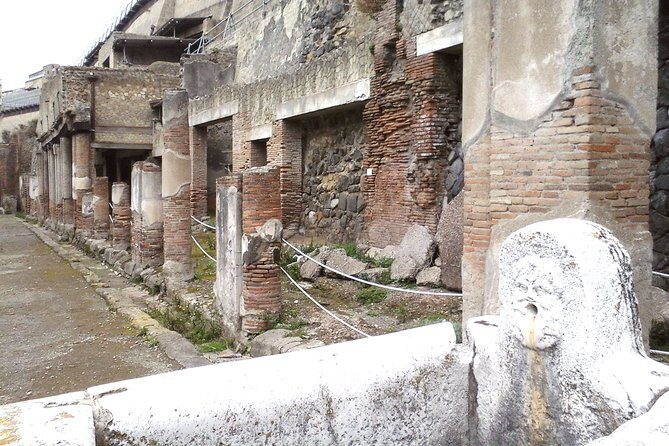
You meet right at the Archaeological Park ticket area on Corso Resina, which means less wandering and more walking. Expect a guided run through a remarkably preserved Roman city, from the ancient square facing the sea to major public sites like the Augusteum and public baths.
In This Review
- Key Highlights
- Herculaneum With a Real Guide, Not a Lecture
- Where You Meet (and How You’ll Find Your Guide)
- The Roman City You’ll Walk Through
- The Beach Victims and Carbonized Evidence
- Public Life Stops: Augusteum, Baths, and the Gymnasium
- The Augusteum
- The Public Baths
- The Gymnasium
- Shops and Streets: How Commerce Worked
- Private Houses and Art Details You’ll Actually Notice
- Timing and What Two Hours Means on Site
- Price: What You Pay, and Why It Can Be Fair
- Who This Tour Fits Best (and Who Might Want Another Option)
- Should You Book Hercululanium?
- FAQ
- Where does the tour meet?
- What time does the tour run?
- Is the tour offered in English?
- Is this a private tour?
- How big is the group?
- What will we see during the guided walk?
- Do I need to be in great shape?
- Are service animals allowed?
- How do I find the guide?
- What is the cancellation policy?
Key Highlights
- A private-style group (up to 10) with an actual guide conversation
- Direct meeting at the Herculaneum ticket office on Corso Resina
- The Vesuvius aftermath story told through real places, not abstract facts
- Sea-facing public spaces plus the beach area with victims’ remains
- Big-hitter stops like the Augusteum, baths, and gymnasium
- Home interiors and art details, including frescoes, mosaics, and marble statuary
Herculaneum With a Real Guide, Not a Lecture
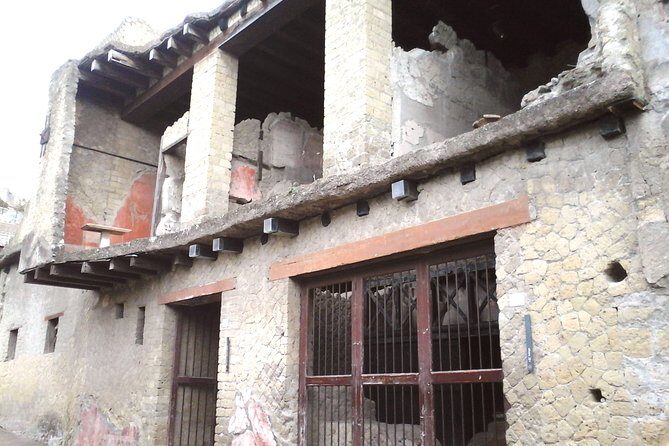
This tour is built for people who want to understand what they’re seeing while they walk. Herculaneum is often compared to Pompeii, but it has its own feel: it was closer to Vesuvius and it’s often described as the best preserved Roman city in the world. That preservation matters because you can actually connect the dots between daily life and what the eruption did.
I also like that you’re not stuck with a big, noisy crowd. With a group capped at 10, you get room to ask questions and keep the pace sensible. If you’ve ever felt rushed on ruin tours, this setup is a relief.
One more practical point: the tour runs about 2 hours. That’s enough time to hit the key zones and learn the story, but it’s not enough to linger like you would on a solo wander.
You can also read our reviews of more guided tours in Naples


Where You Meet (and How You’ll Find Your Guide)
The meeting point is at the Archaeological Park of Herculaneum, Corso Resina 187, 80056 Ercolano (NA), Italy. You’ll meet at the ticket office area, so you’re starting from the right place.
There’s also a simple visual cue: the driver will hold a sign that says IRINA. That might sound small, but it makes the start smoother, especially if you’re arriving near opening time or you’re catching buses.
The tour ends back at the same starting point, so you’re not stuck figuring out a second meeting or getting transportation for a different drop-off.
The Roman City You’ll Walk Through
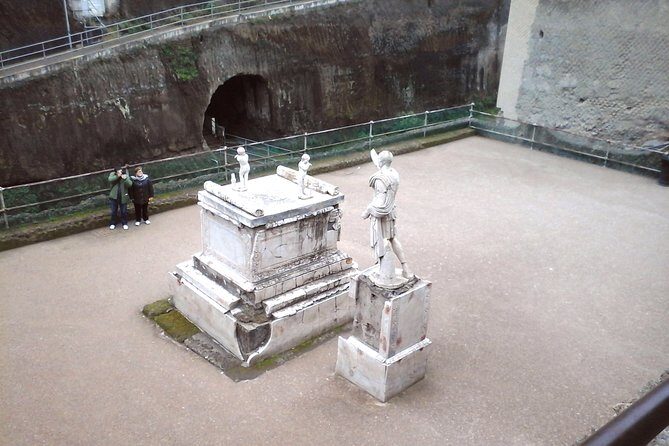
The heart of the experience is walking Herculaneum with context. You’ll hear how this was a rich city of merchants and nobility, not just a place that happened to get buried.
You’ll also focus on the city’s layout through specific stops. One of the first vibes you’ll get is the ancient square facing the sea. Standing there (with the guide’s explanation) you can start to picture how goods and people moved, and why a seaside location mattered in Roman life.
From there, the story shifts from the city as a living place to the city as evidence of what Vesuvius did. That transition is the reason Herculaneum tour guides are so valuable: without guidance, it’s easy to see ruins but miss what makes the whole site emotionally and historically powerful.
The Beach Victims and Carbonized Evidence
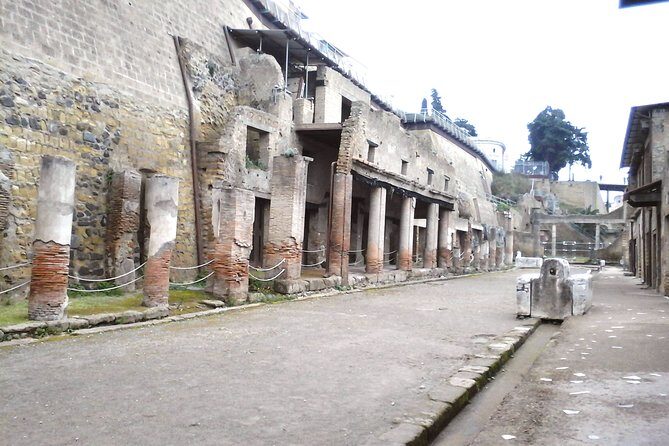
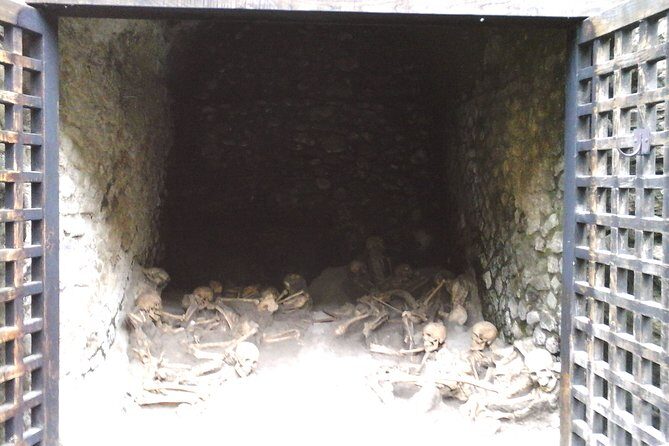
A standout part of this tour is the section connected to the beach and the eruption aftermath. You’ll see skeletons of the victims on the beach, and you’ll also learn how the disaster played out in real, physical ways.
You’ll also encounter carbonized wood, which is one of the more haunting proof points of how intense the event was. The guide’s job here is to connect the dots so these aren’t just shock images. You’ll learn about the disastrous eruption of Vesuvius, but you’ll also keep coming back to life and traditions before the disaster.
If you’re the type who likes history with a human core, these stops tend to land hard in a good way. Just keep in mind that this is a serious part of the story, so it’s not a casually cheerful walk.
Public Life Stops: Augusteum, Baths, and the Gymnasium
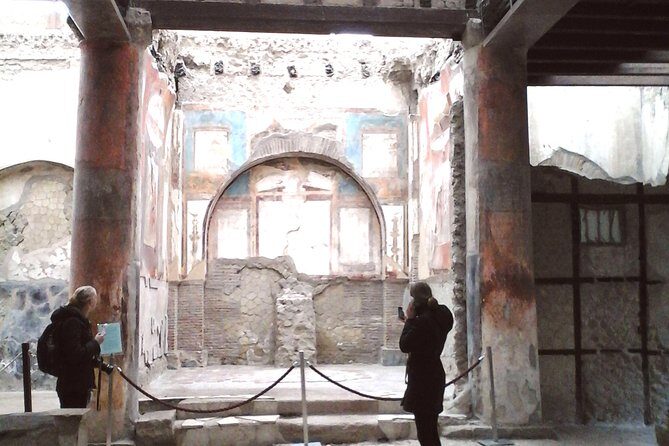
This tour doesn’t only focus on private houses. You’ll spend time on major public areas, and that’s where Herculaneum really shows its Roman character.




The Augusteum
You’ll visit the well-preserved Augusteum. With a guide, it becomes more than a named building. You’ll get the sense of how civic and cultural identity worked in Roman cities, and how rulers and public spaces were linked.
The Public Baths
You’ll also see the beautiful public bath. Roman baths were more than places to get clean. They were social hubs where people talked, met, and spent time together. Having that explained makes the ruins feel like infrastructure, not just stone.
The Gymnasium
Another key stop is the gymnasium. You’ll learn how it fit into daily routines, especially for those connected to athletics, education, and social life.
Together, these stops help you understand Herculaneum as a functioning city. That matters because the eruption story hits harder when you first grasp what was there to be lost.
Shops and Streets: How Commerce Worked
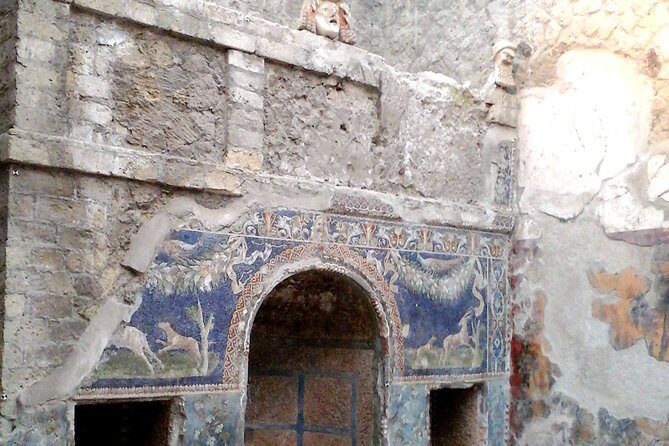
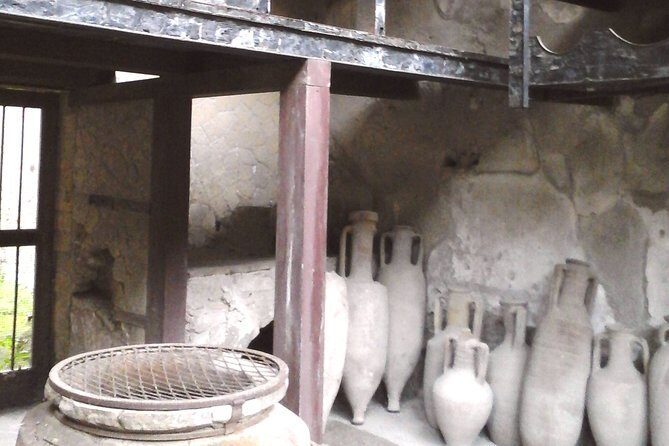
You’ll also see shops and learn about the city as a place where merchants and customers interacted. It’s easy to think of ancient cities as temples and theaters, but daily life ran on commerce.
This is where the small-group format helps. If you want to ask how a specific shop space functioned, or what certain layouts suggest, you’re more likely to get an answer than on a large-group tour.
Private Houses and Art Details You’ll Actually Notice
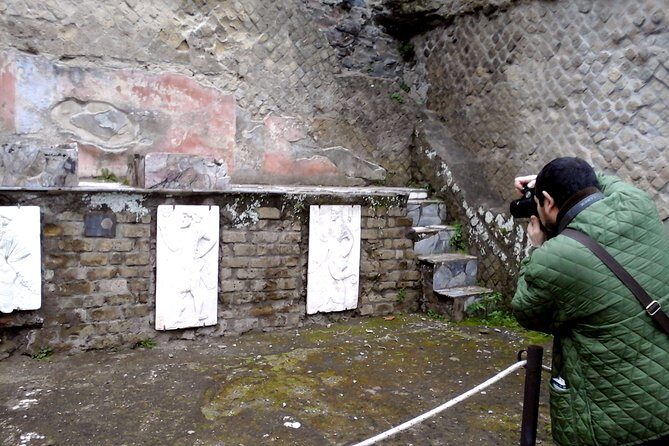
One of the best reasons to choose a guided tour at Herculaneum is that it helps you look past the obvious. The site has well-preserved interiors and decorative elements, but without context they can blur together.
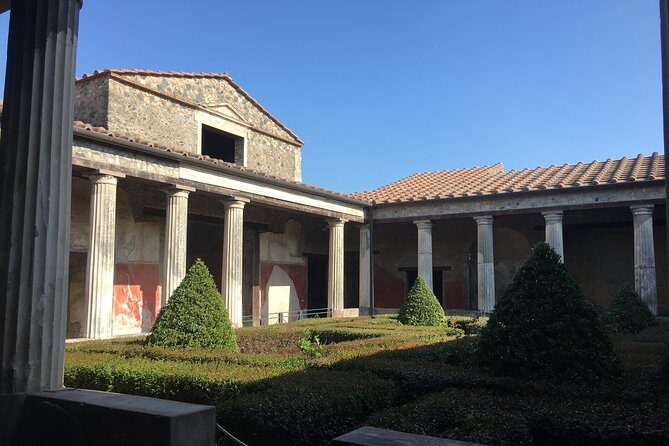
You’ll see several private houses, including the Samnite house and the house of Neptune and Amphitrit. You’ll also be shown things like roofs and houses with a first floor, which can make the structures feel more complete than they might from ground level alone.
On top of that, the tour highlights visual art elements such as ancient frescoes, mosaics, and marble statues. When someone explains what you’re looking at, you can start noticing patterns—how rooms were designed, what decoration signaled, and how status showed up in domestic spaces.
This is also a tour that rewards slower looking, even though the total time is limited. If you’re the kind of traveler who always ends up snapping photos of details (stairs, doorways, floor designs), you’ll love that the guide points your attention in useful directions.
Timing and What Two Hours Means on Site
The tour is about 2 hours, and the Archaeological Park is open daily from 9:00 AM to 3:30 PM (based on the listed hours for 2025 and 2026).
Because time is capped, I’d treat this as a guided “best of” route rather than a full museum-style day. You’ll hit the major zones that tell the story: sea-facing public space, beach aftermath, the Augusteum, baths, gymnasium, shops, and selected homes.
If you want extra time, plan to arrive early so you can do a bit of independent wandering after the guided portion. That’s how you get both value and flexibility.
Also, there’s a moderate physical fitness requirement. That doesn’t mean you need to be an athlete, but it does suggest you should be comfortable walking through an archaeological site.
Price: What You Pay, and Why It Can Be Fair
The price is $241.86 per group, up to 10 people, in English, for about 2 hours. That’s not “cheap per person” if you’re traveling solo, but it can be good value if you’re splitting the cost with a small group or family.
Here’s the practical way I look at it: you’re paying for an authorized guide and a more direct, conversation-friendly experience. On a site like Herculaneum, where the difference between seeing ruins and understanding them is huge, a guide can save you time and help you avoid wandering without purpose.
And since the tour is private in the sense that only your group participates, you’re not boxed into the rhythm of a larger crowd. That can matter a lot when you want to ask questions or move at a steady pace.
Who This Tour Fits Best (and Who Might Want Another Option)
This tour is a strong match if you want:
- A focused walkthrough of the Archaeological Park of Herculaneum
- English narration and interpretation (not just a self-guided path)
- A smaller group experience rather than a large pack
It can also work well for people who care about accessible planning. One past visitor specifically chose it due to wheelchair access. Still, because mobility needs vary, I’d treat that as a positive sign and confirm your exact requirements when you book.
Who might want to think twice? If you need a very slow, unhurried visit with long stops at every decorative detail, two hours may feel tight. In that case, consider doing this tour as your anchor and then plan a longer independent visit after.
Should You Book Hercululanium?
I think you should book if you want Herculaneum to make sense. A guided walk here changes everything: you go from looking at ruins to understanding what Roman life looked like, what Vesuvius did, and why certain places matter more than others.
Also, the “personal” nature is real. Up to 10 people, meeting at the ticket office, and a guide you can actually talk to makes the experience feel far more usable than a fast slideshow of highlights.
If you’re curious about Herculaneum because you want an alternative to Pompeii, this is a smart choice, especially for people who like well-preserved spaces and a clearer story as you walk.
FAQ
Where does the tour meet?
The meeting point is the Archaeological Park of Herculaneum at Corso Resina, 187, 80056 Ercolano (NA), Italy.
What time does the tour run?
The tour lasts about 2 hours. The park is listed as open daily from 9:00 AM to 3:30 PM.
Is the tour offered in English?
Yes, this experience is offered in English.
Is this a private tour?
It’s listed as a private tour/activity, with only your group participating.
How big is the group?
The tour price is per group for up to 10 people.
What will we see during the guided walk?
You’ll see major parts of the Archaeological Park of Herculaneum, including the sea-facing ancient square, the beach victims area, carbonized wood, the Augusteum, public baths, the gymnasium, shops, and private houses such as the Samnite house and the house of Neptune and Amphitrit. You’ll also be pointed out art and details like frescoes, mosaics, marble statues, roofs, and houses with a first floor.
Do I need to be in great shape?
The tour notes a moderate physical fitness level. You should be comfortable walking around an archaeological site.
Are service animals allowed?
Yes, service animals are allowed.
How do I find the guide?
You meet at the ticket office area, and the driver will hold a sign that says IRINA.
What is the cancellation policy?
You can cancel for free up to 24 hours in advance for a full refund. If you cancel less than 24 hours before the start time, the amount paid won’t be refunded.