REVIEW · NAPLES
Campania: Royal Palace of Caserta Guided Private Tour
Book on GetYourGuide →Operated by Askos Tours · Bookable on GetYourGuide
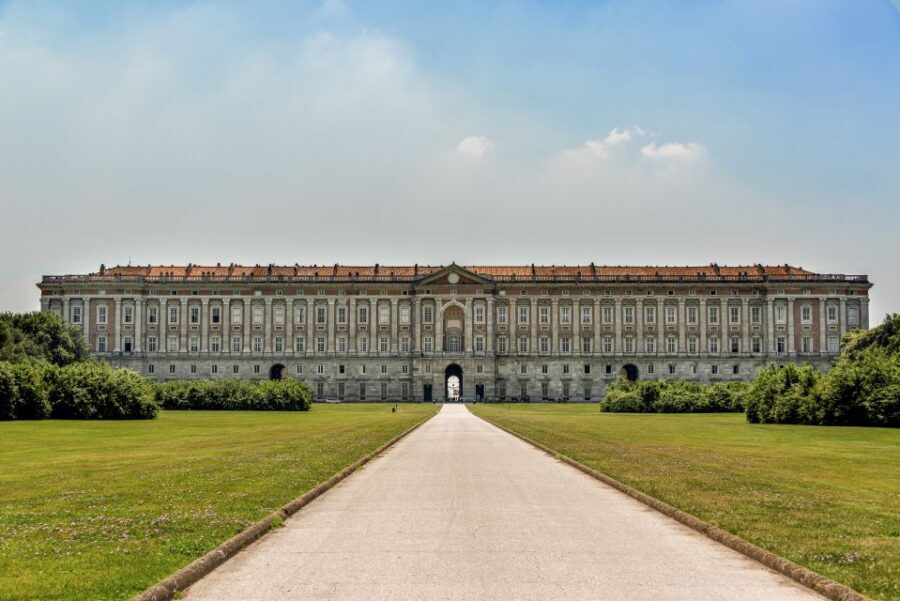
Caserta can feel like a movie set. And in a good way, this palace is the real deal—massive, ornate, and built for power. The Royal Palace of Caserta was commissioned by King Charles of Bourbon in 1751, and architect Luigi Vanvitelli designed it to rival Europe’s biggest monarch palaces.
I especially love how the tour gives you a guided path through places you’d miss on your own: the atrium with its 116-step grand staircase and the Palatine Chapel. Second, I like the mix of art and design styles—Rococo and Neoclassic—so the rooms don’t feel like one long blur of gold and marble.
One drawback: it’s not suitable for wheelchair users, and with a palace this size, you’ll be doing a lot of walking and stair navigation even on a 2-hour schedule.
In This Review
- Key things to know before you go
- Royal Palace of Caserta in 2 hours: the smart way to see it
- Meeting at Piazza Carlo di Borbone: find your guide fast
- What you’ll see inside: the atrium staircase and the Palatine Chapel
- Royal apartments with Rococo and Neoclassic flavor
- Murat’s apartment and the court theater: why the named rooms stick
- The palace scale factor: why 1,200 rooms can still feel manageable
- Languages and private guidance: the difference between hearing and understanding
- Is $47 per person good value for Caserta?
- Before you go: what to plan for after the palace
- Who this tour is best for
- Quick practical notes that can save you time
- Should you book Campania: Royal Palace of Caserta guided private tour?
- FAQ
- What is the duration of the guided tour?
- Where does the tour start?
- How will I recognize the guide?
- Are skip-the-line admission fees included?
- Is private guidance included?
- What languages are available for the live guide?
- Is transportation included?
- Is food and drinks included?
- Is the tour suitable for wheelchair users?
- Can I cancel for a full refund?
Key things to know before you go
- Skip-the-line admission saves time when you’d rather be inside the palace.
- A tight 2-hour route focuses on the big visual hits instead of letting you get lost in 1,200 rooms.
- The grand staircase (116 steps) is the kind of detail you only appreciate with context.
- Palatine Chapel highlights (vaulted ceilings and gilded rosettes) are easier to spot with a guide’s pacing.
- Rococo meets Neoclassic in the royal apartments, so you’ll see how tastes shifted in 18th-century Italy.
- Guides matter: I’ve seen how guides like Anna and Serena can change the feel of the tour with clear storytelling and a calmer pace for families.
Royal Palace of Caserta in 2 hours: the smart way to see it
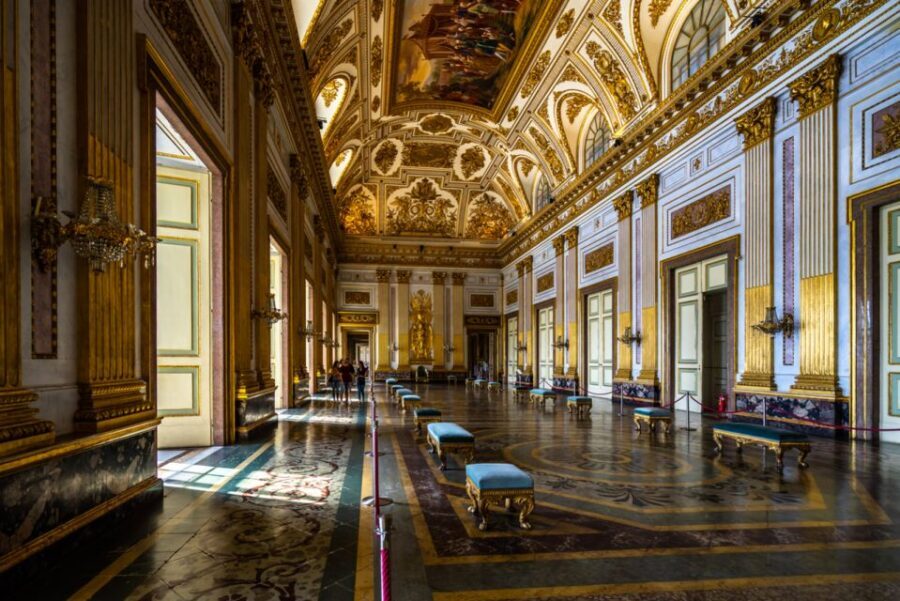
A palace with 1,200 rooms sounds like an impossible shopping list. The magic of this experience is that it doesn’t try to “do everything.” In two hours, you’ll see a carefully chosen slice—enough to understand why Caserta is considered one of Europe’s grandest palatial projects without burning out.
You’ll also appreciate the scale in a tangible way. This isn’t just a pretty building. It was planned by Vanvitelli with a kind of confident ambition: 1,970 windows, lavish internal connections, and 34 staircases of extravagant design. That planning shows up in how the building moves you from one monumental moment to the next.
Think of it like guided storytelling inside stone. You get the what, the why, and the visual cues so the palace starts making sense fast.
You can also read our reviews of more guided tours in Naples


Meeting at Piazza Carlo di Borbone: find your guide fast
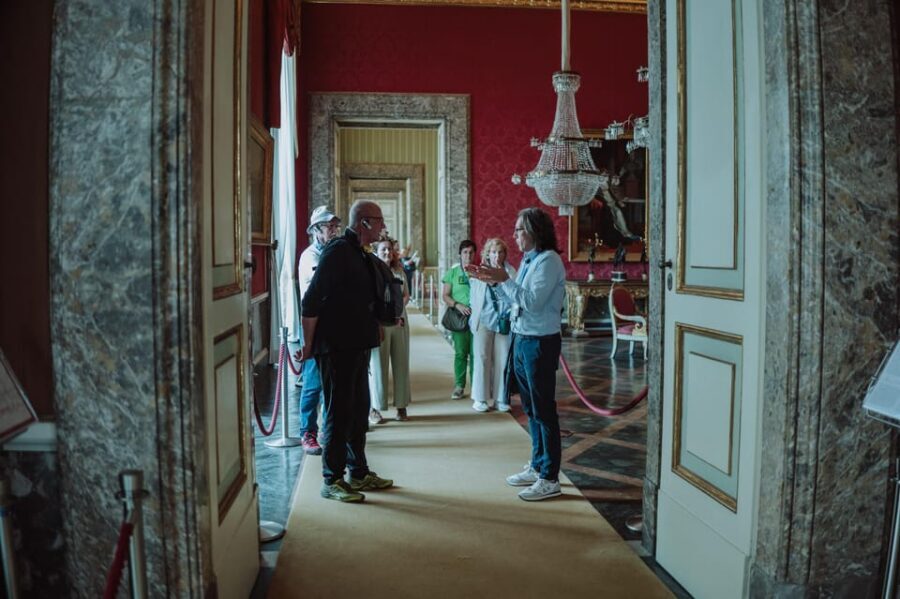
You meet at Piazza Carlo di Borbone, at the Royal Palace main entrance portal (under the flags). The guide will be holding an ASKOS TOURS sign.
I like this meeting setup because it’s easy to locate in a real public space. If you arrive a few minutes early, you can get your bearings before the group gathers.
This tour is run as a private guided experience with live interpretation in multiple languages, so once you’re in place, the guide can immediately set context and keep things moving.
What you’ll see inside: the atrium staircase and the Palatine Chapel
If you want one “wow” moment that helps you understand why Caserta was built to compete with royal palaces across Europe, it’s the main atrium staircase. Expect the 116-step climb that leads you toward the upper vestibule and the Palatine Chapel.
The chapel is a highlight for a reason. The vaulted ceilings and gilded rosettes aren’t just decorative details; they’re part of the palace’s power language. This is a space designed to feel lifted, almost ceremonial—so it reads differently when you know what to look for.
Here’s the practical value of a guide at this point: it’s easy to stand in front of something stunning and realize you don’t know where your eyes should go next. A good guide helps you spot the structure first, then the decoration, then the symbolism.
And it matters because the chapel and staircase are the kind of moments where the palace stops being architecture on a map and turns into an experience.
Royal apartments with Rococo and Neoclassic flavor
After the monumental central spaces, you’ll shift into the heart of the palace’s personality: the royal apartments. This is where you’ll see the mix of Rococo and Neoclassic design, which is the real eye-opener for many first-time visitors.
These styles aren’t just aesthetic labels. They reflect shifting tastes and how the court wanted rooms to feel—sometimes playful and ornate, sometimes more controlled and formal. In the palace, that contrast becomes visible as you move through different interiors and see how details change from one room concept to another.
Your guide also points out how key artisans contributed to the decoration—the painters and cabinet makers whose work helped create what you could think of as the palace’s “finishing layer.” You’ll also hear about specific named areas you’d otherwise gloss over, including the King’s apartment and Murat’s apartment, plus the court theater.
I find the named stops useful. When a tour says the king’s space or Murat’s space, it gives you a mental hook. Without that, you can still admire the rooms, but you might not fully understand how the palace was staged for different eras and occupants.
Murat’s apartment and the court theater: why the named rooms stick
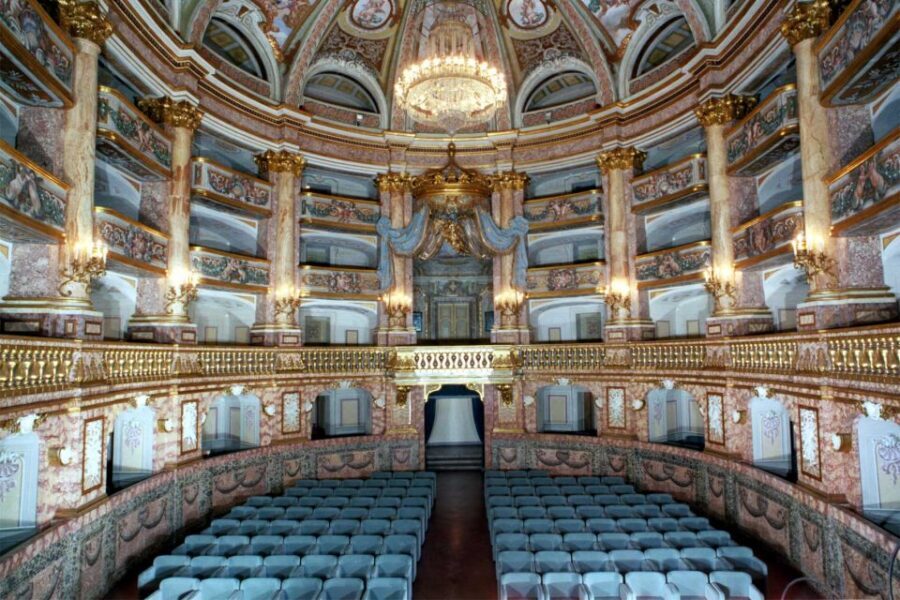
Not every palace gives you strong “named rooms” that feel connected to real people. Caserta does. The tour includes highlights such as Murat’s apartment and the court theater, which helps you understand the palace as a working setting for the court, not just a museum of pretty surfaces.
Even with limited time, this is where guided interpretation pays off. A palace theater, for example, isn’t only about the room itself. It’s about why a court needed a performance space—how social life, status, and power were performed as much as ruled.
Murat’s apartment also matters because it suggests continuity and change inside the same grand shell. The palace can feel timeless at first glance, but the tour helps you notice how different layers reflect different chapters.
You can also read our reviews of more private tours in Naples






The palace scale factor: why 1,200 rooms can still feel manageable
Let’s talk logistics without making it boring. This palace is huge—1,200 rooms and 34 staircases. You cannot “see it all” in two hours. But you also don’t want to.
So the best way to think about this tour is as a course-correction. You’re not left to wander until you either get tired or just start taking photos without remembering what you saw. Instead, the guide keeps the sequence readable, so you finish with a sense of the palace’s structure and artistic goals.
One more practical point: if you’ve ever visited a big attraction and felt overwhelmed, you’ll probably appreciate the tight focus here. The guide’s route prevents that lost-in-the-maze feeling that can happen in places where every corridor looks similar.
Languages and private guidance: the difference between hearing and understanding
The tour offers live guides in English, Spanish, Italian, French, German, and Portuguese. That matters more than people assume. Palace decoration is detailed. Without language access, you may end up admiring visuals you don’t fully understand.
I also like that this is private guidance, not a generic group stampede. Private or small-group interpretation usually means:
- less time waiting around for people to catch up
- more flexibility in how the guide explains details
- more attention to your questions
The supplied guide feedback reinforces this. Anna received praise for being available and great, and Serena stood out for being prepared and for helping keep the tour comfortable for families—specifically by giving attention to children aged 6 and 5 and not making the experience feel heavy for them.
Even if you’re traveling without kids, that kind of pacing tends to make the tour more enjoyable. You get clarity without feeling rushed.
Is $47 per person good value for Caserta?
For $47 per person with a 2-hour private guided visit and skip-the-line admission, I think the value is solid—especially if you care about understanding what you’re looking at.
Here’s the math that matters:
- Admission is included, so you’re not adding extra ticket-buying stress on site.
- Skip-the-line reduces time lost to queues.
- Two hours is long enough for a meaningful overview of key spaces like the atrium staircase, chapel, and royal interiors, but short enough that you can still add on other sightseeing later.
Could you do it cheaper by going on your own? Maybe, but you’d be paying with your time and mental energy. A palace this size rewards context. A guide helps you keep the story straight while your eyes take in the details.
Also, you’re not paying for “extra luxury.” You’re paying for interpretation and saved time, which is what you usually want at a place like this.
Before you go: what to plan for after the palace
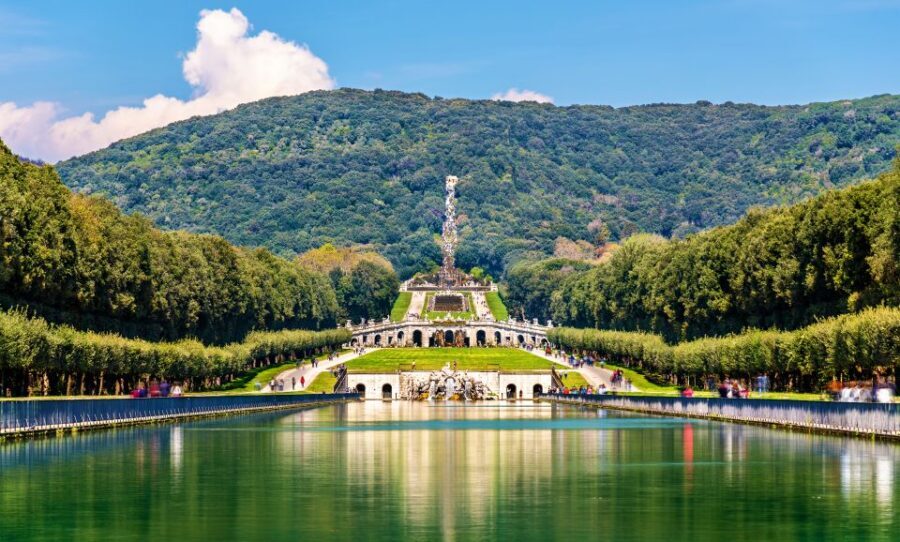
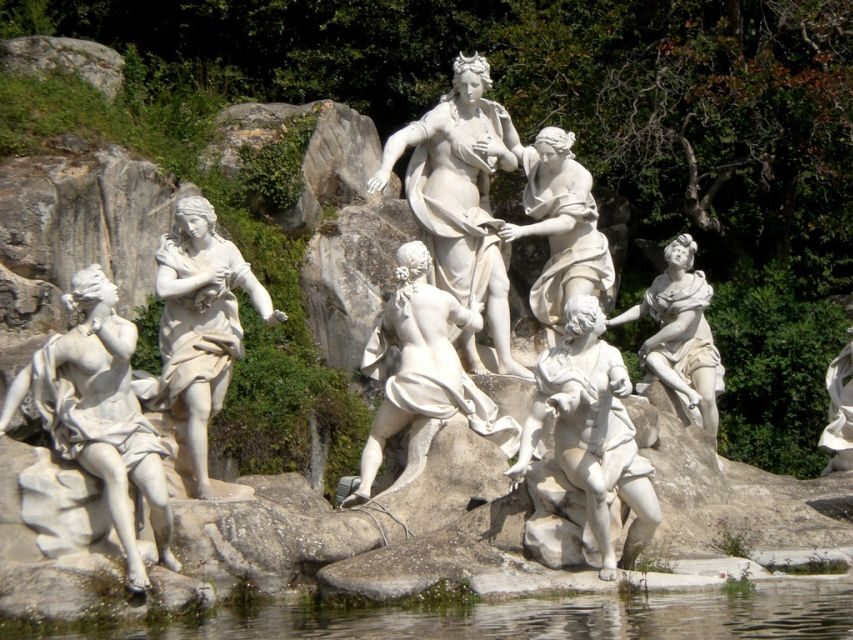
This is a 2-hour guided palace visit, so you’ll likely have time afterward to explore other parts of the estate if your schedule allows. One useful planning idea: if you care about the outdoor experience, decide in advance how much time you want before your next activity.
I’d treat the palace tour as your foundation. Once you’ve seen the main interior highlights, the rest of the property tends to make more sense, because you understand how the whole project was meant to function.
Who this tour is best for
This experience is a great fit if you:
- want a focused introduction to the palace without getting swallowed by 1,200 rooms
- care about Rococo vs Neoclassic design and want to understand what you’re seeing
- prefer a guide who can slow down at key moments
- want a time-efficient visit that still feels meaningful
It may be less ideal if you:
- need wheelchair-friendly access (it’s not suitable for wheelchair users)
- dislike walking and stair navigation in historic spaces
- want a fully free-form wandering day (this is guided and structured)
Quick practical notes that can save you time
The tour lasts 2 hours, so treat it like a timed “best of Caserta” interior experience. Wear comfortable shoes. The palace’s scale means you’ll be moving through multiple major areas.
Also, your tour guide will be recognized by the ASKOS TOURS sign at the main entrance portal under the flags, so plan to meet there exactly rather than trying to find your own way once the group starts.
Should you book Campania: Royal Palace of Caserta guided private tour?
If you want the Royal Palace of Caserta to feel clear and satisfying, I’d book it. The price makes sense for what you get: a guided route through the palace’s most important visual moments, plus skip-the-line entry so you spend more time inside and less time in queues.
I’d especially recommend it if you care about design details and want to understand why the palace looks the way it does—Staircase first. Chapel next. Then royal interiors with Rococo and Neoclassic personality.
The only real reason to skip is if stair-heavy access is a problem for you, or if you truly want a totally self-paced day with no structure.
FAQ
What is the duration of the guided tour?
The Royal Palace of Caserta guided private tour lasts 2 hours.
Where does the tour start?
You meet at the main entrance portal of the Royal Palace (under the flags) in Piazza Carlo di Borbone.
How will I recognize the guide?
The guide will be holding an ASKOS TOURS sign.
Are skip-the-line admission fees included?
Yes. Skip-the-line admission fees are included.
Is private guidance included?
Yes. The tour includes private guidance.
What languages are available for the live guide?
The tour offers live guidance in English, Spanish, Italian, French, German, and Portuguese.
Is transportation included?
No. Transportation is not included.
Is food and drinks included?
No. Food and drinks are not included.
Is the tour suitable for wheelchair users?
No. It is not suitable for wheelchair users.
Can I cancel for a full refund?
Yes. Free cancellation is available up to 24 hours in advance for a full refund.