REVIEW · NAPLES
Tour Of Padre Pio: From Pietrelcina To San Giovanni Rotondo
Book on Viator →Operated by Shore Excursion in Naples · Bookable on Viator
Padre Pio’s story feels close up on this route. You start in Pietrelcina at the Casa Natale, a simple birthplace that still has the feel of lived-in family life, down to the plain furnishings and a room you access by three external steps. Then you head to San Giovanni Rotondo to see both the major shrine and the convent complex tied to Padre Pio’s later life.
I especially love how this trip gives you two kinds of meaning in one day: the quiet, human scale of the birthplace, and the bigger, cathedral-like scale of the shrine. You’ll also get a guide touchpoint that can be as light or detailed as you want, and in at least one case the driver/guide was Mauro, known for careful explanations and strong language help.
One possible drawback: the drive from Naples takes time, so plan for a longer day and some patience on the road.
In This Review
- Key things to know before you go
- Padre Pio by road: what the Naples-to-Puglia day feels like
- Stop 1: Casa Natale di Padre Pio in Pietrelcina (the small room that tells a big story)
- Stop 2: The Shrine of Padre Pio in San Giovanni Rotondo (faith meets modern design)
- Stop 3: Santa Maria delle Grazie, the convent complex, and the sarcophagus story
- Your guide and the small things that make it smooth (Mauro is a standout)
- Transportation, comfort, and what’s actually included
- Price and value: is $810.16 per group fair?
- Who this tour suits best (and who might prefer something else)
- Book it or skip it: my recommendation
- FAQ
- How long is the tour?
- What does the price include?
- Is this a private tour?
- Do I need to pay admission tickets?
- Where do you pick up passengers in Naples?
- What about meals and tips?
- Is a mobile ticket used?
- What is the cancellation policy?
Key things to know before you go
- Private group of up to 3: you move as a small unit, not a big herd.
- Pickup from Naples hotels/ports: hassle drops fast when you don’t have to find a meeting spot.
- Birthplace details in Pietrelcina: one room, modest furnishings, and even a trap door leading to a lower storage/barn area.
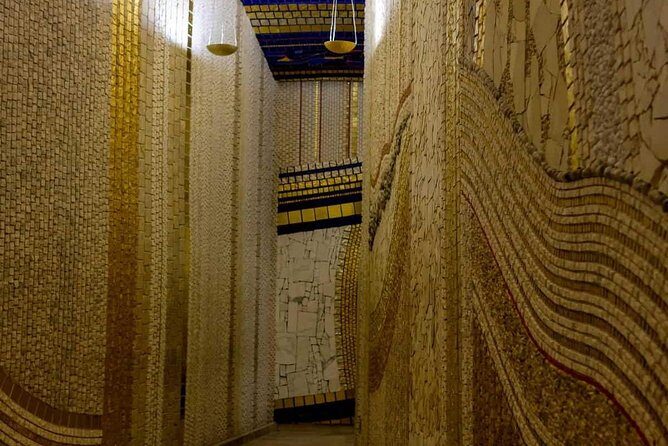
- Modern shrine design in San Giovanni Rotondo: mosaics, stained glass, and a layout that feels different from older sanctuaries.
- Sarcophagus context and 2008 move: you’ll see how his remains are displayed today compared with earlier years.
- Bottled water and air-conditioning: small comfort, especially on longer road transfers.
Padre Pio by road: what the Naples-to-Puglia day feels like
This is a private tour out of Naples, and you should expect the day to be shaped by driving time. You’re traveling through changing scenery, and it really helps to treat the ride as part of the experience rather than wasted time. On the way, you’ll pass from Campania into Puglia, with lots of olive trees showing up along the route.
The pacing is built around a visit to three linked places. The day starts with the birthplace in Pietrelcina, then transitions to San Giovanni Rotondo for the shrine and the convent complex connected to Padre Pio’s life. Even with the fixed stops, you still get enough structure to avoid rushing from one place to the next.
And because the tour includes pickup from hotels, B&Bs, and Naples-area ports (Molo Beverello, Pozzuoli, Molo Luise), the hardest part is handled up front. You’re not wrestling with taxis, timing, or where to stand. You just show up and go.
You can also read our reviews of more tours and experiences in Naples.

Stop 1: Casa Natale di Padre Pio in Pietrelcina (the small room that tells a big story)
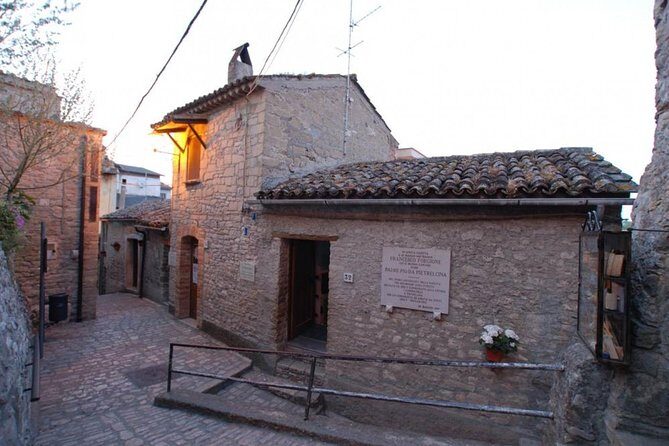
The first stop is the Casa Natale di Padre Pio in Pietrelcina, at Vico Storto Valle 27. This isn’t a huge museum complex where you wander for hours. It’s one modest room, entered via three external steps, and it feels intentional: scale matters here.
Inside, you’ll see simple furnishings: a night table and wrought-iron double bed, plus a four-glazed window facing a washbasin and an old chest. There’s also a square table with a faded carpet covering, where books from Padre Pio’s school years are referenced, along with small details that make the room feel personal rather than staged.
One of the most striking features is that the house has a trap door in the floor leading to a lower space used as storage and a donkey barn. There’s also an external door on the side for that lower area. You don’t need to be a scholar to feel what this means: the site isn’t only about symbolism. It’s about ordinary daily life, preserved enough to let you imagine what “home” meant in that era.
The tour allocates 1 hour 30 minutes for this stop, which I think is the right length. You get time to take in the physical details, read at your pace, and then move on without stress.
Practical note: the birthplace visit includes admission, and if stairs are a concern for you, this stop is worth factoring in because the entry uses those three external steps.
Stop 2: The Shrine of Padre Pio in San Giovanni Rotondo (faith meets modern design)
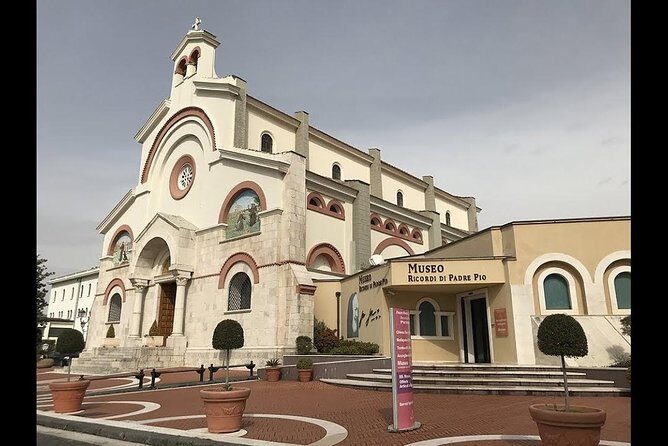
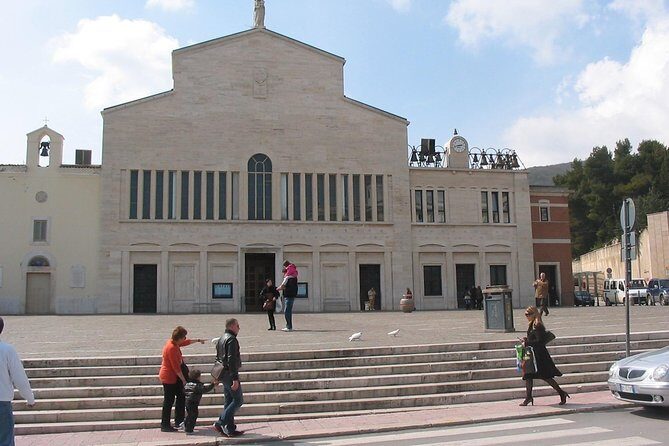
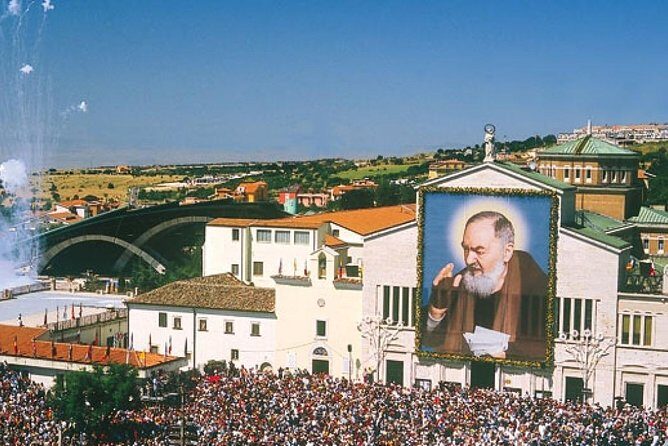
Next you head to San Giovanni Rotondo, where the Shrine of Padre Pio sits. The place draws millions of faithful each year, and you’ll notice right away that the shrine doesn’t try to imitate the look of older European sanctuaries. Instead, you get something that feels more modern in its design language.
Visually, it’s all about contrast: mosaics with iridescent color, polychrome stained glass with sharp or sometimes abstract patterns, and architectural elements that help guide you through the space. It can feel surprisingly easy to navigate, even though it’s a major pilgrimage site. You’re not stuck in a maze of tiny decorative corners.
This stop is scheduled for about 1 hour and includes free admission. That hour gives you enough time to orient yourself, take in the shrine’s visual power, and still keep the day moving. If you like religious art, design, and how architecture affects your mood, this is often the portion that surprises people.
One consideration: since it’s a high-demand pilgrimage area, you may encounter crowds depending on the day and time. The upside is that even crowds here feel purposeful, like everyone has the same reason to be there.
Stop 3: Santa Maria delle Grazie, the convent complex, and the sarcophagus story
From the main area, you’ll walk from the square up the stairways toward another square overlooking Santa Maria delle Grazie and the conventual complex tied to Padre Pio’s life. Two churches—both dedicated to Santa Maria delle Grazie—sit nearby, built according to the needs of the increasing number of pilgrims who came to visit.
This is where the trip shifts from shrine design to life-story geography. You’re seeing the spaces connected to his daily religious world, not just the public pilgrimage center.
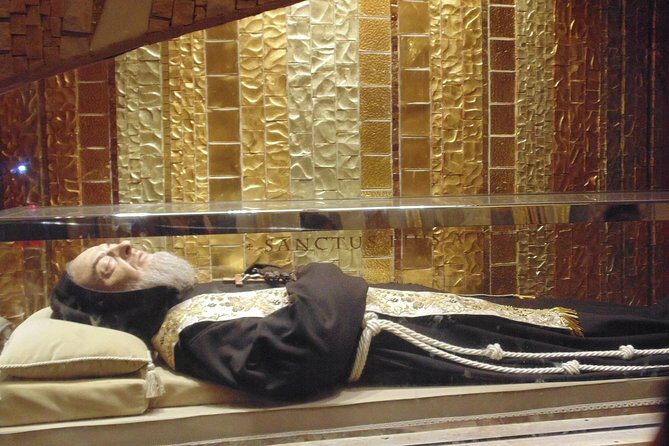
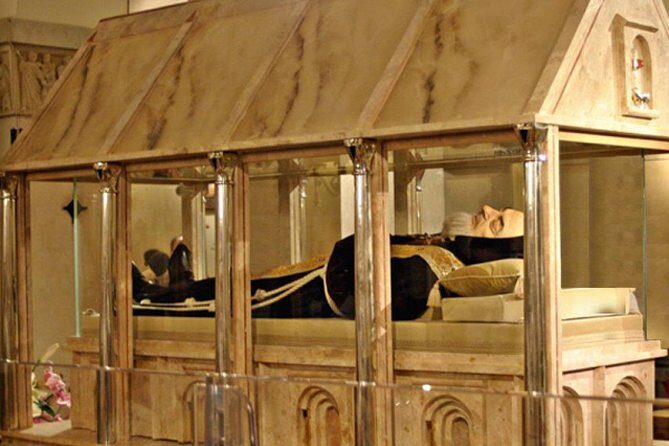
The most important element here is the tomb experience. On the lower floor, you’ll see the sarcophagus where Padre Pio was buried, which guarded his remains until 2008. After that, his body was transferred to a crystal case in the new sanctuary.
This stop is scheduled for about 2 hours, and I like that more time is given here. It’s not just a quick glance-and-go. You need a little breathing room to connect the information to what you’re actually seeing in front of you—church space, convent complex, and the changing display of his remains over time.
Admission is free for this portion, which helps the overall value of the tour. Also, if you appreciate context—how a site evolves with increasing pilgrimage—this is the stop that delivers it.
Your guide and the small things that make it smooth (Mauro is a standout)
The quality of the day often comes down to how the guide manages time and expectations. In one memorable example, the tour guide was Mauro, described as highly professional and genuinely passionate about the sites. That matters because Padre Pio can be approached in two ways: as a list of locations, or as a coherent path.
Mauro’s approach made the experience feel organized without becoming stiff. He also helped with language, and he made sure basic needs didn’t become issues while moving between sites. One standout perk: if you want an extra stop, he can add something like St Michel’s cave at your request, as long as time allows.
Even if your guide is different, this is the kind of help that makes a private tour worth it. You’re not stuck figuring out what to ask or what order to do things in. The day stays readable.


Transportation, comfort, and what’s actually included
This is a private tour in an air-conditioned vehicle, with parking, fuel, and tolls included. You also get bottled water, which sounds basic until you’re sitting in a car for a while in warm weather.
Your meeting coverage is broad for Naples-area travelers. Pickup is included from hotels and B&Bs, and from ports such as Molo Beverello, Pozzuoli, and Molo Luise. If you’re arriving by cruise, this type of pickup can make the difference between a calm morning and a stressful scramble.
You’ll receive a confirmation at booking time, and you’ll be issued a mobile ticket. Service animals are allowed, and the tour notes that most travelers can participate.
Price and value: is $810.16 per group fair?
The price is $810.16 per group, up to 3 people. That sounds like a lot until you break it down by group size and compare it to the cost of individual transportation, entry coordination, and the time cost of trying to self-arrange this route from Naples.
Here’s where the value really comes from:
- You get a dedicated vehicle plus covered logistics like parking and tolls.
- You don’t have to coordinate separate local transfers between Pietrelcina and San Giovanni Rotondo.
- The core admissions are partially covered: Casa Natale admission is included, while the shrine and convent complex have free admission.
On top of that, the day includes bottled water and keeps you moving with a guide. If you’re traveling with a small group—friends, family, or a couple with another pair—this becomes a practical way to do a spiritually meaningful route without the friction.
One cost to keep in mind: meals are not included, and tips are not included. So budget for lunch or snacks separately.
Who this tour suits best (and who might prefer something else)
This works best if you want a guided, structured pilgrimage day and don’t want to build transportation yourself. Because it’s private and capped at three people, you also get flexibility compared with larger group tours.
It’s a great fit for:
- People who want to see both the birthplace and San Giovanni Rotondo’s main religious sites.
- Anyone who appreciates the difference between intimate family-scale places and major pilgrimage architecture.
- Travelers who value a guide to explain context and help with pacing.
It may be less ideal if:
- You dislike long drives and prefer to stay within one city area.
- You want lots of free time to wander off-route without a set plan.
- You need a fully step-free day; the birthplace entry uses three external steps, and the rest of the experience involves stairways.
Book it or skip it: my recommendation
I’d book this tour if you want a focused Padre Pio day with minimal hassle and a realistic schedule. The combination of Casa Natale in Pietrelcina plus the Shrine and Santa Maria delle Grazie convent complex is exactly the kind of pairing that makes a pilgrimage meaningful without turning it into a marathon.
If you’re short on time in Naples or you’re worried about doing this on your own, the included pickup and dedicated vehicle are a big deal. You’re paying for convenience, time, and a guided flow that helps you understand what you’re seeing.
I’d hesitate only if you’re very drive-sensitive or your mobility needs are strict. Otherwise, this is a strong choice for small groups who want the story to feel coherent from morning to afternoon.
FAQ
How long is the tour?
The duration is listed as approximately 1 to 10 hours, with specific site times of about 1 hour 30 minutes at Casa Natale di Padre Pio, 1 hour at the shrine in San Giovanni Rotondo, and 2 hours at the convent complex.
What does the price include?
The tour includes an air-conditioned vehicle, parking, fuel, tolls, and bottled water. Pickup is also included from designated Naples hotels and ports. Admission is included for Casa Natale di Padre Pio, while admission for the shrine and the convent complex is free.
Is this a private tour?
Yes. It’s private, and only your group participates. The group size is up to 3.
Do I need to pay admission tickets?
Casa Natale di Padre Pio admission is included. Admission for the shrine and the Santa Maria delle Grazie convent complex is free.
Where do you pick up passengers in Naples?
Pickup is included from hotels and B&Bs and from ports including Molo Beverello, Pozzuoli, and Molo Luise.
What about meals and tips?
Meals are not included, and tips are not included. Plan to budget for food separately.
Is a mobile ticket used?
Yes. The tour uses a mobile ticket.
What is the cancellation policy?
You can cancel for a full refund up to 24 hours before the experience start time. If you cancel less than 24 hours before, the amount paid is not refunded.