REVIEW · SORRENTO
Pompeii Guided Tour with Ticket & Lunch from Sorrento
Book on Viator →Operated by Buyourtour di Amo Italy Travel · Bookable on Viator
Pompeii, without the usual stress. This all-in-one day outing from Sorrento pairs priority admission with a guided walk through the key ruins, so you spend more time seeing and less time figuring things out. You also get included lunch and a Vesuvius wine tasting, which saves you from hunting for food near the site.
I like how the plan is built for a full day: round-trip minivan, a guided route that hits the Forum, baths, the theatre, and even a brothel stop, plus a winery break after Pompeii. It’s designed for English-speaking groups and keeps the flow tight over about 7 to 8 hours.
One watch-out: this is a mostly outdoor route in an archaeological park. If you’re hoping for more wall paintings and smaller interior details, make sure you manage expectations—or ask the guide what’s covered—because not every stop can be a close-up museum moment.
In This Review
- Key things to know before you go
- Why This Pompeii Day Trip Works From Sorrento
- Getting There: Minivan Pickup and Priority Entry
- Pompeii First Stop: From the Park Entry to the Forum’s Main Decisions
- Inside the City Grid: Market Life and Via dell’Abbondanza
- Stabian Baths and the Reality of Roman Public Life
- Lupanar and Teatro Grande: The Two Sides of Pompeii’s Public Stage
- Lunch at the Winery: Piennolo Cherry Tomatoes and a Quick Wine Education
- Price and Logistics: What $96.33 Buys You
- Time and Comfort Tips for a 7–8 Hour Outdoor Day
- Who This Tour Suits (and Who Should Switch Plans)
- Should You Book This Pompeii Tour With Lunch?
- FAQ
- How long is the Pompeii guided tour from Sorrento?
- What does the price include?
- Is lunch included, and what is it?
- Do I need to buy a Pompeii ticket separately?
- Is the tour guided, or self-guided?
- Is the tour offered in English?
- Where do I meet in Sorrento?
- How many people are in the group?
- Is there a mobile ticket?
- Can I cancel for a full refund?
Key things to know before you go
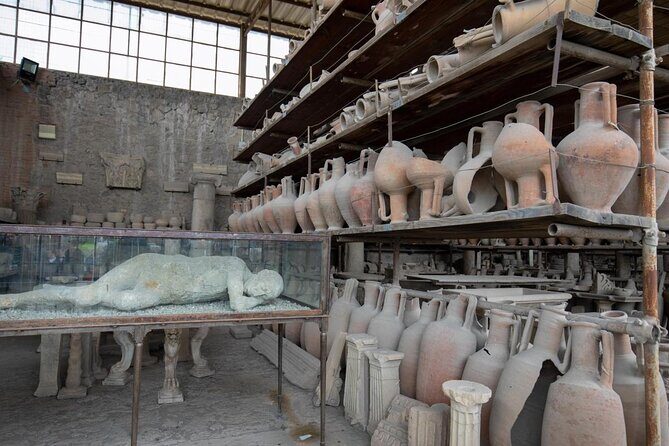
- Priority admission helps you bypass some of the hassle at Pompeii.
- Forum-to-streets route covers the city’s civic, commercial, and daily-life zones.
- Stabian Baths and Teatro Grande give you a clear sense of Roman public life.
- Lupanar stop is a quick but memorable look at Pompeii’s shockingly human side.
- Winery lunch + tasting turns the day trip into a full meal plan, not a snack run.
Why This Pompeii Day Trip Works From Sorrento
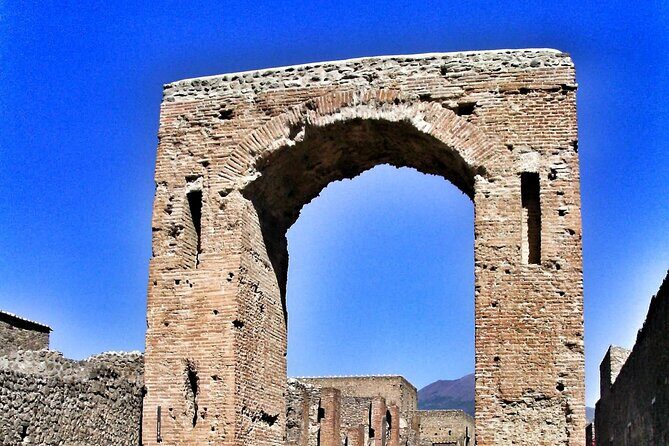
Sorrento is a great launch pad for Pompeii. You trade the hassle of sorting transport and tickets for a planned day with a pick-up point and a return to the same place. For many people, the real value is not just Pompeii—it’s the smooth logistics that let you focus on the ruins.
This tour is also built around understanding what you’re looking at. Pompeii isn’t one single monument. It’s a whole city: streets, houses, offices, markets, baths, theatres, and religious spaces all preserved under volcanic ash from the 79 AD eruption of Mount Vesuvius. A guide helps connect the dots while you’re walking.
Then there’s the food and wine piece, which quietly matters more than you’d think. When you’ve spent hours in the sun, the last thing you want is to search for a restaurant near the site. Here, you get an included lunch and a tasting, so your energy has a plan.
You can also read our reviews of more tours and experiences in Sorrento



Getting There: Minivan Pickup and Priority Entry
You start in Sorrento at Bar Kontatto, Corso Italia 257, near Lauro Square. The tour ends back at that same meeting point, so you don’t have to worry about last-minute transport decisions.
Transport is by minivan, round trip. That’s a big deal for a day like this because Pompeii visits can be time sinkholes when you’re trying to stitch together schedules. Here, you’re on the clock, but in a controlled way.
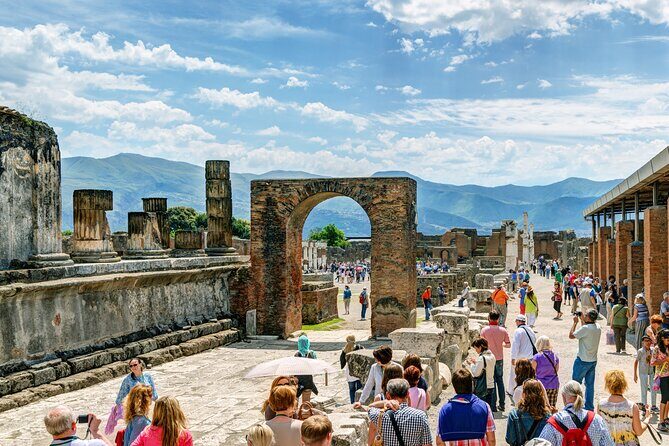
You also get ticket coverage and priority admission to the archaeological park. Priority entry won’t make Pompeii small, but it can cut down the worst waiting time at the gate. And when the day is about 7 to 8 hours, saving 30 to 60 minutes is real value.
Tip: Pompeii is weather-dependent and sun-heavy. Wear comfortable shoes and bring sunscreen and sunglasses in summer, because the day is mostly outdoors.
Pompeii First Stop: From the Park Entry to the Forum’s Main Decisions
Once you reach the Archaeological Park of Pompeii, you get roughly 2 hours in the site as part of the guided schedule. This time feels tight only if you expect slow strolling and optional detours. If you come ready to move and look closely at key structures, it works well.
Your route then moves into the heart of civic life: the Forum area. This is where the city handled administration, justice, business, and worship. Standing in the Forum zone gives you a sense of how Roman cities ran on public spaces, not just private homes.
Stops you make along the way include the Foro de Pompeya (the Civil Forum) and the Tempio di Giove Capitolino, the Temple of Jupiter. The Jupiter Temple is on the northern side of the Forum and is associated with cult statues of Jupiter, Juno, and Minerva. Even if the details you see today are fragments and reconstructions, the layout helps you understand why this spot mattered to everyday politics and religion.
One practical consideration: a Forum stop can feel “brief” compared to the scale of Pompeii. But it’s also the easiest place to get oriented. If you’re new to Pompeii, this part of the tour is the fastest path to making sense of the rest.
Inside the City Grid: Market Life and Via dell’Abbondanza
After the Forum, the route shifts toward everyday work and movement.
You’ll see the Macellum, Pompeii’s market. It wasn’t just produce and shopping. It’s described as a tuff quadri-porticus with a hall used for worship on the elevated eastern side aligned with the entrance. That mix is very Roman: commerce and religion sharing the same built space. Even at a quick stop, it helps you realize Pompeii wasn’t frozen time—it was functioning daily life.
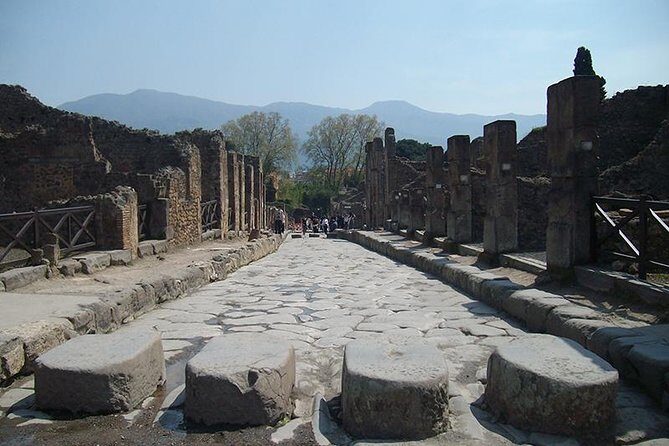
Then comes Via dell’Abbondanza, one of the main streets. This road connected the Forum with the Amphitheatre. Standing along a main thoroughfare is where Pompeii starts to feel less like random ruins and more like a city you could walk through day after day. You can picture crowds moving, goods being carried, and people heading toward public events.
Drawback to keep in mind: you’ll be moving between stops in short segments. If you love long, quiet photography sessions, you’ll want to plan for quicker looks here rather than expecting a slow museum-style pace.
Stabian Baths and the Reality of Roman Public Life

Next you hit the Stabian Baths, called Terme Stabiane. These are ancient Roman bathing complexes and are noted as the oldest and largest of the five public baths in Pompeii.
Baths matter because they weren’t only about hygiene. They were social hubs, and they tell you how Romans used public infrastructure for relaxation and conversation. Even when your time at each stop is short, the size and layout of a bath complex helps you understand the routines of a city that went far beyond temples and politics.
Because the Stabian Baths are an older, larger complex, they tend to give you the most “feelable” sense of what you’d see in a functioning Roman day—people meeting, chatting, and going through bathing steps that were part of the rhythm.
Practical note: baths can mean uneven ground and partially excavated areas. Keep your footing and don’t rush. A good stop here is about steadiness and noticing patterns, not sprinting for photos.
You can also read our reviews of more guided tours in Sorrento




Lupanar and Teatro Grande: The Two Sides of Pompeii’s Public Stage
Pompeii doesn’t pull punches, and this route includes two stops that show that.
The Lupanar is the brothel of Pompeii, with erotic paintings. The people associated with it are noted as mostly Greek and Oriental slaves. Even though your time at this stop is brief, it’s one of the clearest reminders that Pompeii was a real city with real commerce—both respectable and not.
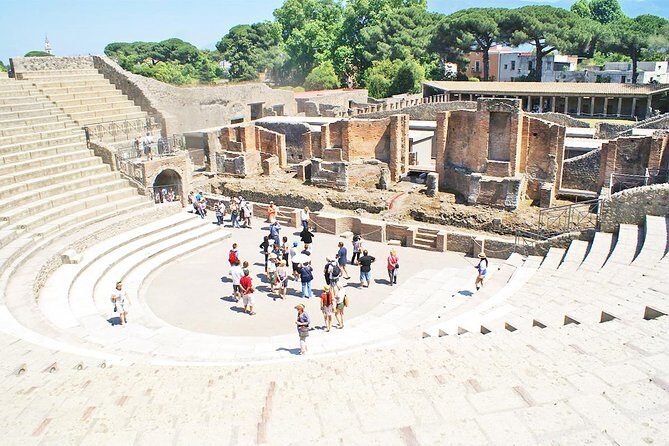
Then you head to Teatro Grande. In the large theatre, performances included comedies and tragedies in a Greek-Roman tradition. The theatre is described as the first large public building freed from the deposits of the eruption, which is a detail worth holding in your head as you look around. It helps you understand why certain structures reappeared early in the archaeological story.
If you’re a culture-and-architecture person, this pairing works: one stop shows a private-but-public economy, and the other shows the big public entertainment system.
One caution from past experience of how tours can feel: if you’re specifically chasing murals and painted wall details, ask the guide what paint-focused stops are included in your group’s route. Pompeii can be unpredictable day to day, and not every tour will prioritize every kind of surface detail.
Lunch at the Winery: Piennolo Cherry Tomatoes and a Quick Wine Education

After Pompeii, you go to Sorrentino Winery for about 2 hours. This break is where the day stops being only walking and turns into food and a calmer pace.
The sample lunch menu includes:
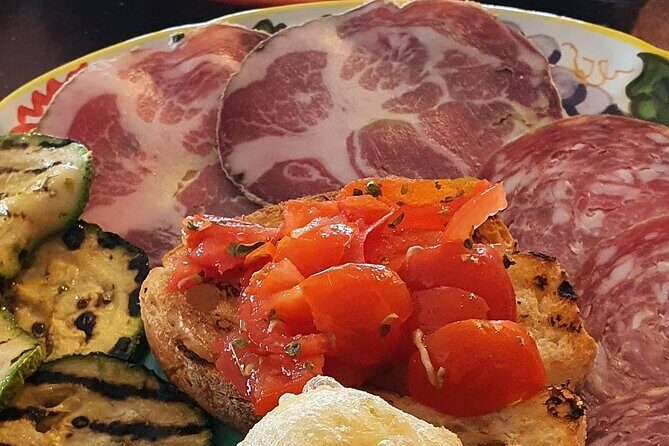
- Bruschetta, cured meats, cheeses, and seasonal vegetables
- Pasta with piennolo cherry tomatoes, a local specialty
- Traditional homemade dessert
Then you get a wine tasting of three wines: Prosecco, red, and white. This is also where the terroir story gets concrete. Sorrentino Vini was founded in 1990 by the passion of Paolo Sorrentino, and it highlights Lacryma Christi, noted as the most famous wine produced on Vesuvius. The tour information also notes that Lacryma Christi is the only DOC product produced on Vesuvius, which gives you a clear reason to care about that volcanic soil beyond the postcard version.
Value angle: a lot of Pompeii day trips stop at ruins and tell you to figure out lunch. Here, lunch is part of the package, and the tasting gives you something useful to remember beyond photos of stones.
One thing to plan: keep your timing in mind. You’ve already done plenty of walking, and you’ll want to leave the winery with enough energy for the return ride without rushing the meal.
Price and Logistics: What $96.33 Buys You

At about $96.33 per person, this isn’t a cheap excursion. But it’s also not just transport and a ticket. The value is the bundle:
- Round-trip minivan from Sorrento
- Priority admission and ticket included
- Guided commentary across major Pompeii zones
- Lunch with a set menu
- Wine tasting (three wines)
- An English-offered tour and a max group size cap of 100
If you were to price these pieces separately—especially transport plus guided entry plus lunch—you’d likely end up spending more or spending time managing details. The best part of this price isn’t the number. It’s the way it protects your day from friction.
Where value can feel thinner: if you’re extremely detail-obsessed and want a slow, pick-your-own-stop pace. A group route with set stops can’t guarantee every preference. But if your goal is to see the big anchors and come away with a clearer understanding of how Pompeii worked, this pricing structure makes sense.
Time and Comfort Tips for a 7–8 Hour Outdoor Day
This tour runs about 7 to 8 hours and is capped at 100 people. That’s plenty of organization for a big site day trip, but it still means you should move with the group and expect short stop windows.
Here’s how I’d prepare:
- Bring comfortable shoes you can walk in for hours, because the ground can be uneven.
- Use sunscreen and sunglasses. Pompeii can get hot and bright fast.
- Have a small day bag for water and personal items, since you’ll be in the open air for long stretches.
- Keep your expectations flexible about murals or specific smaller details. If paint-focused viewing is your top goal, ask your guide how the route covers wall art.
If it rains, plan for the fact that lots of the day happens outdoors. Pompeii is weather-resistant, but your comfort won’t be. You’ll still get the ruins; just dress accordingly.
Who This Tour Suits (and Who Should Switch Plans)
This fits best if you want:
- A structured day trip from Sorrento with minimal logistics
- A guide to explain how the city fits together (Forum, markets, baths, theatre)
- Included lunch plus a wine tasting so you’re not scrambling for food
It may not be ideal if:
- You want long, solitary time in specific indoor or detail-heavy areas.
- You strongly prefer murals and painted surfaces over architecture and larger civic spaces.
- You’re sensitive to language clarity and need very slow, ultra-specific explanations. Even on English-offered tours, guides can vary in style and how easily everyone understands them, especially in mixed groups.
Should You Book This Pompeii Tour With Lunch?
If you’re choosing between a do-it-yourself Pompeii day and an organized day, I’d lean toward this one if you want fewer decisions and a full meal plan. The priority entry, guided route, and winery lunch make it a genuinely efficient way to see Pompeii from Sorrento—especially if this is your first time with the site.
Book it if your priority is the big picture plus key anchors: the Forum and Temple zone, market and main street, the Stabian Baths, and the theatre. You’ll also like the winery stop and tasting because it gives the day a natural ending.
Skip it or ask extra questions if you’re chasing a very specific type of Pompeii viewing, like deep wall-painting focus. In that case, clarify whether your group will spend time where you want it, and arrive ready to steer the experience with your questions.
FAQ
How long is the Pompeii guided tour from Sorrento?
The tour lasts about 7 to 8 hours.
What does the price include?
The price includes round-trip minivan transport, priority admission to Pompeii, a guided tour with commentary, and lunch plus wine tasting at the winery.
Is lunch included, and what is it?
Yes. The sample menu includes bruschetta with cured meats and cheeses, pasta with piennolo cherry tomatoes, and a traditional homemade dessert, plus wine tasting.
Do I need to buy a Pompeii ticket separately?
No. The admission ticket is included as part of the tour stops.
Is the tour guided, or self-guided?
It’s a guided tour with commentary.
Is the tour offered in English?
Yes, it is offered in English.
Where do I meet in Sorrento?
The meeting point is Bar Kontatto, Corso Italia, 257, 80067 Sorrento NA, Italy. The tour ends back at the same meeting point.
How many people are in the group?
The tour has a maximum group size of 100 travelers.
Is there a mobile ticket?
Yes. A mobile ticket is included.
Can I cancel for a full refund?
Yes. You can cancel for a full refund up to 24 hours in advance of the start time.
You Might Also Enjoy


More Tickets in Sorrento
More Tours in Sorrento






More Tour Reviews in Sorrento
- Sorrento Farm and Food Experience including Olive Oil, Limoncello, Wine tasting
★ 5.0 · 2,524 reviews