REVIEW · SORRENTO
Guided Tour of Pompeii and Herculaneum with Lunch and Ticket
Book on Viator →Operated by Buyourtour di Amo Italy Travel · Bookable on Viator
Two Roman cities in one day. Pompeii and Herculaneum are only a short ride apart, but the experience feels very different: Pompeii shows the city’s bones on a huge scale, while Herculaneum can feel almost like you stepped into a still-frozen neighborhood. This tour pulls both together into one long, structured outing, with an included lunch and wine tasting to break up the walking.
I love the way the day is organized around the places that explain daily life, not just the biggest photo spots. I also like that you get an actual Pompeii-and-Herculaneum narrative, with guides such as Celsestina in Pompeii and Diana in Herculaneum bringing the sites to life through details like how people bathed, shopped, and even entertained themselves.
One consideration: it’s a 9-hour day, and Pompeii can be crowded even with reserved access. If you prefer to linger for long stretches on your own, you may feel the pace a bit.
In This Review
- Key takeaways before you go
- Starting in Sorrento: how the day actually flows
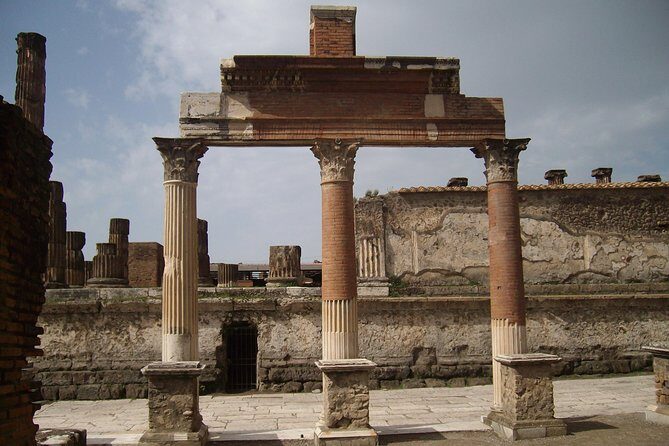
- Pompeii’s Forum and the city layout you can still follow
- Stabian Baths, the Lupanar, and Teatro Grande
- Lunch and wine at Sorrentino Winery (Vesuvius edition)
- Herculaneum’s preserved neighborhoods: why it feels different
- House of the Deer, Neptune mosaics, and the black-painted hall
- Tickets, crowds, and how to stay sane at Pompeii
- Is the price fair for what you get?
- Who this tour suits best (and who should consider alternatives)
- Should you book this Pompeii and Herculaneum day tour?
- FAQ
- How long is the Pompeii and Herculaneum tour?
- Where does the tour start?
- Is lunch included?
- Are admission tickets included for Pompeii and Herculaneum?
- What language is the tour offered in?
- How big is the group?
- Is a mobile ticket provided?
- Will the schedule always run exactly on time?
- Is there weather risk?
- What should I wear or bring?
Key takeaways before you go

- Two sites, one day: Pompeii plus Herculaneum, both with admission tickets included
- Pompeii route hits major themes: Forum, Baths, brothel, and the Large Theatre
- Herculaneum feels more intimate: well-preserved houses and mosaics across about 2 hours
- Lunch + wine on Vesuvius: included tasting of Prosecco, red, and white at Sorrentino Winery
- Group size stays manageable: up to 100 people, with an English guide
Starting in Sorrento: how the day actually flows
This tour is based out of Sorrento and runs for about 9 hours. It’s designed as a full-day loop, so you’ll be on your feet for long stretches. The itinerary timing can shift due to local traffic, and that matters in southern Italy where schedules can be flexible in real life.
You’ll be traveling in a group (up to 100), and the day is carried by an organized plan rather than a free-roam day. One review noted the van/mini bus felt comfortable and air-conditioned, which helps when you’re heading out into warm weather.
Bring what you’d bring for a summer walk: comfortable shoes, sunglasses, and sunscreen. You’ll also want water, since Pompeii and Herculaneum are both exposed places.
You can also read our reviews of more tours and experiences in Sorrento



Pompeii’s Forum and the city layout you can still follow
Pompeii is big, and your first goal is getting your bearings fast. The tour starts at the Archaeological Park of Pompeii (about 2 hours with admission included). You’ll explore excavated streets and houses, and the scale is the first thing that hits you: Pompeii isn’t one ruin. It’s an entire city footprint under glassy ash.
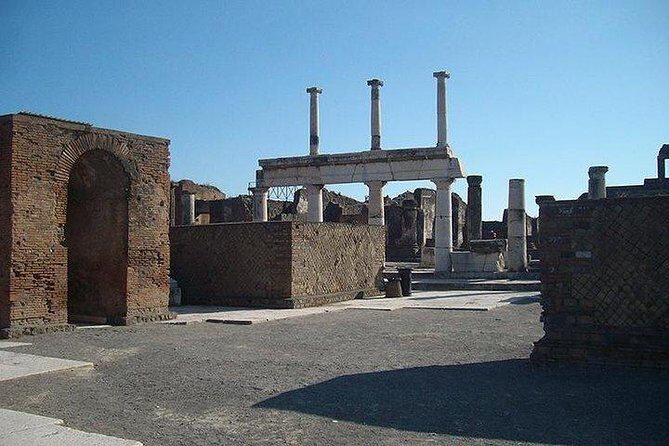
From there, you move into the civic heart at the Foro de Pompeya. This is where the public buildings and the city’s business life clustered—administration, justice, commerce, and worship all orbiting the forum square. Think of it as the place where decisions got made and people kept meeting.
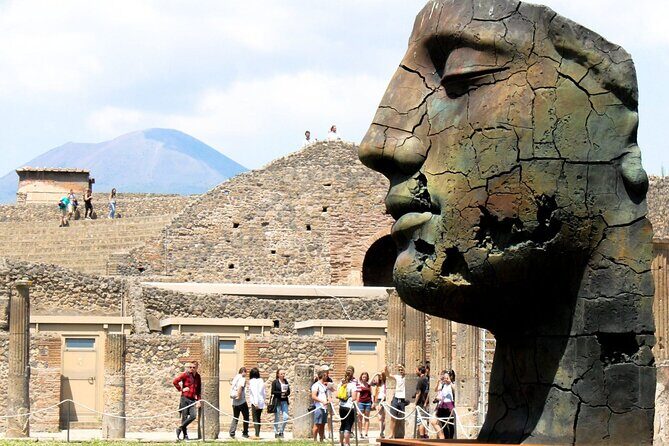
Next is the Tempio di Giove Capitolino on the northern side of the Forum. This temple is visually dramatic, with the Temple of Jupiter commanding the space and Vesuvius rising behind it. The tour approach makes this work well: as you walk the forum, you start to understand why the Romans cared about sightlines and power.
Then comes the Macellum, the city market. You’re not just seeing “a building”—you’re seeing how food culture worked. The Macellum was essentially the market where people bought supplies, and the walls of the porticoes had decorations tied to daily life (fish and poultry) as well as myth themes.
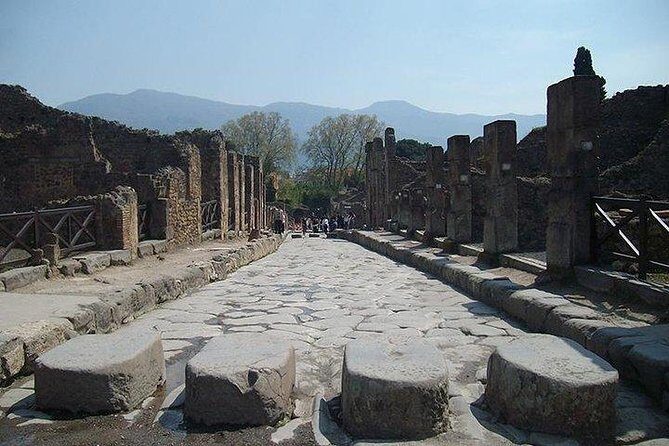
The route ends Pompeii’s early set with Via dell’Abbondanza, one of the main streets linking the Forum with the Amphitheatre. If you can follow this street in your head, Pompeii becomes easier to read. You can picture how foot traffic moved through everyday life.
In a review, Celsestina was praised for explaining daily activities of residents rather than only listing facts. That’s exactly the value here: you get explanations for how the city worked day-to-day.
Stabian Baths, the Lupanar, and Teatro Grande
Pompeii doesn’t slow down here—in fact, it gets more human and more specific.
The Stabian Baths (Terme Stabiane) are your next big theme: how Romans relaxed, cleaned up, and socialized. Built in phases (the earliest starting in the 4th century BC), these baths include areas you can still recognize by function: apodyterium (changing area), frigidarium (cold), tepidarium (warm), and calidarium (hot). What I like about seeing this on site is that the heating system makes sense in your imagination. Heat came through piping in the walls and double floors that circulated hot air from furnaces and braziers.
Another detail the tour highlights is that baths were more than hygiene. People discussed politics, trials, battles, and even women while they soaked and socialized. That turns a ruin into a lifestyle.
After the baths, you visit the Lupanar, Pompeii’s best-known brothel. Expect to see why it earned its reputation: erotic paintings, built-in beds, and the two-floor layout where rooms for the owner and enslaved workers sat above and the customer rooms sat below. The tour description emphasizes that prostitutes were mostly Greek and Oriental enslaved people, which adds a grim historical layer beyond the art.
Finally, the Teatro Grande (Large Theatre) brings in entertainment. Built around the middle of the 2nd century BC and restored in Roman style, it hosted comedies and tragedies drawn from Greek-Roman tradition. There’s also a practical reason this stops feels striking: the theatre was described as the first large public building freed from eruption deposits, so it reads well on the ground.
A balanced warning: this is still a “fast learning” format. One person felt both sites were rushed and that they may have missed more. If you want maximum time in each room, you might need a different kind of tour. But if you want a strong overview with smart stops, this pacing can be worth it.
Lunch and wine at Sorrentino Winery (Vesuvius edition)
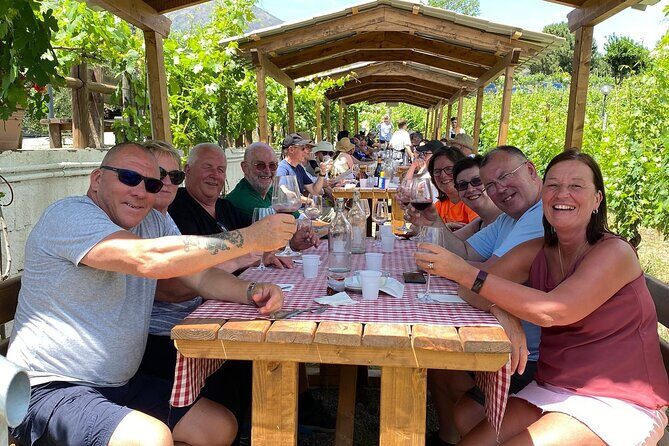
Between the two archaeological parks, you break up the day at Sorrentino Winery. The idea is simple: you get a proper sit-down meal, and you also connect Pompeii and Herculaneum’s volcanic story to the living landscape around Vesuvius.
This lunch is included, and it comes with a tasting of three wines: Prosecco, red, and white. The sample menu includes bruschetta, cured meats, cheeses, and seasonal vegetables as a starter; a main of pasta with Piennolo cherry tomatoes; and a traditional homemade dessert.
In terms of value, this is a big deal for a day tour. Without it, you’d likely be buying lunch twice (or grabbing something quick between stops). Here, you get a structured meal and a tasting, and you’re not left hunting for food on your own in a tight schedule.
One review did complain that the winery lunch used valuable time instead of touring ruins. That’s fair as a concern—if you’re aiming for every minute in archaeology, you may resent any non-ruin stop. Still, a winery break is often what keeps a 9-hour day from turning into a complete slog, especially during hot weather.
Herculaneum’s preserved neighborhoods: why it feels different
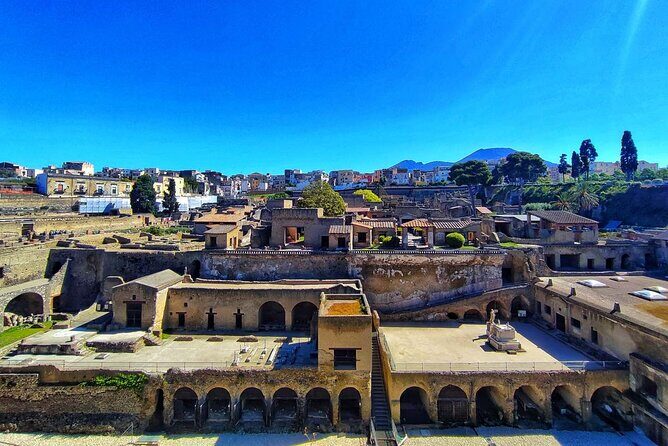
Herculaneum is your next jump: the Parco Acheologico di Ercolano (about 2 hours with admission included). Where Pompeii can feel sprawling, Herculaneum often feels more intimate because it was a smaller city and is preserved in a way that lets you see streets and houses with unusual clarity.
Here’s why that matters: Herculaneum helps you understand how people lived inside buildings—because many spaces remain intact enough to study layouts and materials. You’ll see remains of houses and villas, and the site is still described as perfectly preserved compared to what most people expect from ancient ruins.
A review noted that Herculaneum felt better than Pompeii on the day, partly due to fewer lines. That’s not something you can guarantee, but it’s a useful expectation: Herculaneum often feels easier to process in real time.
With Diana guiding, one person highlighted that the tour explained the differences between the two towns. That’s a smart approach. If Pompeii is about size and variety, Herculaneum is often about preserved details and domestic life.
You can also read our reviews of more guided tours in Sorrento




House of the Deer, Neptune mosaics, and the black-painted hall
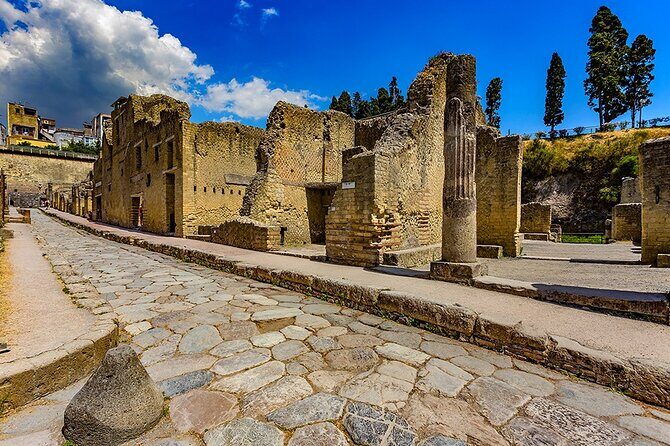
The Herculaneum portion is built around houses and specific rooms, and these stops teach you how status, decoration, and daily function show up in stone.
You’ll start with the House of the Deer. It’s described as a luxurious house with a sea-view terrace that belonged to Q. Granius Verus, a slave freed shortly before the city’s destruction. The name comes from garden statues of deer attacked by a pack of dogs. This is one of those poetic-to-grim connections: you can see the imagery, but you’re also seeing the reality of a sudden end.
Next is Casa di Nettuno e Anfitrite, known for mosaics in glass paste—described as very expensive for the time. You’ll also see floral and hunting scenes and, most importantly, a central mosaic featuring Neptune and Amphitrite.
Then the Casa dello Scheletro. The nickname comes from human remains found in a second-floor room in 1831. Even if you don’t love the macabre, it’s historically important because it shapes the way we understand rediscovery and archaeological history.
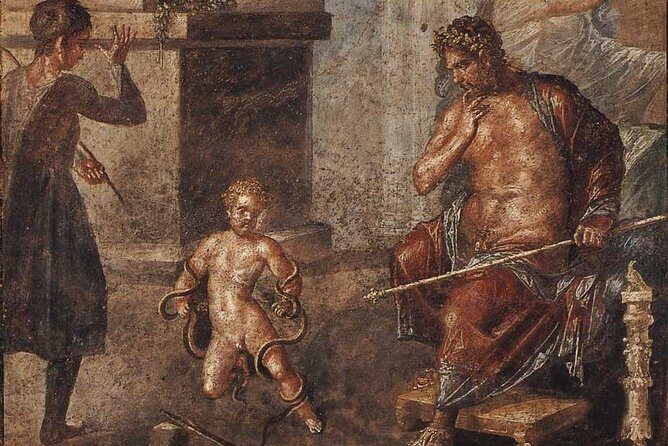
The Sacello degli Augustali comes with powerful visual storytelling. This small sanctuary near the forum includes frescoes depicting Hercules entering Olympus, with Jupiter, Juno, Minerva, and Hercules against Achelous. A detail the tour description includes is that a janitor’s skeleton was found in his room lying on the bed, adding a haunting human anchor to the images.
After that, you visit the House of the Hotel. This is a standout for size and function. It’s described as the largest house of Herculaneum discovered so far, at 2,250 square meters, and it’s also said to be the only one of the city to own a spa district—so it was first considered more like a hotel. The location on the edge of the hill is also described as panoramic.
Finally, there’s Casa del Salone Nero, the house of the black salon. The party hall is painted black with geometric patterns, and the tour includes an archaeological detail tied to waxed tablets belonging to L. Venidius Ennychus, referencing eligibility for Augustale, purchase of a slave, and the birth of a daughter.
If you like when a tour connects art, architecture, and social status, this last run of house visits is where it clicks.
Tickets, crowds, and how to stay sane at Pompeii
You don’t just buy your way in here. The tour includes admission tickets for the listed major stops, plus a mobile ticket format. That’s convenient because you’re not stuck coordinating paperwork mid-day.
That said, Pompeii is one of the most visited archaeological sites on earth. Reserved entry can reduce friction, and some people report it feeling smooth. But another review mentioned long lines to enter Pompeii. The key lesson: assume Pompeii has crowds and build patience into your plan.
What helps most is how the guide keeps you moving and orienting. In one review, the guide made a point of finding shade during explanations when it was hot. In a site where walking is constant, shade breaks can be the difference between enjoying the story and just getting through it.
Is the price fair for what you get?
At $192.22 per person, this isn’t a bargain-basement option. You’re paying for three major things working together:
First, you’re getting an organized, guided day with tickets included across both sites (with only a couple of stops noted as free admission). Second, you’re getting lunch and a wine tasting at Sorrentino Winery, including three wines plus a meal. Third, you’re buying convenience: hotel-to-ruins logistics from Sorrento and a set route that helps you see a lot without planning every turn.
If you were to do Pompeii and Herculaneum independently, you’d still pay for entry and you’d spend time figuring out transportation and where to eat. If you value an explanation-driven route and don’t want to manage everything yourself, this price starts to look more reasonable.
If you only care about wandering for yourself, you’ll probably feel you paid for structure you didn’t need. If you want a clear plan and a guided narrative, it tends to land well.
Who this tour suits best (and who should consider alternatives)
This works especially well if you want to cover both cities in one day from Sorrento, and you like the idea of a guided route that hits the big themes: civic life, markets, baths, entertainment, and domestic spaces.
It’s also a good fit if you’d rather trade some free time for context. The tour descriptions focus on what each location meant—Forum governance, market function, bath heating systems, and house decoration. That’s the value.
It may not be ideal if you want slow, room-by-room exploration with lots of downtime. Between heat, walking, and switching between sites, the day can feel full. A few reviews pointed to pacing concerns, and that’s a real possibility with a 9-hour itinerary.
Should you book this Pompeii and Herculaneum day tour?
I’d book it if you want a guided, explanation-heavy day that covers both Pompeii and Herculaneum without you planning tickets and stops yourself. The strongest reasons are the practical route choices (Forum, baths, Lupanar, theatre, then a sequence of Herculaneum houses) and the included lunch with three-wine tasting on the Vesuvius slopes.
I’d hesitate if your top priority is maximum time inside specific rooms or if you know you hate crowds. Pompeii can be busy, and this tour is built for structured progress, not long lingering.
If you’re aiming for a first-time, best-of-a-day approach, this one is a solid pick.
FAQ
How long is the Pompeii and Herculaneum tour?
The duration is approximately 9 hours.
Where does the tour start?
The tour is located in Sorrento, Italy.
Is lunch included?
Yes. Lunch is included at Sorrentino Winery, along with a tasting of three wines.
Are admission tickets included for Pompeii and Herculaneum?
Yes. Admission tickets are included for the Pompeii and Herculaneum stops listed in the itinerary, with a couple of stops marked as free.
What language is the tour offered in?
The tour is offered in English.
How big is the group?
The maximum group size is 100 travelers.
Is a mobile ticket provided?
Yes, the tour includes a mobile ticket.
Will the schedule always run exactly on time?
The duration and times of the itinerary may vary due to local traffic conditions or other circumstances.
Is there weather risk?
Yes. The experience requires good weather. If it’s canceled due to poor weather, you’ll be offered a different date or a full refund.
What should I wear or bring?
Wear comfortable shoes. In summer, bring sunglasses and sunscreen.
You Might Also Enjoy

More Tickets in Sorrento
More Tours in Sorrento






More Tour Reviews in Sorrento
- Sorrento Farm and Food Experience including Olive Oil, Limoncello, Wine tasting
★ 5.0 · 2,524 reviews