REVIEW · SORRENTO
Skip the line Pompeii Guided Tour
Book on Viator →Operated by Buyourtour di Amo Italy Travel · Bookable on Viator
Pompeii is big. This tour keeps you moving. You’re getting a guided, skip-the-line style Pompeii visit from Sorrento (or Naples) with a comfortable 30-seater bus, an English-speaking guide for the key orientation time, and headsets so you don’t miss a word. I also love that the tour is structured around smart, iconic stops rather than dumping you loose in the ruins, and I like that the Pompeii entrance ticket is included so you can focus on the site. One real consideration: with a 4-hour format and lots of short stops, it’s not for slow wandering or long picture sessions.
The route hits the places that explain how a Roman city worked—forum life, markets, baths, entertainment, and even the famous brothel—while Vesuvius hangs in the background in the most dramatic moments. You’ll get a fast sampler that still covers a lot of ground, and the guide-led pace helps you connect the dots without having to research everything in advance. If you want to fully stretch your legs and take your time at every doorway, you may feel slightly rushed here.
This is also a practical choice if you’re staying on the Sorrento side. Pickup is set up from a meeting point in Sorrento or Naples, and the whole thing is built as a half-day outing—useful when the heat ramps up. Based on what I’ve seen work well for families and first-timers, this tour fits best when you want a clear route and an easy transfer, not when you want freedom to roam for hours.
In This Review
- Key Highlights You’ll Feel on the Day
- Skip-the-Line Pompeii in 4 Hours: What You’re Really Buying
- Getting From Sorrento (or Naples) Without Losing the Day
- Pompeii Archaeological Park: Your Main Time Inside the Ruins
- Forum of Pompeii + Temple of Jupiter: The Big Civic Story
- Macellum and Via dell’Abbondanza: Where the City Ate and Walked
- Stabian Baths: The Practical Side of Roman Life
- The Brothel of Pompeii: Famous, Specific, and a Little Uncomfortable
- Teatro Grande and the Feel of Public Life
- Headsets, Pacing, and Why Organization Matters
- Price and Value: Is $96.38 a Smart Spend?
- Who This Tour Suits Best (and Who Should Skip It)
- Should You Book This Skip-the-Line Pompeii Guided Tour?
- FAQ
- How long is the Skip-the-Line Pompeii Guided Tour?
- Is the Pompeii entrance ticket included?
- Is the guide available in English?
- Do you get headsets?
- Where does pickup happen?
- Is lunch included?
- What is the group size limit?
- What happens if the tour can’t run due to weather?
Key Highlights You’ll Feel on the Day
- Headsets for clear guide audio during the main guided time, so your group won’t get left behind by bad acoustics.
- English guide for 2 hours, which is the sweet spot for context before you start noticing the details on your own.
- Forum focus in the Civil Forum area, then the Temple of Jupiter—one of the best “big view” combos in Pompeii.
- Stabian Baths walkthrough, including the sequence of apodyterium to frigidarium to tepidarium to caldarium and how the heating system worked.
- Brothel stops with built-in beds and the two-floor layout, a standout piece of Pompeii’s everyday reality.
- Short stop times that add up (2 hours plus several 10–15 minute segments), giving you a lot of highlights without a full-day commitment.
Skip-the-Line Pompeii in 4 Hours: What You’re Really Buying
This is a half-day Pompeii guided tour with a simple promise: get you inside Pompeii and show you the most important areas efficiently. The headline value for me is the mix of included entrance ticket plus a structured route led by an authorized English guide for about 2 hours. That helps you avoid the common first-time mistake of seeing everything as random ruins instead of as a working city plan.
You’re also paying for the “how” of getting there. You’ll be picked up at a meeting point in Sorrento or Naples, ride in a comfortable 30-seater bus, and use headsets to hear the guide clearly. For many visitors, that’s where the real payoff is—less time managing logistics, more time reading the site with a guide.
The other part of the value equation is time. The tour is about 4 hours total, with each stop designed to keep momentum. It’s great when you’re on a tight schedule and want a meaningful Pompeii experience without burning your entire day. Just keep in mind: Pompeii is vast, and a highlights route will never feel like you “mastered” it.
You can also read our reviews of more guided tours in Sorrento


Getting From Sorrento (or Naples) Without Losing the Day
Pickup is a big deal on this one. If you’re staying in Sorrento, a round-trip transfer setup is often the difference between a smooth visit and a stressful one. The tour includes pickup at the meeting point in Sorrento or Naples, and you’ll be on a 30-seater bus.
Two small things matter for comfort and sanity:
- Headsets are provided to help you follow the guide even when groups cluster or walk.
- The tour notes it’s near public transportation, which can make it easier to connect if your day already involves trains or local transit.
There’s also a practical reality: the group size is capped at 100 travelers. That doesn’t mean you’re all crammed into one bus the whole time; it means the overall operation can involve multiple groups. Either way, you should expect a lively site day rather than a private stroll.
Pompeii Archaeological Park: Your Main Time Inside the Ruins
The center of the tour is the Archaeological Park of Pompeii, and this is where the 2 hours really count. Pompeii is preserved because it was buried under meters of ash and pumice after Mount Vesuvius erupted in 79 AD. That destruction is also the reason you can still make sense of streets and houses today.
What I like about starting here is that it gives you grounding. The ruins include excavated streets and houses you can explore, but without a route you can lose context fast. With a guide, you’re more likely to connect what you see in the park to the civic life sites that come right after.
In this first stop, you’re not just “looking at walls.” You’re learning how the city spaces relate to each other: where people lived, moved, and gathered. That matters because later stops like the Forum and baths feel more meaningful when you understand the surrounding city layout.
Forum of Pompeii + Temple of Jupiter: The Big Civic Story
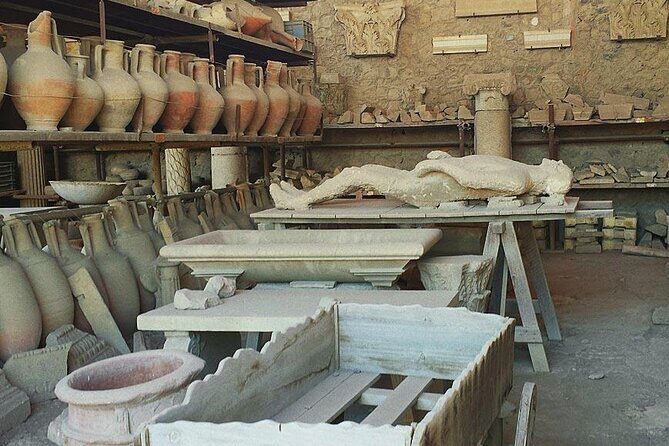
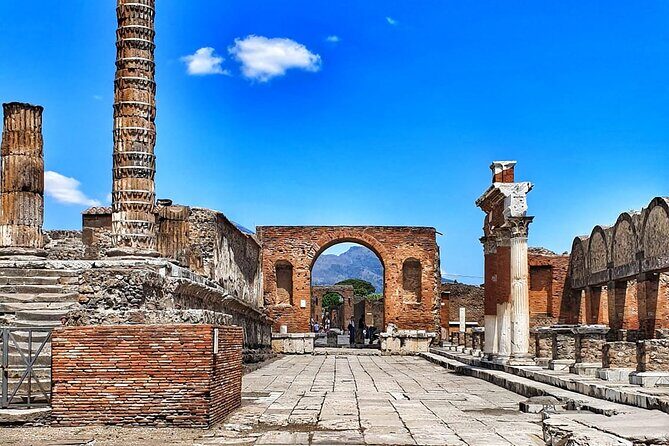
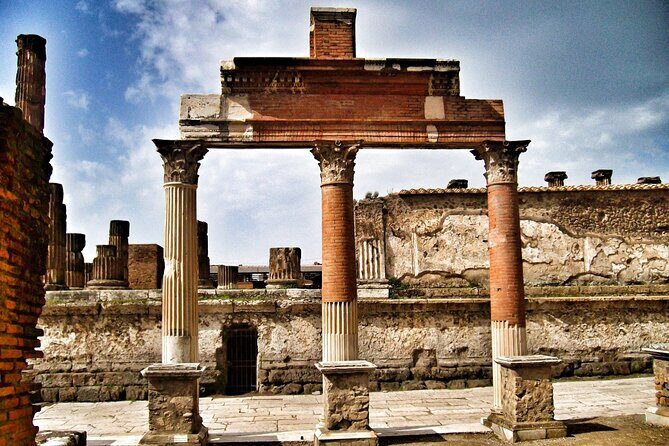
After you settle into the site, the tour shifts to the heart of civic life: the Foro de Pompeya (Civil Forum). This is described as the center of daily life—administration and justice, business management, commercial activity like markets, and major worship spaces all gathered in one area.
Then the route moves to the Tempio di Giove Capitolino (Temple of Jupiter) on the northern side of the Forum. What makes this stop pop is the spatial drama: the temple dominates the Forum area, and Vesuvius rises spectacularly behind it. The tour also points out that after the colony was established (80 BC), the temple underwent major renovation and became a real Capitolium-like space with statues of Jupiter, Juno, and Minerva.
If you remember just one takeaway from this section, make it this: the Forum wasn’t a single monument. It was a whole system for government, religion, and commerce. The guide-led time helps you see it as an operating hub, not a pile of stones.
Possible drawback here: since the later stops are timed tightly (some are around 10–15 minutes), you’ll want to move with purpose. If you’re the type who freezes at every doorway, this may feel like you’re grazing instead of studying.
Macellum and Via dell’Abbondanza: Where the City Ate and Walked
Next up is the Macellum, Pompeii’s market. The Macellum is described as a city market where people bought food, laid out with a tuff Quadri porticus and a hall for worship positioned on an elevated spot on the eastern side. The tour notes the complex had to stay out of the main square to reduce crowding—because Pompeii saw a lot of foot traffic.
The Macellum’s portico walls also get attention. The decorations referenced include scenes from daily life like selling fish and poultry, plus mythological subjects. This is one of those stops where the guide’s framing matters: you’re not just seeing a room, you’re seeing a daily rhythm.
Then you’ll walk toward the Via dell’Abbondanza, one of Pompeii’s main streets. The street is important because it connects key areas—linking the Forum with the Amphitheatre. A quick stop here helps you understand Pompeii as a city of routes, not isolated attractions.
If you’re traveling with kids or a stroller, this segment is usually practical because it’s part of moving between major zones. One family-focused review even mentioned staff helping with a pram, which is a nice sign that the operation pays attention to the small issues that can derail a day.
You can also read our reviews of more tours and experiences in Sorrento


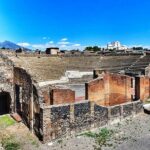
Stabian Baths: The Practical Side of Roman Life
The Stabian Baths (Terme Stabiane) are a major change of pace. This stop is longer than the tight 10-minute segments (about 15 minutes), and the details are specific: the baths were built at different times, with an initial phase dating back to the 4th BC.
The tour describes a clear layout. You enter through Via dell’Abbondanza into a large courtyard, then find a pool on the left and a colonnade on the right leading to the men’s quarters. From there, you get the sequence:
- apodyterium (dressing room)
- frigidarium (cold baths)
- tepidarium (medium temperature baths)
- caldarium (hot baths)
Even better, the heating system is explained: heat was delivered through a piping system in the walls and double floors, with hot air coming from furnaces and mobile braziers. The women’s quarters follow a similar path but were smaller and lacked the richer decorations in the men’s area.
This is the stop I’d recommend to anyone who likes the “how did they live” angle. It’s also one of the stops that tends to feel more vivid once you understand how the system worked rather than treating the baths like just another ruin.
The Brothel of Pompeii: Famous, Specific, and a Little Uncomfortable
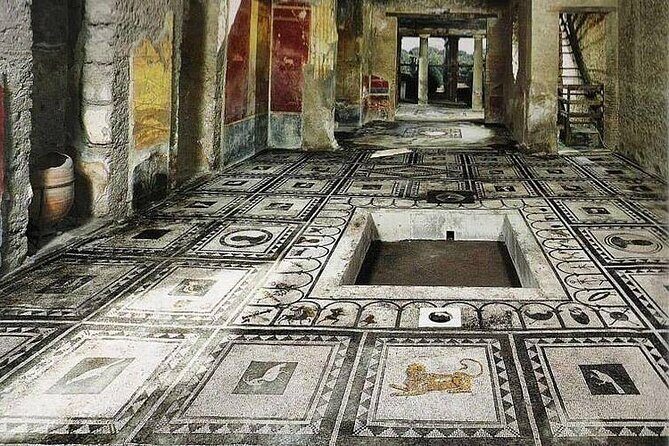
Yes, you’ll see the brothel of Pompeii. It’s famous for its erotic paintings and for being one of the best-known buildings in the excavations. The tour notes the brothel’s function and the social reality behind it: the prostitutes were mostly Greek and Oriental slaves, and the building has two floors.
The layout is described clearly:
- The upper floor held the homes of the owner and slaves.
- The lower level has five rooms with built-in beds.
It’s also named from Lupa, a Latin word meaning prostitute. For many people, this is a “wow, Pompeii was real” moment—because it’s not trying to impress you with grandeur. It shows the messier sides of everyday life.
A quick note on expectations: if you’re sensitive to adult subject matter, this stop may be a tough read. But if you want an honest picture of the city, it’s part of the full range of what Pompeii preserved.
Teatro Grande and the Feel of Public Life
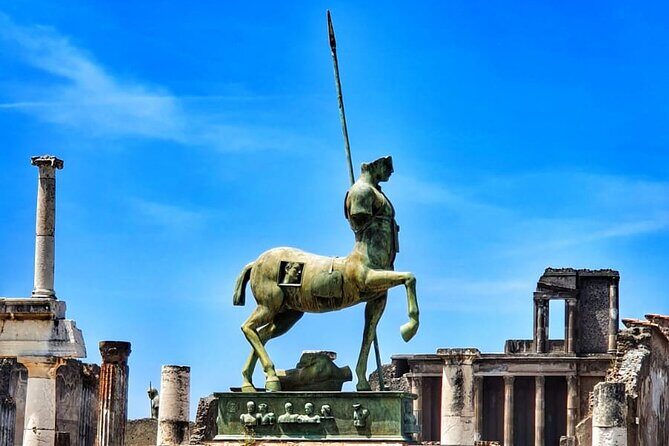
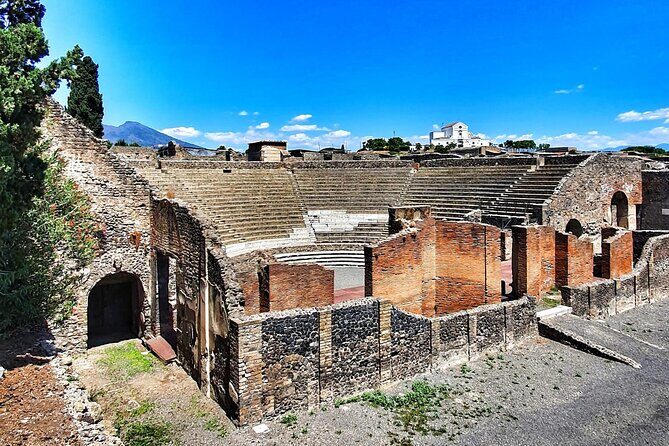
The tour ends with a jump into public entertainment: Teatro Grande (Large Theatre). It was built around the middle of the 2nd century BC and restored in the Roman style. The theatre hosted comedies and tragedies in the Greek-Roman tradition.
One detail the tour highlights is that it was the first large public building completely freed from the deposits of the eruption. Even if you don’t know the theatre’s history in advance, you can leave this stop feeling like Pompeii wasn’t only about daily chores. It also had stage life and public performance.
This final segment works well because it pulls you away from “city function” and into “how people gathered for culture.” With only about 15 minutes here, it’s a taste rather than a long lecture, but it helps close the loop on how Pompeii operated.
Headsets, Pacing, and Why Organization Matters
A big part of this tour’s reputation comes down to execution. Several guide experiences were praised for being informative and for keeping the group moving in a timely way. One mention even called out a guide named Gino as a standout, and another credited the tour operator Giovanna with helping manage pram logistics while parents carried kids through the ruins.
What you should take from that, even if you don’t get the same guide: the day depends on the guide’s ability to connect points fast, and headsets help you follow. This matters on a site like Pompeii where the ground can pull you in ten directions at once.
Still, pacing is the tradeoff. The itinerary is built from a 2-hour main stop plus multiple timed segments. One practical warning: if you’re traveling with slower walkers or you want to stop constantly for photos, you may feel pressure to keep up. Pompeii is the kind of place that rewards lingering, and this tour is designed to ration your time.
Price and Value: Is $96.38 a Smart Spend?
At $96.38 per person, this is not a budget “hop on a bus and wander” outing. But the cost makes more sense when you break down what’s included:
- pickup from Sorrento or Naples
- a 30-seater bus
- an authorized English-speaking guide for 2 hours
- headsets
- the Pompeii entrance ticket
You’re paying for fewer moving parts. If you were to plan a self-guided day, you’d still need a way to get from Sorrento to Pompeii, pay for entry, and decide how to structure your route so you don’t miss the story. Here, that structure is built in.
Group discounts are also listed as part of the offering. That can make a difference if you’re traveling with a few people and want to keep costs under control.
One last value note: this tour is listed as commonly booked about 65 days in advance. That’s a hint that popular days sell out, especially in warmer months. If Pompeii is a must-do for you, booking earlier tends to give you more choice.
Who This Tour Suits Best (and Who Should Skip It)
This is a great fit if you want:
- a first-time Pompeii highlight route
- an English-speaking guide who helps you connect the civic, daily, and public sides of the city
- an easy transfer from Sorrento without building your own day plan
- a half-day format that can help you avoid the worst of midday heat
It may not fit as well if you:
- want hours of free wandering and deep detours inside every neighborhood
- hate being time-managed between stops
- plan to spend a lot of extra time in shops instead of in the ruins
Also, consider the “what if something changes” reality. In one reported case, a bus issue led to a temporary shift in transport plans and caused confusion and a shorter experience than expected. That doesn’t mean it’s the norm, but it’s worth keeping an open mind and arriving with flexibility.
Should You Book This Skip-the-Line Pompeii Guided Tour?
I’d book it if you’re the kind of traveler who wants Pompeii to make sense fast. The strongest reasons are the English guide for 2 hours, the headsets, and the fact that you get an efficient route through the Forum, Jupiter Temple, market area, baths, the brothel, and the theatre. For Sorrento-based visitors, the included pickup and entrance ticket are also a big deal.
Pass on it if you’re chasing a slow, independent, take-every-street route. Pompeii deserves that style too, but this tour is built for a “quick taste with context” day, not a long personal expedition.
If you do book, I’d prioritize comfort and pacing: wear shoes you can handle on uneven ground, and be ready for short stops that move you between major zones. If you’re traveling with kids or a stroller, it’s smart to mention your needs at pickup so staff can plan help where possible.
FAQ
How long is the Skip-the-Line Pompeii Guided Tour?
It’s about 4 hours total.
Is the Pompeii entrance ticket included?
Yes. Entrance ticket to Pompeii is included.
Is the guide available in English?
Yes. The tour includes an authorized English-speaking guide.
Do you get headsets?
Yes. Headsets are included so you can hear the guide clearly.
Where does pickup happen?
Pickup is included at a meeting point in Sorrento or Naples.
Is lunch included?
No. Lunch is not included.
What is the group size limit?
The experience has a maximum of 100 travelers, and the bus is described as a 30-seater.
What happens if the tour can’t run due to weather?
The experience requires good weather. If it’s canceled due to poor weather, you’ll be offered a different date or a full refund.
You Might Also Enjoy



More Guided Tours in Sorrento


More Tours in Sorrento





More Tour Reviews in Sorrento
- Sorrento Farm and Food Experience including Olive Oil, Limoncello, Wine tasting
★ 5.0 · 2,524 reviews