REVIEW · SORRENTO
Skip the Line Pompeii Guided Tour from Sorrento
Book on Viator →Operated by Acampora Travel · Bookable on Viator
Pompeii hits harder with a guide. This half-day trip from Sorrento uses an air-conditioned bus, live commentary, and an English-speaking guide with headsets, so you can follow the story without craning your neck in a crowded archaeological park. I especially like how the route focuses on daily civic life—forums, markets, bathing—rather than just random ruins.
Two other things I really like: you get Pompeii entry included for the main 2-hour block, and the small-group feel (up to 30 travelers) makes it easier to ask questions. The one watch-out is physical: the ground is uneven, so this tour is not suitable for people with mobility problems.
In This Review
- Key highlights you’ll care about
- From Sorrento to Pompeii: bus comfort and fast entry
- Group size and headsets: why you won’t lose the guide in the noise
- Stop 1: Pompeii Archaeological Park and the Forum storyline you can follow
- Teatro Grande: a Roman theater built into the hill (and your 10-minute reality check)
- Foro de Pompeya: the Civil Forum, where justice, business, and worship meet
- Pompei La Basilica: the 1,500-square-metre court-and-business machine
- Macellum: the food-market layout and why it mattered
- Stabian Baths: the Roman spa route, step by step
- Granai del Foro: storage sheds that explain the city’s supply chain
- Time on your feet: pacing, crowds, and what to bring
- Price and value: what you’re really paying for at $107.17
- Who this Pompeii tour fits best (and who should look elsewhere)
- Should you book this Pompeii guided tour from Sorrento?
- FAQ
- How long is the Skip the Line Pompeii Guided Tour from Sorrento?
- Does this tour include Pompeii admission tickets?
- Do I need to speak Italian or bring my own translation devices?
- Is pickup provided from Sorrento?
- Are meals and drinks included?
- Is this tour suitable for people with mobility problems?
Key highlights you’ll care about
- Forum-first route that connects public life, worship, courts, and trade in one walk
- Headsets included so you can hear the guide even in peak crowds
- Skip-the-line style entry with Pompeii admission handled for you
- Time-smart stops (short 10-minute beats) that still hit major landmarks
- Stabian Baths with a clear path through the bathing sequence
- Max 30 per guide for a more personal feel than big coach chaos
From Sorrento to Pompeii: bus comfort and fast entry
This is a straight, half-day-style excursion. You’re picked up in Sorrento (pickup starts 45/30 minutes before departure, depending on the local schedule), then you ride in an air-conditioned bus with live commentary along the way. That pre-show talk matters because Pompeii can look like scattered stones if you don’t get bearings first.
The tour is designed around getting you into Pompeii without spending your morning stuck in long lines. Even if you’ve seen photos, Pompeii is a real place with real crowds. Having the entry ticket handled and your guide coordinating the flow means more time walking and less time waiting.
Also, this tour uses a mobile ticket, which is handy when you’re juggling transit and timing in a busy travel day.
You can also read our reviews of more guided tours in Sorrento


Group size and headsets: why you won’t lose the guide in the noise
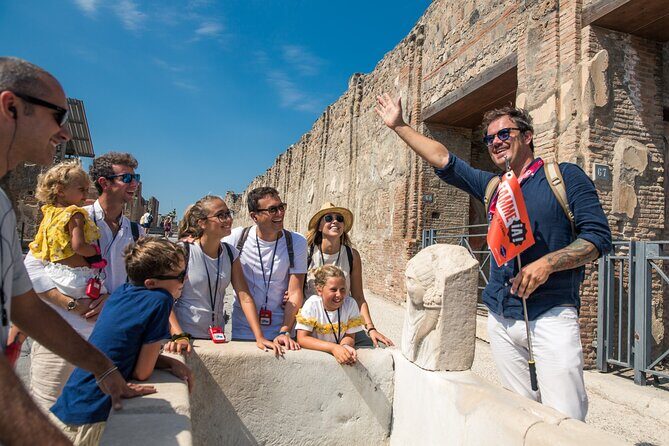
Pompeii is popular, and the site is large enough that groups naturally stretch out. Here, you’ll travel with a guide managing a maximum of 30 pax per guide, and you’ll use headsets during the walking tour.
That headset part is a big deal. It means you don’t have to hover at the guide’s shoulder to hear key explanations. You can pause to look at details—doorways, street layouts, inscriptions—without cutting your ears off trying to catch every word.
That said, you may still be on a larger coach for the drive (the bus can hold up to 40/50 passengers). So, expect a bigger vehicle up front, but a more manageable feel once you’re inside the ruins with your guide.
Stop 1: Pompeii Archaeological Park and the Forum storyline you can follow
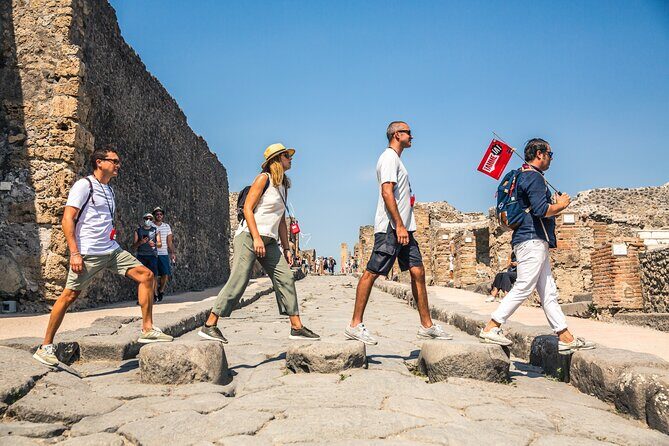
You’ll spend about 2 hours in the Pompeii Archaeological Park with admission included. The heart of the tour is the Forum area, which is where the city’s civic and economic life stacked up day after day.
Here’s what to watch for as you walk:
- The Forum itself: the civic center surrounded by major public buildings. This is the “how the city worked” zone.
- Basilica and Temple connections: even when you don’t linger, your guide can point out what buildings were for—justice, administration, and worship.
- Street rhythm: Pompeii’s layout starts to make sense once you see how marketplaces and public spaces relate to each other.
A practical tip: take a slow minute early on and orient yourself. The guide will be moving, but your job is to spot what’s central versus what’s just nearby. Once you do that, the rest of the half-day starts clicking into place.
Teatro Grande: a Roman theater built into the hill (and your 10-minute reality check)
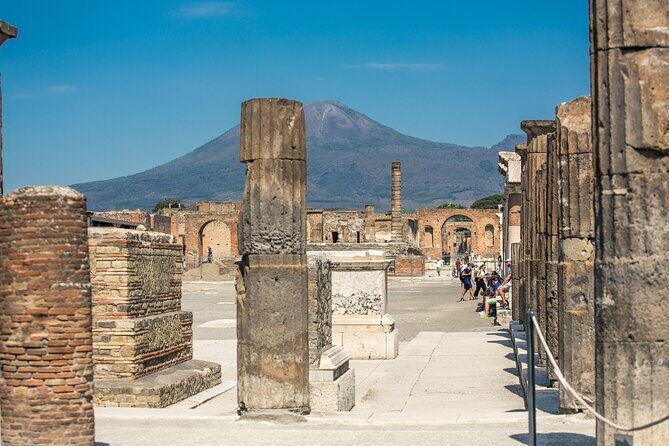
Next comes Teatro Grande, one of Pompeii’s big performance spaces. The theater was built using the natural slope of the hill, so the structure feels integrated into the terrain rather than plopped down. Construction dates to around the middle of the 2nd century BC, with later restorations in Roman style.
You get about 10 minutes here, and that’s realistic. A theater is easy to appreciate at a glance—rows of seating, the stage perspective, the way architecture follows the landscape. But it’s also the kind of stop where you’ll only fully appreciate it if you know what to look for.
If you want to make the most of your short window, focus on:
- How the seating is carved into the slope
- The way corridors and sectors help organize crowds
- The architectural clues around the entrance area (your guide can point out inscriptions and how they relate to later work)
Foro de Pompeya: the Civil Forum, where justice, business, and worship meet
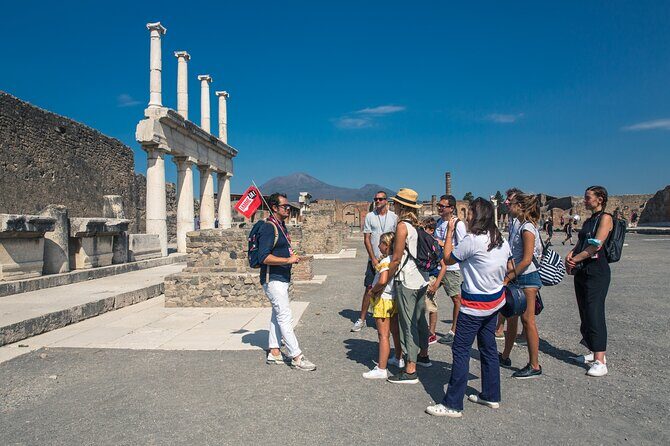
You’ll then hit Foro de Pompeya (about 10 minutes, ticket-free here). This is the civil Forum as a concept: the focal point of daily city life, tying together city administration, justice, business management, markets, and worship.
This is one of the most useful stops for first-timers because it prevents the classic mistake: treating Pompeii as only a set of dramatic scenes. The Forum is where people handled contracts, heard cases, bought goods, and participated in religious life. When you connect those dots, even brief time feels productive.
Here’s how to enjoy it even if you’re rushing: stand where you can imagine movement. Think about lines of sight and where crowds would naturally gather.
You can also read our reviews of more tours and experiences in Sorrento


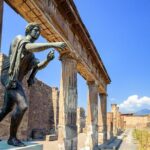
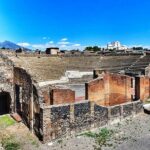
Pompei La Basilica: the 1,500-square-metre court-and-business machine
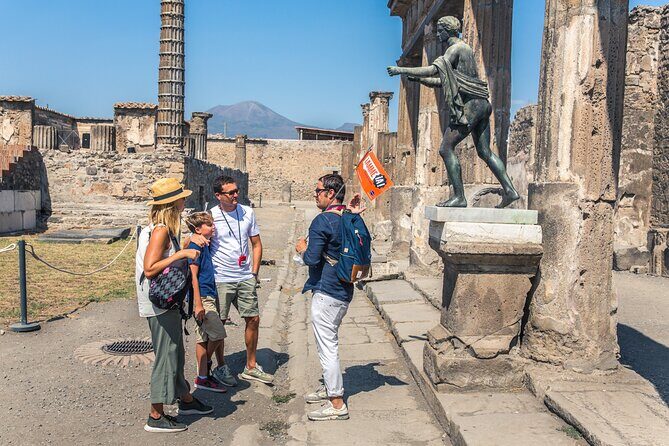
The Basilica is next, and it’s a favorite stop for anyone who likes how cities function. This building was one of the most sumptuous structures in the Forum area, spanning about 1,500 square metres.
Your guide will walk you through what the Basilica was for: business and administration of justice. It has multiple entrances, tuff pillars, and an interior layout that reads like a plan for handling lots of people efficiently—naves, brick columns with Ionic capitals, and a raised area (the suggestum) where judges sat.
In practical terms, the Basilica is also an easy place to absorb because it’s built for crowds. You’ll get the sense of a venue where transactions and decisions happened under one roof-like structure.
Short stop or not, I’d pay attention to the center area and the entrance flow. That’s where the “what happened here” becomes clear.
Macellum: the food-market layout and why it mattered
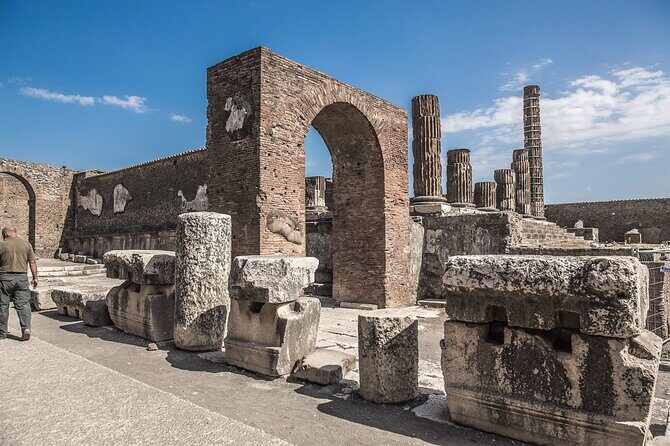
Then you move to the Macellum, the food market. You’ll get around 10 minutes, and it’s one of those stops where the building’s purpose is almost obvious from its layout.
The Macellum is described as a tuff quadriporticus with a worship space on the elevated eastern side, aligned with the entrance. The niches include copies of marble statues (including a female and an armed male), plus a fragment that likely relates to an emperor cult connection.
Even if you’re not trying to memorize every detail, this is a great stop because it shows how Roman life blended practical needs with religious messaging. Markets weren’t just where food changed hands. They were also part of the city’s identity and beliefs.
Look for:
- The arrangement around the elevated worship area
- The “counter” space your guide may point out (a clue to how vendors sold items, including fish)
Stabian Baths: the Roman spa route, step by step
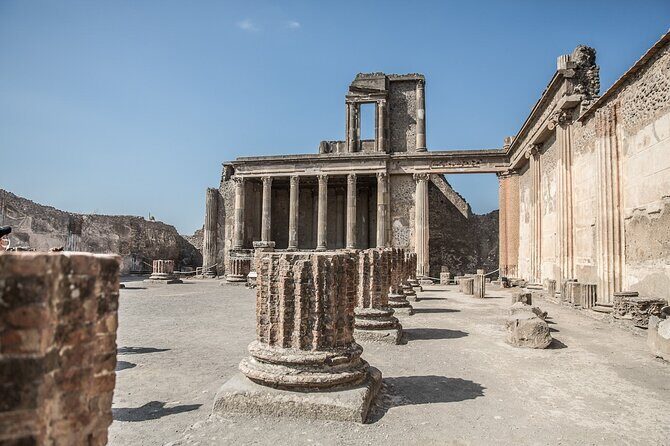
The Stabian Baths (Terme Stabiane) stop is where the tour gets very human. These baths date to the 2nd century BC and are among the oldest Roman bath complexes you can still recognize.
You’ll have about 10 minutes here, but your guide can make that time feel longer by explaining the sequence. The main entrance is on via dell’Abbondanza and leads into a large courtyard. From there, the layout takes you through a clear progression:
- Dressing room (apodyterium)
- Cold bath (frigidarium)
- Medium temperature bath (tepidarium)
- Hot bath (calidarium)
Heating was delivered through a piping system in the walls and double floors circulating hot air from furnaces and braziers. Even if you don’t see every pipe, the tour helps you imagine the mechanics behind the comfort.
If you’re the type who likes to picture everyday life, this is a highlight. Baths were social spaces, not just sanitation. And Pompeii’s preserved layout makes it easier to understand the routine.
Granai del Foro: storage sheds that explain the city’s supply chain
The final stop is Granai del Foro on the western side of the Forum. You’ll see eight openings separated by brick pillars. These were used for storing produce—fruit and vegetables connected to the Forum Holitorium.
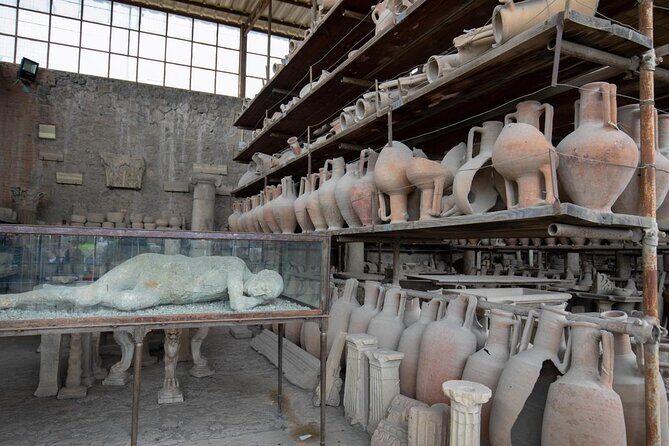
What makes this stop especially worthwhile is the way it connects archaeology to everyday objects. Today, these structures form a major archaeological inventory with over 9,000 artifacts from excavations since the end of the 19th century. You can also learn how everyday terracotta cookware (pots, pans, jugs, bottles) tells you what people used in the city’s final decades.
If you care about how cities worked beyond monuments, storage is where your brain clicks into place. People needed food routes, inventory, and timing. Granai is a reminder that Pompeii wasn’t only public drama—it was logistics.
Time on your feet: pacing, crowds, and what to bring
This is roughly 4 to 5 hours total, including bus time and walking between stops. You’ll spend the longer chunk at Pompeii’s archaeological park, and the remaining landmarks are short segments.
That rhythm is smart. It keeps you moving through a huge site without forcing you to wander alone in confusion. But it also means you won’t get long “sit and study” time at every location.
Come prepared:
- Wear comfortable shoes because the terrain is uneven
- Plan for crowds. Even late-year trips can feel busy, so don’t count on a quiet, empty Pompeii
- Bring your own water if you can. On-site options exist, but the tour doesn’t include meals or drinks
If you’re traveling with kids or anyone who gets tired fast, the stop-by-stop structure helps. You’re never stuck for hours at one location.
Price and value: what you’re really paying for at $107.17
At $107.17 per person for a 4–5 hour half-day, this tour isn’t just paying for entry. You’re also paying for:
- Air-conditioned bus transportation
- Live commentary on board
- A English-speaking guide through the site
- Headsets during the walking part
- Pompeii admission for the main block
That’s the value equation. Pompeii is large and hard to navigate if you want more than a photo list. A guided route saves time and turns the ruins into a readable story—Forum to theater to baths to markets—so you leave with context, not just snapshots.
If you’d rather roam without structure, DIY can work. But if you want the site to make sense quickly, this is the type of setup that usually delivers.
One more point: group discounts are offered, and smaller group size helps you actually hear and interact. In busy places, that’s not a “nice-to-have.” It’s part of the experience quality.
Who this Pompeii tour fits best (and who should look elsewhere)
This tour works well if you want a guided overview with real anchors: Forum, Basilica, baths, and market buildings. It’s especially good for first-timers because the route follows the logic of civic life rather than chasing every single famous wall painting.
It’s not a fit if:
- You have mobility problems. The uneven surface can be a deal-breaker.
- You need long, quiet stops. Most highlights are brief, so you’ll be moving.
It also fits well for people who like hearing details without shouting over a crowd—headsets help a lot, and the guide keeps you oriented.
If your guide is Carmela, you’ll likely get extra energy and a friendly pace. One account specifically noted her knowledge and the excitement of seeing excavation activity in progress.
Should you book this Pompeii guided tour from Sorrento?
Yes—if your goal is understanding Pompeii in a half-day and you don’t want to spend half your time figuring out where to stand. This tour’s biggest strength is that it gives you a guided path through the city’s main functions: civic center, entertainment, markets, and daily bathing life.
I’d book it if you like structure, you’re comfortable walking for a few hours, and you value headsets + a small guided group. I’d think twice if mobility is an issue or if you want long stays at just one or two places.
One practical heads-up: the return bus can include multiple stops back into Sorrento, and that can stretch the ride time.
FAQ
How long is the Skip the Line Pompeii Guided Tour from Sorrento?
The tour runs about 4 to 5 hours total, with time spent walking Pompeii’s main highlights.
Does this tour include Pompeii admission tickets?
Yes. Pompeii entry ticket is included, and the main Pompeii stop lists admission included, while several specific nearby stops are noted as admission-free within the tour timing.
Do I need to speak Italian or bring my own translation devices?
No. The tour is offered in English, with an English-speaking guide and live commentary during the walking tour and on the bus.
Is pickup provided from Sorrento?
Yes, pickup is offered. Pick-up time begins 45/30 minutes before departure, and you must confirm the exact pickup time and location with the supplier ahead of time.
Are meals and drinks included?
No. Meal and drinks are not included.
Is this tour suitable for people with mobility problems?
No. Due to the uneven surface, this tour is not suitable for people with mobility problems.
You Might Also Enjoy



More Guided Tours in Sorrento


More Tours in Sorrento





More Tour Reviews in Sorrento
- Sorrento Farm and Food Experience including Olive Oil, Limoncello, Wine tasting
★ 5.0 · 2,524 reviews