REVIEW · SORRENTO
Private Skip-the-line Pompeii & Mt. Vesuvius Tour from Sorrento
Book on Viator →Operated by IAMME IA! - Gray Line Amalfi Coast · Bookable on Viator
Pompeii and Vesuvius, minus the stress. This private day trip is built to squeeze in the big hits with priority access at both sites and hotel pickup in the Sorrento area, so you spend less time waiting and more time learning. In about 8 hours, you get a guided walking circuit through Pompeii’s Forum and major landmarks, then head up Vesuvius for close-up crater views.
The one thing to plan for: the Vesuvius path is uneven, and at the base there’s basically just one restroom option, so go before you start the climb.
If you like structure with room for real questions, this format works well. You’ll have an English-speaking driver, a private guide for Pompeii, and a mobile ticket, all while sticking to a timeline that’s designed for a long, memorable day.
In This Review
- Key things to know before you go
- Private pickup from Sorrento: your day starts on rails
- Pompeii in about two hours: how the route hits the big themes
- The Pompeii Forum circuit: politics, religion, and commerce
- Via dell’Abbondanza and the Stabian Baths: street life and reset rituals
- Casa del Fauno and the Lupanar: wealth, art, and the less polite side
- Teatro Grande and the Basilica: entertainment and justice in one city
- Priority transfer to Mount Vesuvius: what the climb is really like
- Timing on Vesuvius: avoid the short-change version of this day
- Guide quality and the small details that make history feel real
- Price and value: what $635.61 buys you (and what it doesn’t)
- Who this Pompeii and Vesuvius tour fits best
- Should you book this private Pompeii and Mt. Vesuvius tour?
- FAQ
- How long is the Pompeii and Mt. Vesuvius private tour?
- Where does the tour start and end?
- Is hotel pickup included?
- Are skip-the-line tickets included?
- What is included in the tickets?
- What language is the tour offered in?
- Is food and drink included?
- How much time do you spend at Mount Vesuvius?
- Can I cancel for a full refund?
- Is the tour really private?
Key things to know before you go
- Skip-the-line entry for Pompeii and Vesuvius so you lose less time to queues
- Door-to-door Sorrento pickup and drop-off for a calmer start and end
- A guided Pompeii walk that covers daily life fast from the Forum to baths, homes, and public buildings
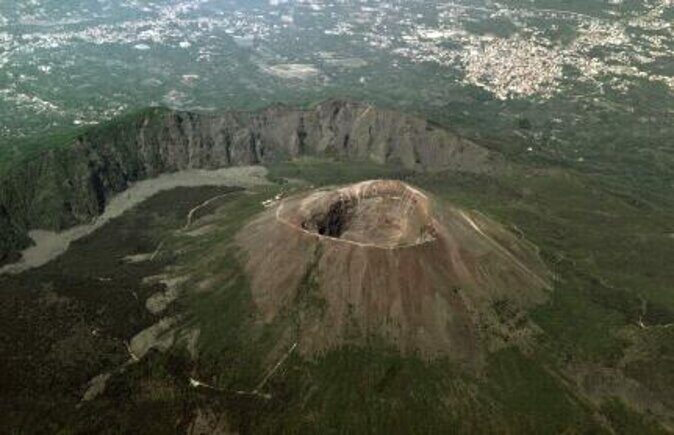
- Crater-edge time at about 1,280 m with big Gulf of Naples views
- Tickets included for Pompeii and Mount Vesuvius stops
- Uneven walking on Vesuvius plus limited restroom access near the hike start
Private pickup from Sorrento: your day starts on rails
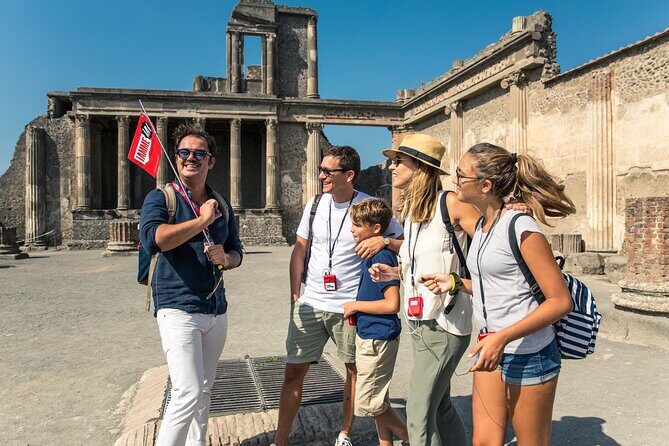
Meeting point is Piazza Torquato Tasso, 16, 80067 Sorrento, and the tour ends back there. But the real win is door-to-door pickup across the Sorrento area, with private vehicle transport. That means you’re not juggling buses, coordinating with strangers, or trying to time public connections while you’re already excited (and slightly wired) for Pompeii.
The driver is English-speaking, and you can select your language for the Pompeii part; the driver will speak English or Italian as needed. If you’ve ever had a day trip where you lose the best parts to translation issues, a private format helps a lot.
Time management matters on this route. This is designed as an around-8-hour outing with structured stops in Pompeii and a planned climb on Vesuvius. If you’re the type who likes to linger, tell yourself right now that this tour is about coverage and context, not slow wandering for hours in one spot.
You can also read our reviews of more private tours in Sorrento



Pompeii in about two hours: how the route hits the big themes
Pompeii is huge. Even with skip-the-line priority, you can easily burn half your day just orienting yourself. This private tour fixes that by giving you a guided walking route that covers the city’s main “themes” in a compact way.
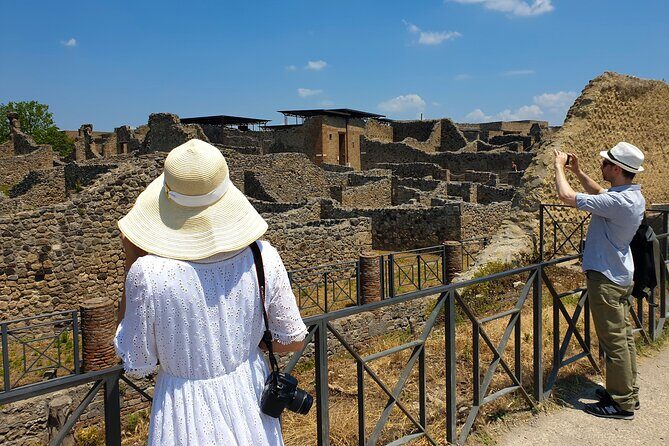
You’ll spend about 2 hours in the Pompeii Archaeological Park with admission included. The itinerary moves through key public buildings and street areas—think Forum life, commerce, baths, elite homes, entertainment, and the more human side of the city. Many stops are timed around 10 minutes each, so you don’t get stuck in one place while the rest of the city goes past.
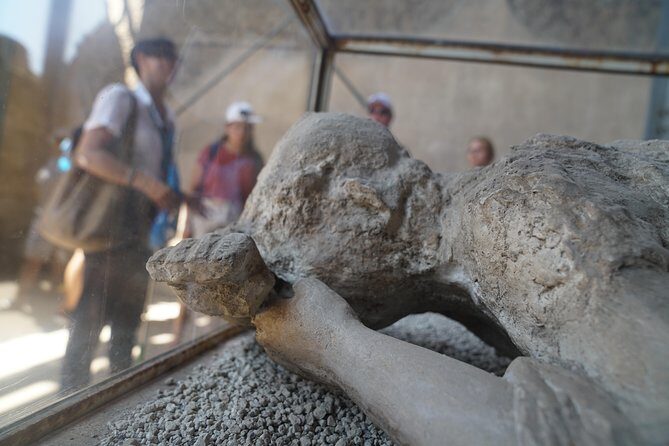
What I like about this approach: it gives you a fast mental map. After you’ve seen the Forum buildings, the main street (Via dell’Abbondanza), and then the residential/luxury and everyday-life areas, you start understanding how the city worked. You’re not just looking at walls—you’re seeing the jobs, rituals, and status systems that shaped daily routine before 79 AD turned everything to ash and pumice.
Practical tip: wear comfortable walking shoes with grip. Pompeii’s ground can be uneven, and you’ll be on your feet more than you expect from a “short” stop list.
The Pompeii Forum circuit: politics, religion, and commerce
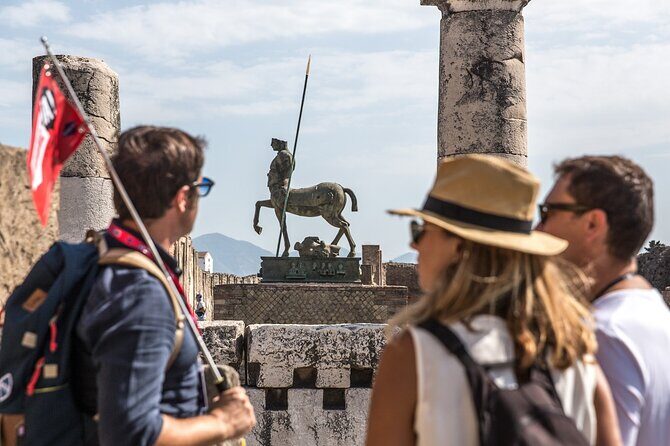
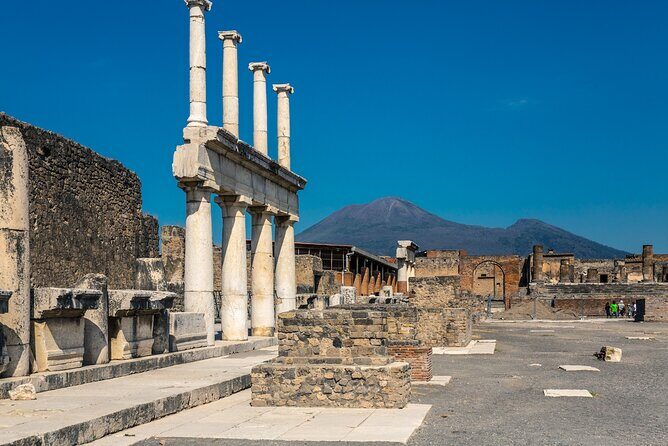
The heart of the city is the Forum, and the tour works it like a guided loop: Foro de Pompeya first, then stops tied to religion and administration, and then the buildings that show how money and power moved.
Foro de Pompeya (Civil Forum) is where the city ran. It’s described as the core of daily life, linking public buildings for administration and justice, business and trade, and even places of citizen worship. Standing in the center of it, you can feel why Romans built civic power in plain sight. It’s not hidden. It’s the stage.
Next is the Tempio di Giove Capitolino (Temple of Jupiter) on the north side of the Forum. What’s striking here is the view alignment: Mount Vesuvius rises behind the temple, framing the location. The temple was renovated when the colony was founded around 80 BC, taking on the look of a Capitolium in Rome, with cult statues of Jupiter, Juno, and Minerva placed on a high base so they could be seen across the Forum square.
Then comes the Macellum, a market complex with a tuff quadriporticus and an elevated hall tied to worship. This is where the city’s rhythm shows up: trade plus religion, business with rituals in the same zone. The Macellum also has niches with copies of marble statues and hints of an imperial-cult theme, and there’s a counter-like area that likely relates to selling food (including fish).
Why this set of stops is valuable: it connects public life to physical spaces. You’re not memorizing names—you’re learning how Romans used buildings as tools for order, belief, and commerce.
If you only visit Pompeii once, start here. This tour makes the Forum the spine of the day.
Via dell’Abbondanza and the Stabian Baths: street life and reset rituals
After the civic core, the itinerary shifts into atmosphere.
Via dell’Abbondanza was Pompeii’s ancient main street (the decumanus maximus), running east/west from the Forum to Porta Sarno. You’ll get a short stop here, but even in that brief window, it’s worth taking a minute to imagine what the street felt like when it was busy—shops, workshops (officinae), snack-bars, cafes, restaurants, noise, and movement. Modern ruins can be quiet. This kind of street stop helps you rebuild the soundtrack in your head.
Then you head to Stabian Baths (Terme Stabiane), located behind the Temple of Jupiter. The baths date to shortly after the colony of veterans was founded around 80 BC. The key practical detail is that men and women had separate entrances. The men’s area includes spaces that map to different temperatures: an apodyterium for changing, plus tepidarium, frigidarium, and calidarium for medium, cold, and hot baths.
The baths also remind you Pompeii wasn’t only one disaster. They were heavily damaged during the earthquake of 62 AD—right before 79 AD delivered the final curtain.
This stop is a good pacing break from grand public buildings. It shifts the vibe to routine. And it makes the ruins feel less like a museum and more like a city people lived inside of.
Casa del Fauno and the Lupanar: wealth, art, and the less polite side
This is where the tour turns more personal.
Casa del Fauno (House of the Faun) is one of the largest and most luxurious residences, occupying a whole city block. It’s named after a famous bronze statue of a dancing faun found in the main atrium. The standout is the Alexander Mosaic, depicting the battle between Alexander the Great and Darius III of Persia. If you’re the kind of person who loves art history, this is a major moment because it shows you how elite taste sat right inside everyday architecture.
You’ll also hear about the house’s two peristyle gardens and intricate floor mosaics. And there’s a social layer too: the house belonged to Quintus Poppaeus Sabinus, connected to the Poppei family and relatives of Empress Poppea Sabina, Nero’s second wife. That family link helps you understand the kind of power and wealth tied to a home this big.
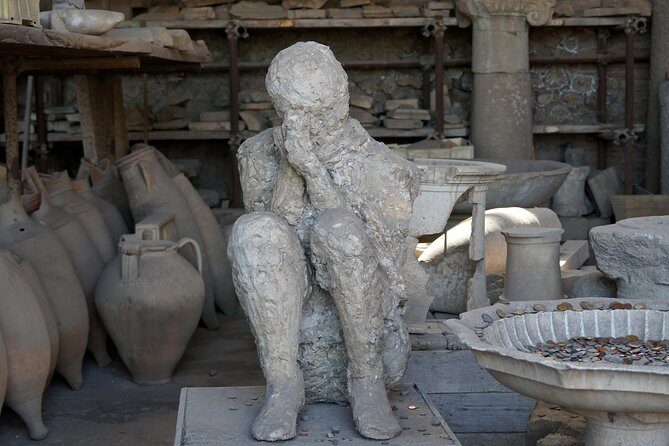
Then the itinerary takes a sharp turn to Lupanar (the well-known brothel), described as the most famous brothel in Pompeii due to the erotic paintings on its walls. This stop includes the basics of how it worked: prostitutes were often Greek and Oriental slaves, and the price ranged between two and eight Asses. The tour data also notes that a glass of wine cost one As, which helps you place the economics in everyday terms.
Is this stop for everyone? Not necessarily. But it’s useful because it rounds out Pompeii. The city wasn’t only temples and theaters; it also had services, desires, and transactions. If you want a complete picture of how Romans lived, it belongs in the route.
You can also read our reviews of more tours and experiences in Sorrento


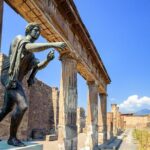
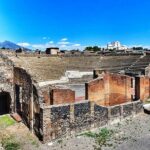
Teatro Grande and the Basilica: entertainment and justice in one city
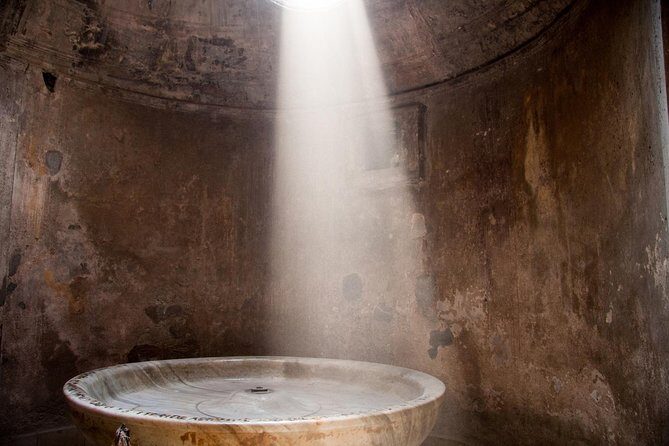
You’ll finish the Pompeii walk with two big public institutions that show how the city handled both leisure and law.
Teatro Grande (Large Theater) was built into a hillside slope, taking advantage of the natural depression to form a grand auditorium divided into five sectors. The stage was used for tragedies from Greco-Roman traditions. This is where you start to feel Pompeii as a living culture, not just an archaeological site.
Next is the Basilica, spanning about 1,500 square meters and described as the most sumptuous building of the Forum. It served business purposes and administration of justice. In other words, it was a central space where power, paperwork, and public life overlapped.
Together, these stops make Pompeii click. You see the city’s big systems: religion and government in the Forum, bathing and daily routine in other zones, elite status and scandal in residential areas, and finally entertainment and law in the major public buildings.
Priority transfer to Mount Vesuvius: what the climb is really like
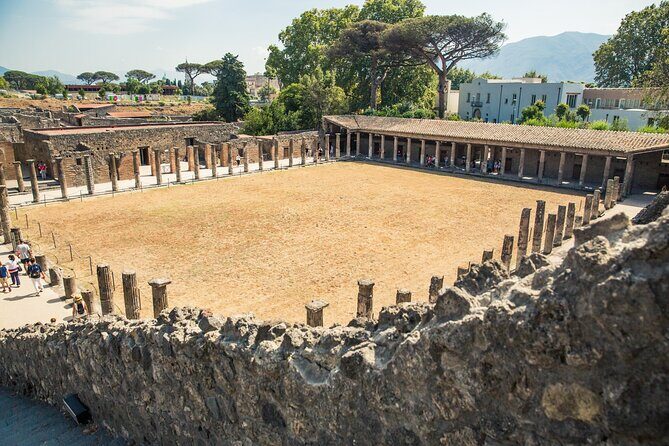
After Pompeii, you head toward Vesuvius National Park by private vehicle. The tour includes priority access to Mount Vesuvius, which is a big deal because Vesuvius can feel chaotic when everyone arrives at once.
You’ll be dropped off around 1,000 m. From there, the plan is to reach the crater’s edge at about 1,280 m for the main panorama. The surface of the path is uneven, and the tour frames it as worth it for the payoff: wide Gulf of Naples views.
A few details help you interpret what you’re seeing:
- Mount Vesuvius is a somma-stratovolcano with Monte Somma attached.
- The eruption in 79 AD destroyed Pompeii and Herculaneum.
- Scientists monitor Vesuvius 24/7, and volcanologists/geologists in the provided info emphasize that a future eruption is overdue and could be big.
- The mountain is associated with Vulcan, the Roman god of flame and metal forgery.
What I recommend you do at the crater edge: slow down and look outward first, not at your feet. The sense of scale is what makes it memorable—suddenly you understand why this volcano shaped the whole region.
Timing on Vesuvius: avoid the short-change version of this day
This part can make or break your experience, so I’ll be blunt.
The itinerary’s structure gives you around 1 hour at the 1,000 m drop-off stage, then a roughly 30-minute crater-edge segment with uneven walking. That’s enough time for a careful climb and a meaningful look, but it depends on your pace and confidence on rocky, uneven ground.
One thing I’d do before the day starts: confirm your on-site time with the supplier or driver. There’s real-world risk that time gets tightened when drivers are focused on their schedule. If you need slower pacing—because of knees, balance, or just because you want to take photos without rushing—you’ll want that handled upfront.
Also, plan your bathroom moment. The experience notes one very poor restroom option at the base of the hike. Don’t treat that as your only plan. If you can, use facilities before you arrive near the start.
What to pack (based on what’s not included and the nature of the hike): water, a hat or sun protection, and layers. The crater area can feel different than the coast, and you don’t want to arrive unprepared.
Guide quality and the small details that make history feel real
This tour is private, so the guide matters more than you might expect. A good guide turns piles of stone into an ordered story: where people ate, prayed, argued, bathed, and displayed wealth.
In the Pompeii guide pool, names like Vincenzo and Paola have been called out for being friendly and extremely knowledgeable, with explanations that bring the ruins to life. Another guide name that shows up in the information is Raffaella, and there are also credits to Leonarda and Gianluigi.
For drivers, Fabio is specifically mentioned as providing a comfortable ride and professional, safe driving. That matters because the day is long, traffic can be unpredictable, and you want someone who keeps you moving without making you feel rushed.
Here’s what I’d watch for in any good Pompeii guide interaction:
- They connect buildings to daily habits, not just dates.
- They point out visual clues you might miss on your own.
- They help you build a mental map fast, so you stop feeling lost.
If you get a guide who does that well, the timed stops feel generous instead of cramped.
Price and value: what $635.61 buys you (and what it doesn’t)
At $635.61 per person, this is not a cheap day trip. So you should think of it as paying for three things:
1) Time savings
You get priority access to both Pompeii and Vesuvius. Less waiting can mean more understanding, because you’re not exhausted before you start.
2) A private setup
Private transportation with an English-speaking driver, door-to-door pickup/drop-off, and a Pompeii guide for your group only. That gives you control over pace and questions.
3) Tickets handled
Mount Vesuvius entrance and Pompeii entry are included in the tour as described, with admissions ticket included for the major Pompeii stops and Vesuvius stops.
What’s not included is food and drinks. That’s normal for private tours, but it’s worth planning for. Bring a snack if you know you get hungry, or plan to buy a meal on your own schedule. This matters because once you’re on a fixed route, you don’t want to be stuck searching for food while everyone else is already moving.
If you’re traveling with family or friends and splitting costs, the private value can look much stronger. Just keep in mind that this is still a long walk + climb day, so it’s best when your group has a similar pace.
Who this Pompeii and Vesuvius tour fits best
This tour is a strong match if:
- You’re seeing Pompeii for the first time and want a guided route that hits the city’s main sections without planning.
- You want skip-the-line priority and hotel pickup, especially if you’re short on time.
- You like the combination of public buildings (Forum, Basilica, Theater) plus human-scale details (baths, a mosaic masterpiece, the Lupanar).
It may not be ideal if:
- You have trouble with uneven walking. Vesuvius includes a rocky, uneven path to the crater edge.
- You need long free stretches of downtime. The stops are structured and timed, so the day moves.
- Your top priority is “slow and leisurely.” This is more about efficient coverage with a knowledgeable guide.
The good news: the tour states that most travelers can participate. The better news: you can make it easier by showing up with solid shoes and a calm plan for pacing.
Should you book this private Pompeii and Mt. Vesuvius tour?
Yes, with a couple of smart checks.
Book it if you want a high-value day that ties Pompeii’s public life to personal stories, then delivers crater views without you having to organize transport and timing. The private guide for Pompeii and the priority access for both stops are the core reasons this works.
Before you confirm, do these two things:
- Make sure you’re comfortable with uneven walking on Vesuvius, and plan your bathroom stop early since the base restroom is described as limited.
- Ask for clarity on how much time you’ll have at Vesuvius crater edge, so you don’t end up feeling rushed.
If you’re good with that, this is the kind of day trip that gives you far more than a checklist. It’s one of those “you’ll remember the feeling” routes: the scale of Pompeii’s civic life, the art and power inside the houses, and then the raw presence of the volcano above the Bay of Naples.
FAQ
How long is the Pompeii and Mt. Vesuvius private tour?
It runs about 8 hours (approximately), including hotel pickup, time in Pompeii, transfer time, and the climb to the crater edge.
Where does the tour start and end?
The tour starts at Piazza Torquato Tasso, 16, 80067 Sorrento, Italy, and ends back at the same meeting point. Pickup in the Sorrento area is also included.
Is hotel pickup included?
Yes. Door-to-door pickup is offered from the Sorrento area, with hotel drop-off included as well.
Are skip-the-line tickets included?
Yes. Priority access is included for both the Mt. Vesuvius visit and the Pompeii Archaeological Site.
What is included in the tickets?
Admission tickets are included for Pompeii stops and for Mount Vesuvius National Park entry, as listed throughout the itinerary.
What language is the tour offered in?
The tour is offered in English. The driver speaks English or Italian, and the Pompeii tour runs in the selected language.
Is food and drink included?
No. Food and drinks are not included.
How much time do you spend at Mount Vesuvius?
You are dropped off at about 1,000 m (about 1 hour), then you reach the crater’s edge at about 1,280 m for the panorama (about 30 minutes, with an uneven path).
Can I cancel for a full refund?
Yes. Free cancellation is available up to 24 hours in advance for a full refund.
Is the tour really private?
Yes. It’s a private tour/activity, so only your group participates.
You Might Also Enjoy
More Private Tours in Sorrento


More Tours in Sorrento



More Tour Reviews in Sorrento
- Sorrento Farm and Food Experience including Olive Oil, Limoncello, Wine tasting
★ 5.0 · 2,524 reviews