REVIEW · NAPLES
Naples Walking Tour: Old Town and Spaccanapoli
Book on Viator →Operated by Napoli Official Tour · Bookable on Viator
Old Naples comes with an easy map: your guide’s voice. This walking tour strings together the Greek-and-Roman bones of the city and the street life you actually see today, from Piazza Dante through Spaccanapoli and ending at Piazza del Gesù Nuovo. You’ll also get headsets (so you don’t have to play telephone with a crowd) and a small food tasting to keep energy up.
I especially like two parts: the route itself, which connects major ancient landmarks with the everyday streets that locals use, and the guide-led storytelling that makes names like Port’Alba and Decumano Maggiore feel real instead of like trivia. If you’re lucky enough to get a guide like Rosa or Ines—both praised for passion and for mixing history with local tradition—you’ll leave feeling like you understood the city’s layout, not just its monuments.
One consideration: guiding style can vary. If you want lots of back-and-forth questions or you’re sensitive to religious commentary, you may want to set expectations before you start.
In This Review
- Key things to know before you go
- From Neapolis to Spaccanapoli: how the route makes Naples click
- Piazza Dante to Port’Alba: starting with the ancient gate energy
- Piazza Bellini’s tufa walls: the Greek layer you can actually see
- Via dei Tribunali (Decumano Maggiore): monuments, pizzerias, and the main spine
- Via San Gregorio Armeno: nativity scenes as a real craft street
- Spaccanapoli (Decumano Inferiore): the street where you feel the city’s pulse
- Piazza del Gesù Nuovo: the finish square and why it’s a good landing
- Headsets and tasting: small inclusions that make the walk smoother
- Price and value: what $30.25 buys you here
- Practical tips: shoes, questions, and how to pace yourself
- Who this Naples Old Town and Spaccanapoli walk fits best
- Should you book this tour or go free-strolling?
- FAQ
- How long is the Naples Walking Tour: Old Town and Spaccanapoli?
- What time does the tour start?
- Where do I meet the guide?
- Where does the tour end?
- Is the tour offered in English?
- What is included in the price?
- Do I need to pay admission at the stops?
- What group size should I expect?
- Will I receive a ticket on my phone?
- Is the tour dependent on weather?
- Can I cancel for a refund?
Key things to know before you go
- Greek-era entry points right at the start: Piazza Dante and the ancient gate area at Port’Alba
- Piazza Bellini’s tufa-block walls, dated to the late 4th century BC
- Via dei Tribunali (Decumano Maggiore) as the main historic spine of the old center, with historic pizzerias and side streets branching off
- Via San Gregorio Armeno, the famous nativity-scene street
- Spaccanapoli (Decumano Inferiore) as the “real Naples” street, running between Quartieri Spagnoli and Forcella
- Small-group setup (max 20) with headsets and a sweet-or-salty tasting
From Neapolis to Spaccanapoli: how the route makes Naples click
Naples can feel like a lot at first—streets twisting, names overlapping, and buildings piled right up against the sidewalk. This tour helps because it follows a clear logic: follow the city’s ancient lines, then watch how modern neighborhoods grew into and around them.
The backbone is the Decumani idea. Two main east-west streets run through the historic center, and the tour uses them to organize everything you see. Via dei Tribunali is the Decumano Maggiore, and later you walk Spaccanapoli as the Decumano Inferiore. Once you grasp those lines, you stop feeling lost and start reading the city like a map—without needing to pull out a phone every five minutes.
Timing also helps. This starts at 4:00 pm. Late afternoon light makes churches and old stone faces look better, and you’re walking during the part of the day when the city feels most “open”—not sleepy, not rush-only.
You can also read our reviews of more walking tours in Naples


Piazza Dante to Port’Alba: starting with the ancient gate energy
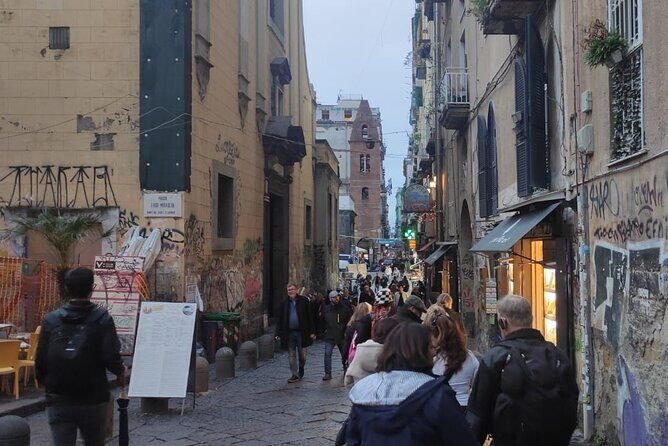
The walk kicks off in Piazza Dante, where you meet your guide and begin through the ancient streets of Neapolis. Think of this as your orientation lap, but with real historical landmarks—not just vague directions. You’re led back toward Greek and Roman times via the alleys of ancient Naples, so you get context before you start chasing smaller details.
The first stop is right there: the route takes you to the historic gate area at Port’Alba. This is one of the oldest gates of the city, and it acts like a threshold between the modern center and the older layout. Port’Alba also connects to the Decumanus Major, which is a fancy way of saying you’re stepping near one of the main ancient street axes. Even if you don’t memorize every term, you’ll notice how your guide keeps pointing out “why this street matters,” not just “what you’re standing next to.”
Practical value: at this stage, you’re learning the city’s grammar. Later, when you hit Via dei Tribunali and Spaccanapoli, it will make more sense why they’re so central.
Piazza Bellini’s tufa walls: the Greek layer you can actually see
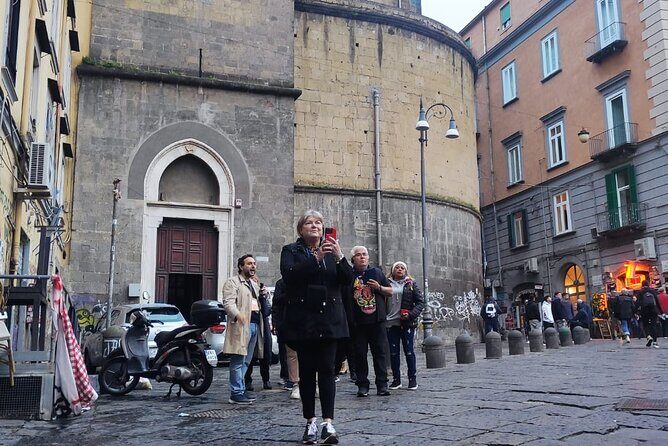
Next up is Piazza Bellini, and here the tour slows just enough for you to notice something most people walk past. On the western side of the square, you can admire remains of walls from the Greek Neapolis period.
The key detail is the material and date: the fortification system is made of compact tufa blocks, and the walls are dated to roughly the second half of the 4th century BC. That’s the kind of fact that turns a “pretty square” into a tangible timeline. You’re not just learning that Naples has ancient roots—you’re seeing where the ancient city’s defenses were.
If you tend to rush when you travel, give yourself permission to pause here. This is one of the stops where standing still actually pays off. The walls are the reminder that the street plan you’re walking today didn’t appear out of nowhere.
Via dei Tribunali (Decumano Maggiore): monuments, pizzerias, and the main spine
After the Greek-era anchor, the tour moves to the heart of the historic center: Via dei Tribunali, also known as Decumano Maggiore. This is the main artery. Along it, historic businesses—including some of the famous Neapolitan pizzerias—sit alongside monuments, so the street works as both a museum corridor and a working neighborhood.
What I like about this section is that your guide uses the street layout to explain how other alleys branch off. You’re not only walking one “attraction street.” You’re learning how the city spreads from the spine into smaller lanes, which is exactly what you’ll want once you leave the tour.
This is also where Via San Gregorio Armeno comes into the story. The route introduces it as a special offshoot, which helps when you finally reach it—because you’ll already understand the role it plays in the overall neighborhood web.
One more practical note: this is where foot traffic can be heavier simply because it’s central. Headsets help a lot here. You don’t lose the thread when someone stops or when a group bunches up.
Via San Gregorio Armeno: nativity scenes as a real craft street
Via San Gregorio Armeno is the famous street of nativity scenes. It’s the kind of place where the theme sounds simple, but the reality is much more interesting: people treat these displays like a craft and a tradition, not a quick souvenir stop.
The tour treats it as a dedicated segment rather than a quick look-and-go. That matters, because if you only glance, you’ll miss why the street is so well known in the first place. You get time to slow down, look at the details, and notice the street rhythm—how shop fronts and street life mix together.
Even if nativity scenes aren’t your thing, you’ll still get something valuable: a snapshot of Naples as a place where tradition lives in everyday commerce. You’re seeing how culture gets practiced and sold right on the street.

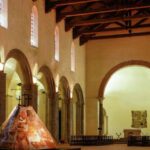


Spaccanapoli (Decumano Inferiore): the street where you feel the city’s pulse
The tour’s signature middle-to-late portion is Spaccanapoli. This picturesque street runs from the Quartieri Spagnoli area to Forcella, and it bisects the city as the Decumano Inferiore. In other words, you get the “street cut” view of Naples: one of those linear roads that makes the whole city feel organized, even when it doesn’t look organized at first glance.
This part is where the tour leans hardest into what people mean when they say real Naples. Here you’ll see a mix of churches, residential buildings where locals live, and a few small bars. It’s not set up like an attraction bubble. It feels like you’re walking through a working neighborhood, not just a staged viewpoint.
Why it’s worth it: after learning the ancient framework earlier, Spaccanapoli shows you how history and daily life share the same sidewalk. The tour doesn’t only point at stone. It points at how Naples breathes around it.
Piazza del Gesù Nuovo: the finish square and why it’s a good landing
You end in Piazza del Gesù Nuovo, one of the key squares of the historic center. This isn’t a random exit point. The square sits in the orbit of major sights: the church of the same name, the Basilica of Santa Chiara, and restaurants that make it an easy place to continue your evening.
Finishing here gives you a helpful transition. After two hours of guided context, you’re not forced to immediately plan a route from scratch. You can grab a drink, grab a bite, and keep walking at your own pace with more confidence about where you are.
Headsets and tasting: small inclusions that make the walk smoother
The tour includes a local guide, headsets (for groups of 6 participants and on), and a food tasting—sweet or salty. These are small line items, but they matter on the ground.
Headsets keep the tour from turning into a silent shuffle. On a street route like this, it’s easy for voices to disappear under street noise. With headsets, you stay with the story instead of trying to guess what’s important.
The tasting is also a smart move for a 2-hour timeline. Naples walking can work up an appetite fast, and a quick sweet-or-salty stop makes the tour feel like a shared neighborhood moment rather than just sightseeing.
Price and value: what $30.25 buys you here
At $30.25 per person for about 2 hours, you’re paying for more than “someone to walk with.” You’re paying for:
- A guided route through the old center’s major ancient-to-modern storyline
- Headsets (when the group is large enough)
- A guided food tasting
- A compact format that covers several anchor stops without dragging all day
If you’re the type who hates spending hours in planning mode, this can be a good deal. You can absolutely DIY these streets, but you’d be piecing together why Port’Alba, Decumano Maggiore, and Spaccanapoli connect the way they do. The tour compresses that understanding into a short, manageable window.
Also, this tour is often booked ahead (on average about 33 days), so it’s smart to lock in your spot early if you’re traveling during a busy stretch.
Practical tips: shoes, questions, and how to pace yourself
Naples old town is a walking experience, but it’s also a city experience. That means you’ll want to plan for crowds and tight turns.
A few tips that make the tour go better:
- Wear shoes you trust for uneven sidewalks and quick stops.
- Bring your curiosity. If you want specific answers, ask early—before the group spreads out.
- If you care about pacing, listen for the guide’s rhythm. Some stops are about 15 minutes; others last around 30.
- For comfort, keep water handy, especially since the tour requires good weather to run.
One other thing: because this is an afternoon start at 4:00 pm, consider planning a lighter schedule earlier in the day. You’ll get more out of it if you’re not already exhausted from museums and long rides.
Who this Naples Old Town and Spaccanapoli walk fits best
This tour works well if you want:
- A guided path through the historic center without needing to study a map for days
- The street layout explained (Decumani) in a way you can remember
- A mix of major points (gates, walls, squares) and everyday lanes (nativity scenes, residential streets)
- A manageable time commitment—about 2 hours
It’s also a solid pick for first-time Naples visitors, since it gets you oriented and then hands you off to the best kind of travel: wandering with purpose.
If you’re traveling with mobility constraints, the itinerary is still described as a walking tour through multiple areas. Most people can participate, but you’ll want to judge the pace and sidewalk conditions for your own needs.
Should you book this tour or go free-strolling?
I’d book it if you want the city’s layout explained while you’re still close enough to sights that it feels practical. Paying $30.25 for a local guide, headsets, and a tasting is a fair swap for time and confusion.
I’d skip or rethink if you hate structured routes, or if you already know the Decumani layout and prefer to build your own day with zero schedule. In that case, you can still walk the same streets on your own—just expect to do more reading and more guessing.
Best compromise: if you’re unsure, think of this tour as your opening lesson. Finish at Piazza del Gesù Nuovo, then use what you learned to pick your own next stops.
FAQ
How long is the Naples Walking Tour: Old Town and Spaccanapoli?
The tour is approximately 2 hours.
What time does the tour start?
It starts at 4:00 pm.
Where do I meet the guide?
The meeting point is Piazza Dante (P.za Dante, 80135 Napoli NA, Italy).
Where does the tour end?
The tour ends at Piazza del Gesù Nuovo (80134 Napoli NA, Italy).
Is the tour offered in English?
Yes, it is offered in English.
What is included in the price?
It includes a local guide, headsets (for groups of 6 participants and on), and a food tasting (sweet or salty).
Do I need to pay admission at the stops?
The stops listed are marked as admission ticket free.
What group size should I expect?
The maximum group size is 20 travelers.
Will I receive a ticket on my phone?
Yes, the tour provides a mobile ticket.
Is the tour dependent on weather?
Yes, it requires good weather. If it’s canceled due to poor weather, you’ll be offered a different date or a full refund.
Can I cancel for a refund?
Free cancellation is available. You can cancel up to 24 hours in advance for a full refund. If you cancel less than 24 hours before the start time, the amount paid is not refunded.