REVIEW · NAPLES
Naples panoramic tour and Monumental historic center.
Book on Viator →Operated by AmalfiTourCampania · Bookable on Viator
Naples looks different from every turn. This day tour is built for getting your bearings fast: you cover the historic center and multiple viewpoints in one run, with commentary in English and a comfortable air-conditioned vehicle while you move between areas. I like how the route mixes grand interiors with outdoor views, so the “wow” moments aren’t only at the end.
I also like that the included ride services are practical: bottled water, onboard Wi‑Fi, and all fees and taxes. And you’ll finish with some serious artifact power at the Museo Archeologico Nazionale di Napoli, so the day has both atmosphere and context.
One consideration: several big stops don’t include admission, so you’ll want to budget extra time (and money) for ticketed entries. Also, this is more of a chauffeur-driven style than a full-on scripted walking guide everywhere, so set your expectations if you crave constant, detailed talking at every curb.
In This Review
- Key highlights worth knowing
- The “panoramic plus monuments” formula that works in Naples
- Palazzo Reale and Piazza del Plebiscito: where Naples royalty lived
- Galleria Umberto I: elegant arcade, darker past beneath it
- Castel Sant’Elmo on the Vomero hill: fortress views and museum time
- Posillipo: coastal perspective plus Roman hints
- Lungomare Caracciolo: the easiest scenic win in the day
- Piazza del Gesù Nuovo: the religious cluster that feels like a neighborhood
- Museo Archeologico Nazionale di Napoli: where Pompeii and Herculaneum artifacts take over
- Price and logistics: what you’re really paying for
- Who should book this Naples tour?
- Should you book this panoramic and historic center tour?
- FAQ
- Is pickup included for the Naples panoramic and historic center tour?
- What languages is the commentary available in?
- Are monument and museum tickets included?
- How long is the tour?
- Is Wi‑Fi provided during the tour?
- Is this tour private?
Key highlights worth knowing

- Royal Palace in Piazza del Plebiscito: see how Spanish viceroys, the Bourbons, and later the Savoys shaped the complex
- Galleria Umberto I: stop in an elegant indoor arcade after a darker 1500s origin story
- Castel Sant’Elmo: a hilltop fortress with views over the city and gulf (250 m above sea level)
- Posillipo + Roman remnants: coastal viewpoints with references to ancient tunnels and a villa area
- Lungomare Caracciolo sea air: an easy, scenic breather along the waterfront
- Museo Archeologico Nazionale di Napoli: a major museum stop focused on finds from Pompeii and Herculaneum
The “panoramic plus monuments” formula that works in Naples
This tour is the kind of Naples day that helps you stop guessing. You get driven between key zones—the royal square area, the hill, the coast—and then you’re given enough time at each place to actually take it in. The whole point isn’t to sprint through everything; it’s to connect landmarks with where they sit in the city.
Because it’s a private setup for just your group, the pace can feel calmer than a large public group ride. And you’ll appreciate the operational basics: pickup is offered, you get bottled water, and you can use Wi‑Fi on board when you need it for maps or messages.
The biggest trade-off is that “vehicle comfort + multiple zones” can mean less time spent in deep, slow conversations at every monument entrance. If you want a specialist-level guide who talks nonstop at each stop, this may feel more like an excellent overview plus scenic time—rather than a fully narrated, every-corner walking tour.
You can also read our reviews of more tours and experiences in Naples.


Palazzo Reale and Piazza del Plebiscito: where Naples royalty lived
You start at Palazzo Reale, the Royal Palace in Piazza del Plebiscito. It’s not just a pretty building; it’s a stack of centuries. The palace was the residence of the Spanish viceroys for more than 150 years, then became part of the Bourbon period (1734 to 1861). There’s also a disruption you’ll hear about: French domination in the early 1800s under Giuseppe Bonaparte and Gioacchino Murat.
Then it shifts again after the unification era: the Savoys used it, and in 1919 Vittorio Emanuele III sold it to the state. Today it’s mainly used as a museum—Royal Apartments—and it also serves as the seat of the national library.
The palace complex grew over a long construction stretch, starting around 1600 and reaching its final appearance in 1858, with multiple architects involved in both building and restoration. That long timeline helps you understand why it doesn’t look like one single style frozen in time.
Expect about an hour here, and plan for the practical part: admission isn’t included. If you’re the type who likes to step into interiors rather than only look at façades, this is where you’ll likely be glad you budget for tickets.
Galleria Umberto I: elegant arcade, darker past beneath it
Next comes Galleria Umberto I. The building sits on a site that was already urban in the 1500s, with tight lanes and short alleys that connected to Via Toledo and faced Castel Nuovo. This area had a reputation tied to taverns and crime—places associated with people who wanted trouble rather than culture.
Still, the story doesn’t stop in the rough stuff. The fame of the area lingered for centuries, and it even caught literary attention—Giambattista Basile referenced women of malfeasance in Le muse napolitane. So when you step into the airy, more refined feel of the gallery, it helps to remember you’re walking over a layer of Naples that was never only polite.
The good news: you’re scheduled about an hour, and admission is free. That makes this a low-stress stop—more like a strong palate cleanser between ticketed monuments. It’s also a nice moment for photos because it’s an indoor space where you can still take your time without weather problems.
Castel Sant’Elmo on the Vomero hill: fortress views and museum time

Castel Sant’Elmo is the hilltop piece that gives the tour its panoramic punch. It’s a medieval castle near San Martino, reached from the Vomero hill. Before it became a fortress, the site had a church linked to Sant’Erasmo, and the castle you see today traces its roots to a Norman observation tower called Belforte.
What makes this stop click for me is the strategic geography. At about 250 meters above sea level, the castle location lets you observe the city, the gulf, and the roads leading up from surrounding hills. In other words: you’re not just looking at Naples—you’re seeing how Naples spreads.
The castle is also used as a museum. One named permanent collection is “Naples Novecento,” plus you may find temporary exhibitions, fairs, and events. There’s also a reference point in the timeline: it hosted Napoli Comicon from 1998 to 2011, before that moved to Mostra d’Oltremare.
You’ll get about an hour here. Like Palazzo Reale and the museum later in the day, admission isn’t included, so you’ll want to mentally separate “time in the castle” from “time for tickets.” If you’re short on energy, still try to prioritize the outdoor viewing points first—because the view is the main payoff.
Posillipo: coastal perspective plus Roman hints

Then you move along the coast zone toward Posillipo. This area shows up in ancient sources going back to Greek times. The promontory was first inhabited by the Greeks, then later the region was covered with rocks and trees. You’ll also hear about Roman remains near the banks and near the highest point of the hill, including traces of openings connected to a tunnel that led to the residence of Publius Vedio Pollione.
There’s also mention of remains of an amphitheater. After ancient times, the area declined and was enclosed within fortified walls as Naples consolidated inward. In modern periods, development stayed limited until a key construction phase: Via Posillipo was built between 1812 and 1824, starting at the port of Mergellina and running along the coast almost parallel to the shoreline.
Some areas were heavily rebuilt after World War II, but a few historic buildings survived, including Villa Rosebery—the residence of the President of the Republic.
What you’ll actually enjoy here is the shift in pace from fortress to coastline. You get sea air and a sense of Naples as a city that hugs geography, not just streets.
This stop is scheduled for about an hour and admission is free, so you can relax and focus on what you see from the roads and viewpoints rather than planning museum logistics.


Lungomare Caracciolo: the easiest scenic win in the day

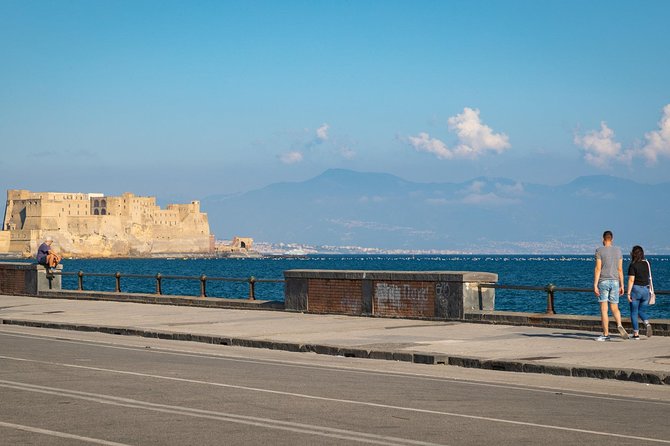
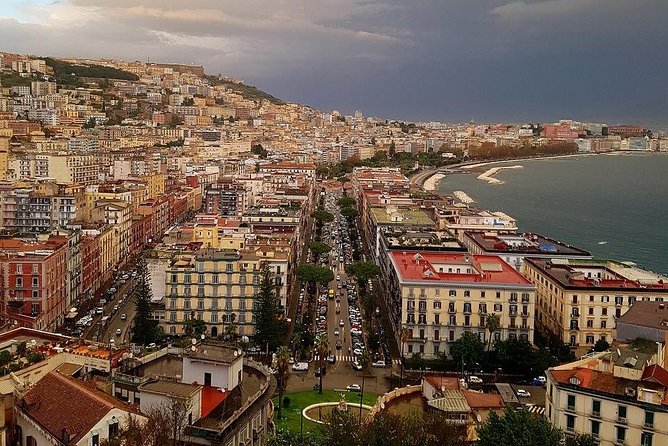
Lungomare Caracciolo is the simple, satisfying break along the waterfront. You’re basically there for the sea view and the sea air, and it works even if you don’t want to treat every stop like a big cultural assignment.
This kind of pause matters. Naples can feel intense—noise, color, traffic, layers of buildings. A waterfront segment lets your eyes reset, and it gives you time to look toward the harbor area and the horizon while your feet rest.
You’ll have about an hour, and it’s free. If you’re the type who likes photos, this is also where you can grab a few that show Naples as a coastal city, not just a museum city.
Piazza del Gesù Nuovo: the religious cluster that feels like a neighborhood

Piazza del Gesù Nuovo is one of those areas where multiple important sites sit close together, and you end up seeing the broader Naples pattern: a church, a monastery complex, and other landmarks all shaping how people move.
Here, you’ll be oriented around places like Chiesa del Gesù nuovo, the monastery of Santa Chiara, and the Cristo Velato located in the chapel of San Domenico maggiore. You’ll also hear a local phrase tied to La Spacca Napoli, which signals this is a spot that’s known for its “division” vibe—two sides, different streets, different energies.
This stop is about an hour, and admission isn’t included. So again, you should expect that if you want to go inside, you’ll pay tickets separately. If you’re more focused on exterior architecture and the feel of the square, you can still get plenty from the time allotment.
Museo Archeologico Nazionale di Napoli: where Pompeii and Herculaneum artifacts take over

The big museum finale is Museo Archeologico Nazionale di Napoli, and it’s hard to overstate how practical this is. Naples without its archaeological weight can feel like it’s missing one of its main pillars. This museum stop is built to correct that.
The museum includes archaeological finds from Pompeii, Herculaneum, and Oplontes, along with sculptures and paintings described as unique pieces. That means your experience isn’t only about reading labels. It’s about standing in front of objects that connect Naples to the wider story of the region.
You’ll get about two hours. Like the other ticketed sites, admission isn’t included, so plan your timing accordingly. If you’re easily tired by museum crowd flow, prioritize major rooms and major objects first, then go back for anything that catches your eye.
This is also a good place for a “slow moment.” By the time you reach the museum, you’ve had the royal square, the hilltop fortress, and the coast air. Now you can let the objects do the talking.
Price and logistics: what you’re really paying for
At $247.91 per person for roughly 6 to 8 hours, you’re paying for more than sightseeing. You’re paying for a coordinated way to cover a lot of ground without renting a car. Included value items that actually help your day include:
- Air-conditioned vehicle
- Bottled water
- On-board commentary in your agreed language (English)
- Wi‑Fi on board
- All fees and taxes
What you’re not paying for (and should plan for) is monument and museum admission. Palazzo Reale, Castel Sant’Elmo, Piazza del Gesù Nuovo area sites, and the Museo Archeologico Nazionale di Napoli are listed as not included. Meanwhile, Galleria Umberto I, Posillipo, and Lungomare Caracciolo are marked as free. That mix is useful: you can enjoy some stops without extra ticket thinking, but you’ll still want to handle entries at the major “pay” moments.
Another small but important reality: good weather is required for the experience. Naples is beautiful in sunshine, and some of the tour’s best moments are tied to viewpoints, so plan for that.
Finally, set expectations about guide style. In past experiences with the same provider, there’s been feedback that the driver can feel more like a chauffeur giving general info than a fully licensed walking guide at every stop. The provider’s response emphasized that the booked service includes a chauffeur-driven tour, not a licensed tour guide, while still committing to answering questions and sharing information. If you want constant, specialized commentary throughout, it’s smart to ask in advance what level of guiding your group expects.
Who should book this Naples tour?
This fits best if you:
- want a one-day route that ties together royal Naples, viewpoint Naples, and museum Naples
- appreciate a comfortable ride with onboard commentary rather than a long, exhausting walking marathon
- like the idea of both ticketed monuments and free outdoor stops
It may be less satisfying if you:
- want a stop-by-stop, script-like explanation at every entrance without gaps
- dislike ticketed entries and prefer tours where all key admissions are included
- want total flexibility to linger longer at only one site (the structure is designed for covering multiple zones)
The private-group setup is a plus if you’re traveling with friends or family and want a calmer vibe than a big bus day. It’s also a good choice if you’re new to Naples and want your first visit to feel organized.
Should you book this panoramic and historic center tour?
I’d book it if you want a smart Naples “starter day” that blends viewpoints, major landmarks, and a museum anchor. The mix is strong: royal palace in Piazza del Plebiscito, a hilltop fortress at Castel Sant’Elmo, coastal air at Posillipo and Lungomare Caracciolo, the religious hub around Piazza del Gesù Nuovo, and the archaeology punch of Museo Archeologico Nazionale di Napoli.
Just go in with two expectations: plan for ticketed admissions at several stops, and treat the onboard commentary as helpful overview-style rather than a constantly deep, specialist guide at every curb. If that matches your travel style, you’ll come away with a clear sense of Naples—how it’s built, where it looks out, and what it remembers.
FAQ
Is pickup included for the Naples panoramic and historic center tour?
Pickup is offered. You’ll display a cartel with the name of your reservation at the pickup point.
What languages is the commentary available in?
The tour includes commentary on board in the agreed language, and it is offered in English.
Are monument and museum tickets included?
No. Entry to the monuments and archaeological sites is not included. Tickets are noted as not included for Palazzo Reale, Castel Sant’Elmo, Piazza del Gesu Nuovo, and the Museo Archeologico Nazionale di Napoli.
How long is the tour?
The duration is approximately 6 to 8 hours.
Is Wi‑Fi provided during the tour?
Yes. Wi‑Fi is included on board.
Is this tour private?
Yes. This is described as private, with only your group participating.