REVIEW · POSITANO
Transfer from Naples to Positano with 2 hours Private Tour in Herculaneum
Book on Viator →Operated by Askos Tours · Bookable on Viator
That Roman buried-city stop changes the whole day. This private transfer pairs a door-to-door ride from Naples to Positano with a guided visit to Herculaneum, so you trade sitting on a bus for real seeing. You get picked up where you choose in Naples, ride in an air-conditioned minivan with a professional driver, then step out for a 2-hour archaeologist-guided walk through Pompeii’s less-crowded cousin.
Two things I like a lot: the logistics are simple—your driver handles transport and your bags—and the Herculaneum guidance makes the ruins feel readable instead of random stone. One possible drawback to consider: the Herculaneum visit is great, but it’s not a full-day deep visit, so if you want lots of time to linger, you might feel a bit rushed.
In This Review
- Key highlights you’ll care about
- Naples to Positano, without the hassle spiral
- The value equation: paying for time you can actually use
- A practical 4-hour plan that fits real travel timing
- Herculaneum with an archaeologist guide: what the stops teach you
- Stop 1: Parco Acheologico di Ercolano
- Stop 2: Casa dei Cervi
- Stop 3: La Terrazza di M. Nonio Balbo
- Stop 4: College of the Augustales
- Stop 5: Casa del Rilievo di Telefo
- Stop 6: Partem Domus lignea – Casa del Tramezzo di Legno
- Stop 7: House of the Skeleton
- Stop 8: Central Thermae
- Stop 9: Casa del Salone Nero
- Stop 10: Casa Sannitica
- Stop 11: Casa del Bel Cortile
- Stop 12: House of the Grand Portal
- The transportation part: when your driver matters
- Who this is best for (and who might want something else)
- Tips to make the most of your 2-hour Herculaneum window
- Should you book this Naples to Positano + Herculaneum tour?
- FAQ
- How long is the transfer and Herculaneum tour combined?
- What does the tour include for Herculaneum?
- Does the driver stay with the vehicle while we visit Herculaneum?
- Where does the Herculaneum tour start?
- Is pickup offered in Naples, and can I choose the location?
- Is the vehicle air-conditioned?
- Are meals included?
- How is entry handled—tickets or mobile tickets?
- What about kids or car seats?
- Can I cancel for a full refund?
Key highlights you’ll care about
- Private, door-to-door transfer from Naples to Positano with a professional driver
- Guided Herculaneum stop designed to fit into your travel day (about 2 hours)
- Air-conditioned minivan plus luggage transport, with driver waiting during your site time
- Herculaneum entry tickets included (listed as €16 each) and a mix of paid/free viewing spots
- Only your group on this private activity, with mobile ticket access
- Car seats available on request, and service animals are allowed
Naples to Positano, without the hassle spiral
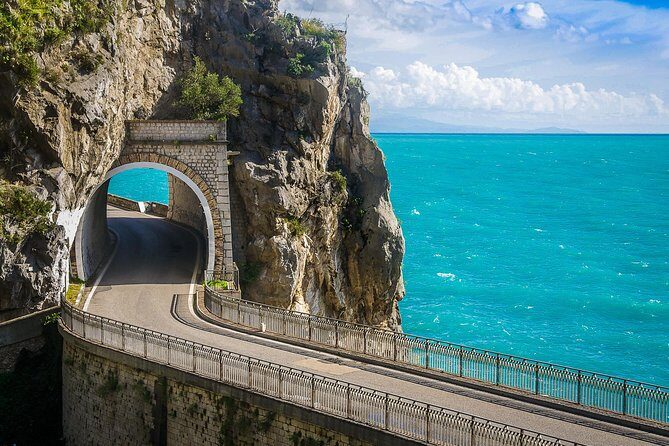
If you’ve ever tried to connect Naples to the Amalfi Coast with public transport, you already know the story: long waits, transfers you didn’t plan for, and schedules that don’t care about your momentum. This experience swaps that stress for a private ride in an air-conditioned vehicle. You get picked up at the time and location in Naples that you choose, then you’re handled all the way to Positano with a hotel drop-off included.
The best part is that the day is built around comfort and control. Your driver stays with the vehicle while you explore Herculaneum, so you don’t have to constantly manage where the car is parked, how you’ll carry bags, or whether you’ve left something behind. For a travel day, that matters more than you might think. It keeps you in sightseeing mode instead of logistics mode.
And yes, it’s private. That means you’re not negotiating space, timing, or pacing with a crowd. It’s just your group and your schedule, which is a big deal if you want a calm, guided experience rather than a sprint between stops.
You can also read our reviews of more private tours in Positano


The value equation: paying for time you can actually use
At $456.70 per person, this isn’t a budget transfer. But the pricing makes sense when you treat it as two things you’d otherwise pay for separately: transport to the Amalfi Coast plus a guided Herculaneum visit.
Here’s the math that’s often overlooked. You’re not only getting a ride. You’re getting:
- a professional guide for Herculaneum
- admission tickets for Herculaneum listed as €16 each (included)
- a structured route through major parts of the archaeological area
- a one-way transfer with hotel drop-off in Positano
Meals aren’t included, so you’ll want to plan food separately. But you do avoid the cost and time of figuring out ticket lines, transport connections, and site navigation on your own.
If your goal is simply to go from Naples to Positano, you could go cheaper. But if you want to add a meaningful Roman ruins stop without burning half your day on transit, this is the kind of service that can be worth the money—especially if your schedule is tight or you hate uncertainty.
A practical 4-hour plan that fits real travel timing
The total duration is about 4 hours. That number matters because Amalfi Coast days can get swallowed by ferry times, traffic, and “just one more stop” syndrome. This itinerary is built to move you along while still giving Herculaneum enough time to matter.
What you can expect in that time window:
- Time in the Roman site is about 2 hours, guided
- You’re transferred in an air-conditioned vehicle the rest of the time
- You’re dropped in Positano (hotel drop-off is included)
It’s a “you’ll see the highlights” setup rather than “you’ll finish every room and courtyard.” If you’re traveling with limited days in the area, that’s usually a feature, not a bug.
Herculaneum with an archaeologist guide: what the stops teach you
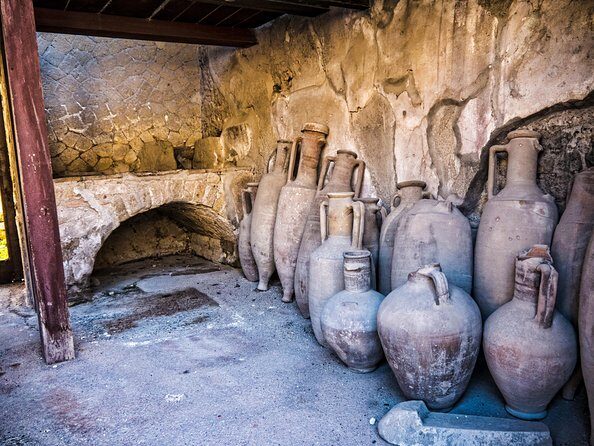
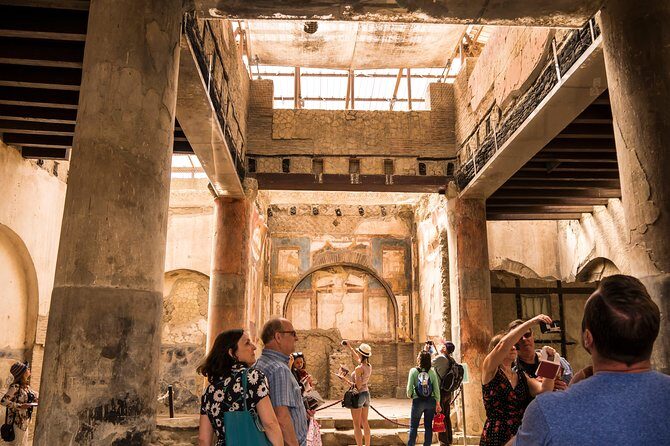
The guided portion starts at Parco Acheologico di Ercolano, meeting the guide at the ticket office. From there, the route moves house to house, building to building—each stop giving you a specific piece of how this town worked and what was lost.
A big reason Herculaneum impresses is that it’s not just about ruins. It’s about contrast. You’re looking at a town that was engulfed and preserved differently than Pompeii, so the vibe is quieter and, for many visitors, easier to understand when someone explains the layout and daily life.
Stop 1: Parco Acheologico di Ercolano
This is the main site. The guide meets you at the ticket office and you begin with the overall context—where you are, what you’re seeing, and why it matters. The admission for this is included, and it’s the foundation stop that sets the rhythm for everything that follows.
You can also read our reviews of more tours and experiences in Positano

Stop 2: Casa dei Cervi
This house gets its name from marble statues of deer (or stags) found in the peristyle. It’s a short stop, but it signals something important: these homes weren’t bare. They were decorated, curated, and designed for social display.
What I’d watch for here is how these details help the guide explain status and taste. You’re not just looking at walls; you’re learning what visitors once experienced walking through a home.
Stop 3: La Terrazza di M. Nonio Balbo
You’ll also see a terrace tied to M. Nonius Balbus, described as the city’s major benefactor who restored and built public buildings. After his death, his honors are recorded in a long inscription tied to his funeral altar.
This is a great example of why a guide helps. An inscription can feel like an unreadable wall to most people—until your guide translates the meaning and shows you how “public works” connect to the name on the stone.
Stop 4: College of the Augustales
This building is thought to have been a center linked to the cult of Emperor Augustus, with a role tied to the headquarters of the Collegium Augustalium—or possibly even the local curia. That’s a mouthful, but the concept is simple: this is a space where religious-political life intersected.
Even in a 15-minute moment, this stop can change how you view the whole site. Instead of thinking only about private homes, you start seeing institutions.
Stop 5: Casa del Rilievo di Telefo
This house is unusual because it has private access to the adjoining Suburban Thermae to the south. It’s also possibly associated with leading benefactors like Marcus Nonius Balbus.
Why this matters: it hints at how people moved through space—especially how elite homes connected to public or semi-public facilities like baths. Your guide can connect the “why” behind the architecture instead of leaving it as a random layout.
Stop 6: Partem Domus lignea – Casa del Tramezzo di Legno
This stop highlights an elegant wooden partition that remained. Even though it’s a short stop, it points to a key challenge of archaeology: not everything survived the same way. Wood often doesn’t last, so what’s preserved here is significant.
If you like details that explain what the materials tell us, this one is worth paying attention to. It’s the kind of stop that turns ruins into evidence.
Stop 7: House of the Skeleton
The name comes from human remains discovered in a second-floor room in 1831. The moment is brief, but it can be heavy, in a quiet way.
Your guide’s role is especially important here, because the name can pull you toward the sensational. The better experience is when it’s framed as a reminder of what happened to people—without turning tragedy into a theme park stop.
Stop 8: Central Thermae
The Central Thermae were built around the beginning of the 1st century AD and were divided into men’s and women’s baths, each with separate entrances.
This is one of the most practical “learn how it worked” stops. It helps you picture daily life, not just topography. Even if you’ve read about Roman baths, seeing the structure makes the gender separation and the flow through the complex feel tangible.
Stop 9: Casa del Salone Nero
The House of the Black Hall offers a monumental entrance with carbonised remains of doorposts and lintel. This is one of those places where the ruins look almost like a frozen snapshot.
In a short stop, I’d focus on the guide’s explanation of materials and what survived. The charred elements are not just spooky decoration—they’re physical traces of the event.
Stop 10: Casa Sannitica
This home has an arrangement typical of the Samnites, described as part of the Sabine race who occupied mountainous central Italy. You’ll also see an atrium with a gallery and Ionic columns, plus frescoes in the rooms.
If you’re interested in how cultures and influences overlap, this stop is a good one. It’s not just “Romans lived here.” It’s a town where influences show up in architecture and design.
Stop 11: Casa del Bel Cortile
This house is original because it features a courtyard with a stairway and a stone balcony instead of a Roman atrium.
Short and sweet, but it helps you understand that Herculaneum houses don’t all follow the same template. You start seeing individuality and different architectural choices.
Stop 12: House of the Grand Portal
You’ll end at a central-area domus with multiple environments, colonnati, frescoes, and evidence of burned wooden parts. It’s a strong “final picture” stop because it pulls together what you’ve been learning across the route.
When a guide is good, the last stop feels less like an ending and more like it clicks everything into place. You walk away with a mental map, not just scattered impressions.
The transportation part: when your driver matters
The transfer is done in a private air-conditioned minivan with a professional driver. The tour includes transport plus a one-way transfer from Naples to Positano, with luggage transport handled by the service.
That’s a key detail for Amalfi plans. The road along this coast can be slow, and you want your energy to go into sightseeing, not into bracing yourself for a stressful logistics scramble. A calm pickup and a clear arrival drop-off help the day feel organized—even when traffic exists.
And since your driver stays with the vehicle while you tour Herculaneum, you’re not timing your steps against a group’s fear of missing the van. It’s a more relaxed rhythm.
Who this is best for (and who might want something else)
This is a great match if:
- you’re short on days and want a smart use of a travel day
- you’re heading into Positano and want a meaningful stop on the way
- you value a guide to make ruins readable
- you’d rather pay for convenience than spend your day untangling transport
You might choose a different option if you want:
- a slower, longer visit where you can linger in every space
- food included as part of the package
- a full day solely dedicated to Herculaneum
Also, the guide experience is a big part of the value. One of the best-rated parts of the experience is the guide at Herculaneum—Laura is specifically mentioned as having strong knowledge of ancient Rome and explaining it in a way that makes the site click.
Tips to make the most of your 2-hour Herculaneum window
Since the guided stop is time-limited, you’ll get the most if you come ready to focus. I recommend you:
- pick your priorities before you arrive (homes, baths, public buildings, inscriptions)
- ask your guide for one thing you can keep in mind while walking (like how the baths were organized)
- wear shoes that handle uneven ground, because ruins don’t come with “smooth museum paths”
Also, remember meals aren’t included. Plan a snack and water timing around your tour so you don’t end the ride hungry and rushed.
Should you book this Naples to Positano + Herculaneum tour?
I’d book it if you want two goals without the usual stress: reach Positano and get a guided archaeology stop that most people skip or underdo. The combination of private transport, a real guide, and entry tickets included turns what could be a boring transfer day into something with actual substance.
Skip it (or consider a different format) if you’re the type who needs more time in archaeological spaces and hates feeling scheduled. Also, if budget is your main driver and you don’t care about a guided ruins stop, there are cheaper transfer options.
For many people doing the Amalfi Coast for the first time, this hits a sweet spot: you get comfort, clarity, and a Roman site that’s less crowded than its famous neighbor—all before you even start your Positano stay.
FAQ
How long is the transfer and Herculaneum tour combined?
The total duration is approximately 4 hours, including a guided visit stop at Herculaneum.
What does the tour include for Herculaneum?
It includes admission tickets for Herculaneum (listed as €16 each) and a professional guide and assistance during the visit.
Does the driver stay with the vehicle while we visit Herculaneum?
Yes. The description notes that the driver stays with the vehicle and your bags while you explore.
Where does the Herculaneum tour start?
You meet the guide at the ticket office of the Parco Acheologico di Ercolano.
Is pickup offered in Naples, and can I choose the location?
Pickup is offered, and you can choose the time and location in Naples for pickup.
Is the vehicle air-conditioned?
Yes, transport is in a private air-conditioned minivan.
Are meals included?
No, meals are not included.
How is entry handled—tickets or mobile tickets?
The experience includes a mobile ticket.
What about kids or car seats?
Car seats are available on request.
Can I cancel for a full refund?
You can cancel for free up to 24 hours in advance for a full refund.