REVIEW · SORRENTO
Sorrento Walking Tour with a Local Guide
Book on Viator →Operated by IAMME IA! - Gray Line Amalfi Coast · Bookable on Viator
Sorrento is best met on foot. This 3-hour walk strings together the town’s big landmarks and quieter corners, with photo breaks, artisan crafts, and a short street food tasting that keeps things fun instead of pure sightseeing. I really like the way the guide ties details to place—your stops around Piazza Tasso and the Sorrento Cathedral feel connected, not random. I also like the craft element, including time for traditional inlaid wood and leather-sandal style artistry. One possible drawback: this tour is more history-and-views than a full-on food tour, so if you want lots of food, eat a light breakfast or snack first.
You’ll move at a comfortable pace for about 3 hours with a small group (max 15). You meet at the Iamme Ia! Gray Line Amalfi Coast office area near Piazza Torquato Tasso and the tour ends back at the same starting point. Wear shoes for uneven pavement and expect stairs along the way—Sorrento doesn’t do flat and easy.
In This Review
- Key highlights at a glance
- First steps: meeting at Piazza Torquato Tasso
- Piazza Tasso: patron saints, poet names, and the town’s center
- Il Vallone dei Mulini: the Valley of the Mills story you won’t guess
- Corso Italia and the walk through Sorrento’s main artery
- Cattedrale di Sorrento: Santi Filippo e Giacomo and Torquato Tasso’s baptism font
- Chiostro di San Francesco: a peaceful cloister break
- Villa Comunale: palm gardens, sea air, and Vesuvius in view
- Marina Grande: the old-feeling fishing harbor finish
- Craft and street food: lemon, wood inlay, and quick bites
- Pacing, steps, and getting the most out of the 3 hours
- Price and value: what $59 buys you in real time
- Should you book this Sorrento walking tour?
- FAQ
- How long is the Sorrento Walking Tour with a Local Guide?
- What does the tour cost?
- Where do I meet the guide?
- Is the tour offered in English?
- How large is the group?
- What stops and experiences are included?
- Do I need to pay for admissions during the tour?
- Is hotel pickup or drop-off included?
- Can I cancel for a full refund?
Key highlights at a glance
- Small group size (15 max) means more time for questions and quicker adjustments to the day
- Piazza Tasso + Sorrento Cathedral pack poetry, patron saints, and architecture into one compact route
- Il Vallone dei Mulini adds surprising depth, from mills to ancient geology
- Chiostro di San Francesco gives you a calm, shaded break and a rare look at mixed architectural styles
- Villa Comunale viewpoints put the Gulf and Vesuvius in your camera frame
- Marina Grande ends the tour in the older-feeling fishing harbor zone
First steps: meeting at Piazza Torquato Tasso
I like tours that start where you can immediately orient yourself, and this one does. You begin at the Iamme Ia! Gray Line Amalfi Coast office area at Piazza Torquato Tasso, with the tour’s main ideas explained early. It’s also a practical choice if you’re arriving by foot from your hotel or walking in from the train/ferry side of town.
From the start, you’re set up to explore like a local: short walks, then sudden moments worth stopping for—statues, staircases, and views. Expect a day that mixes “look at this” with “here’s why it matters,” which is exactly what you need on a first visit to Sorrento.
You can also read our reviews of more walking tours in Sorrento



Piazza Tasso: patron saints, poet names, and the town’s center
Your first major stop is Piazza Tasso, Sorrento’s central square. The square is named for the poet Torquato Tasso, and you’ll also spot a statue of S. Antonino Abbate, the city’s patron saint. The guide uses these details to explain how Sorrento’s identity is built from both literary fame and local devotion.
This is a smart place to begin because everything radiates outward from here: it helps you understand where you are before you start climbing and weaving through side streets. Take a minute to look up, not just straight ahead—you’ll notice facades and angles that make Sorrento feel taller and more dramatic than it looks from street level.
You’ll also get your first sense of the walking route’s rhythm: a mix of open squares and narrower lanes, with quick pauses for photos.
Il Vallone dei Mulini: the Valley of the Mills story you won’t guess

Next comes Il Vallone dei Mulini (the Valley of the Mills), and this stop is one of the most surprising on the route. The valley’s mills date back to stone-built flour mills from the 13th century, grinding grain and then gradually falling out of use long before modern times.
What I find especially cool is that the guide connects the valley to deep time. The valley’s origins tie to water release onto a tufa plain about 37,000 years ago after the Campi Flegrei eruption. Then the story turns back toward humans: the area’s function changed over centuries, and by the 1940s, the mill building was closed and abandoned.
A short visit here is the right format. You don’t need a long lecture to get the point. You just need a guide to point out how geology and industry shaped where Sorrento could grow and where the coastline later got cut off by development around Piazza Tasso.
Corso Italia and the walk through Sorrento’s main artery

Between major monuments, you’ll walk along Corso Italia, the town’s main street. It’s not just a transit stretch. You’ll use it to get your bearings and get a feel for how shops, daily life, and tourist flow mix together.
This is also where having a guide helps. You learn what to pay attention to—where the street changes character, how side streets branch off, and why certain buildings and corners matter in the larger town layout. You’re building a mental map while walking, not after the fact.
If you’re the type who wants to see “the highlights” but also understands the why, this middle section does the job.
Cattedrale di Sorrento: Santi Filippo e Giacomo and Torquato Tasso’s baptism font
Then you reach the Cattedrale di Sorrento, dedicated to Santi Filippo e Giacomo. This is one of those places that feels slightly off the radar from the busier shopping corridor, which is exactly why I like it. The cathedral was originally built in the 11th century and reconstructed in the 15th.
The guide highlights the architectural blend: a Neo-Gothic facade added in 1924, plus Baroque interior decoration. You’ll also hear about local marquetry (intarsia), which is the kind of craftsmanship that looks good even if you don’t know every term. One especially memorable detail is the font where Torquato Tasso was baptized—poet history meets religious ritual in one room.
This stop is also a good example of the tour’s overall style. It’s not trying to overwhelm you with facts. It points you toward what you can actually see, and gives you just enough context to make it click.
You can also read our reviews of more guided tours in Sorrento





Chiostro di San Francesco: a peaceful cloister break
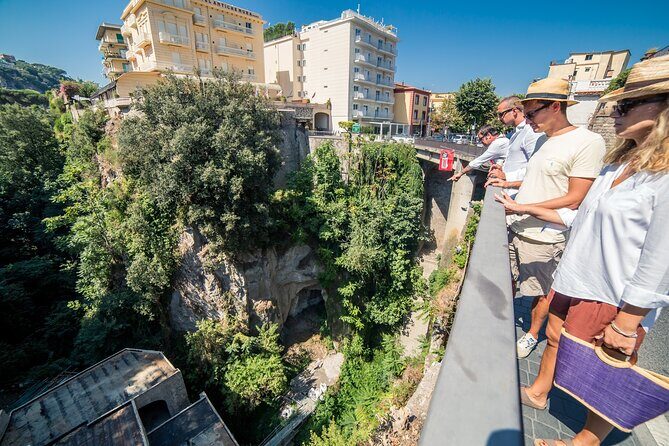
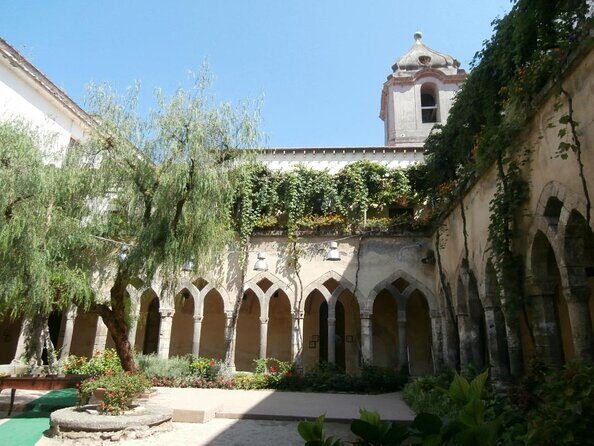
If you want a mental reset during your walk, this is where you get it. The Chiostro di San Francesco is a cloister area built on the remains of a 7th-century monastery, with dating around the 14th century. It sits steps away from the town’s central action, but once you’re inside, the mood changes fast.
What makes this stop special is the variety of architectural styles. The cloister brings together religious structures from different eras, with influences described as moving from pre-Roman through Arabic, then into medieval. You’re encouraged to look closely at details like the columns, each decorated differently.
And yes, you’ll want to pause for the pepper tree in the middle. It’s one of those small visual anchors that makes the cloister feel like a real place, not just a photo background.
This is also a practical break. Even a short stop in shade and calm helps you keep going with better energy for the final stretches.
Villa Comunale: palm gardens, sea air, and Vesuvius in view
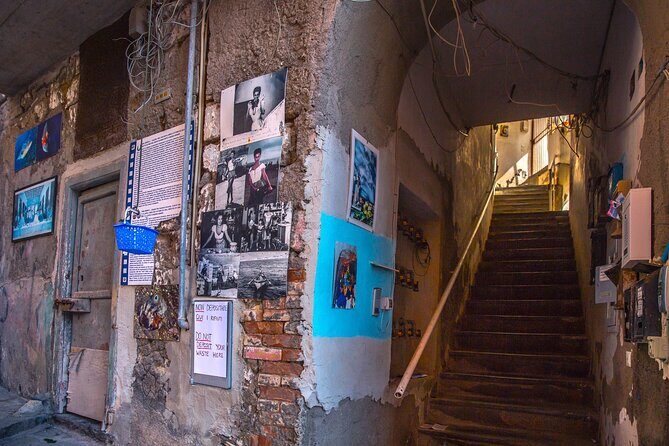
From the cloister, the walk shifts toward viewpoints. Villa Comunale di Sorrento sits on gardens connected to Franciscan friars. It’s the kind of stop where you can slow down, breathe, and let your eyes travel across the Gulf.
The gardens include palms, holm, oaks, and century-old pines. Most people come for the sea views, and that’s justified—you’ll likely be able to frame the Gulf with Vesuvius as the dramatic background.
This is a good point in the route to check how you’re doing. If you’re feeling okay, take time with photos and just enjoy the view. If you’re tiring, this is the moment to slow your pace and recover, because the last portion includes a more atmospheric harbor walk.
Marina Grande: the old-feeling fishing harbor finish
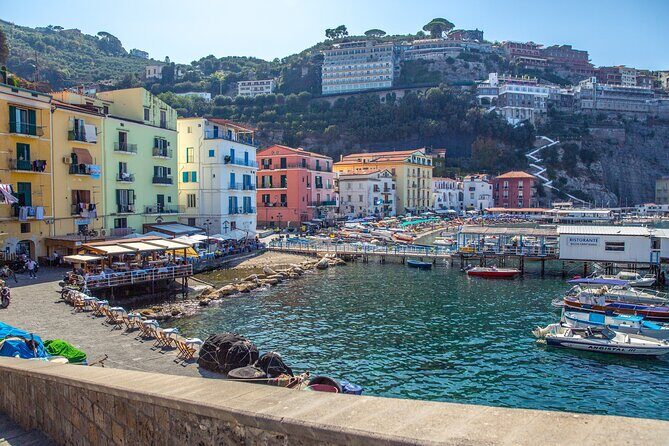
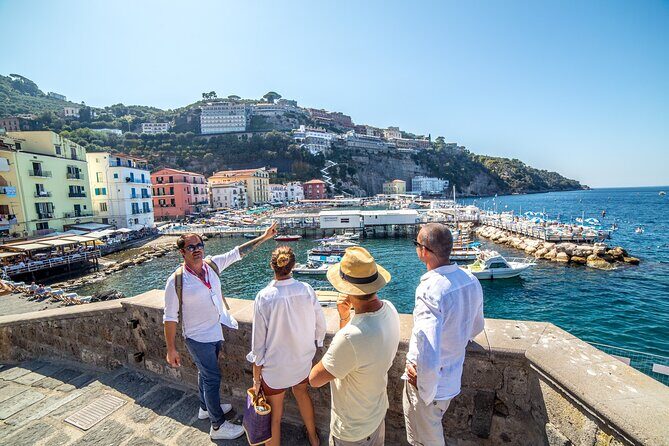
At the end, you reach Marina Grande, Sorrento’s more authentic and picturesque fishing village. The harbor is separated from the main town by a dramatic stone gateway built by the Greeks, and that small detail helps explain why the area feels older.
You’ll notice the visual rhythm right away: colorful wooden boats, pastel-colored houses, and nets drying in the sun. The guide frames Marina Grande as a place where family-run restaurants keep seafood traditions going, and where the area has also served as a filming location for the classic 1954 movie Scandal in Sorrento.
This ending works well because it gives you a contrast. You’ve spent time with churches, squares, and gardens—now you’re in the working harbor world. It’s the best kind of finale: less formal, more sensory, and easy to wander after the tour ends.
Craft and street food: lemon, wood inlay, and quick bites
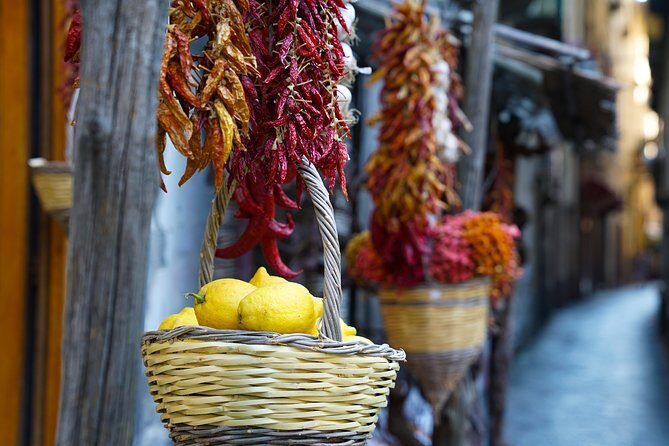
The tour includes time for traditional artisan crafts and a break for something refreshing. You’ll get a chance to discover wood inlay work, and the broader craft focus includes leather-sandal style artistry as part of the local handmade scene.
For the food portion, the tastings center on Sorrento’s lemon culture and simple local flavors. Expect sugar-coated lemon slices, salami and cheese, and deep-fried seafood. You’ll also have a refreshing break with orange or lemon juice, or a lemon gelato option.
I want to set expectations clearly: this is a tasting, not a full food tour. Several people in the tour feedback liked the food, but others felt the name sets the bar like a larger meal. My practical advice is to eat beforehand if you’re hungry for a lot of bites, especially since you’re also walking a lot.
If you do approach it as a snack-and-culture add-on, the tasting fits perfectly. It gives you something local to remember without derailing the walking route.
Pacing, steps, and getting the most out of the 3 hours
This tour is about highlights plus context, and it tends to move with intention. It’s roughly 3 hours, with short stops along the way and photo breaks built into the route.
Plan for steps and uneven pavement. Sorrento’s streets can be tricky, and the tour route includes stairs that can add up. If you’re traveling with mobility concerns, you’ll want to judge your comfort level carefully.
The good news: the route is organized into frequent “pause moments” where you can catch your breath—squares, church interiors, cloister shade, and the Villa Comunale viewpoint. It’s not one long grind without relief.
This is a strong first-day option. It helps you learn the town’s shape so the rest of your time feels easier and less like wandering with no plan.
Price and value: what $59 buys you in real time
At about $59.13 per person for around 3 hours, you’re paying for a guided route plus included tastings and refreshment. For that money, I like that you get both major sights and the softer stops that many self-guided walks skip—especially the cloister atmosphere and the mill valley stop.
Group size matters here. With a maximum of 15 travelers, you’re not stuck watching the guide from the back row the whole time. You’re more likely to hear details, ask quick questions, and keep up with the pace.
Also, the craft and tasting elements add value beyond photos. You’re not just looking at places; you’re learning how local hands and local ingredients fit into Sorrento’s daily story.
Should you book this Sorrento walking tour?
Book it if you want a solid first overview with guided context, plus a short taste of lemon-and-sea flavors and a glimpse of traditional craft. This is also a good match if you like guides who mix humor and local stories—different guides run the tour, and names like Danielo, Gabriela, Kelly, Roberta, Veronica, Sofia, Isabella, Giulia, Patrick, and Tonya have shown up in past groups.
Skip it or adjust your expectations if you want a big, meal-like food experience. Even when the tastings are fun, the tour focus is still more history, architecture, and viewpoints than a dedicated food crawl.
One last thought: if you go, go prepared. Bring comfortable shoes, and eat something light beforehand. You’ll enjoy the walks more, and the tastings will feel like a bonus instead of a consolation prize.
FAQ
How long is the Sorrento Walking Tour with a Local Guide?
It lasts about 3 hours.
What does the tour cost?
The price is $59.13 per person.
Where do I meet the guide?
You meet at Iamme Ia! – Gray Line Amalfi Coast Office near Piazza Torquato Tasso (Piazza Torquato Tasso, 16, 80067 Sorrento NA, Italy).
Is the tour offered in English?
Yes, it’s offered in English.
How large is the group?
The maximum group size is 15 travelers.
What stops and experiences are included?
You’ll visit sights like Piazza Tasso, Il Vallone dei Mulini, the Sorrento Cathedral, the Cloister of San Francesco, Villa Comunale, and Marina Grande. The tour also includes time for artisan craft (wood inlay) and a refreshment break with orange or lemon juice or lemon gelato, plus street food tastings.
Do I need to pay for admissions during the tour?
Most featured stops list free admission. Chiostro di San Francesco is noted as not included.
Is hotel pickup or drop-off included?
No. Hotel pickup and drop-off are not included.
Can I cancel for a full refund?
Yes. You can cancel up to 24 hours in advance for a full refund.
You Might Also Enjoy

More Walking Tours in Sorrento

More Tours in Sorrento






More Tour Reviews in Sorrento
- Sorrento Farm and Food Experience including Olive Oil, Limoncello, Wine tasting
★ 5.0 · 2,524 reviews