REVIEW · NAPLES
Herculaneum Small Group Tour and Ticket With an Archaeologist
Book on Viator →Operated by Askos Tours · Bookable on Viator
Buried streets have a way of grabbing you fast. This Herculaneum tour is interesting because you walk through the preserved town with an archaeologist at your side, using real site details to explain daily life. I especially like the small group size (max 20) and the archaeologist-led focus that turns stone and scorch marks into stories you can actually picture.
One thing to know upfront: you should expect a good bit of standing and moving. It’s a tight, 2-hour route, so if you’re hoping for long stops inside the museum areas after the tour, keep your schedule flexible.
In This Review
- Key things to know before you go
- Why Herculaneum feels different from Pompeii
- Price and value: what $53.81 buys you
- Getting to the meeting point near the Herculaneum Ticket Office
- Small-group format, headsets, and pacing
- Stop-by-stop: what you’ll see in Herculaneum
- House of the Deer: art in the peristyle
- La Terrazza di M. Nonio Balbo: the benefactor story
- College of the Augustales: imperial cult meets local leadership
- Casa del Rilievo di Telefo: a house with a story doorway
- Partem Domus lignea: the wooden partition you can still see
- House of the Skeleton: the 19th-century find with a quiet shock
- Central Thermae: men and women baths, separate entrances
- House of the Black Salon: carbonised doorway remains
- Casa Sannitica: Samnite style with an Ionic gallery
- Casa del Bel Cortile: courtyard stairs and a stone balcony
- House of the Grand Portal: a center-stage mansion
- Time after the tour: museum access and what to plan
- What guides add (and why this tour feels worth it)
- Weather, comfort, and who this tour fits best
- Should you book this Herculaneum archaeologist tour?
- FAQ
- How long is the Herculaneum small group tour with an archaeologist?
- What’s the maximum group size?
- Is the tour offered in English?
- What’s included in the tour price?
- Does this tour include skip-the-line tickets?
- Where do we meet the guide?
- If I need to cancel, can I get a refund?
- Does the tour operate in bad weather?
- Can I bring a dog?
Key things to know before you go
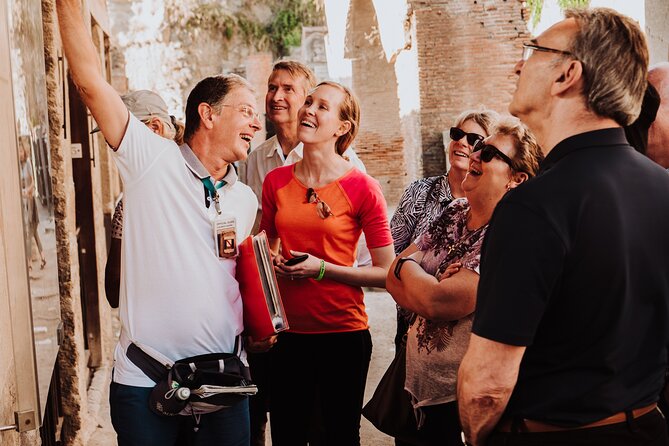
- Max 20-person group keeps the pace human and the questions practical
- Headsets help you hear clearly, even in a crowded ruin
- Skip-the-line entry reduces queue time so you start seeing faster
- Archaeologist narration connects architecture, daily routines, and the eruption
- Walking route through standout houses and baths gives you variety without overkill
Why Herculaneum feels different from Pompeii
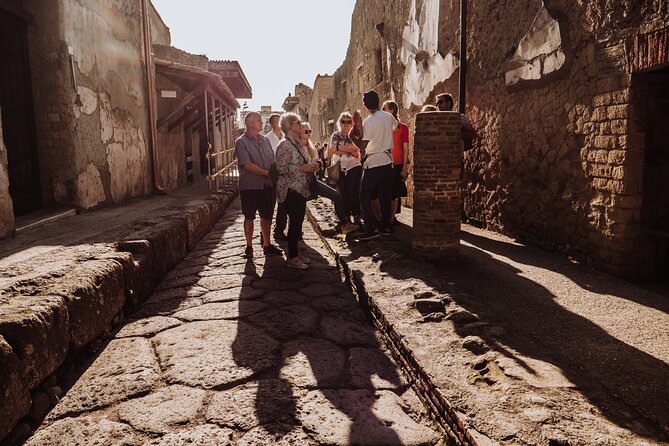
Herculaneum is the quieter cousin, but it’s also more intimate. Instead of broad streets and huge public monuments taking over the view, you get a steady stream of doors, rooms, courtyards, and bath spaces. That matters, because the town’s layout and domestic details help you understand how people actually lived: where they ate, how they moved through rooms, and how status showed up in design.
This is also a smart alternative if you’re doing Naples and the volcano story is already on your mind. You still get the dramatic end-of-world context, but the experience is more about what was saved—charred wood traces, carbonised doorposts, tiled floors, and spaces that feel “close” because they’re not rebuilt to be dramatic. You’re studying the real bones of the place.
You can also read our reviews of more tours and experiences in Naples.

Price and value: what $53.81 buys you
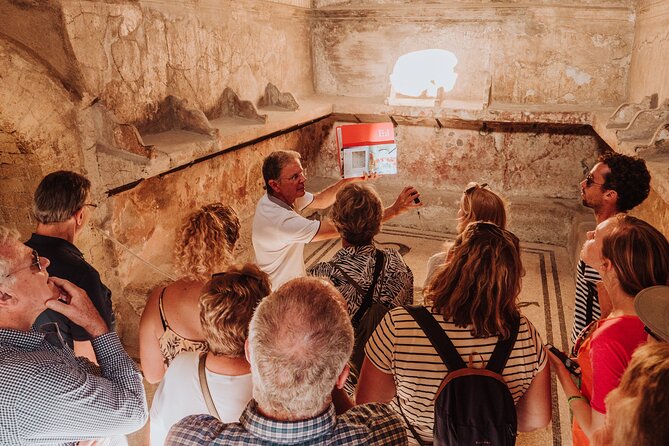
At about $53.81 per person, the big value is that the tour doesn’t treat the ruins like an add-on. It bundles the archaeologist guide plus entry tickets to Herculaneum, along with headsets so you stay connected to the guide’s explanations.
Here’s the practical math: the standard Herculaneum entry ticket listed for adults is 16 euros. Since this experience includes admission, you’re mostly paying for the guided portion, the small-group experience, and the convenience of skip-the-line access. For a 2-hour walk, that can be good value—especially if you care about understanding what you’re seeing, not just checking boxes.
The other value point is time. Skip-the-line entry means you’re not burning your visit standing in a queue while your ticket could be doing something more interesting.
Getting to the meeting point near the Herculaneum Ticket Office
The meeting point is the Ticket Office at the Herculaneum ruins. The exact start address is listed at Corso Resina 187, 80056 Ercolano (Ercolano), Naples.
If you’re driving, there’s parking nearby on via Pignalver. It’s not guarded, so treat it like you would any casual parking area: don’t leave valuables in the car.
If you’re coming by train, the nearest stop is Circumvesuviana, at Corso Resina 1. Plan on a roughly 10-minute walk from the station to the meeting point. This matters because Herculaneum tours are time-based—show up with enough margin to handle the last bit of walking and any ticket exchange.
Small-group format, headsets, and pacing
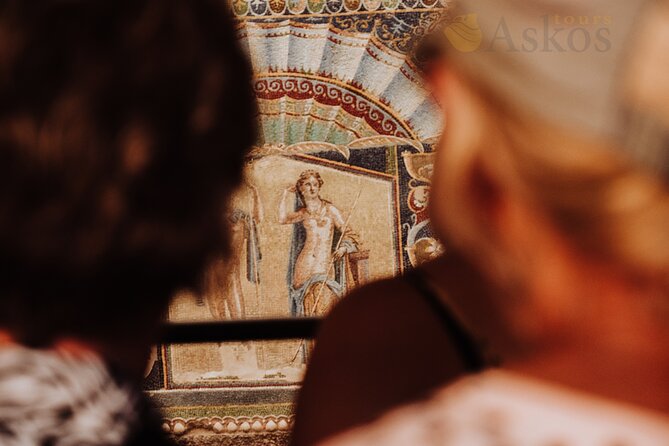
This tour is capped at 20 people, which is the difference between hearing the guide and playing the guessing game. You’ll also use headsets, so you can follow explanations even when the group shifts positions.
A lot of the best moments in Herculaneum come from noticing tiny features: how a doorway is preserved, why a room layout looks unusual, or what a building’s purpose might have been. A headset system helps you keep up as the guide moves you from one house or bath space to the next.
Pacing is part strength and part trade-off. Many visitors love the fact that you cover multiple highlights in 2 hours. The trade-off is that it’s not a slow wander. You’ll spend time looking, but you won’t have long “linger on one mosaic and do the math” sessions.
If you’re the type who likes a more self-directed visit, the guided pace can feel like pressure. If you’d rather hear the “why” behind what you see, this format is much easier to love.
Stop-by-stop: what you’ll see in Herculaneum
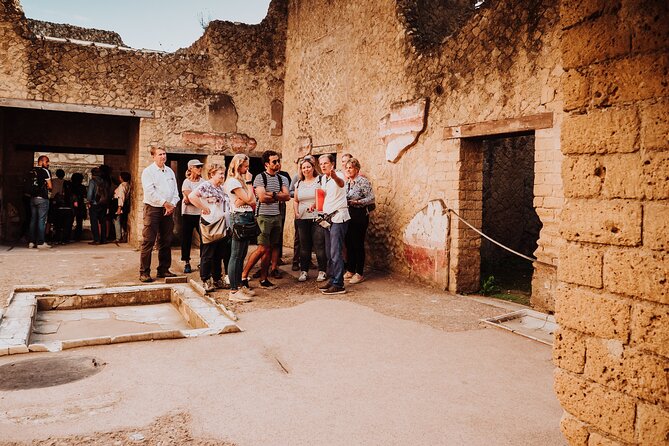
The route is a walking tour through a set of major houses and bath buildings. Each stop is brief, but the variety is the point: you get religious and civic spaces, multiple domestic styles, and major bathing areas.


House of the Deer: art in the peristyle
You’ll begin at the House of the Deer, named for marble statues of stags/deer found in the peristyle. This is a good “starter stop” because it shows how decorative pieces reinforced status and identity inside everyday spaces.
Watch how the peristyle concept ties into movement and social space. Even without full reconstruction, the room layout helps you understand how people hosted visitors and used interior courtyards as a kind of stage.
La Terrazza di M. Nonio Balbo: the benefactor story
Next is La Terrazza di M. Nonio Balbo, tied to city benefactor M. Nonius Balbus. A long inscription on his funeral altar records honors and details, and this stop is where you start to connect buildings to real names and real power.
If you like context, this is where it clicks: Herculaneum isn’t just houses. It’s also civic life and public patronage, even when the public spaces feel smaller than in bigger Roman cities.
College of the Augustales: imperial cult meets local leadership
The College of the Augustales is next. The building is thought to have connected to the cult of Emperor Augustus and possibly served as a local headquarters tied to Augustus-era civic identity.
This stop gives you a more organized view of how religion and politics braided together in daily life. You also learn how archaeologists interpret buildings with incomplete evidence: the goal isn’t one “perfect answer,” it’s best-fit reasoning from layout and remnants.
Casa del Rilievo di Telefo: a house with a story doorway
At Casa del Rilievo di Telefo, you’re looking at a home that may have belonged to a leading benefactor such as Marcus Nonius Balbus. What stands out here is the presence of a private connection to other areas (not just a random room arrangement), which suggests this house wasn’t designed for average residents.
Even if the exact ownership is debated, the layout and its relationship to adjacent spaces help you picture how elite households could control access and flow.
Partem Domus lignea: the wooden partition you can still see
One of the most memorable stops is Partem Domus lignea – Casa del Tramezzo di Legno, noted for the elegant wooden partition that remained.
This is the stop that changes how you see Herculaneum. In many ancient sites, “organic” materials like wood vanish. Here, wood traces matter, so your understanding shifts from only stone and masonry to a fuller picture of how rooms functioned.
If you like building details—thresholds, partitions, and how people separated spaces—this will feel like a highlight for the rest of your visit.
House of the Skeleton: the 19th-century find with a quiet shock
At the House of the Skeleton, the name comes from human remains found in a second-floor room in 1831. This stop has a different emotional tone than the “pretty houses” moments, because it turns disaster into a physical, human story.
You don’t linger long here, but the stop is important. It reminds you the town wasn’t just preserved as art—it was a real place with real people who had futures that ended abruptly.
Central Thermae: men and women baths, separate entrances
Then you step into bathing life at the Central Thermae, built around the beginning of the 1st century AD. The baths were divided, as was common practice, into men’s and women’s baths, each with separate entrances.
This matters because it shows how routine and rules shaped everyday behavior. Bathing wasn’t just hygiene; it was a social pattern with boundaries. A guided visit helps you see those boundaries in the architecture, not just in theory.
House of the Black Salon: carbonised doorway remains
The House of the Black Salon is one of the more luxurious mansions, and the details are striking. The house has a monumental entrance with carbonised remains of the doorposts and lintel.
That preserved threshold is the kind of thing you’ll never get from a flat photo. In person, it connects you directly to the exact moment of destruction—without needing dramatic explanations.
Casa Sannitica: Samnite style with an Ionic gallery
At Casa Sannitica, you’ll see a layout linked to typical Samnite arrangements. The spacious atrium is bordered by a gallery with Ionic columns, and the rooms had frescoes.
This is a good stop for architecture lovers. Even with missing paint or worn surfaces, you can still “read” the space: the atrium as a hub, the gallery as a framing element, and the column work as visual signaling.
Casa del Bel Cortile: courtyard stairs and a stone balcony
Then comes Casa del Bel Cortile, described as one of the more original houses. Instead of a classic atrium layout, it has a courtyard with a stairway and a stone balcony.
This is where the tour’s variety really pays off. You’re not just seeing one type of rich home over and over—you’re comparing styles and watching how families arranged space for light, movement, and daily routines.
House of the Grand Portal: a center-stage mansion
The final stop in the sequence is House of the Grand Portal, a mansion in the central archaeological area with multiple environments, collonnati, frescoes, and evidence of charred wooden parts.
This is the kind of end point that leaves you with a full sense of scale. You see how the public-facing entrance worked, and you get one more reminder that wood and stone survived differently—so the mansion tells multiple stories at once.
Time after the tour: museum access and what to plan
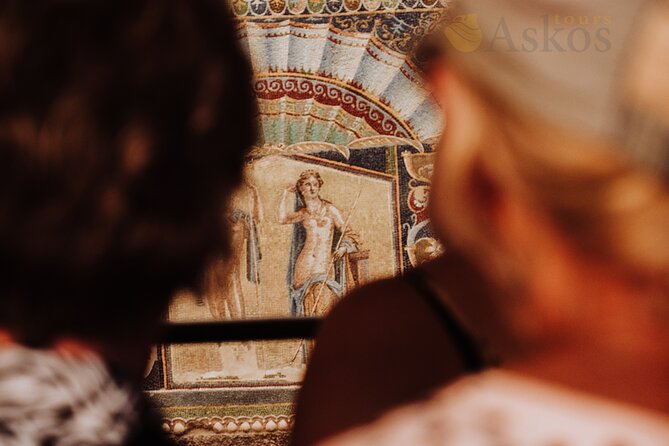
The entry ticket is part of what makes this experience feel efficient. Your ticket includes the on-site museum areas connected to the complex, so you can use your remaining time to look at recovered items such as furniture and jewelry.
The catch: the tour itself is structured and fast-moving, so if you’ve got a train to catch or a tight schedule, keep an eye on your timing. A short buffer after the walk is a smart move.
If you love to see objects next to the spaces they came from, plan to spend at least some time in the museum portion right after. That pairing helps the houses make more sense.
What guides add (and why this tour feels worth it)
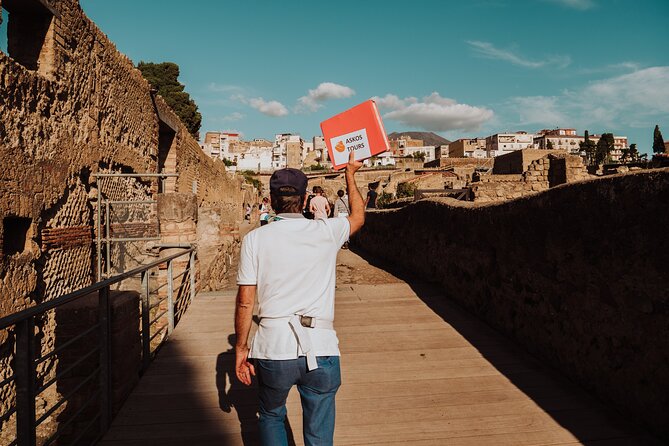
The archaeologist guide is the heart of the experience, and the best versions of this tour don’t just list facts. Guides explain how buildings work, why certain features exist, and how archaeologists interpret what they find.
For example, guides in this archaeologist role—like Michele/Michael, Luciano, and Julia—are known for connecting engineering and cultural context, or for presenting the site with steady clarity and strong English. Names you might hear include Paulo, Gennaro, Antonella, Diego, Marie, and Sergio.
The practical benefit is that you start noticing things on your own. After a strong guide-led walk, you’ll look at a doorway, see the preserved threshold, and immediately understand what questions to ask: who used this entrance, what did it lead to, and what does that placement suggest about everyday routines.
Some guides also use visual reconstructions—so you can picture how the wooden parts, rooms, and entrance features may have looked before the eruption. That kind of mental reset is what makes the ruins feel like living architecture instead of only stone fragments.
Weather, comfort, and who this tour fits best
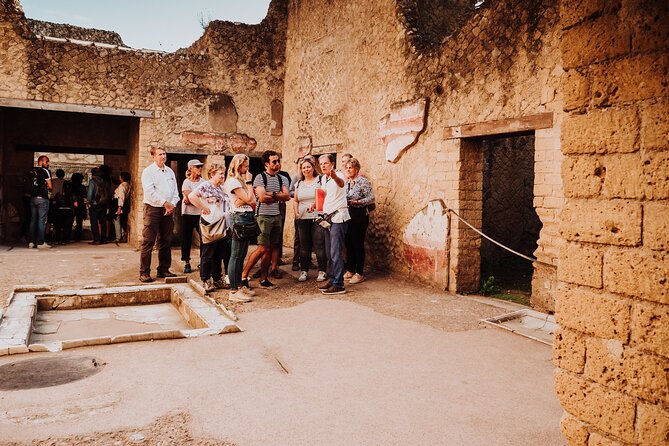
This tour runs in all weather conditions. That’s good news because it means you aren’t forced to gamble on sunny skies. Bring rain protection if rain is possible and wear shoes with decent grip.
You should also plan for time on your feet. Even though each stop is brief, the overall experience is a walking loop with standing to see details. If you need frequent seating breaks, you may find it harder than a slower museum-only plan.
This tour suits you if:
- You want an archaeologist-led explanation rather than an audio-only pass
- You like comparing multiple houses and public/bath spaces in a short window
- You’re visiting from Naples or doing a compact volcano day and want maximum learning per hour
Should you book this Herculaneum archaeologist tour?
I’d book this if you want the fastest path to understanding Herculaneum’s “how it worked” details. The combination of small group size, headsets, and skip-the-line entry is practical, and the stop list hits both daily life and standout architectural moments.
Skip it if you’re chasing a slow, self-paced stroll where you can spend long minutes on a single room without anyone guiding your route. Also consider another option if your main goal is museum time first and ruins second, because this experience is structured to cover a set number of sites in about 2 hours.
If your schedule allows it, booking ahead is wise. The tour is commonly booked about 42 days in advance, so your best chance at a convenient slot is to reserve early.
FAQ
How long is the Herculaneum small group tour with an archaeologist?
It’s approximately 2 hours.
What’s the maximum group size?
The group is capped at a maximum of 20 travelers per guide.
Is the tour offered in English?
Yes, it’s offered in English.
What’s included in the tour price?
The experience includes guidance, assistance, entrance fee to Herculaneum, a small group format, a licensed guide with an archaeological background, and headsets.
Does this tour include skip-the-line tickets?
Yes, you get skip-the-line entry.
Where do we meet the guide?
You meet at the Ticket Office of the Herculaneum ruins. The start address is listed as Corso Resina 187, 80056 Ercolano NA, Italy.
If I need to cancel, can I get a refund?
Free cancellation is available up to 24 hours in advance for a full refund.
Does the tour operate in bad weather?
Yes, it operates in all weather conditions. You’ll want to dress appropriately.
Can I bring a dog?
Dogs are allowed at the Herculaneum Archaeological Park with leash or muzzle requirements and you must bring bags for droppings. Inside certain areas like the Antiquarium premises, the Boat Pavilion, and domus with mosaic floors, dogs are allowed only if carried in arms or transported in an appropriate carrier.
If you tell me your travel month and whether you’re pairing this with Pompeii, I can help you map a smart order and timing.