REVIEW · NAPLES
Herculaneum Private Tour with an Archaeologist
Book on Viator →Operated by Askos Tours · Bookable on Viator
Herculaneum feels like a time capsule. This private, archaeologist-led walk through one of Italy’s best-preserved Roman seaside towns is built around short, focused stops inside the ruins. You get the comfort of your own group while a guide helps you notice what most people miss.
I really like two things about this tour: the house-by-house structure and the way it keeps you moving at a comfortable pace (about 10 minutes per stop). And it’s family friendly, so it works if you’re mixing adults with kids who still want to look at real places, not just stories.
The main drawback to consider is time. Two hours is tight for a site this detailed, and you won’t have long stretches to wander alone. Also, the tour price does not include the Herculaneum entrance ticket, so you’ll add that cost to your total.
In This Review
- Key highlights to look for
- Herculaneum with a private archaeologist: what you’re really paying for
- Finding the tour meeting point outside the red ticket office
- The best kind of 2-hour plan: short stops, big context
- College of the Augustales: a social world behind the facade
- House of the Skeleton: the art of shock in everyday Roman life
- Casa del Rilievo di Telefo: art as storytelling
- Wooden Partition and the M. Nonio Balbo Terrace: rooms with a purpose
- House of the Black Salon and Samnitic House: status, style, and identity
- Central Thermae plus courtyard and portals: public life meets street life
- House of the Deer: finishing with a detail that sticks
- Price and value: €16 ticket plus a private guide’s brain
- What kind of traveler this tour suits best
- Should you book this Herculaneum private tour?
- FAQ
- Does the tour include the Herculaneum entrance ticket?
- What’s included in the private tour price?
- How long is the Herculaneum private tour?
- Where do we meet the guide?
- Is the tour in English?
- Is transportation provided?
- Are there food and drinks during the tour?
- Is there luggage storage at the meeting point?
- Is this tour really private?
- What if plans change? Is free cancellation available?
Key highlights to look for
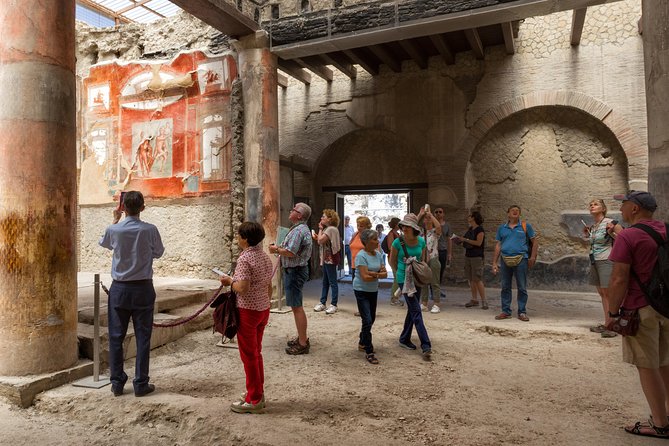
- Private archaeologist guidance: You’re not scanning plaques alone.
- 10-minute stop pacing: Enough time to see details without dragging.
- Standout Roman spaces: Houses, baths, terraces, and everyday corners.
- Guides named in the guide pool: People often mention Mena, Lucio, Michele Lamberti, Sara, Daniela, and Antonella for strong explanations.
- You stay inside one loop: The stops are arranged like a walkable route through the key areas.
Herculaneum with a private archaeologist: what you’re really paying for
If you’ve visited Pompeii, you know how easy it is to feel overwhelmed. Herculaneum is different. The town was buried under volcanic material, and much of it stayed put—so you get a clearer read on daily life: how people cooked, where they socialized, what visitors saw at the front, and how rooms were laid out.
This tour is built for comprehension, not just sightseeing. A guide doesn’t just tell you what something is. They help you connect the dots: why a particular room matters, what social status looked like in a doorway, and how the town’s public areas fit into ordinary routines. That’s why a private format tends to be worth it here. You can ask quick questions and get straight answers without waiting for a crowd.
One more practical point: the guide format can make a huge difference. Some people specifically called out an archaeologist guide—others noted a mismatch between the advertised title and the guide’s credentials. So if you care a lot about the archaeologist label, it’s smart to confirm the guide’s specialty when you book.
You can also read our reviews of more tours and experiences in Naples.

Finding the tour meeting point outside the red ticket office
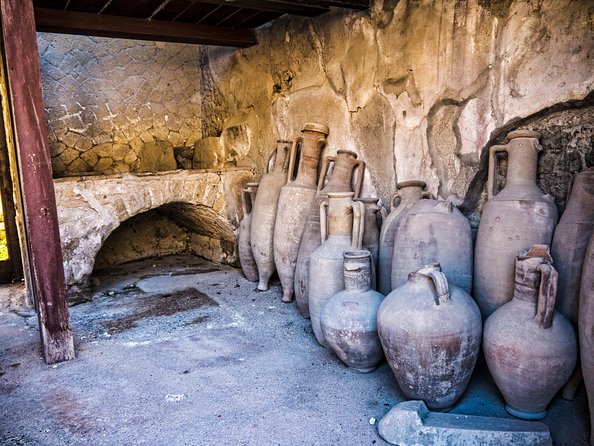
Meet your guide at Via dei Papiri Ercolanesi, 80056 Ercolano NA, Italy, outside the archaeological site’s ticket office, described as a red building. The tour ends back at the same meeting point, so you don’t have to figure out a second pickup.
This matters more than you might think. Herculaneum site entrances can be confusing if you’re arriving on your own. Going with a planned meeting point reduces stress, especially if you’re trying to time your visit to avoid peak heat. A lot of people book these tours in advance, and the typical booking window here averages around 45 days, so plan ahead if you want a specific time slot.
Good news: the meeting point includes a free luggage store, which is a big help if you’re traveling light but still need somewhere secure for bags.
The best kind of 2-hour plan: short stops, big context
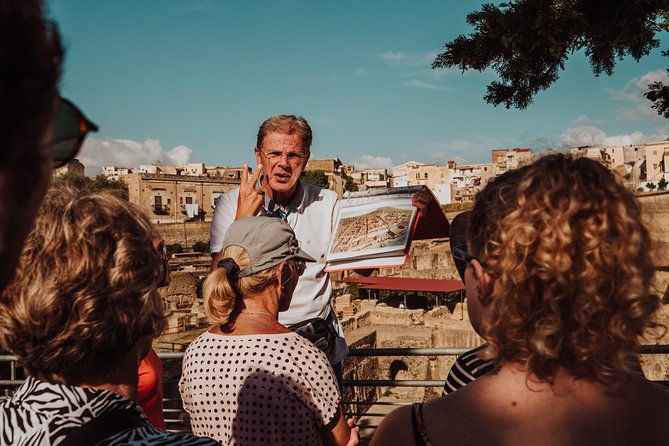
At about 2 hours total, you’ll move through 11 major highlights, with roughly 10 minutes per stop. That’s a thoughtful pace for Herculaneum, where every corner can feel meaningful once someone points out what to look for.
The secret is what the stops are. They’re not random. You get a mix of:
- public-facing spaces (where people gather or show status),
- private homes (where you see living patterns),
- and the town’s practical infrastructure (like baths).
If you like tours where you leave with a mental map—rather than a pile of photos—this format fits.
College of the Augustales: a social world behind the facade
Your first stop is the College of the Augustales. This is one of those places where the architecture alone can look “important,” but a guide helps you understand why it mattered. The college concept is tied to organization and status in Roman public life. Even in a short visit, the guide can frame what you’re looking at: who would have been connected to it, and how religious or civic identity often worked in Roman towns.
What you should do here: slow down for doorway details and any areas that look like meeting or ceremonial space. This is where your understanding starts to build. When the guide explains the function, the building reads less like a wall and more like a living institution.
Potential drawback: because the stop is short, you won’t get deep time to sit and read. If you love museum-style explanation, you’ll want to follow up after the tour by reading on-site signs or visiting a nearby museum.
House of the Skeleton: the art of shock in everyday Roman life
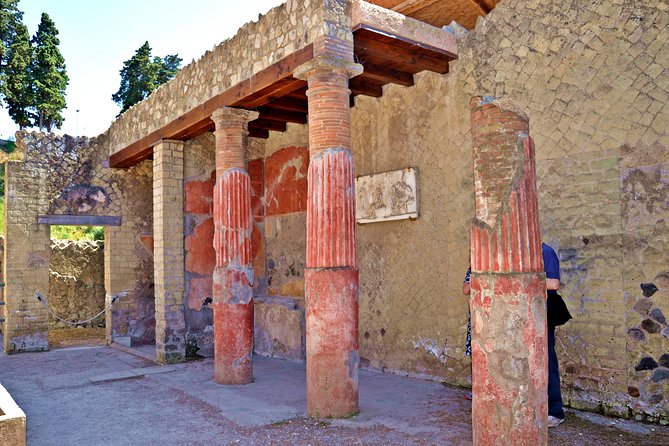
Next up is the House of the Skeleton. The name alone grabs attention, but the real value is context. Roman homes weren’t always quiet and solemn. They could be theatrical, surprising, and designed to leave an impression on visitors.
A strong guide usually uses this stop to teach a pattern: how decorative choices, display spaces, and interior themes often reflect social tastes. You also learn to separate the eye-catching feature from the practical layout of the home—so you don’t just remember one creepy image.
Tip: look for how people would have moved through the space. A guide can often point out the logic of access: where you’d enter, where you’d turn, and what rooms were meant for public viewing versus private living.


Casa del Rilievo di Telefo: art as storytelling
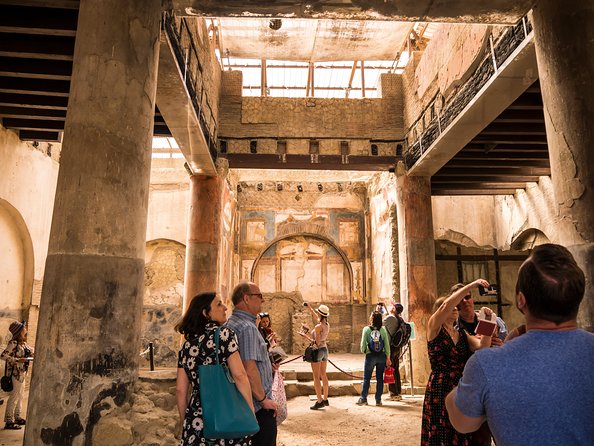
You’ll then visit the House of the Relief of Telephus. This is one of those moments where Roman art works like a narrative panel. The relief ties to myth and storytelling, but the guide’s job is to show you how that art functioned in real domestic life.
In a short stop, you’ll likely get:
- what the scene represents in simple terms,
- why artwork showed up in specific places,
- and what themes were popular enough to commission or display.
Why it’s worth your time: it’s easy to treat ruins like architecture only. This stop brings human culture back in—belief, taste, and the kinds of stories that traveled through Roman society.
Wooden Partition and the M. Nonio Balbo Terrace: rooms with a purpose
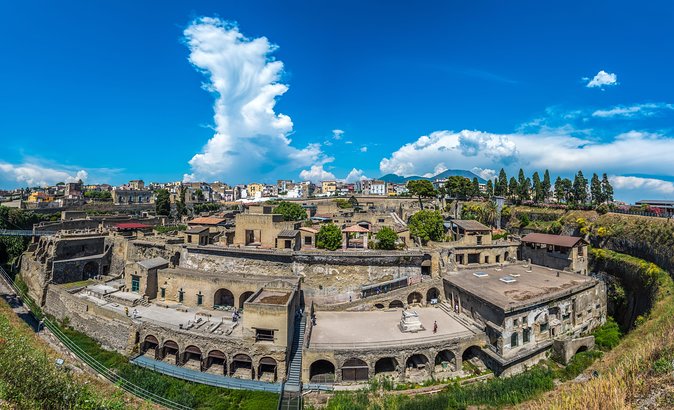
Two stops in a row focus on how space worked day to day.
- Partem Domus lignea – Casa del Tramezzo di Legno (the House of the Wooden Partition) helps you understand the internal layout. Roman homes used partitions to shape privacy, airflow, and how rooms were used.
- La Terrazza di M. Nonio Balbo takes you to a terrace perspective. Terraces are where you feel the town’s geography and the way people used outdoor space as part of daily routines.
Even in just 10 minutes, a good guide makes this real: not just where things were, but what they were for. If you’re traveling with kids, terraces often get a quick win. They’re easier to visualize than an explanation-only stop.
Small consideration: because each stop is brief, you should decide early what you want to photograph. Pick one “detail shot” per stop. That keeps you engaged without falling behind the group.
House of the Black Salon and Samnitic House: status, style, and identity
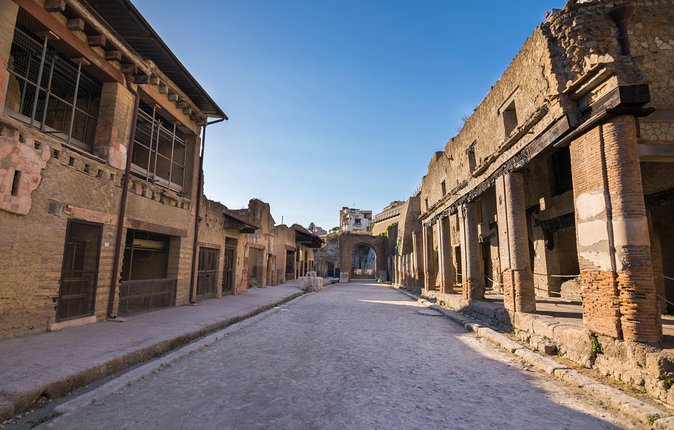
Then you’ll see the House of the Black Salon, which draws you in with the idea of an interior mood—darker, more dramatic, and designed to make an impression. Again, your guide’s role matters here. They can connect the visual style to social behavior: how a home communicated taste, and how visitors would have experienced rooms.
After that comes Casa Sannitica (the Samnitic House). This is an important reminder: Roman cities weren’t built in a vacuum. Regional identity and cultural mixing show up in domestic choices. A guide helps you understand what that mix might mean in practical terms—how residents lived, and how the town shaped identity over time.
What I’d watch for: front-of-house cues. Places like these often show how status played out at entrances, transitions, and the public view within homes.
Central Thermae plus courtyard and portals: public life meets street life
At Central Thermae, you switch from homes to the town’s public rhythm. Baths in Roman life were not just about washing. They were social hubs, part conversation space, part relaxation spot, and a way people stayed connected.
If you want one “aha” moment from a guide, it’s usually here: how the layout supported different activities and how public space shaped community.
Then you visit:
- Casa del Bel Cortile (the House of the Fine Courtyard), and
- House of the Grand Portal (a space defined by entrance impact).
A good guide uses these to show you the language of Roman architecture: how a courtyard cools the pace of a home, how portals signal importance, and how the street-to-interior transition works psychologically for visitors.
Practical note: courtyards and portals are great for photos, but don’t spend so long shooting that you miss what the guide explains about movement and function.
House of the Deer: finishing with a detail that sticks
You end with House of the Deer. This kind of stop is the perfect closer because it leaves you with something memorable and specific. A guide often uses it as a “wrap” point—tying the decorative or thematic feature back to what you learned about homes and daily life.
At the end of the two hours, you should feel like you can mentally walk through the town in a simple way: public spaces, then homes, then the rhythm of everyday life.
Price and value: €16 ticket plus a private guide’s brain
The tour price is $178.38 per person for a private experience with guidance by an archaeologist guide (in English). That’s not cheap, but it’s also not priced like a generic walk.
Here’s the value math:
- You’re paying for interpretation—how the site turns into a story you can actually understand.
- You’re also paying for time efficiency. Herculaneum is smaller than Pompeii, but it still takes focus to read the space correctly.
- You’re not paying for entrance tickets inside the offer.
Budget for the site entry ticket separately: 16 euros for adults, and 2 euros for EU citizens age 18–25. Since the tour includes multiple interior stops, the entrance ticket covers the broader experience, while the guide helps you get far more out of each space you pass.
One more value detail: the tour notes group discounts. If you’re traveling with friends or family who want the same time slot, that can make the per-person cost feel more reasonable.
What kind of traveler this tour suits best
This works especially well if you:
- want a private Herculaneum visit rather than a group shuffle,
- enjoy ruins with clear explanations of everyday life,
- are traveling with kids who can handle a short, structured visit,
- and you want to compare Roman domestic and public spaces in one outing.
It may be less ideal if you want to linger and wander for longer stretches. The stop-based format is tight. Also, if you’re the type who likes lots of museum reading time or a slow, self-guided photo tour, you might find the pace a bit structured.
If you get a guide like Mena, Lucio, Michele Lamberti, Sara, Daniela, Jasmine, or Antonella (names that have come up strongly), aim to ask at least one question per stop. That’s how you get the full payoff from a private guide.
Should you book this Herculaneum private tour?
Yes, I’d book it if you care about understanding what you’re seeing. The stop-by-stop format plus a private archaeologist guide is a strong match for Herculaneum, where the details are worth “translating” into real life.
If cost is your main concern, price it against how much you’ll actually learn. A self-guided visit can show you ruins. This tour helps you see why they were arranged the way they were, and what Roman life likely felt like in those rooms and baths.
And one final check before you pay: if the archaeologist credential matters to you, confirm that the guide assigned is the one holding that specialty label.
FAQ
Does the tour include the Herculaneum entrance ticket?
No. The tour guidance is included, but you’ll need to buy the Herculaneum entry ticket separately. The adult ticket is listed as 16 euros, and EU citizens ages 18–25 pay 2 euros.
What’s included in the private tour price?
The included items are guidance and assistance by an archaeologist guide, plus the fact that it’s private (only your group participates).
How long is the Herculaneum private tour?
The duration is about 2 hours.
Where do we meet the guide?
You meet outside the archaeological site ticket office, described as a red building, at Via dei Papiri Ercolanesi, 80056 Ercolano NA, Italy.
Is the tour in English?
Yes, it’s offered in English.
Is transportation provided?
No transportation is included.
Are there food and drinks during the tour?
No food and drinks are included.
Is there luggage storage at the meeting point?
Yes. The meeting point has a luggage store for free.
Is this tour really private?
Yes. It’s a private tour/activity, and only your group participates.
What if plans change? Is free cancellation available?
Yes. You can cancel up to 24 hours in advance for a full refund. If you cancel less than 24 hours before the start time, the amount paid is not refunded.