REVIEW · SORRENTO
Private Pompeii & Herculaneum Tour from Sorrento
Book on Viator →Operated by IAMME IA! - Gray Line Amalfi Coast · Bookable on Viator
Pompeii and Herculaneum in a single day sounds intense. The trick here is the private transport and skip-the-line tickets, so you spend hours looking at ruins instead of queueing. You also get a real guided flow across both sites, not just a drop-off and a map.
I especially like the way the tour targets Roman daily life, from the city’s public center to bathing culture and neighborhood streets. I also like that Pompeii gets a focused 2-hour guided pass, then Herculaneum gets another 2-hour guided visit plus time to wander, so you can reset your brain halfway through.
The main consideration is price. At $769.43 per person, it only feels like a slam dunk if you value convenience, a guide, and not wasting time getting in and out of the archaeological parks.
In This Review
- Key things to know before you go
- Private pickup from Sorrento: the day starts with momentum
- Pompeii with a guided plan: Forum to the everyday street
- The Forum stops: where politics, business, and worship mixed
- Markets and meeting spaces: how money moved
- Via dell’Abbondanza: the street you can almost walk back into time
- The Stabian Baths: public wellness as social life
- Private homes and public entertainment: two sides of the same city
- The Lupanar: what people talked about behind the scenes
- Quick look at a deeper city core
- Lunch break between sites: protect your energy
- Herculaneum: better preserved and easier to wrap your head around
- Casa dei Cervi and residential details you won’t get from quick photos
- College of the Augustales: religion as organization
- House of the Skeleton: a sobering stop
- Central Thermae: public baths again, but with different scale and feel
- Partem Domus Lignea and the wooden door detail
- Salone della Barca di Ercolano: the recovered boat story
- Price and value: is $769.43 per person worth it?
- Who should book this Pompeii and Herculaneum day?
- Small tips that make a big difference
- Should you book it?
- FAQ
- How long is the Private Pompeii & Herculaneum Tour from Sorrento?
- Where does pickup happen in Sorrento?
- Are admission tickets included?
- Is lunch included?
- Is this tour private or shared?
- What language is the tour offered in?
- Will there be time to explore on your own?
- What time will I return to Sorrento?
- What’s the cancellation policy?
Key things to know before you go
- Private pickup from central Sorrento means less hassle than coordinating buses and trains.
- Skip-the-line entry helps you keep your day on schedule at both sites.
- Two guided blocks (about 2 hours each) cover Pompeii and Herculaneum without turning it into a blur.
- Roman daily life highlights include the Forum, markets, baths, and household spaces.
- You get breathing room for lunch and for independent exploring at Herculaneum.
- Private group format keeps the pace focused on your group’s questions.
Private pickup from Sorrento: the day starts with momentum
The tour kicks off with pickup from your hotel or a central Sorrento location at the agreed time. You’ll meet the vehicle around Piazza Torquato Tasso, 16 and head inland to Pompeii first. This matters more than it sounds. Pompeii and Herculaneum are big, and your time disappears fast if you’re traveling like a crowd.
By keeping it private and air-conditioned, you also dodge a common problem: arriving tired, late, and immediately sprinting through entrances. Here, you’re guided into Pompeii with a plan, and the day stays structured. Expect to be back in Sorrento around 4pm to 5pm, which gives you a full evening for dinner afterward.
This tour is offered in English, and it’s designed for groups that want a guide plus the comfort of controlled logistics. If you like your travel days with a clear route and fewer decisions, this format fits.
You can also read our reviews of more private tours in Sorrento



Pompeii with a guided plan: Forum to the everyday street
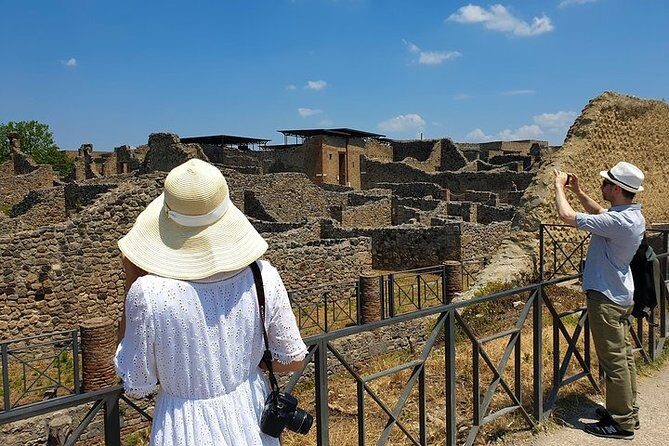
Pompeii is the headline site for a reason. When it was uncovered, the ruins were startlingly well preserved because the city was buried under volcanic ash and pumice after the eruption of Mount Vesuvius in AD 79. The scale can overwhelm you if you walk unguided. With a guide, you start connecting buildings to how people actually lived and worked.
Your Pompeii portion is a 2-hour private guided tour inside the Archaeological Park. That’s the sweet spot: long enough to understand the layout, short enough to avoid fatigue before Herculaneum. You’ll also have your admission ticket included, and the tour includes skip-the-line entrance, so you’re less likely to lose time at the ticket gates.
The Forum stops: where politics, business, and worship mixed
You start in the thick of civic life. One early stop is the Forum (Foro di Pompeya), the city’s main hub. It’s described as the focal point for public buildings tied to administration, justice, business, and trade, plus areas for worship. In other words, this wasn’t just a square where people walked through. It was the engine room.
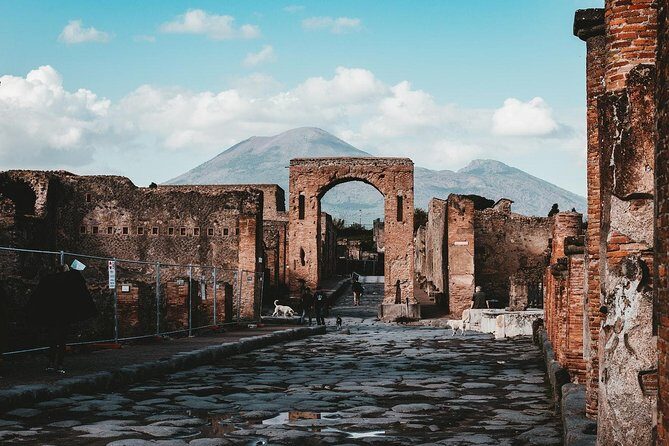
From there, you see the Temple of Jupiter (Tempio di Giove Capitolino). The temple dominates the north side of the Forum, with Mount Vesuvius rising behind it. It also connects Pompeii to the wider Roman world: when the colony was founded in 80 BC, the temple underwent major renovation and became a form of a Capitolium, with cult statues of Jupiter, Juno, and Minerva. Standing there gives you a strong sense of how Roman religion was staged into everyday movement.
You’ll also pass through the Basilica, another major Forum building. It was an oversized structure used for business and justice—so it’s a reminder that Roman “daily life” included formal systems, not just entertainment and street food.
Markets and meeting spaces: how money moved
Next up is the Macellum, the market complex. The Macellum is described as a tuff quadriporticus with an elevated worship area on the eastern side, plus rooms tied to meetings and a counter area that may have been used for selling fish. Even in ruins, you can picture the rhythm: shoppers, vendors, and civic-religious signals all in one zone.
If you’ve ever wondered whether Pompeii was a real city or just a museum, the market stops answer that. It feels like a place where the city’s social life happened as much as the economy did.
Via dell’Abbondanza: the street you can almost walk back into time
Then you move to Via dell’Abbondanza, Pompeii’s main commercial artery. This is the stretch that helps you see how a city works when it’s awake. The road runs from the Forum to the Sarno Gate, and it’s lined with shops and workshops. You’ll notice raised stepping stones and traces of graffiti—details that help the street feel lived-in rather than staged.
A quick practical point: this section is walking-heavy. In the summer, it can get hot, so do yourself a favor and wear comfortable shoes. The tour operator specifically suggests sunscreen for a reason.
- Sorrento Farm and Food Experience including Olive Oil, Limoncello, Wine tasting
★ 5.0 · 2,524 reviews





The Stabian Baths: public wellness as social life
One of the best Roman “daily life” anchors in Pompeii is the Stabian Baths (Terme Stabiane). This bathing complex is noted as the oldest and largest in Pompeii, with Roman engineering like the hypocaust underfloor heating. You’ll also see features tied to both social and wellness culture—an open-air gymnasium (palaestra), stucco decorations, and a large pool.
The payoff is how you start understanding Roman routine. Baths weren’t only for cleanliness. They were community spaces. Seeing the bath layout in one visit helps you stop thinking of Rome as abstract power and start seeing it as an everyday schedule.
Private homes and public entertainment: two sides of the same city
Pompeii isn’t only streets and public buildings. The tour also includes quick visits to residential and entertainment sites that broaden the picture.
You’ll visit the House of the Faun (Casa del Fauno), one of the largest aristocratic residences, with construction dating to the 2nd century BC. Its scale and art treasures make it feel like a wealth marker, not just a home.
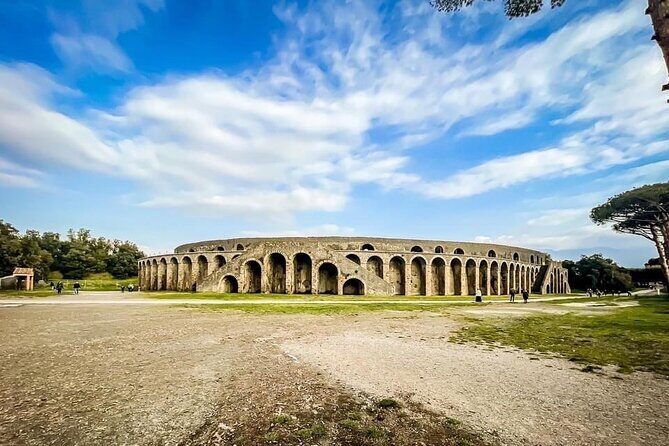
You’ll also see the Teatro Grande, a horseshoe-shaped theater built into a hillside. It’s dated to the 2nd century BC and held roughly 5,000 spectators. This stop is a good reminder that public entertainment was central to Roman civic life, not a side note.
The Lupanar: what people talked about behind the scenes
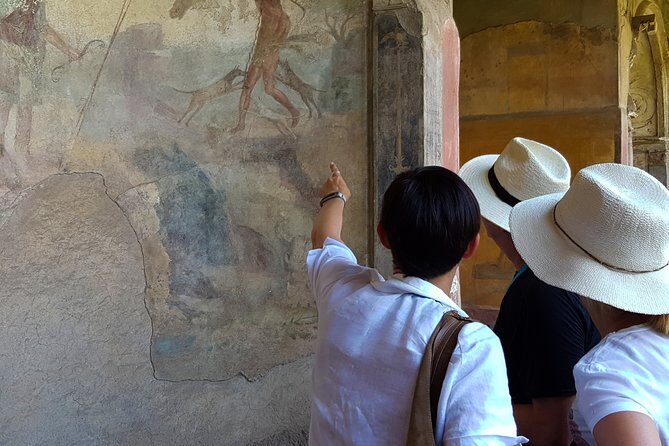
The tour includes the Lupanar, the famous brothel area. This is one of the most talked-about stops in Pompeii, largely because of the erotic wall paintings. The tour notes that prostitutes were often Greek and Oriental slaves, and it even references payment norms in asses (a glass of wine cost one As).
This is not everyone’s favorite stop, but it’s historically grounded. It gives you a more honest idea of the city’s social realities—plus it sparks useful conversations about how Romans viewed pleasure, commerce, and power.
Quick look at a deeper city core
There’s also a stop at the Civil Forum core and supporting monuments like the Temple of Jupiter, Basilica, and market areas. Altogether, Pompeii becomes less like one big ruin and more like a map of systems: religion, law, trade, entertainment, and home life.
Lunch break between sites: protect your energy
After your Pompeii guided time, you get free time for lunch with lunch at your own expense. This break is important because your second stop is Herculaneum, and you won’t want to spend it hungry and cranky.
I like that the tour doesn’t cram lunch into the guide’s schedule. You get to choose a restaurant that fits your pace. If you’re sensitive to crowds or prefer a quick bite, aim for something fast near where you’ll be heading back through the route.
Tip: bring water if you can (the tour data you provided doesn’t mention it being included). One review specifically pointed out that water would have been helpful, which is a fair call when you’re walking ruins under sun.
Herculaneum: better preserved and easier to wrap your head around
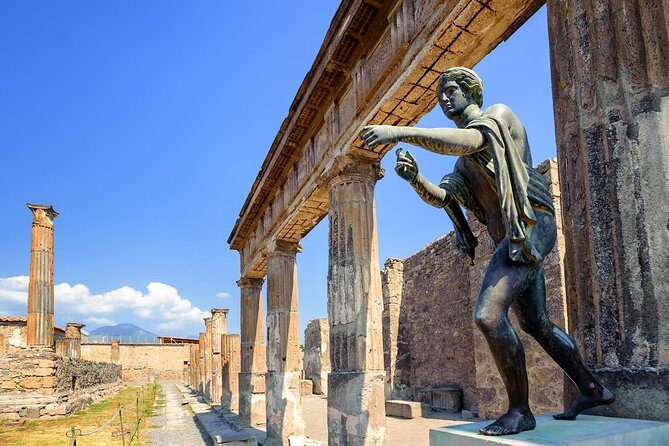
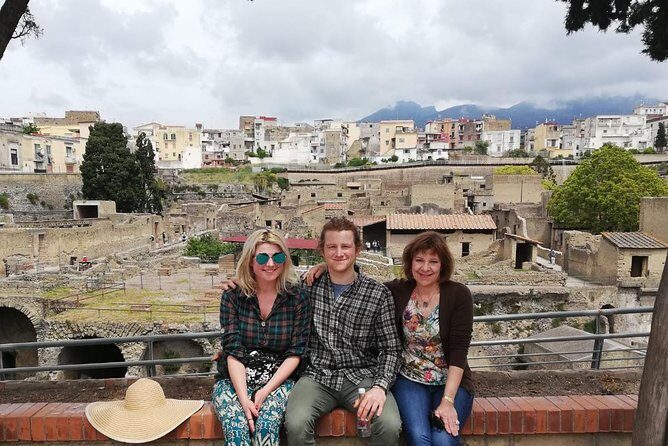
After Pompeii, you travel to Herculaneum, another town buried in the AD 79 eruption of Vesuvius. The big difference is preservation. Herculaneum was encased in mud and lava, and that can make the ruins feel more intact than Pompeii. If Pompeii sometimes feels like you’re staring at scattered stones, Herculaneum can feel more like a city you’re stepping through.
Your Herculaneum guided portion is about 1 hour with a guided tour, followed by free time for exploring at leisure. Admission is included, and the tour includes skip-the-line entrance tickets at both sites, which keeps the day from losing momentum.
Casa dei Cervi and residential details you won’t get from quick photos
You’ll see the Casa dei Cervi, a noble family home that was seafront before the eruption. The structure is built around a central courtyard and is known for murals and still-life paintings. A residential stop like this is valuable because it makes the eruption personal. This wasn’t just a city of buildings; it was a place where families ate, hosted, decorated, and slept.
College of the Augustales: religion as organization
The tour also includes the College of the Augustales, thought to be tied to Emperor Augustus’s cult and the headquarters of a local group. Even when you can’t read the inscriptions, you can still feel the role: this kind of building shows Roman religion as a structured institution, not a one-off ceremony.
House of the Skeleton: a sobering stop
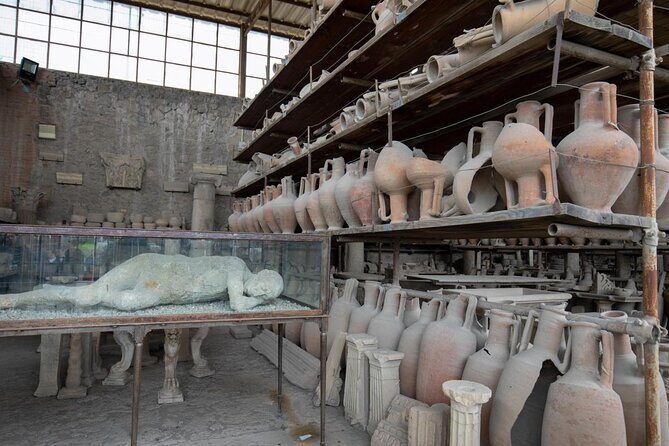
The House of the Skeleton is a heavy moment. It likely came from multiple smaller buildings, and it got its name from human remains found in a second-floor room in 1831. The tour notes that some inhabitants shut themselves in and died there—either from suffocation or extreme heat from gases.
This stop changes how you experience the rest of the ruins. After Pompeii’s civic life and public entertainment, the tragedy at Herculaneum feels closer and more immediate.
Central Thermae: public baths again, but with different scale and feel
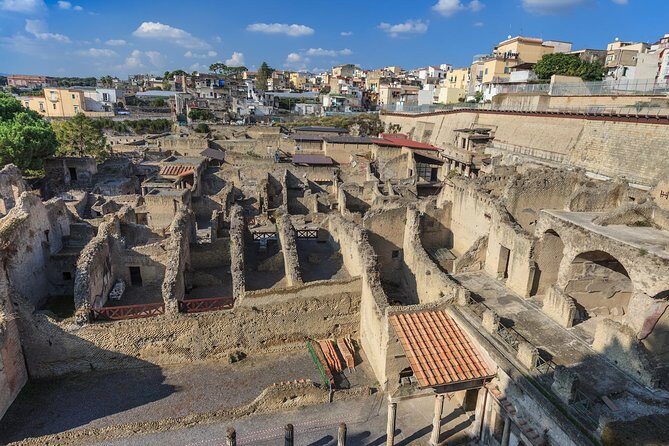
You’ll also visit the Central Thermae, Herculaneum’s public bath buildings. The tour notes the baths were divided into men and women sections and that the rooms include changing areas and different temperature zones: cold, tepid, and hot. It emphasizes that the layout remains well preserved.
Roman baths are one of the best ways to understand daily life because they’re routine. Seeing them again in Herculaneum helps you compare how bathing culture worked in two different cities affected by the same catastrophe.
Partem Domus Lignea and the wooden door detail
One of the more intriguing Herculaneum stops is Partem Domus lignea (Casa del Tramezzo di Legno), tied to a folding wooden door found there. The stop notes that the wooden door separated the atrium from the tablinium. It also mentions benches where clients waited to be received.
This kind of detail is a reminder that Roman architecture often had moving parts and everyday rhythms you can miss if your sightseeing is only broad-brush.
Salone della Barca di Ercolano: the recovered boat story
The Salone della Barca di Ercolano is dedicated to a wooden boat recovered from the ancient beach. The tour describes how people fled to the beach after the eruption; men tried to protect women and children, but the volcanic fury destroyed the port and beach. The boat was preserved under resinous material and was returned to its position so visitors can see it.
This stop gives you a visual handle on survival and escape—and it’s one of those moments where the museum-like setup helps you focus. Even people who usually want fewer exhibits often appreciate this one because the story is clear.
Price and value: is $769.43 per person worth it?
At $769.43 per person, this isn’t a budget day trip. So you have to judge it on what you’re buying, not just what you’re seeing.
Here’s what you’re paying for, in practical terms:
- Private transportation between Sorrento, Pompeii, and Herculaneum.
- Private guided time in Pompeii (about 2 hours) and in Herculaneum (about 1 hour guided plus free time).
- Admission tickets included for both archaeological parks.
- Skip-the-line entry, which can be the difference between a full day and a day that runs late and feels rushed.
If you’re going as a couple or small group and you value comfort and clarity, the cost can start to look like value. If you’re traveling solo with a flexible schedule and you’re the type who enjoys figuring out transit and waiting in lines, you might choose a cheaper option.
But if you want the ruins plus a guide who can connect buildings to daily life, and you want your day to run on time, this private structure is the point.
Who should book this Pompeii and Herculaneum day?
This tour fits best if you:
- Want both sites in one day without building your own route.
- Prefer a guide-led approach because Pompeii is huge and easy to wander.
- Care about not losing time at entrances thanks to skip-the-line tickets.
- Like a day plan with breaks: lunch freedom after Pompeii, plus free exploring at Herculaneum.
It’s also ideal if you’re traveling with family and want a guide to keep everyone engaged. One review mentioned a great balance of walking and stopping at interest points. The best version of this tour is the one where you ask questions and let the guide steer your attention.
Small tips that make a big difference

- Wear comfortable shoes. Both sites involve uneven ground and lots of walking.
- Use sunscreen, especially in summer heat.
- Bring a light layer if you’re sensitive to AC on the vehicle ride.
- If you’re prone to getting thirsty, plan for it. One past comment specifically wished water had been provided.
Should you book it?
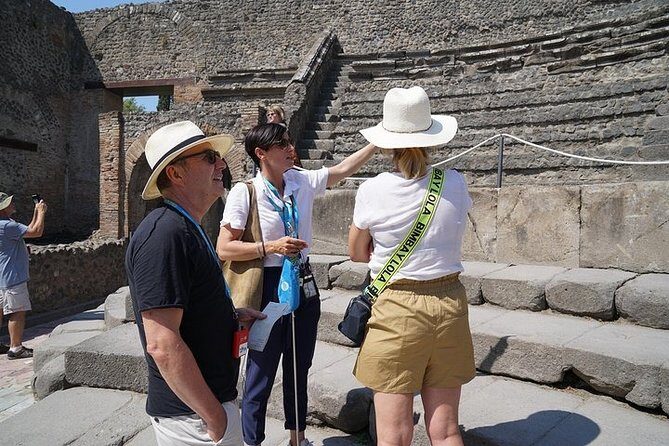
If your priority is a high-efficiency, guided day with private pickup, skip-the-line access, and structured time at both Pompeii and Herculaneum, I’d say this is a solid choice. Pompeii is where you get the civic and commercial picture; Herculaneum is where preservation and intimate details tighten the story.
If you’re trying to keep costs down or you’re happy planning transit and handling entrance lines yourself, you can probably find cheaper ways to see the sites. But you’ll work harder for the same outcome.
My advice: book it if you want a smoother day and more understanding per hour.
FAQ
How long is the Private Pompeii & Herculaneum Tour from Sorrento?
The tour runs about 8 hours total (approximately), with guided time at Pompeii and Herculaneum and travel back to Sorrento in the late afternoon.
Where does pickup happen in Sorrento?
Pickup is offered from your hotel or a central location in the Sorrento area, with the meeting point listed at Piazza Torquato Tasso, 16, 80067 Sorrento NA, Italy.
Are admission tickets included?
Yes. Admission tickets are included for both Pompeii and Herculaneum, and the tour also includes skip-the-line entrance tickets at both sites.
Is lunch included?
No. You’ll have free time for lunch at your own expense between the Pompeii and Herculaneum portions.
Is this tour private or shared?
This is a private tour/activity. Only your group participates.
What language is the tour offered in?
The tour is offered in English.
Will there be time to explore on your own?
Yes. After the guided part at Herculaneum, you’ll have free time to explore at leisure. You’ll also have free lunch time after Pompeii.
What time will I return to Sorrento?
The tour returns to Sorrento at around 4pm to 5pm, depending on the day’s schedule.
What’s the cancellation policy?
You can cancel for a full refund up to 24 hours before the experience starts. If you cancel less than 24 hours before, the amount paid is not refunded.
You Might Also Enjoy
More Private Tours in Sorrento


More Tours in Sorrento



More Tour Reviews in Sorrento
- Sorrento Farm and Food Experience including Olive Oil, Limoncello, Wine tasting
★ 5.0 · 2,524 reviews