REVIEW · POMPEII
Pompeii tour with archaeologist
Book on Viator →Operated by Pina Esposito · Bookable on Viator
Pompeii makes more sense with a guide.
This tour is interesting because it links street corners and buildings to the big story of Pompeii, from the city’s rise through the eruption of 79 AD. I especially love how the archaeologist tour keeps your eyes busy with specific originals to watch for, like the mosaics and relief details, not just general descriptions. I also like the small-group feel (up to 15), which means you can ask questions and actually pace yourself through a site that can otherwise feel like a maze.
One possible drawback: the route is packed, so each stop is brief. If you want long, slow lingering in just one area, you may feel rushed during the 2.5-hour loop.
In This Review
- Key highlights I think you’ll care about
- Pompeii with an archaeologist: what changes for you
- Where the tour starts (Villa dei Misteri area) and how it flows
- Stop 1: Foro di Pompei and the city’s big story in one breath
- Stop 2: Granai del Foro and the plaster casts that hit hardest
- Stop 3: The Basilica and why Pompeians needed monumental public space
- Stop 4: Temple of Apollo and the religious details you can actually see
- Stop 5: Hotel Vittoria as an ancient city gateway moment
- Stop 6: Cave Canem mosaic at the House of the Tragic Poet
- Stop 7: Casa del Fauno, where Pompeii art and scale finally click
- Stop 8: Thermopolium Regio VI, Insula VIII, 8 and ancient fast food
- Stop 9: Temple of Vespasian (Genius Augusti) and imperial power
- Stop 10: Via dell’Abbondanza and reading the street like a map
- Stop 11: Teatro Grande and the theater district’s best-preserved feel
- Stop 12: Doric Temple and Triangular Forum, the oldest corner
- Stop 13: Stabian Baths (Terme Stabiane) and daily leisure
- Stop 14: Lupanar and the brothel frescoes you’ll remember
- Price and value: is $42.01 worth it?
- Who should book this Pompeii archaeologist tour
- Should you book this Pompeii archaeologist tour?
- FAQ
- How long is the Pompeii tour with an archaeologist?
- What language is the tour offered in?
- What is included in the price, and what is not?
- Where do I meet, and where does the tour end?
- How big is the group?
- What if the tour is canceled due to weather or low demand?
Key highlights I think you’ll care about
- Forum-focused storytelling that connects the civic core of Pompeii to what people did day to day
- Granaries and victim plaster casts that add an emotional, human layer to the disaster story
- Casa del Fauno mosaics including the Dancing Faun bronze and the Battle of Alexander mosaic
- Everyday Pompeii stops like a well-preserved thermopolium (ancient fast-food)
- After-hours Pompeii with the Stabian Baths and the Lupanar brothel
- End in the Forum so you can keep exploring on your own after the guided portion
Pompeii with an archaeologist: what changes for you
You’re buying time with an archaeologist, and that matters at Pompeii. Without context, you’ll read plaques, glance at walls, and still wonder how the whole city worked. With a guide, the site starts acting like a real place again: you understand why buildings are positioned where they are, and what daily life probably looked like.
The tour is led by archaeologist Pina Esposito, and the style is clear and teacher-like. Expect explanations that don’t just name things, but also explain what they were for and how we understand them today. That comes through especially at the stops where Pompeii is famous for its originals and for the physical evidence left behind.
Also, you’re not stuck in a giant herd. With a maximum of 15 people, you’re more likely to get answers to your questions, and less likely to feel like you’re being dragged through.
Where the tour starts (Villa dei Misteri area) and how it flows
You meet at Pompei Scavi Villa Dei Misteri (80045 Pompei). The tour ends at the Foro di Pompei, specifically at the Foro area on Via Villa dei Misteri, 2 (so you can stay inside the excavations after you finish the guided walk).
Plan for about 2 hours 30 minutes. The timing per stop is tight, but that’s part of the value: you get a route that hits Pompeii’s major highlights without spending half the day in transit between scattered areas. The tour also runs with a mobile ticket, and it’s offered in English (and also Italian or German, depending on the booking).
One more practical note: since food and drink aren’t included, bring water. Pompeii is outdoors, and this is a walking circuit, so you’ll want to keep your energy up between short explanations.
Stop 1: Foro di Pompei and the city’s big story in one breath
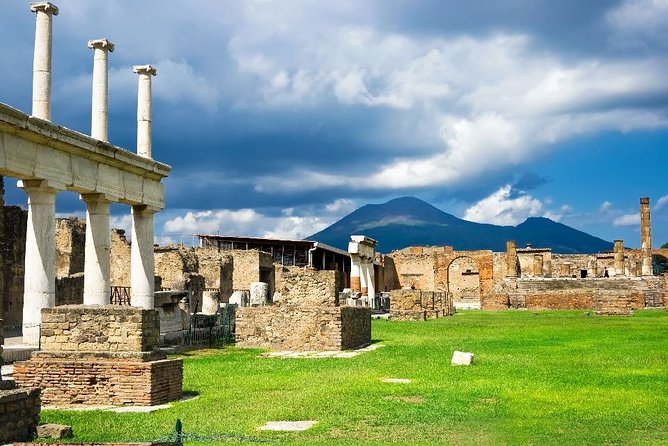
The walk kicks off in the Foro di Pompei. This is where Pompeii’s civic identity shows up, and your guide sets the timeline from the city’s origins all the way to the eruption of 79 AD.
What I like about starting here: it gives you a mental map before you go deeper into buildings. You learn what the Forum represented, then the rest of the route stops feeling random. You also start noticing how Pompeii’s layout reflects politics, religion, and public life all at once.
Since this is an early stop, you’ll want to be mentally ready for context-setting. The more attentive you are at the beginning, the easier it gets to follow later when the tour moves from civic spaces to homes, baths, and street-level commerce.
Stop 2: Granai del Foro and the plaster casts that hit hardest
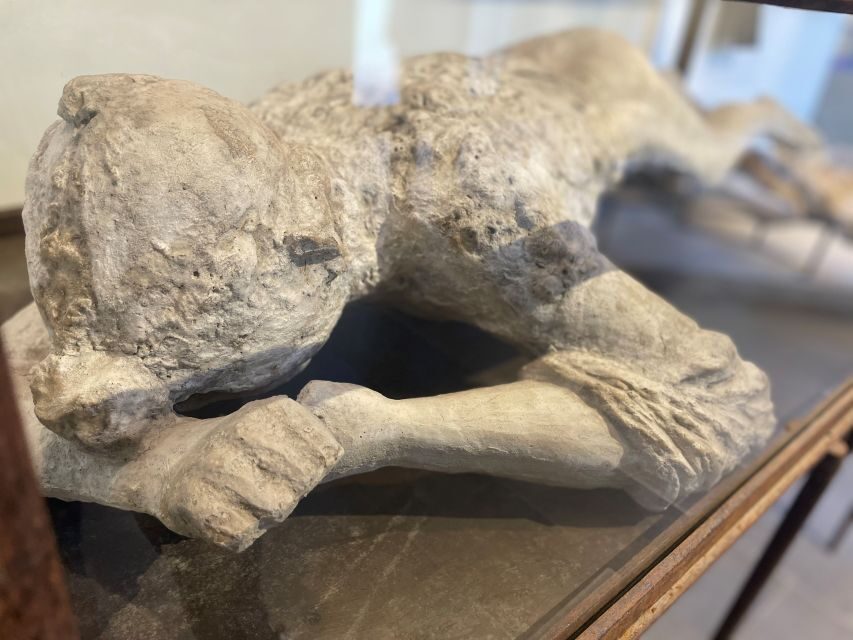
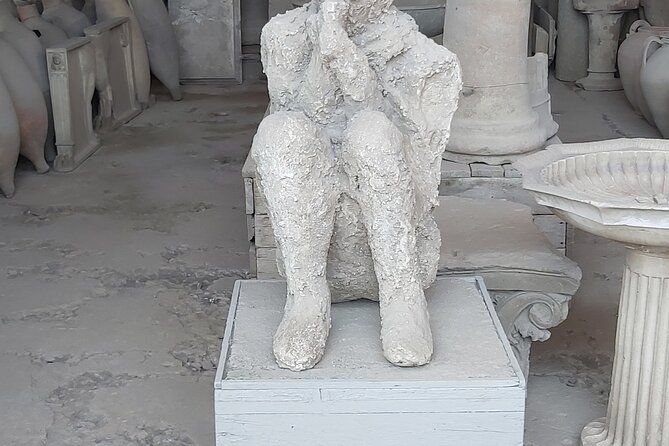
Next is the Granai del Foro, Pompeii’s granaries area. Your guide explains the space as a storehouse and points out important finds tied to daily administration and trade. This is also where the emotional weight enters, since you’ll see references to the plaster casts of the victims.
Why this matters for your understanding: it stops Pompeii from being only architecture. You remember this was a lived city, interrupted fast. The granaries also help you grasp how food supply and storage connected people across social classes.
This stop is short, so don’t expect a slow, emotional pause. Instead, treat it like a turning point in the tour’s narrative: after this, you’ll be able to “place” the disaster within a city’s functioning rhythm.
Stop 3: The Basilica and why Pompeians needed monumental public space
Then you head to Pompei La Basilica. Your archaeologist explains the building’s functions and why the Basilica is one of Pompeii’s most impressive monumental structures.
The Basilica is a great example of Roman design doing real work. It wasn’t built just to look grand. It supported public life, and it signals how Romans organized legal and civic activities through architecture.
A small practical consideration: since this stop is timed, you’ll get the main points fast. If you want to study columns or ceiling details at length, you might want to plan extra independent time later in the excavations.
Stop 4: Temple of Apollo and the religious details you can actually see
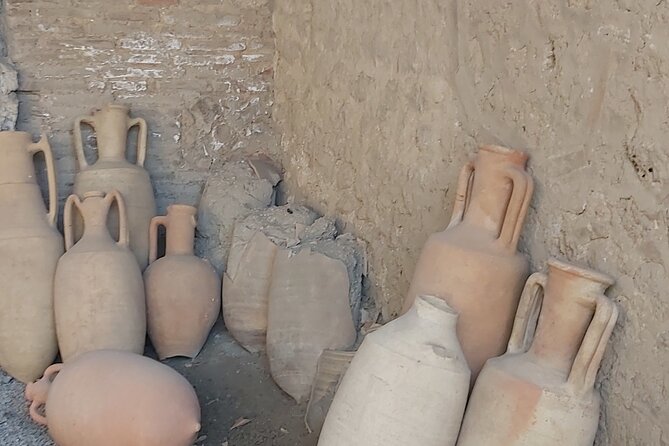
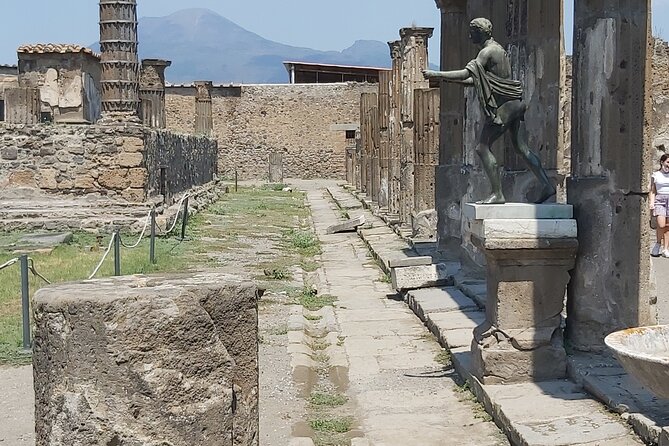
At the Temple of Apollo, your guide focuses on what makes this temple special: it’s rich in original finds and built evidence you can still interpret on-site. You’ll hear about sculptures, altar elements, inscriptions, columns, and a Roman sundial, plus other features connected to worship.
This is where a guided tour really pays off, because temples can look similar if you only skim. With a guide, you start noticing how specific objects relate to ritual and daily religious practice.
Also, the stop supports a bigger theme of the route: Pompeii wasn’t just homes and street signs. It was a city with strong religious infrastructure, and these details shaped how people understood time, order, and authority.
Stop 5: Hotel Vittoria as an ancient city gateway moment
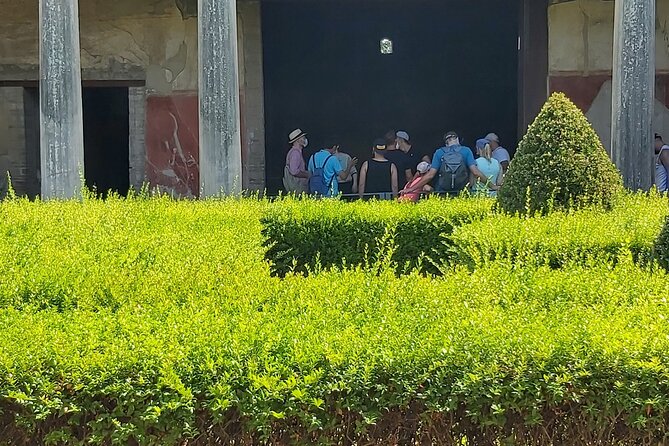
The tour briefly includes Hotel Vittoria, explained as an ancient gateway connected to the city and its surrounding area. This isn’t a “big ruin moment” like a house or theater, but it is useful for your sense of arrival and movement.
I like these smaller transition stops because they help you read Pompeii like a system. You start understanding how people approached the city, how the street network and entry points connect, and why the route you’re walking makes sense.
In terms of pacing, this is a quick stop. If you’re craving extra time at major monuments, this is the place where you might wish the guide lingered longer.
Stop 6: Cave Canem mosaic at the House of the Tragic Poet
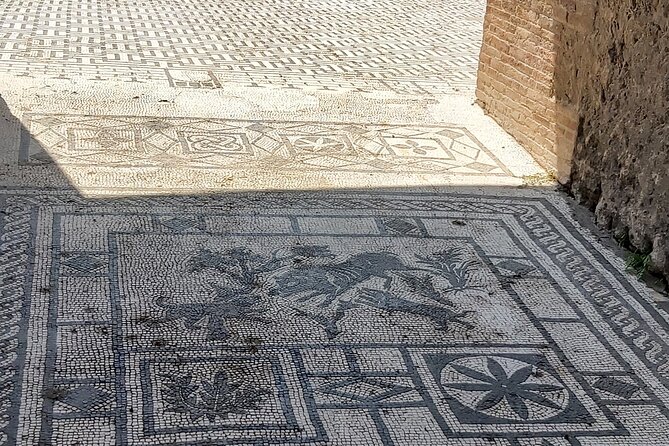
You then hit the famous Cave Canem mosaic, placed at the entrance of the House of the Tragic Poet. This is one of those Pompeii moments that feels instantly memorable, because the warning is both literal and playful in a way you can’t get from pictures alone.
What I like here: the mosaic sets tone. It’s not a solemn museum label moment. It’s a neighborly warning from an ancient household that tells you something about attitudes toward space, visitors, and boundaries.
Because this stop is brief, you’ll want to look first, then listen. If you do it the other way around, the mosaic can blur into the background of the walking flow.
Stop 7: Casa del Fauno, where Pompeii art and scale finally click
At the Casa del Fauno, you’re seeing the largest house in Pompeii and one of its most important art showcases. Your archaeologist explains the house’s significance and highlights the bronze sculpture of the dancing Faun plus the huge Mosaic of the Battle of Alexander, built from more than a million tiny colored tiles.
This stop is a turning point for many people. Up to now, you’ve learned how the city functioned. Here you learn how ambitious wealth and taste looked in everyday domestic space.
Try to approach this stop with two modes: first appreciate the scale and craft, then listen for what the mosaic and objects were doing inside the household. It changes how you interpret “decoration” from background texture into messaging and identity.
Stop 8: Thermopolium Regio VI, Insula VIII, 8 and ancient fast food
Next comes the Thermopolium at Regio VI, Insula VIII, 8. Your guide explains the thermopolium as a preserved example of ancient fast-food and ties it to social life and nutrition.
This is an underrated stop if you think Pompeii is only about elites. A thermopolium helps you picture ordinary meals, quick service, and how people gathered in public-facing spaces to eat and talk.
One useful angle: understanding nutrition and social behavior makes the rest of Pompeii feel more human. When you see street life later (and even the layout of roads), you start thinking about movement and food stops in a more realistic way.
Stop 9: Temple of Vespasian (Genius Augusti) and imperial power
At the Temple of Vespasian, also known as the Temple of Genius Augusti, your archaeologist frames the stop in terms of the Roman imperial cult. In plain terms, this is where Roman political authority expressed itself as religious practice.
Why this matters: once you connect worship to power, Pompeii doesn’t just feel old. It feels organized. You start seeing how loyalty, law, and religion reinforced each other through physical space.
Because this stop is short, don’t worry about memorizing names of cult concepts. Focus instead on the big takeaway: how the empire’s presence showed up in local city life.
Stop 10: Via dell’Abbondanza and reading the street like a map
You then walk along Via dell’Abbondanza, explained as part of the road network and Pompeii’s urban plan. This is a practical stop, because streets are how cities move people between every other stop you’ve seen.
Your guide’s job here is to make the street layout make sense. Once you see it as a system, you’ll understand why houses, businesses, temples, and theaters end up where they do.
I’d suggest you use this moment to slow your body a bit. Take in the sightlines. Even if the explanations move quickly, the street view helps you build a personal mental map for your later self-guided exploring.
Stop 11: Teatro Grande and the theater district’s best-preserved feel
In the theater district, you’ll see the Teatro Grande, with context that the area includes other key performance spaces like the Teatro Piccolo and the Quadriportico dei Teatri.
Theater sites work best with interpretation. Pompeii’s theaters aren’t just stages; they’re social machines. You learn how crowds gathered, how entertainment fit Roman public culture, and why the city invested in performance architecture.
This stop is timed, but the setting helps you understand why people would have talked about events as community moments. If you like human-scale observations, this is a great area to reset your attention after the intensity of mosaics and disaster-related sections.
Stop 12: Doric Temple and Triangular Forum, the oldest corner
Next is the Doric Temple, explained as the oldest temple in Pompeii, along with the so-called Triangular Forum. This stop adds depth because it shifts you from “big monuments everyone knows” toward the older layers of civic and religious space.
I like this part of the route because it prevents Pompeii from feeling like a single snapshot. You see how the city’s religious and civic foundations connect across time.
Since the stop is short, your best move is to look for contrasts: older design cues versus later architectural swagger you’ve already seen.
Stop 13: Stabian Baths (Terme Stabiane) and daily leisure
Then you step into the Stabian Baths (Terme Stabiane). Your guide highlights the baths as an extraordinary example of ancient thermal building and explains what the complex meant for daily life.
This is one of the tour’s most satisfying stops if you care about how people relaxed. Baths were social, not just functional. Even a quick guide explanation can make the rooms feel more purposeful than “ruins with benches.”
One thing to consider: baths layouts can be easy to visualize while you’re listening, but harder later when you’re on your own. If you want to re-check details, take a careful look before moving on.
Stop 14: Lupanar and the brothel frescoes you’ll remember
Finally, you visit the Lupanar, Pompeii’s most spectacular example of an ancient brothel. Your archaeologist focuses on its exceptional state of conservation, including the bedrooms and erotic frescoes that depict various amorous positions.
This stop is not subtle. It’s also historically revealing, because it shows how commerce and sexuality worked in public-facing spaces of the ancient city. It helps you see Pompeii as a full society, not a staged collection of “nice” buildings.
If you’re sensitive to adult content, this is the point to mentally prepare. The tour still explains it in context, but the imagery is part of why the Lupanar is famous.
Price and value: is $42.01 worth it?
At $42.01 per person, this tour is priced like a serious add-on that expects you to understand the value of expertise. The key detail: entrance fees are not included. That means your total cost depends on what you personally need to enter Pompeii and which areas you want to revisit after the tour.
Still, for many visitors, the guide is worth it because Pompeii isn’t just sightseeing. It’s interpretation. You’re paying to save yourself the hours of reading and guesswork, and to get the “why” behind the “what.”
Also, the small group size helps justify the price. With up to 15 people, you spend more time actually understanding what you see and less time waiting for the group to catch up.
One last value note: since the tour ends in the Forum, you get a logical place to keep exploring without re-planning your route from scratch.
Who should book this Pompeii archaeologist tour
This is a strong fit if you want a guided route that hits Pompeii’s biggest themes fast: civic life, religion, art in elite homes, everyday eating, public leisure, and taboo corners like the Lupanar.
It’s also a good match if you’re the type who likes asking questions. In a smaller group, you’re more likely to get direct answers instead of hearing the same lines on repeat.
If you’re traveling solo, on a couple’s trip, or with family-aged adults who can handle adult themes, you’ll probably enjoy the pacing. If you’re traveling with very young kids or you want a slow, museum-style experience, this format may feel too structured and quick at each stop.
Should you book this Pompeii archaeologist tour?
I’d book it if you want Pompeii to make sense in a couple of hours. The stop list is well chosen: Forum anchors the story, mosaics and major houses show what people built and loved, and baths plus the Lupanar widen the picture beyond the postcard version of Pompeii.
I wouldn’t book it if your priority is deep, uninterrupted time in one single area, like only homes or only theaters. This tour is designed as a focused circuit, not a “pick your favorite ruin and stay there” plan.
If you’re ready to walk, listen, and build a real mental map of Pompeii, this one is a solid value—especially with archaeologist Pina Esposito guiding the route and keeping each stop tied to the bigger story.
FAQ
How long is the Pompeii tour with an archaeologist?
It lasts about 2 hours 30 minutes.
What language is the tour offered in?
The tour is offered in English, and guided tours are available in Italian, English, or German.
What is included in the price, and what is not?
The guided tour with an archaeologist is included. Food, drink, tip, and the entrance fee are not included.
Where do I meet, and where does the tour end?
You start at Pompei Scavi Villa Dei Misteri, 80045 Pompei. The tour ends in the Foro di Pompei area, at Via Villa dei Misteri, 2, 80045 Pompei NA.
How big is the group?
The tour has a maximum of 15 travelers.
What if the tour is canceled due to weather or low demand?
The experience requires good weather. If it’s canceled due to poor weather, you’ll be offered a different date or a full refund. If the minimum number of travelers isn’t met, you’ll also be offered a different date or a full refund.