Pompeii and Herculaneum feel less chaotic here. You get a private archaeologist guide who can translate what you’re seeing into everyday Roman life, not just stone facts. I also like that the route mixes major must-sees with smaller, specific rooms and features (wooden partitions, baths, big-name benefactors), so your half-day doesn’t turn into a blur. One drawback: entry tickets are not included, and it’s a walking day—plan on solid shoes and patience for timed site access.
This is a private tour for your group (up to 15) in English, with a total duration around 5 hours 30 minutes. It starts at Ercolano and ends inside Pompeii Ruins, with an in-between transfer by train plus a short walk.
Finally, you’ll walk through two different types of “frozen in time” sites. Herculaneum is famous for preservation under Vesuvius’ volcanic ash. Pompeii gives you the broader city sweep: streets, squares, markets, baths, and big public buildings.
In This Review
- Key things to know before you go
- Why this private archaeologist tour is worth your time
- Timing, route, and how the 5.5-hour plan fits together
- The Herculaneum block: houses, baths, and the ash-preservation effect
- Entering Herculaneum: your guide starts with orientation
- House of the Deer: a name you can spot
- M. Nonius Balbo’s terrace: power and public honor
- College of the Augustales: religion and local government
- Casa del Rilievo di Telefo: a house with an unusual link
- Partem Domus lignea: the wooden partition moment
- House of the Skeleton: the story behind the name
- Central Thermae: separate baths for men and women
- House of the Black Salon: carbonised door details
- Casa Sannitica: regional identity in layout and decoration
- Casa del Bel Cortile: a courtyard with a stair and balcony
- House of the Grand Portal: the “center of the action” domus
- Pompeii’s highlight run: brothel lane, forum energy, big public buildings
- Lupanar: Pompeii’s most famous brothel
- Main street and Foro de Pompeya: the city’s “center”
- Granaries of the Forum: tables, fountains, and casts
- Basilica and Stabian Baths: commerce + routine
- Big houses: House of the Faun and House of Menander
- Teatro Grande and Teatro Piccolo: entertainment built into the city
- How the archaeologist guide changes the whole experience
- Tickets, shoes, and what to bring to avoid a bad day
- Entry tickets: plan on paying extra
- Wear real walking shoes
- Lunch is flexible
- Getting value from a $597.36 private tour (up to 15 people)
- Where this tour shines, and where you should be cautious
- Who should book this Pompeii and Herculaneum archaeologist tour?
- Should you book this tour?
- FAQ
- How long is the Pompeii and Herculaneum private walking tour?
- Is this tour private, or shared with other groups?
- What language is the tour offered in?
- Are entry tickets included?
- How much are the Herculaneum ruins entry tickets?
- Where do we meet for Herculaneum?
- Where do we meet for Pompeii?
- Do I need my own transportation between Naples-area sites?
- What should I wear or bring?
- Can I cancel for a full refund?
Key things to know before you go
- Private, archaeologist-led pacing: you can ask questions as you walk, instead of speed-running the site.
- Two sites, one day plan: Herculaneum first, then Pompeii, with a train transfer in between.
- Ash-preserved details: you’ll notice how the eruption preserved materials, including places with carbonised wooden elements.
- Stop choices go beyond the obvious: houses, baths, and specific named buildings (like the House of the Deer and Stabian Baths).
- Tickets are separate: Herculaneum entry is an extra cost (adult 16 euros; EU citizens 18–25: 2 euros).
- You’ll walk a lot: comfortable shoes are required; no flip-flops.
Why this private archaeologist tour is worth your time
Pompeii and Herculaneum are both big, but they hit differently. Pompeii can feel like a movie set unless someone helps you connect the dots. Herculaneum often feels quieter, but it rewards close attention—especially when you see how finely the city’s life was preserved.
That’s where the archaeologist guide matters. With this kind of expert-led walkthrough, you’re not just reading signs. You’re getting the “how did they live?” layer: what a house layout implies, why certain buildings were important, and how public and private spaces worked together.
This tour is also built for actual sightseeing flow. You’re not stuck in a loud crowd shuffling forward. One of the strongest themes from guides on this route is the ability to turn rooms into stories—so you can look at a wall or doorway and understand why it matters.
Timing, route, and how the 5.5-hour plan fits together
The whole outing is about 5 hours 30 minutes, give or take. The schedule is split into two main blocks:
1) Herculaneum Archaeological Park first
You meet at the Ticket Office of the Herculaneum ruins. The plan includes a train transfer to Herculaneum (about 30 minutes by train plus about 10 minutes walking). There’s also a quick lunch break if you need it.
2) Pompeii Archaeological Park after that
You then meet your guide at the main entrance of Pompeii’s site called Porta Marina Superiore, with the guide holding a sign for Askos Tours.
That structure matters because it reduces the “where are we?” moments. And because the day is time-limited, the stops are tightly grouped. You’ll spend short bursts at many locations rather than getting stuck at one area while everyone else waits.
One practical note: because the tour is private but still follows site rules and entry timing, you’ll want to keep your pace steady. This isn’t a leisurely stroll where you linger for hours in one house.
The Herculaneum block: houses, baths, and the ash-preservation effect
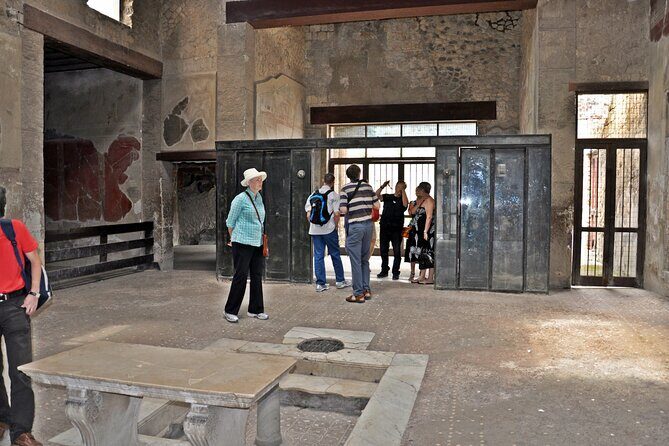
Herculaneum is the first half of your day, and it’s where you’ll see the city’s everyday texture up close. Expect a sequence of named houses and civic buildings, each one giving you a different “slice” of how people lived.
Entering Herculaneum: your guide starts with orientation
You start at the Ticket Office of the Herculaneum ruins. From there, the walking route quickly gets you into the neighborhood scale of the site.
I like this start because it helps you get your bearings fast. Herculaneum is smaller than Pompeii in terms of sprawl, but it’s easy to feel lost if you’re bouncing between disconnected points. A guide keeps your eyes moving in the right direction.
House of the Deer: a name you can spot
The tour stops at the House of the Deer. It’s called that because marble statues of stags/deer were found in the peristyle.
This is the kind of stop that works well with a smart guide: instead of just noting decorative art, you learn why peristyles and sculpture matter in a house’s “public-facing” feel.
M. Nonius Balbo’s terrace: power and public honor
You’ll also see La Terrazza di M. Nonio Balbo, tied to the city’s major benefactor. The name connects to a long inscription describing his honors on his death.
If you like epigraphs (inscriptions) or politics-by-stone, this is a strong moment. It turns architecture into a social timeline.
College of the Augustales: religion and local government
Next up is the College of the Augustales. The building is thought to have connections to the cult of Emperor Augustus and the headquarters of the Collegium Augustalium, possibly even the local curia.
This is a good stop for understanding Roman “in-between” power: not quite a state office, not quite private business. It’s civic ritual and administration tangled together.
Casa del Rilievo di Telefo: a house with an unusual link
Casa del Rilievo di Telefo is described as possibly tied to a leading benefactor (Marcus Nonius Balbus). It’s unusual partly because it has private access to the adjoining Suburban Thermae to the south.
This is where you’ll see how elites could connect home convenience to public (or semi-public) bathing spaces. Even if you’re not a Roman architecture nerd, you’ll get the practical point.
Partem Domus lignea: the wooden partition moment
One of the most intriguing stops is Partem Domus lignea, also known for the Casa del Tramezzo di Legno (a preserved wooden partition).
You’ll appreciate this more than you think. Wooden elements are rare to survive, so anything like a preserved partition helps you visualize interior life that usually disappears in other archaeological sites.
House of the Skeleton: the story behind the name
The House of the Skeleton gets its name from human remains found in a second-floor room in 1831.
This is heavy subject matter, so it helps to have a guide who can keep it factual and respectful. It’s not meant to be spooky for fun; it’s a reminder of the human reality behind the dramatic setting.
Central Thermae: separate baths for men and women
Then comes the Central Thermae. These baths date to around the beginning of the 1st century AD and are divided—following common practice—into men’s and women’s baths, each with separate entrances.
This is one of those practical history stops. You’re not just looking at tubs; you’re seeing how daily routine and social norms shaped building design.
House of the Black Salon: carbonised door details
House of the Black Salon is described as a luxurious mansion. The guide highlights the monumental entrance where you can still see carbonised remains of doorposts and the lintel.
Even without getting too technical, this is a powerful “see it to believe it” moment. Volcanic preservation isn’t abstract here—you get physical traces.
Casa Sannitica: regional identity in layout and decoration
Casa Sannitica shows an arrangement typical of the Samnites, including a splendid atrium with a gallery and Ionic columns, plus fresco decoration.
I like this stop because it adds regional identity. It’s not all one Roman style everywhere.
Casa del Bel Cortile: a courtyard with a stair and balcony
Casa del Bel Cortile features a courtyard with a stairway and a stone balcony instead of an atrium.
It’s a quick way to see how house design can vary even within one city. The guide can explain what you’re looking for so you don’t miss the big difference while walking.
House of the Grand Portal: the “center of the action” domus
Finally in Herculaneum, you’ll see the House of the Grand Portal. It’s described as a beautiful domus with multiple environments, collonatti, frescos, and charred remains of wooden parts.
This is a good wrap-up because it ties together the “luxury + preservation” theme. It helps you end Herculaneum feeling like you’ve seen more than random rooms.
Pompeii’s highlight run: brothel lane, forum energy, big public buildings
After Herculaneum, you shift to Pompeii. The tour meets at Porta Marina Superiore, and from there it’s a classic highlights path—main street, major civic spaces, baths, and big structures.
Lupanar: Pompeii’s most famous brothel
You’ll stop at the Lupanar, described as the most famous brothel in Pompeii.
This is a controversial but historically significant stop. The best use of it is to let your guide connect it to the city’s economy and urban life, not just the shock factor. It also sets the tone for Pompeii’s mix of public and private reality.
Main street and Foro de Pompeya: the city’s “center”
Next comes a look at Pompeii’s main street, then the Foro de Pompeya, the ancient main square.
This is where your guide helps you understand spatial flow. Once you see the forum context, side streets stop looking like random corridors and start looking like neighborhoods feeding a public center.
Granaries of the Forum: tables, fountains, and casts
You’ll visit the Granaries of the Forum. The description includes marble tables and baths for fountains at entrances to houses, plus casts of victims and even a dog and a tree.
It’s a stark stop. But it also makes Pompeii more than an architectural tour—it becomes a lesson in how catastrophe leaves traces.
Basilica and Stabian Baths: commerce + routine
Then you see the Basilica, an open portico sheltering merchants and other activities. After that comes the Stabian Baths (Terme Stabiane), a vast thermal complex considered the oldest in the city.
These two stops work as a pair. One is public commerce space; the other is daily relaxation and routine. Together, they help you picture how people spent time, not just where they lived.
Big houses: House of the Faun and House of Menander
The tour then moves into private wealth stops:
- House of the Faun: one of the largest and most impressive private residences
- House of Menander: one of the richest and most magnificent houses in terms of architecture, decoration, and contents
If you love decoration and layout, this part of the day is great. If you don’t, a good guide can still keep it lively by focusing on what house design says about social rank and lifestyle.
Teatro Grande and Teatro Piccolo: entertainment built into the city
Finally, you’ll see Teatro Grande, described as the most important theater in Pompeii, plus a look at the Teatro Piccolo.
Theaters can feel like just another building unless you connect them to what people did for fun and community life. A guide helps you see the purpose behind the scale.
How the archaeologist guide changes the whole experience
The biggest upside of this tour is that you’re not left to guess. The archaeologist guide is doing the interpretation work, and it shows in how the stops are framed.
Here are the kinds of guidance that make or break a day like this:
- Turning names into meaning. When a building is tied to a benefactor like M. Nonius Balbo, you get the human story behind the stone.
- Explaining why details survive. When you see preserved wooden elements, charred door components, or surviving materials, you get the why, not just the what.
- Keeping you from wasting time at the wrong spot. Pompeii and Herculaneum can eat hours fast. A guide keeps your attention on high-value viewing points.
Also, the guide quality is a strong theme. People have highlighted archaeologist-level explanations from guides like Mena, Vincenzo, Ivan, Sylvia, Raffaele Romano, Paola, Giovanni, and Giancarlo. That doesn’t mean you’ll get the same guide, but it does suggest the tour’s strongest moments happen when your archaeologist guide is active, patient, and willing to answer questions.
If you’re traveling with kids, the patience factor matters too. One family experience specifically noted how an archaeologist guide handled questions from children ages 11, 11, and 14 without turning it into a lecture. That’s exactly the kind of skill you want.
Tickets, shoes, and what to bring to avoid a bad day
This is a practical walking tour, so the basics are not optional.
Entry tickets: plan on paying extra
Herculaneum ruins entry tickets are listed as:
- 16 euros for adults
- 2 euros for EU citizens age 18–25
Pompeii admission is also not included, and the tour notes Pompeii express entry tickets are not included either. So treat this as a guided tour with your own admissions to manage.
Practical tip: if you’re arriving at the sites earlier than planned, don’t assume the guide will handle every ticket step. Build in time for buying or validating entry.
Wear real walking shoes
The tour calls for comfortable shoes and says no flip-flops. That’s not fussiness—it’s because you’ll be moving between many areas with uneven ground.
Bring sunglasses and sunscreen. Even in cooler months, these open-air sites can still get bright and tiring.
Lunch is flexible
You’ll have a quick lunch break if required during the Herculaneum portion. That’s helpful, because otherwise you’ll be tempted to snack your way through the whole day and then wonder why your feet feel like lead.
Getting value from a $597.36 private tour (up to 15 people)
The price listed is $597.36 per group (up to 15 people). That number looks high until you do the math.
- If you fill the group with 15 people, you’re effectively paying about $40 per person for a private archaeologist-led route.
- If you have 2 people, it’s about $299 per person.
- If you’re a family of 4, it lands around $150 per person.
So the value depends on your group size and what you’re trying to buy:
- If you want a personalized explanation and you’re splitting costs, this can be great value.
- If you’re only 2 people, it’s a premium option. It still can be worth it if you care about expert interpretation and not missing key rooms.
One more value angle: crowd control. A private tour doesn’t magically erase crowds, but it usually keeps you from being stuck waiting behind slow groups at every turn.
Where this tour shines, and where you should be cautious
This tour shines if you want a structured, archaeologist-led way to see both sites without getting lost in trivia. It’s also good if your group likes houses, civic buildings, and specific preserved features—wood partitions, baths, and big public spaces.
Be cautious if you expect a zero-friction skip-the-line experience. One feedback point noted that queue-skipping details weren’t clear, and that time was lost when tickets weren’t planned well. The simplest fix: handle tickets in advance and ask your guide about the ticket flow you should expect on the day.
Also, because it’s a long walking day, it’s not ideal for anyone who needs frequent breaks beyond what’s scheduled. The tour lists moderate physical fitness as the level to aim for.
Who should book this Pompeii and Herculaneum archaeologist tour?
Book it if:
- You want two major sites in one day without turning the day into a transport puzzle.
- You care about understanding daily life in Roman towns, not just taking photos.
- Your group includes people who want to ask questions and actually get answers.
- You value expert interpretation, especially where buildings have names tied to benefactors or specific preserved materials.
Skip or rethink if:
- You’re determined to spend long stretches alone in silence.
- Your group struggles with sustained walking.
- You’re only looking for a quick highlights sweep and you don’t care about deeper context.
Should you book this tour?
I’d book it if you’re willing to pay for explanation and you’ll benefit from a guided route through both Pompeii and Herculaneum. The strongest reason to choose it is the combination of private pacing + archaeologist interpretation across high-impact stops, including preserved features that are hard to appreciate on your own.
If you’re price-sensitive, it’s still smart if you can bring enough people to spread the group cost. And if you do book, do one thing that really helps: plan your entry tickets early and wear good shoes. That’s how you turn this into a day that feels like it clicked, instead of a day you just survived.
FAQ
How long is the Pompeii and Herculaneum private walking tour?
It runs for about 5 hours 30 minutes.
Is this tour private, or shared with other groups?
This is a private tour/activity. Only your group participates.
What language is the tour offered in?
The tour is offered in English.
Are entry tickets included?
No. Herculaneum entry tickets and Pompeii entry tickets (including Pompeii express entry tickets) are not included.
How much are the Herculaneum ruins entry tickets?
Herculaneum entry tickets are listed as 16 euros for adults, and 2 euros for EU citizens age 18–25.
Where do we meet for Herculaneum?
The meeting place is the Ticket Office of the Herculaneum ruins.
Where do we meet for Pompeii?
The tour meets at the main entrance of Pompeii called Porta Marina Superiore, where the guide holds a sign with the company name Askos Tours.
Do I need my own transportation between Naples-area sites?
The tour includes a transfer by train to Herculaneum in the plan, but it also states that any kind of transportation to the sites is not included. Plan on handling transport on your end.
What should I wear or bring?
Wear comfortable shoes (no flip-flops). Sunglasses and sunscreen are suggested.
Can I cancel for a full refund?
Yes. You can cancel up to 24 hours in advance for a full refund.