REVIEW · SORRENTO
Pompeii & Amalfi Coast Private Tour: Archaeologist-led, Flexible
Book on Viator →Operated by Fabrizio Belleni - Leisure Italy Private Guide · Bookable on Viator
Pompeii hits different when the day is custom. This archaeologist-led private tour pairs expert context in Pompeii with a flexible Amalfi Coast route you can shape around your group.
I especially like how the guide focuses on everyday Rome, not just the famous postcard spots. My second favorite thing is the convenience: door-to-door pickup and private transportation mean you spend more time sightseeing and less time wrangling buses or finding meeting points.
One thing to consider: the Pompeii portion is walk-heavy. If you have walking issues, the tour notes that Pompeii is not recommended, and the day can feel full with multiple stops between ruins and towns.
In This Review
- Key things that make this tour worth your time
- The big idea: Pompeii with context, Amalfi with breathing room
- Pompeii starts at Porta Marina: the city opens like a movie
- The Basilica and Forum: where Roman justice and business happened
- Macellum and Forum Baths: food and daily social life
- Casa dei Vettii: the “Sistine Chapel” effect of Roman homes
- Thermopolium and Insula dei Casti Amanti: newer finds with personality
- Teatro Grande and the Antiquarium: finish with art and impact
- The coast begins with SS145: the cliff road that sets your mood
- Sorrento and the Amalfi switch: where you plan and where you wander
- Positano and Amalfi: classic towns, different vibes
- Ravello and Villa Cimbrone: the calm balcony after the busy coast
- Minori, Maiori, Erchie: a calmer slice of the Amalfi region
- Price and logistics: is $540.66 per person good value?
- Who should book this tour, and who should think twice
- Final call: should you book this Pompeii and Amalfi Coast private tour?
- FAQ
- How long is the Pompeii and Amalfi Coast private tour?
- What language is the tour offered in?
- Where can pickup happen?
- Is Pompeii admission included?
- Is lunch included?
- Does the tour include transportation?
- Is this a private tour?
- Is it okay if I have mobility concerns?
- Is bottled water and WiFi included?
Key things that make this tour worth your time
- Fabrizio Belleni leads the day and tailors Pompeii and the coast to what you care about
- Pompeii route includes streets, shops, and private homes, so you get daily life, not only monuments
- Door-to-door private transport, bottled water, and WiFi keep the long day comfortable
- Newer-access Pompeii highlights can be included (like the Thermopolium and Insula dei Casti Amanti)
- You end Amalfi time with scenic road stops plus time in towns like Positano, Amalfi, and Ravello
- Lunch planning can fit dietary needs when you tell the guide in advance
The big idea: Pompeii with context, Amalfi with breathing room
This isn’t a drive-by “see everything fast” kind of day. The value is in how the guide connects the ruins to real human routines—work, justice, bathing, eating, and living with Vesuvius hanging in the background.
On the Amalfi side, you still get structure (you’ll follow the famous coastal roads and hit key towns), but you’re not locked into a rigid schedule. That flexibility matters because weather, heat, and energy levels can change hour to hour.
You can also read our reviews of more private tours in Sorrento



Pompeii starts at Porta Marina: the city opens like a movie
Your Pompeii time begins with the Archaeological Park of Pompeii, and you’re set up to understand why it’s so unusually well preserved. Pompeii was buried under about 20 feet of volcanic debris, which kept street levels and many everyday spaces surprisingly intact—so you don’t just read about it, you can feel the original layout.
Next comes Porta Marina (Marine Gate), a dramatic main entry rather than a bland ticket-zone entrance. You walk up that steep basalt-paved ramp through the dual-arched gateway, and once you come out, the Forum area “appears” in front of you—Temple of Apollo, the Basilica, and the heart of the park.
If you’re the type who gets lost in crowds, this opening is a cheat code. The guide helps you get your bearings fast and explains what you’re seeing before your brain hits overload.
The Basilica and Forum: where Roman justice and business happened
Basilica Pompeiana is one of my favorite “why this matters” stops. This wasn’t a church; it was Pompeii’s civic and commercial hub—like a courthouse and market exchange rolled together. You walk through a massive interior and hear how magistrates once sat from a raised podium, with the building’s scale still showing the ambition of Roman public engineering.
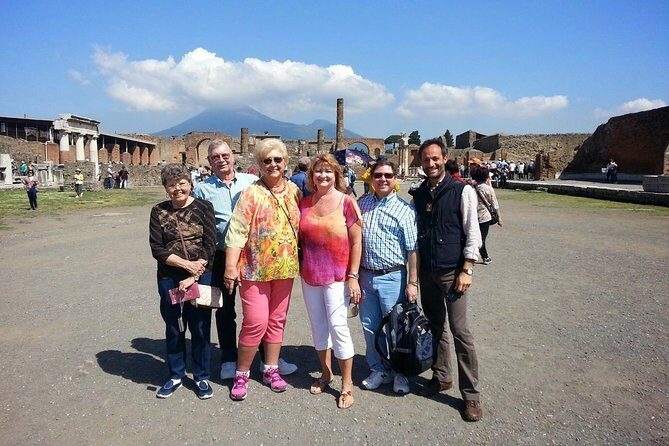
Then you move into the Forum of Pompeii, the city’s busiest public square. Standing on the original travertine paving stones, you’re surrounded by major monuments like the Temple of Jupiter and the Basilica, and you get the classic framed view of Mount Vesuvius in the distance.
This is where the day clicks for most people. The Forum is where politics, religion, and commerce collided, and you can still spot details tied to fair trade, like the mensa ponderaria used to verify weights and measures.
Practical note: this is also where crowds can build. A private route and a guide who knows pacing help you avoid spending most of your energy just walking around people.
Macellum and Forum Baths: food and daily social life
From the big civic space, you shift to daily routines with Macellum, Pompeii’s official covered food market by the Forum. You’ll be able to trace the layout: small shops (tabernae) around the area, plus the central circular pavilion (tholos) where food was handled and sold.
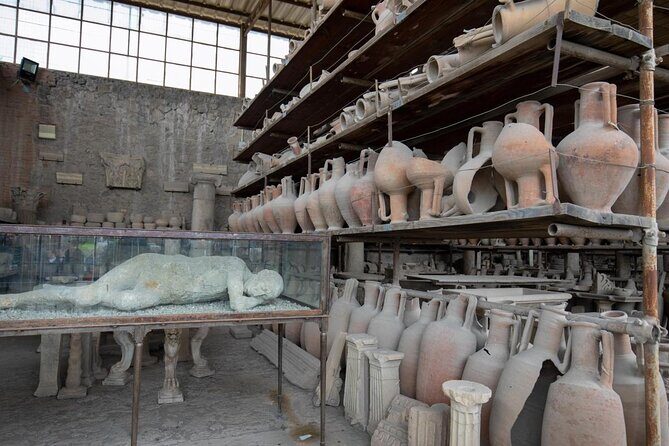
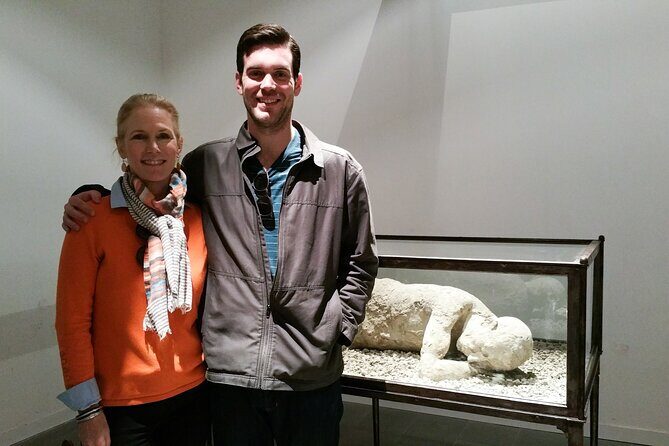
One of the cool details here is how archaeology catches both business and people. You’ll see remaining frescoes of market goods and the stone mensa ponderaria, plus plasters casts of eruption victims at this stop—an emotional reminder that this wasn’t just a sightseeing set.
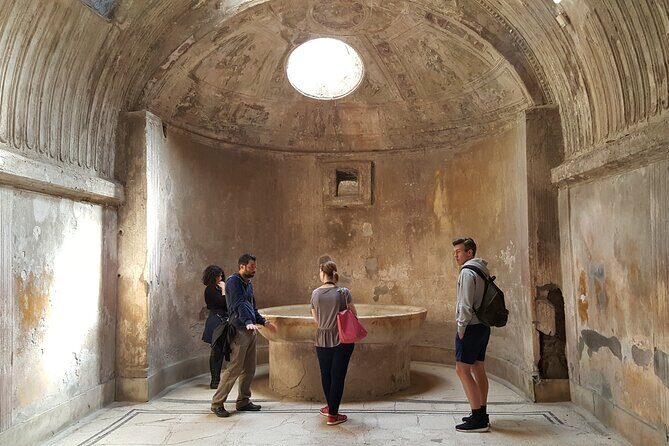
Right after that, you hit Forum Baths (Terme del Foro). This complex is especially powerful because it was still operating in 79 AD, so you can follow the bathing circuit: apodyterium (changing), frigidarium (cold), tepidarium (warm), and calidarium (hot). The hypocaust system—the hollow-wall and airflow engineering used to heat spaces—helps you understand how “luxury” worked in Roman daily life.
If you’re traveling in warm months, baths can also be a smart contrast stop. Even when it’s hot outside, these rooms feel like stepping into an older, cooler rhythm.
Casa dei Vettii: the “Sistine Chapel” effect of Roman homes
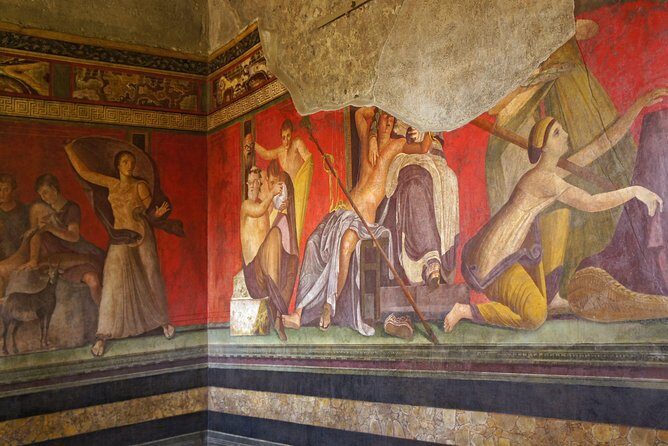
Then you step into private life with Casa dei Vettii. The guide frames it as Pompeii’s luxury-house star, famous for vivid frescoes that were recently restored. You’ll move through spaces tied to the owners’ rise from slavery to wealthy merchant status, and you’ll see famous imagery like the entrance painting with Priapus and scenes connected to the Room of the Cupids.
The real reason this stop works is the peristyle garden. That outdoor core gives you a sense of how elite households used architecture, plants, and water features as daily mood-setting—before the eruption ended it all.
If you only like “major ruins,” this might still win you over. It’s one of the few places where Pompeii feels personal rather than just historical.
- Sorrento Farm and Food Experience including Olive Oil, Limoncello, Wine tasting
★ 5.0 · 2,524 reviews






Thermopolium and Insula dei Casti Amanti: newer finds with personality

One of the best surprises on this itinerary is how modernly it can feel. Thermopolium (the ancient fast-food counter) is planned as a standout stop, with the note that it was fully excavated in 2020. You’ll look at a counter with bright animal frescoes—like mallard ducks and a rooster—acting like a visual menu.
You’ll also peer into deep terracotta jars (dolia) where archaeologists found remains of a Mediterranean diet mixed together. The point is simple: “takeout culture” didn’t start with modern marketing. It was already part of ancient street life.
Next up is Insula dei Casti Amanti, tied to the name from a famous fresco showing a gentle kiss during a banquet. This stop is also described as an advanced archaeological experience using elevated walkways so you can look down into active excavations. You’ll see glimpses into daily life beyond adults—like charcoal sketches connected to childhood—and you’ll also encounter remains connected to victims of the eruption.
This portion works best if you like a bit of “how we’re still learning.” It’s not just museum viewing; it’s history in progress.
Teatro Grande and the Antiquarium: finish with art and impact
Even though you’ve walked a lot, Teatro Grande is a strong final emotional beat. You’ll see one of the earliest stone theaters, with a horseshoe-shaped arena and seating tiers that reflect social hierarchy. The acoustics are part of the story too, with the theater designed so whispers can carry across the seating.
Then you wrap up Pompeii with the Antiquarium di Pompei. This modern museum is air-conditioned and built for orientation, with precious and fragile objects gathered in one place. You’ll see everything from silver hoards to amulets, plus plaster casts of victims and animals from the eruption—an intense, human connection after walking through stone streets.
The plan even calls out that newer digital media and rotating displays can enhance the museum experience, so it doesn’t feel like a stale “add-on room.”
The coast begins with SS145: the cliff road that sets your mood
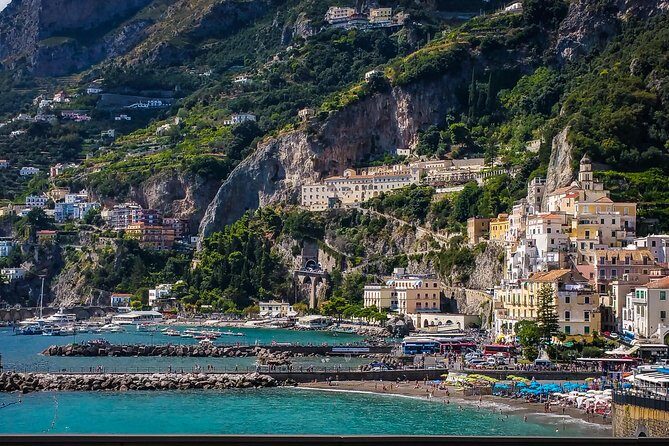
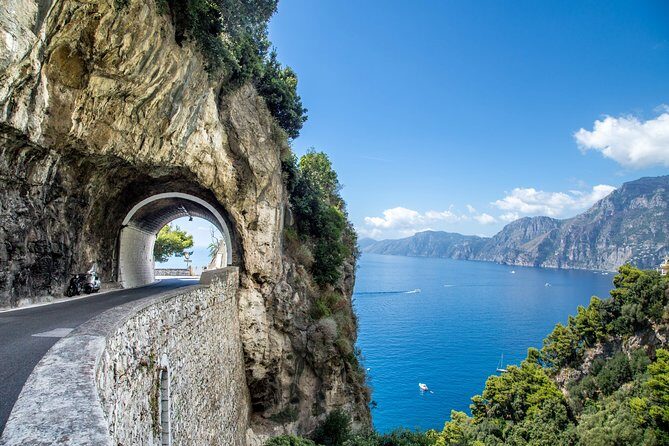
After Pompeii, the day shifts from ruins to views. You’ll travel along SS145 (Sorrentina), a scenic coastal route connecting the Bay of Naples to the Sorrento Peninsula. The key here is the feel of the drive: tunnels, bridges, curves, and cliff-top panoramas with Vesuvius visible across the water.
This is a good time to pause and look, not scroll. The coast towns appear in layers—Vico Equense and Meta on limestone bluffs, plus lemon groves and watchtowers that quietly build the excitement before you reach Sorrento.
Sorrento and the Amalfi switch: where you plan and where you wander
In Sorrento, you’ll get time to breathe and orient in an elegant cliff-top town. The centro storico is described as a maze of narrow lanes, with sfusato lemons and inlaid wood craft showing up everywhere. You’ll also find viewpoints like those around Villa Comunale, and you can choose whether to angle toward the harbor or toward a higher garden-like area.
Then comes the big “Amalfi Coast road moment” on SS163, the Amalfi Drive. You’ll ride the hairpin turns where the road hugs vertical cliffs, with Positano-style vistas dropping far below. This is part adrenaline, part photo stops, and part “you finally get why people fall for this coastline.”
If you’re prone to motion sickness, this is one of those times you’ll be glad you planned ahead with water and a comfortable seat.
Positano and Amalfi: classic towns, different vibes
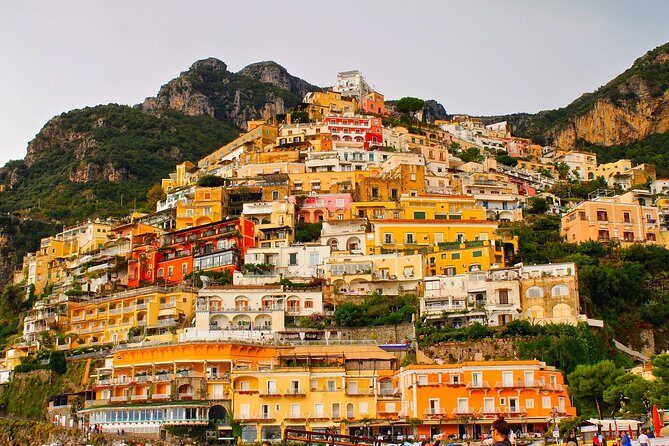
Positano is described as a vertical city of pastel houses cascading toward the sea. Expect narrow lanes, bougainvillea, and the iconic Church of Santa Maria Assunta with its tiled dome. If you want the classic Amalfi look, this is where you’ll find it.
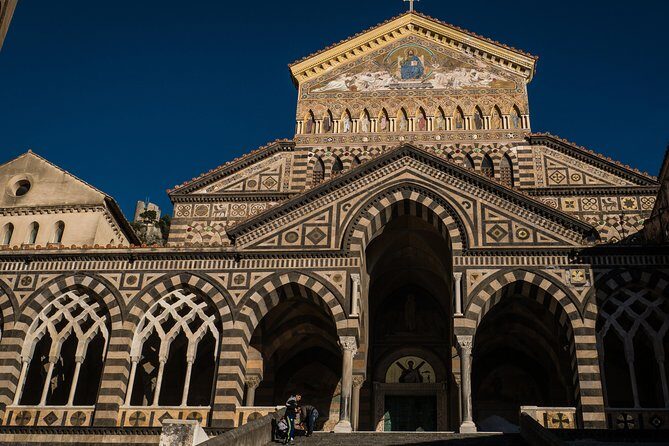
Then you head to Amalfi, the historic heart of the coastline and home to the maritime past. This stop centers on the Duomo di Sant’Andrea (the Cathedral of St Andrew), with its striped Arab-Norman facade and the famous 62-step staircase leading to the main entrance. The plan also highlights layers inside—Gothic and Baroque influences—and the crypt tied to Saint Andrew’s relics.
Amalfi is a great place to slow down because you can mix history with simple town wandering. The itinerary also includes time for the Paper Museum and time in the vicoletti alley system, which is useful if you want a break from the main square crowds.
Ravello and Villa Cimbrone: the calm balcony after the busy coast
After the busier sea-town energy, Ravello gives you a quieter, high-up reset. You’ll be in the “City of Music” mood, with medieval streets and standout estates—especially Villa Rufolo and Villa Cimbrone.
For most people, the highlight is Villa Cimbrone Gardens and the Terrace of Infinity. The plan describes that belvedere as dramatic, with classical marble busts and a view that feels suspended between sky and sea. You’ll also have time for the Cloister and themed garden spaces, so the visit isn’t only about one viewpoint.
This is where you’ll likely understand why Ravello earned its reputation. It’s less about rushing and more about letting the scenery sit with you.
Minori, Maiori, Erchie: a calmer slice of the Amalfi region
The itinerary can include smaller towns beyond the headline names, which is a big part of the value if you dislike constant crowds. Minori is pitched as a food-focused alternative, tied to Sal De Riso pastries and a Roman-era connection through Villa Romana Marittima. Maiori is described as more beach-forward, with a longer sandy stretch and easy strolling along a palm-lined promenade.
You may also stop in Erchie, presented as a more secluded fishing hamlet with pebble beach views and a slower pace. And if you’re looking for craftsmanship souvenirs, Vietri sul Mare can be a fun end stop, famous for ceramics and the Church of San Giovanni Battista covered in majolica tiles.
These “extra” towns matter because they diversify the day. You go from iconic postcard town energy to lived-in local rhythm.
Price and logistics: is $540.66 per person good value?
The price point can feel steep until you break down what’s included. At $540.66 per person for an 8 to 9 hour private experience, you’re paying for private transportation with pickup and drop-off, bottled water, and WiFi on board. You’re also getting a private Pompeii walking component with an official guide, led by Fabrizio Belleni.
The big “gotcha” is Pompeii admission. The plan notes that admission fees and skip-the-line entry are included only if you choose the ticket-included option. Otherwise, Pompeii admission is listed as €19 per person (with free for kids).
So the value equation depends on your ticket choice and your tolerance for waiting. If you hate standing in lines after a long drive, choose the ticket-included option. If you don’t mind handling tickets yourself, you may save money—just plan the time.
One more practical value point: this is private. For families and multigenerational groups, the guide can keep the day moving at the right speed, instead of forcing a one-size-fits-all group pace.
Who should book this tour, and who should think twice
This tour is a strong match if you want Pompeii explained by someone who treats ruins like real neighborhoods. It’s also great if you care about Amalfi more than just the checklist—because you’ll follow scenic coastal roads and get time in towns like Sorrento, Positano, Amalfi, and Ravello.
It’s also a good fit for families. Multiple groups in the tour feedback emphasize that Fabrizio can keep kids engaged and that he’ll help plan the day around comfort and heat.
Think twice if you have limited mobility in Pompeii. The tour guidance says Pompeii isn’t recommended for walking issues, and the day structure includes several stops that require steady walking.
Final call: should you book this Pompeii and Amalfi Coast private tour?
Yes, if you want an archaeologist-led day with flexible pacing, door-to-door comfort, and Pompeii focused on daily life. You’re paying for fewer hassles and better interpretation, especially if you choose the ticket-included option to protect your time.
Wait or skip if you’re hoping for minimal walking in Pompeii or if you want a light, slow coast-only day. This is still an action-packed combo tour—amazing, but best for groups who can handle a full itinerary.
If you book, do one smart thing: message Fabrizio Belleni ahead with what you care about (and any dietary needs). The plan is designed to customize your route, and that’s where the day turns from nice sightseeing into a memorable story.
FAQ
How long is the Pompeii and Amalfi Coast private tour?
It runs about 8 to 9 hours.
What language is the tour offered in?
The tour is offered in English.
Where can pickup happen?
You can meet the guide in Naples or Sorrento or Positano or Pompeii. The port, airport, or railways in Naples are not a problem. Pickup in Amalfi or Ravello is possible for an additional charge.
Is Pompeii admission included?
Admission fees are included only if you choose the ticket-included option during booking. If not, Pompeii admission is €19 per person (free for kids, per the provided info).
Is lunch included?
Lunch is not included. The guide can help with options based on your request.
Does the tour include transportation?
Yes. Private transportation with pick-up and drop-off is included.
Is this a private tour?
Yes. It is private, and only your group participates.
Is it okay if I have mobility concerns?
The tour says travelers should have moderate physical fitness, and visiting Pompeii is not recommended for those who have walking issues. Service animals are allowed.
Is bottled water and WiFi included?
Yes—bottled water and WiFi on board are included.
You Might Also Enjoy


More Private Tours in Sorrento



More Tours in Sorrento



More Tour Reviews in Sorrento
- Sorrento Farm and Food Experience including Olive Oil, Limoncello, Wine tasting
★ 5.0 · 2,524 reviews