REVIEW · NAPLES
Herculaneum small group tour with an archaeologist – skip the line
Book on Viator →Bookable on Viator
Herculaneum hits hard because it is frozen in time. This guided visit makes the volcanic ash story feel real, with an archaeologist explaining how a Roman resort town played out when disaster struck. I really like the skip-the-line entry (so you start seeing things fast) and the two-hour pace in a small group where questions are actually possible, not shoved to the end. One thing to plan for: the site is outdoors and sun can be brutal, so you’ll want shade-aware timing and a hat.
What makes this tour practical is the mix of big landmarks and very specific house details. You’ll move through well-known homes and public spaces like bathhouses and villas, and each stop is framed with why it mattered—names, benefactors, building design, even carbonized remnants you can still learn from. The small group cap of 20 keeps the walk from turning into a rushed stampede.
The only real watch-out is logistics at the start. The meeting point is the Archaeological Park of Herculaneum on Corso Resina, and if your ticket info doesn’t match what you see on-site, you may need a minute to orient yourself. Do yourself a favor: arrive early, bring a cap, and give yourself a little buffer so you can settle in before the tour begins.
In This Review
- Key Things to Know Before You Go
- Herculaneum Under Ash: Why This Site Feels So Different
- Skip-the-Line Entry at Herculaneum: Worth It for Time and Energy
- Your Archaeologist Guide and a Small 20-Person Group
- Stop-by-Stop: From Casa dei Cervi to the Balbo Terrace
- Augustales, Telefo, and the Homes That Were Built for Status
- House of the Skeleton and Central Thermae: Where the Evidence Gets Personal
- Casa del Salone Nero, Casa Sannitica, and Bel Cortile: Three Ways to Read Wealth
- House of the Grand Portal: Charred Details and Civic-Style Layouts
- Price and Time: Is $57.26 Good Value?
- What to Bring for a Sunny, Outdoors Walk
- Who This Tour Suits Best
- Should You Book This Herculaneum Tour?
- FAQ
- FAQ
- How long is the Herculaneum small group tour?
- Is skip-the-line entry included?
- Is there a live guide?
- What’s the group size limit?
- Where does the tour start?
- Will I need a paper ticket?
- How do I get to the meeting point?
- Is transportation included from Naples?
- Can I cancel for a refund?
Key Things to Know Before You Go
- Skip-the-line admission fees included so your first minutes are spent inside the site, not stuck at the desk
- Archaeologist-licensed live guidance with context behind the houses, inscriptions, and public buildings
- Small group up to 20 people with time to ask questions during the walk
- A strong mix of stops: villas, bathhouses, and the kinds of domestic features that change how you read daily Roman life
- Built for a 2-hour visit so you can see a lot without spending the whole day in the park
Herculaneum Under Ash: Why This Site Feels So Different
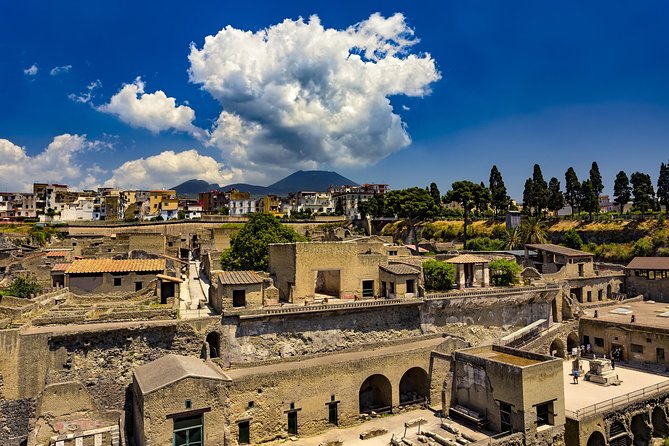
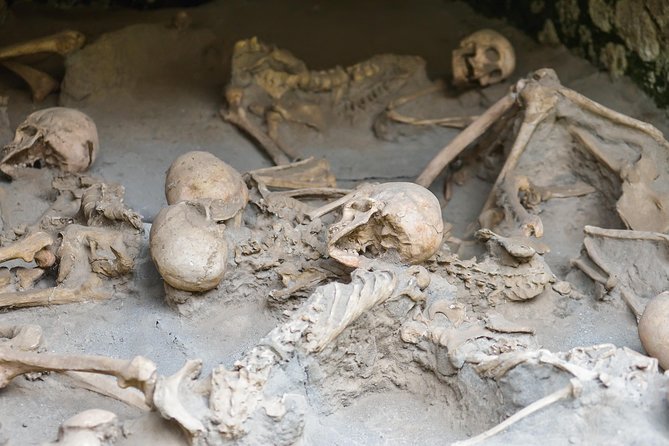
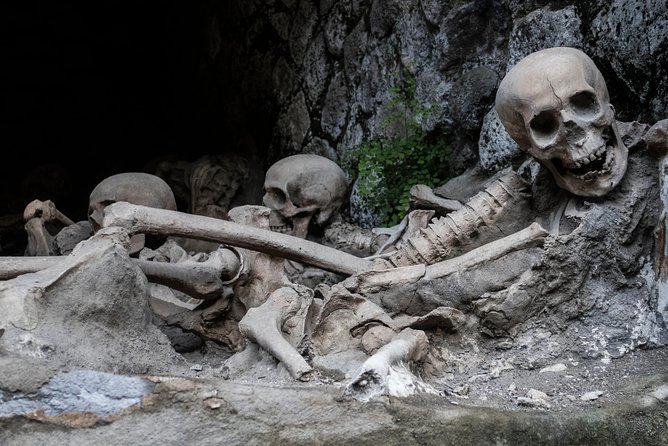
Herculaneum is one of those places where you don’t just look at stones. You look at evidence of real daily life—furniture spaces, building layouts, and human traces preserved under layers of volcanic ash for millennia. That preservation is the whole point of the visit, because it helps you understand how a Roman town functioned, and what changed when residents faced the choice to flee or stand their ground.
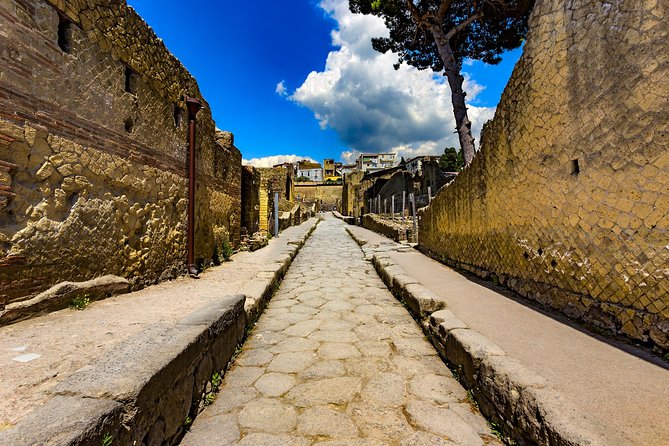
This tour focuses on how the city worked at street level. You’re not only learning names like Casa or Thermae. You’re learning what the layout suggests: where people gathered, how spaces were used, who had status, and how civic or religious life showed up in public buildings. It also adds a human scale by connecting the physical remains to the story of sudden catastrophe—how residents reacted, and how the town’s structures captured a snapshot of life.
If you like history that feels grounded, this is a good fit. You’re walking through a site where the details matter, and the guide’s explanations help you notice what you might otherwise miss.
Skip-the-Line Entry at Herculaneum: Worth It for Time and Energy
At Herculaneum, time is a real factor. Even a short wait can cut into your best daylight and turn the visit from relaxed to frantic. That’s why the skip-the-line admission is a big deal in the value equation here. You pay for the tour, and part of what you’re buying is guaranteed entry without the typical admission bottleneck.
This matters even more because the tour length is about 2 hours. You don’t want half that feeling like paperwork and queues. Once you’re inside, you’ll get a structured path through highlights and carefully explained stops, with time to ask questions while the group is still together.
You’ll also use a mobile ticket, which is usually easier than printing, especially if you’re bouncing around Naples and the surrounding area. And because the meeting point is near public transportation, you’re not forced into a car-first plan.
Your Archaeologist Guide and a Small 20-Person Group
The biggest practical advantage is the guide format: live guidance by an archaeologist, with a group capped at 20 people. That size changes the experience. You can hear explanations, see what the guide points out, and actually ask something without feeling like you’re competing for attention.
In a place like Herculaneum, questions are powerful. You might want to understand why a house has a particular layout, what an inscription meant, or how baths were organized. The tour is built to handle that curiosity on the way, not just at the end.
Also, the guide approach seems aimed at connecting physical objects to stories. The tour leans into the startling evidence—how carbonized elements survive—and uses it to talk about both everyday life and the catastrophe that interrupted it.
Stop-by-Stop: From Casa dei Cervi to the Balbo Terrace
Your walk starts at Casa dei Cervi. The name comes from marble statues of stags (deer) found in the peristyle. That detail matters because it signals how households used art and symbolism. Even if the average visitor only sees a house, an archaeologist helps you read the house as a statement: what was displayed, where it was placed, and what visitors would have noticed as they moved through.
Next is La Terrazza di M. Nonio Balbo. You’ll learn about M. Nonius Balbus, described as the city’s major benefactor who restored and built public buildings. When he died, he was honored and made patron, with the details recorded in a long inscription on his funeral altar. This stop is a great example of why an archaeologist guide is useful: inscriptions aren’t just text. They are civic messaging, power, memory, and local pride turned into stone.
What to watch for: these early stops give you the tour’s rhythm. You’re moving between private life and public honor quickly, so you can start building a picture of the town as both a home for residents and a stage for benefactors.
Augustales, Telefo, and the Homes That Were Built for Status
A standout stop is the College of the Augustales. The building is thought to have been a center for the cult of Emperor Augustus and may have served as headquarters of the Collegium Augustalium, or possibly a local curia. Translation: this isn’t just “a building.” It’s a clue to how religious or political identity showed up in daily town life.
Then you move to Casa del Rilievo di Telefo. The house may have belonged to a leading benefactor connected with M. Nonius Balbus, and it’s unusual because it has its own private access to the adjoining Suburban Thermae to the south. That kind of private connection is a status signal. It suggests convenience for the household and hints that some residents could manage access to leisure in a way that feels very different from ordinary life.
After that, the tour covers Partem Domus lignea (Casa del Tramezzo di Legno), important because it features an elegant wooden partition that remained. Wooden elements don’t usually survive in the long run, so when you encounter evidence like this, it’s not just decoration. It’s architecture you can visualize and interpret—how rooms were separated, how movement and sightlines were shaped.
If you’re into design details—how Romans planned space—this segment will click. It turns “houses” into systems.
House of the Skeleton and Central Thermae: Where the Evidence Gets Personal
One of the most memorable stops is the House of the Skeleton. The name comes from human remains discovered in a second-floor room in 1831. Even if you’ve read about Herculaneum before, this kind of evidence changes the tone of the visit. It makes disaster feel less abstract and more like a real outcome for specific people.
Right after that, you’ll be at Central Thermae. These baths were built around the beginning of the 1st century AD and were divided, following the common practice of the time, into men’s and women’s baths with separate entrances. That’s a key point for understanding Roman social life. Baths weren’t only about hygiene; they were about routine, social order, and the rules of public space.
This stop also gives you a chance to compare public structures to the houses you just saw. With baths, you’re reading a town-wide system. With private homes, you’re reading household identity.
Casa del Salone Nero, Casa Sannitica, and Bel Cortile: Three Ways to Read Wealth
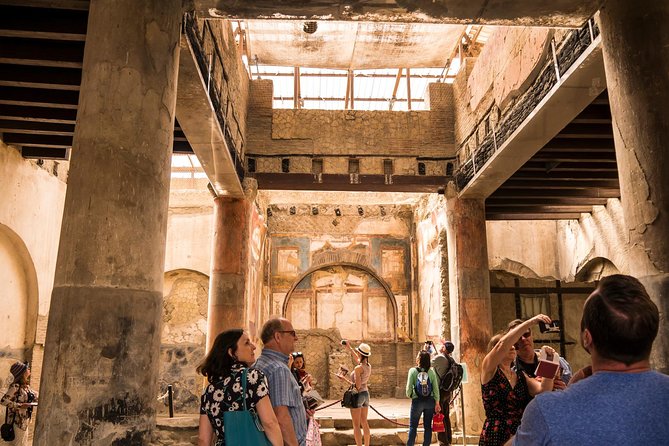
Next comes Casa del Salone Nero, often described as one of Herculaneum’s more luxurious mansions. You’ll see a monumental entrance and carbonised remains of doorposts and lintel. That preservation detail is both eerie and useful. Door frames and wooden components are exactly the kind of material that would normally vanish, so when they survive, they give you a more complete mental picture of the original building.
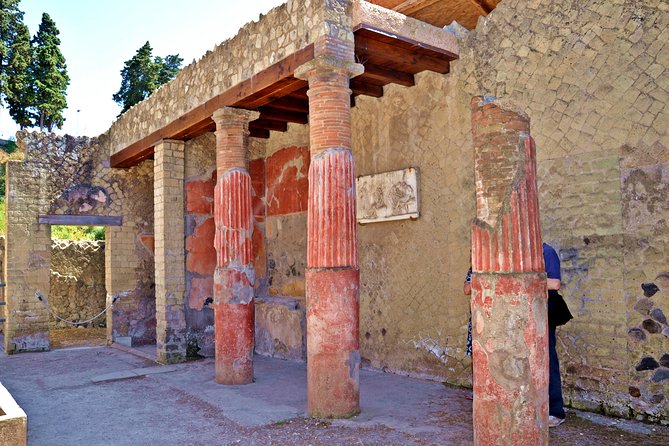
Then the tour shifts to Casa Sannitica. This house has an arrangement typical of the Samnites—a people from mountainous central Italy. The atrium is skirted by a gallery with Ionic columns, and rooms are decorated with frescoes. If you’re trying to understand cultural mix in ancient Italy, this is a smart stop. It shows that Herculaneum wasn’t a single-note culture; local influences could appear in architecture and decoration.
Finally, you visit Casa del Bel Cortile. This is described as one of the most original houses in Herculaneum. Instead of an atrium, it has a courtyard with a stairway and a stone balcony. That means you can’t rely on one “standard” Roman house plan here. You get a reminder that even in a preserved site, every household has its own choices.
If you like comparing homes, this segment gives you enough variety to make the differences feel meaningful, not random.
House of the Grand Portal: Charred Details and Civic-Style Layouts
Near the end, you’ll visit the House of the Grand Portal in the central archaeological area. It’s known as a beautiful domus with different environments, collonnati, and frescoes, with charred remains of wooden parts still visible. This is a strong finale because it pulls together multiple themes from earlier stops: status through layout, art through frescoes, and shock-through-survival through carbonized wood.
One practical tip: take a slow moment here. The “grand portal” is designed to impress, and the remaining traces of charred wood can be easy to overlook if you’re moving too fast. This is the kind of stop where you want to stand still for a minute, look, and then let the guide tie those details into the larger story.
Price and Time: Is $57.26 Good Value?
For $57.26 per person, you’re paying for a short, guided path with skip-the-line admission fees included and about 2 hours of live guidance by an archaeologist. Whether it’s a “good deal” depends on how you value time and interpretation.
Here’s how I’d think about it:
- If you hate waiting and want your entry time to count, skip-the-line is a clear win.
- If you’d rather spend your limited time on the site learning what things mean, the archaeologist-led structure is a value multiplier.
- If you’re the type who enjoys reading a guidebook alone and moving freely, you might feel the group format is limiting. But with this tour’s stop-based plan, you’re basically buying a curated route and a built-in explainer.
Also, the group cap of 20 people and the tour’s question-friendly approach are part of the value. You’re not just getting access. You’re getting context without having to guess your way through layout and symbolism.
What to Bring for a Sunny, Outdoors Walk
This is an outdoor archaeological park, and the sun can be intense. Bring a cap or hat. Bring water. Wear shoes you can walk in comfortably for a couple of hours. And because it can be easy to get flustered when you’re trying to locate a meeting point, arrive early enough to orient yourself without rushing.
If you’re sensitive to heat, plan your day so you’re not doing this at the hottest part of afternoon. The tour’s schedule is tight enough that you don’t want discomfort to steamroll your attention.
Who This Tour Suits Best
This tour fits you if you want:
- A guided experience that helps you interpret houses, inscriptions, and bath layouts
- Archaeology explanations tied to specific stops, not generic background
- A short, small-group format that stays under control and keeps questions alive
- Skip-the-line entry so your time in the park starts right away
It may be less ideal if you want long free time to roam without a set route or if you expect to spend hours inside a museum-like space. The value here is the guided walk and stop-based learning.
Should You Book This Herculaneum Tour?
I’d book it if you want the best chance to understand Herculaneum quickly and clearly. The skip-the-line admission plus an archaeologist-led small group is a strong pairing for a site where details matter. You’ll come away with a sharper mental map of the town: benefactors and inscriptions in public spaces, status and design in homes, and a very human sense of what the catastrophe meant for individuals.
I’d reconsider if you’re planning a slow, flexible day with lots of independent wandering, or if you know you struggle with orientation in large sites. If that’s you, solve it by arriving early and planning a calm start.
FAQ
FAQ
How long is the Herculaneum small group tour?
It runs about 2 hours (approx.).
Is skip-the-line entry included?
Yes. Skip-the-line admission fees are included.
Is there a live guide?
Yes. You get 2 hours of live guidance by an archaeologist licensed guide.
What’s the group size limit?
The tour has a maximum of 20 travelers.
Where does the tour start?
It starts at the Archaeological Park of Herculaneum, Corso Resina, 187, 80056 Ercolano NA, Italy.
Will I need a paper ticket?
No. The tour includes a mobile ticket.
How do I get to the meeting point?
The meeting point is near public transportation.
Is transportation included from Naples?
No. Transportation is not included.
Can I cancel for a refund?
You can cancel for a full refund if you cancel at least 24 hours before the experience’s start time.