REVIEW · GUIDED
Guided Tours of Pompeii Excavations Historical and Cultural Itineraries
Book on Viator →Operated by Bruno Pisano · Bookable on Viator
Pompeii feels like a story when it’s guided well. This tour is built around history and culture, with the Villa dei Misteri (and its famous Dionysian fresco) as a centerpiece. You’ll move through Pompeii’s religious life, everyday spaces, and art, not just “see ruins.”
I really like two things here. First, the guide is Bruno Pisano, specialized in archaeology, history, and philosophy, and he uses that training to connect what you see to how people may have lived and believed. Second, it stays a small group (max 15), which matters when the park is crowded and you want clear explanations without fighting for attention.
One thing to watch: the price does not include the Pompeii entrance ticket, and snacks aren’t included either. If you arrive thinking the $57.62 covers everything on your phone, you’ll need a little extra planning once you get there.
In This Review
- Key highlights you’ll care about
- A Pompeii tour with a clear point of view
- Your morning logistics: 9:30 start, Porta Marina, and a set pace
- Stop-by-stop: from frigidarium pools to the Villa dei Misteri
- Stop 1: Pompeii Archaeological Park frigidarium and Nilotic wall painting
- Stop 2: Tempio di Venere on a dominating terrace
- Stop 3: The Basilica of Pompeii as a public “tribunal” space
- Stop 4: Temple of Apollo and the taste of Greek-style worship
- Stop 5: Foro di Pompeya—religion, administration, and commerce together
- Stop 6: Terme del Foro—SPA culture and Egyptian-linked materials
- Stop 7: Casa del Fauno—Hellenistic palace scale and Alexander vs. Persia
- Stop 8: Casa dei Vettii—fourth Pompeian style frescoes and myth play
- Stop 9: Casa degli Amorini Dorati—Isis shrine, Rhodian peristyle, and Trojan War scenes
- Stop 10: Villa dei Misteri—the Dionysian fresco in world-class condition
- Why the guide’s approach matters (especially in a small group)
- Price and value: what $57.62 really buys you
- Who this Pompeii guided tour is for
- Should you book? My take
- FAQ
- FAQ
- How long is the Pompeii guided tour?
- What’s included in the tour price?
- Is the Pompeii entrance ticket included?
- Where does the tour start and end?
- What time does the tour begin?
- How big is the group?
- Who is the guide?
- Do I need to bring snacks?
- What ticket do you receive?
- Is free cancellation available?
Key highlights you’ll care about
- Villa dei Misteri’s Dionysian fresco gets the time and context you usually miss on rushed Pompeii visits
- Max 15 people per guide helps you actually hear the explanation at each stop
- Bruno Pisano guides with archaeology, history, and philosophy (and keeps the visit moving with purpose)
- Mystery cults show up in the route, including Dionysian themes and an Isis-focused shrine
- Four hours and 10 minutes hits a strong mix of baths, temples, public buildings, and domus
A Pompeii tour with a clear point of view
What makes this experience work is the way it frames Pompeii. You’re not only looking at collapsed walls and preserved floors. You’re being walked through an ancient city that was strongly shaped by Hellenistic culture, long-distance trade, and local religious life.
Pompeii matters in a bigger Mediterranean story, and the tour leans into that. You’ll hear that Pompeii was not simply Greek or simply Roman, but Hellenistic—a commercial and industrial center with relationships reaching toward Asia Minor and beyond. That perspective changes what you notice as you walk: mosaics and frescoes stop being decoration and start feeling like “evidence” of who Pompeii was connected to.
Your morning logistics: 9:30 start, Porta Marina, and a set pace
The tour starts at 9:30am at the Porta Marina audioguide official (Via Villa dei Misteri, 2). It also ends back at the same address, which keeps the day simple.
The total time is about 4 hours 10 minutes, and the visit is paced in chunks—each major stop gets around 25 minutes. That rhythm is a plus if you want structure and reliable timing. It can feel limiting if you like lingering and comparing every carved detail, but that’s the tradeoff for seeing a full set of highlights in one go.
You’ll also get a mobile ticket, and confirmation comes within 48 hours of booking (subject to availability). The group stays small—again, helpful if you’re trying to learn, not just take photos.
Stop-by-stop: from frigidarium pools to the Villa dei Misteri

Here’s what you can expect on the route, and why each stop matters for your understanding of Pompeii.
Stop 1: Pompeii Archaeological Park frigidarium and Nilotic wall painting
You begin in the Pompeii Archaeological Park area, moving into the suburban spas. The standout details are the frigidarium with its nymphaeum in glass paste and polychrome glazed tiles. Even before you reach the domus and temples, you’re learning one key idea: people in Pompeii planned daily life around communal spaces, comfort, and spectacle.
You also get a glimpse of a swimming pool frescoed with Nilotic subjects. That’s a useful detail because it shows how far Pompeii’s visual imagination extended—Egypt appears in local art, even though it isn’t physically close.
Possible drawback: because the stop is short, you’ll need to decide what to focus on—tiles, water features, or the paintings—rather than trying to study everything equally.
Stop 2: Tempio di Venere on a dominating terrace
Next comes the Tempio di Venere. The tour frames it as a place connected to the Imperial cult and as the goddess of sailors—so religion here isn’t abstract. It links political power, worship practice, and maritime identity.
The temple sits on a terrace that dominates the surrounding view, and there’s also a notable modern touch: a bronze statue depicting Daedalus by Polish artist Igor Mitoraj. You’ll see how contemporary art sits inside an ancient setting, which can make the scene feel oddly current while you keep the past as the main focus.
Stop 3: The Basilica of Pompeii as a public “tribunal” space
The Basilica is next, described as the great tribunal of Pompeii. Architecture lovers will like this stop because it’s built for public business: it has three naves and it even anticipates the typology of the later Christian basilica.
It’s also the largest public building in Pompeii in this area, and that scale helps you understand the city’s organization. This isn’t a private household; it’s where authority and civic life showed up.
Short caution: if you’re expecting a quiet moment for photos, plan for foot traffic. It’s a main node in the public layout.
Stop 4: Temple of Apollo and the taste of Greek-style worship
Then you reach the Temple of Apollo, presented as Greek in design and connected to ethical and prophetic worship. The focus isn’t just the building shape—it’s the idea that people came here because they believed in guidance, prophecy, and moral order.
The tour also highlights the two bronze statues representing Apollo and Diana dominating the scene. That pairing helps you see how worship in Pompeii mixed roles and identities rather than sticking to one narrow theme.
Stop 5: Foro di Pompeya—religion, administration, and commerce together
The Foro (Forum) is the city’s commercial, administrative, and religious center. You’ll see it described as an urban complex with majestic grandeur, dominated by the Temple of Jupiter, Juno, and Minerva.
The big value of this stop is learning how one space can hold multiple kinds of power. In modern cities, shopping, politics, and worship often happen in different places. Pompeii compresses them into one system—so the Forum helps you “read” the city layout like a map of priorities.
Stop 6: Terme del Foro—SPA culture and Egyptian-linked materials
After the Forum, you step into Terme del Foro, the wellness center and SPA of ancient Pompeii. This is where the tour’s cultural interpretation becomes physical: you’re moving from public decision-making into relaxation and body care.
The tepidarium stands out with stuccoes from the Neronian school, and the caldarium features a grandiose alabaster labrum said to be of Egyptian origin. That Egypt link again reinforces the tour’s bigger theme: Pompeii had tastes, materials, and visual references that traveled.
Practical note: since snacks aren’t included, this is a good stop to keep your pace steady so you don’t feel drained before the domus section.
Stop 7: Casa del Fauno—Hellenistic palace scale and Alexander vs. Persia
The tour shifts into private life with Casa del Fauno, described as the largest palace house in Pompeii from the Hellenistic era.
Your art highlight here is a copy of one of the most famous Roman-world mosaics: the Battle of Issus (333 BC), showing Alexander the Great against Darius III of Persia. Even if it’s a copy, the meaning is still clear. Pompeii’s elite households kept symbols of power and imperial stories on the floor.
This is also a reminder that the tour’s Hellenistic framing isn’t academic. It shows up in how households displayed knowledge of distant rulers and legendary conflicts.
Stop 8: Casa dei Vettii—fourth Pompeian style frescoes and myth play
Next is Casa dei Vettii, famous for fourth Pompeian style frescoes. The tour points out the Priapus figure linked to the Neronian school, plus the grand hall full of Cupids engaged in working activities.
You’ll also see mythological paintings that the route connects to themes like Daedalus and the Minotaur. This part of Pompeii is where you start thinking less like a tourist and more like an interpreter: symbols, myth, and household identity overlap.
Short drawback: frescoes reward slow looking, but the stop timing keeps things moving. Bring your curiosity, but accept the time limit.
Stop 9: Casa degli Amorini Dorati—Isis shrine, Rhodian peristyle, and Trojan War scenes
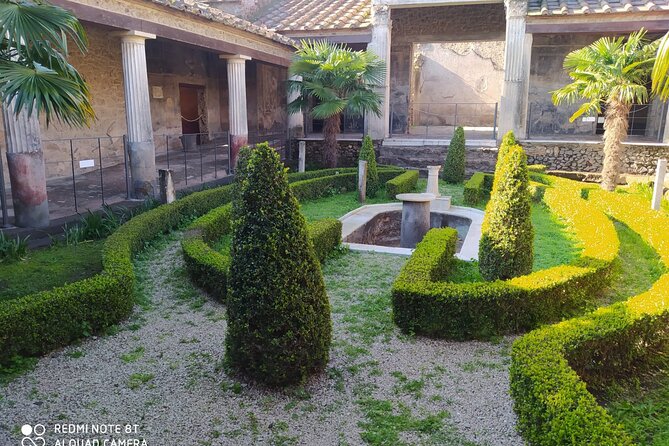
Then comes Casa degli Amorini Dorati, presented as a perfectly preserved Pompeian domus with a Rhodian peristyle. The tour also spotlights obsidian mirrors, which is the kind of detail that makes you pause because it sounds specific—and it’s meant to be.
The house includes a shrine dedicated to the cult of Isis, plus the Lararium (the protector gods of the house). That’s where the tour’s “mystery cult” theme becomes tangible. You’re not just hearing about Dionysian or Isiac ideas in the abstract—you see how domestic space reflected belief.
And you get mythological frescoes tied to the Trojan War, which again supports the idea that Pompeii’s walls carried stories from across the Mediterranean cultural world.
Stop 10: Villa dei Misteri—the Dionysian fresco in world-class condition
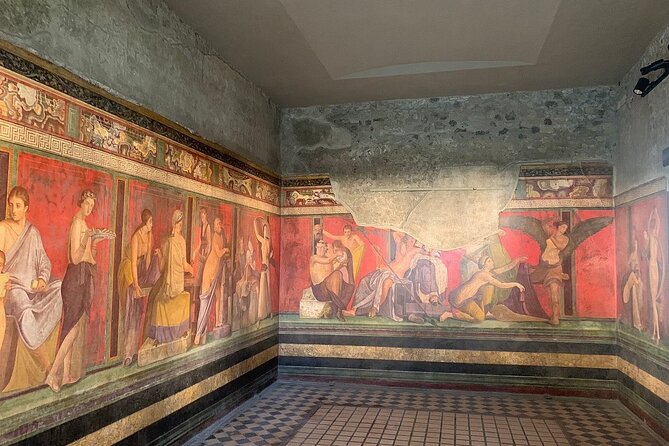
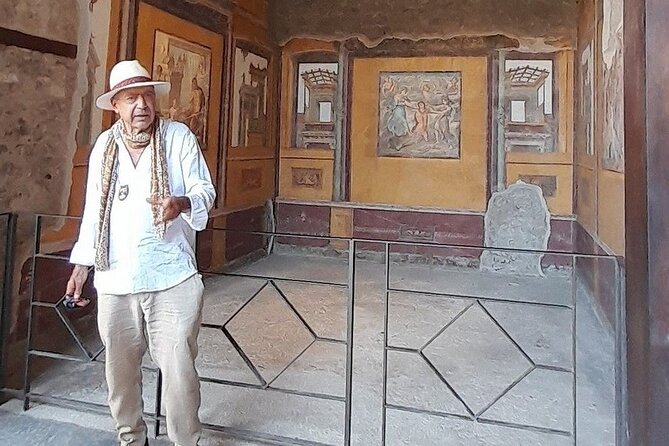
Finally, you reach the tour’s emotional and visual peak: Villa dei Misteri. The itinerary emphasizes the Dionysian fresco, from the first century BC, described as unique in its state of conservation.
This is the stop that often turns Pompeii from “a site” into a place with atmosphere. Because the fresco survives so well, you can see narrative details that you’d struggle to interpret if the paint were faded or damaged. The tour’s interpretation is especially useful here because mystery-cult imagery can look like strange theater at first glance. The guide helps you connect symbols to belief and practice.
Even better, you don’t end the day with just one isolated masterpiece. You’ve already seen public worship spaces, household shrines, and the city’s daily infrastructure—so the fresco lands with context.
Why the guide’s approach matters (especially in a small group)
I like tours where the guide doesn’t just list facts like a checklist. This one is described as historiographical and cultural interpretation, and that shows up in how you move through Pompeii.
With a guide like Professor Bruno Pisano, the explanations stay connected: religion shows up in temples and shrines, art connects to myth and identity, and buildings tell you who held power and where daily routines took place.
The small group size (max 15) helps a lot. When you get to a stop like the Villa dei Misteri, you’re not stuck waiting to hear what you’re looking at. The group format makes the explanations feel more like a conversation than a lecture you can’t fully catch.
Price and value: what $57.62 really buys you
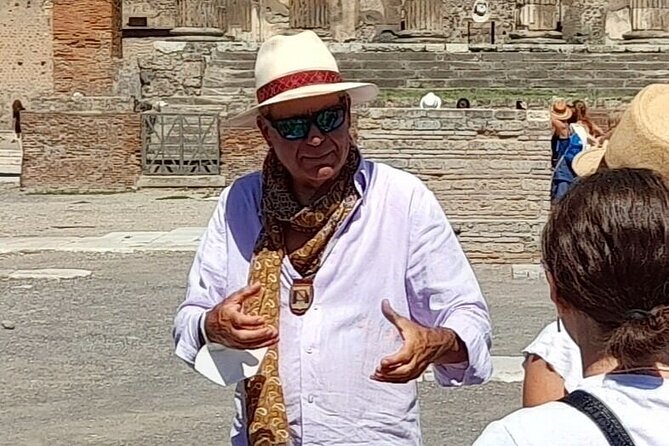
The tour costs $57.62 per person, lasts about 4 hours 10 minutes, and includes a guide plus assistance the entire time. It also includes a mobile ticket and a specialist guide in archaeology, history, and philosophy.
But two big items are not included:
- entrance admission to the Pompeii ruins
- snacks
So the real value is not the “ticket savings.” The value is the guided route through high-priority sites—especially the inclusion of Villa dei Misteri and the way the guide connects temples, baths, basilica, Forum life, and domestic art.
When I’m judging price for Pompeii, I ask a simple question: are you buying time with a skilled interpreter, or are you just paying to get from place to place? This tour leans hard toward interpretation. If that’s what you want, the pricing feels reasonable. If you’d rather roam slowly on your own and read every placard, you might spend more time elsewhere for less money.
One practical note: if you’re booking through a middle layer, compare total cost carefully. Some bookings can include extra fees on top of the base price, and it’s not hard to reduce cost by booking cleanly.
Who this Pompeii guided tour is for
This is a strong fit if:
- you want structure in a big archaeological park
- you care about religion, art, and daily life, not just one famous highlight
- you prefer a small group so you can actually hear the guide
- you want the Villa dei Misteri experience with context, not just a photo stop
It may be less ideal if:
- you expect a lot of free time at each stop (each segment is about 25 minutes)
- you plan to arrive without entrance tickets or the ability to handle basic needs during a 4+ hour walk
Should you book? My take
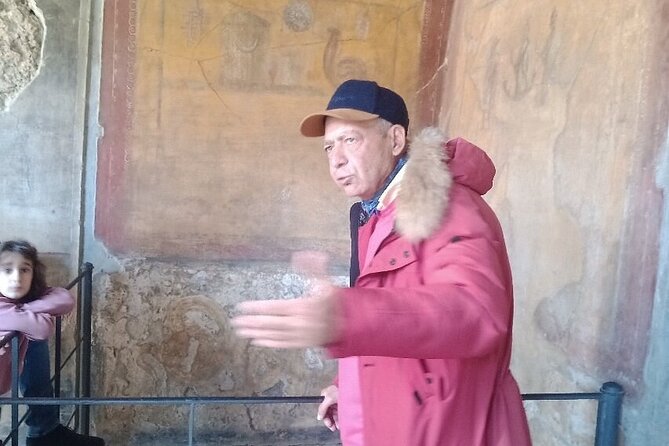
I’d book this tour if you like Pompeii as a living culture, not only as a tragic disaster preserved in stone. The mix of baths, temples, Forum power, and elite domus paintings gives you a well-rounded picture in one morning, and the fact that Villa dei Misteri is built into the route makes it feel worth your time.
If you’re budget-tight, just remember the extra entrance ticket cost and bring what you need for comfort since snacks aren’t included. And if you’re picky about how you spend money, check for any extra booking fees so you’re paying for the guide, not for copy-and-paste extras.
FAQ
FAQ
How long is the Pompeii guided tour?
It runs about 4 hours and 10 minutes.
What’s included in the tour price?
You get a guide and assistance for the whole tour, a small group format (max 15), and a guided route through the listed major sites.
Is the Pompeii entrance ticket included?
No. The entrance ticket to the Pompeii ruins is not included.
Where does the tour start and end?
It starts at Porta Marina audioguide official, Via Villa dei Misteri, 2, 80045 Pompei (NA), Italy, and ends at the same location.
What time does the tour begin?
The start time is 9:30am.
How big is the group?
The maximum group size is 15 travelers per guide.
Who is the guide?
The experience provider listed is Bruno Pisano, specialized in archaeology, history, and philosophy.
Do I need to bring snacks?
Snacks are not included, so plan accordingly.
What ticket do you receive?
You get a mobile ticket.
Is free cancellation available?
Yes. You can cancel up to 24 hours in advance for a full refund.