REVIEW · SORRENTO
Full-Day Private Capri and Pompeii from Sorrento
Book on Viator →Operated by Askos Tours · Bookable on Viator
Pompeii and Capri in one day can sound rushed. But this private setup is built to save you the hardest parts—getting there, getting through the main sights, and translating what you see—while still giving you time for Capri views. I like that Pompeii entry is included and that the day is guided with a real order to your walk, so the ruins make sense instead of turning into random columns.
Two other things I really appreciate: Capri includes the jetfoil (round-trip ferry tickets are part of the package), and the format can be customized to your interests, which is great when one person wants more archaeology while another wants more scenic time. One catch: you’ll still face a few extra costs on Capri (like Blue Grotto entry and Giardini di Augusto admission), and weather can affect whether Capri is accessible.
In This Review
- Key things I’d plan for before you go
- Capri and Pompeii in one day: the 8-hour reality check
- Getting from Sorrento: pickup, minivan transport, and timing pressure
- Pompeii Archaeological Park: why the guided route matters
- The Forum, basilica, and “street-level” Pompeii stops
- Stabian Baths: the easiest stop to picture real daily life
- Two famous houses: Casa del Fauno and Casa del Menandro
- Granaries and the logistics of a working city
- Capri by jetfoil: Marina Grande, Capri town, and the Faraglioni view
- Blue Grotto and Giardini di Augusto: what costs extra (and why you should care)
- Weather and access issues: what to do when Capri isn’t cooperating
- Private format in the real world: guides like Paolo and what to ask for
- Price and value: is $700.88 per person fair?
- Avoiding the main headache: timing, inclusions, and what is private
- Who should book this private Capri and Pompeii day
- Should you book this Capri and Pompeii private day?
- FAQ
- What time does the tour start and where does it end?
- How long is the full-day tour?
- Is hotel pickup included?
- Is Pompeii admission included?
- Is the Blue Grotto included?
- What happens if Capri can’t be accessed due to weather?
Key things I’d plan for before you go

- Private guide + private mainland transport keeps the day organized, even when schedules are tight.
- Pompeii admission is included, and you’ll hit classic stops like the Forum, thermopolium, and two famous houses.
- Jetfoil round-trip to Capri is included, but Blue Grotto and island getting-around are not.
- Giardini di Augusto and Blue Grotto cost extra, so budget a little beyond the base price.
- Capri can be delayed or canceled by weather, so be ready for a Plan B mindset.
Capri and Pompeii in one day: the 8-hour reality check
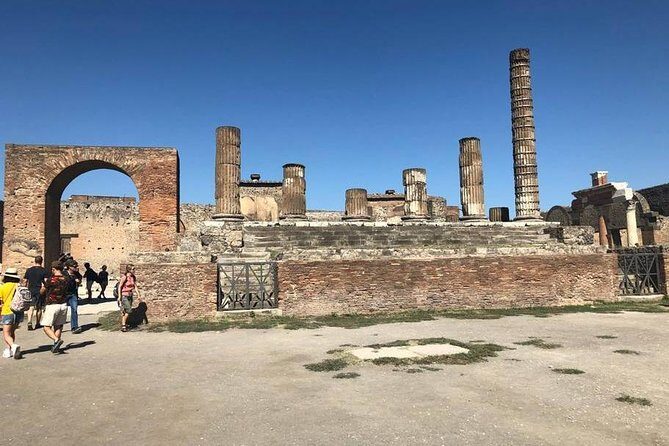
This is an all-in-one day: Pompeii in the morning, then Capri in the afternoon. The duration is about 8 hours, starting at 8:00 am from the Port of Sorrento, and ending back at the same meeting point. That time box matters, because both places are big, and neither one is best done at “tourist sprint” speed.
The good news is how the day is paced. You get a guided route through Pompeii’s major areas, with short focused stops rather than a long free-for-all. Then Capri is handled more lightly: you’re on the island for a set block of time centered around the port area and Capri town.
If your idea of a perfect vacation includes long unstructured wandering, you’ll need to accept that this day is structured. Comfortable walking shoes help, and “moderate physical fitness” is a fair expectation, since Pompeii involves walking over uneven ground.
You can also read our reviews of more private tours in Sorrento



Getting from Sorrento: pickup, minivan transport, and timing pressure

You can expect hotel pickup to be offered, plus a modern minivan for mainland transport. That’s one of the practical advantages of a private format here. Instead of figuring out local bus schedules or working out where everyone meets, you’re handed an itinerary and moved through it.
Still, timing is the quiet make-or-break factor. The day starts early. If you’re late, it can shrink your Capri time because ferry/jetfoil departures are time-based. One important takeaway for you: show up early enough that you’re not sprinting down to the port at the last second.
Also, note that the tour says it can operate from Sorrento or Naples in some cases. Your specific plan here lists the Port of Sorrento as the meeting point, so I’d treat Sorrento as the anchor for your day.
Pompeii Archaeological Park: why the guided route matters
Pompeii isn’t just ruins. It’s a whole city laid out in sections, and it can feel overwhelming without a guide to connect the dots. You start at the Pompeii Archaeological Park, with admission included and about 1 hour 30 minutes here—enough time to get oriented and see the major themes.
A private guide also changes how you experience the place. You’re not stuck listening to a crowd herd. Instead, you can ask practical questions—what you’re looking at, why it’s arranged that way, and what life likely looked like in those rooms and streets.
One thing I’d watch for: Pompeii is active outdoors. Sun, shade, and the amount you walk can swing your energy fast. If you like photos, you’ll want short stops where you can reset, not endless “keep moving” time.
The Forum, basilica, and “street-level” Pompeii stops
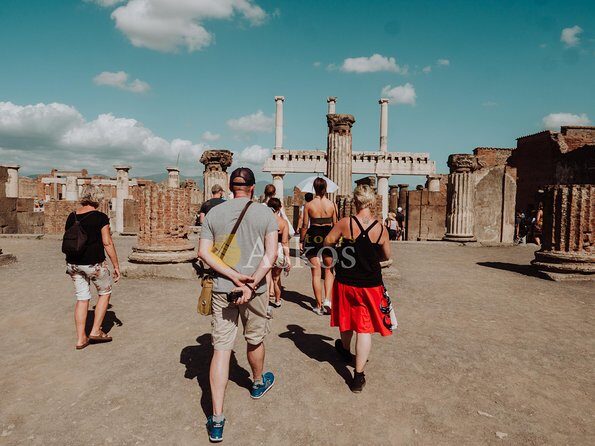
After the main park time, the itinerary moves through emblematic sections with smaller stops—often around 15 minutes each. That sounds short, but it works because you’re hitting the city’s key public spaces and learning what they meant.
Here’s the pattern you’ll follow:
- Foro de Pompeya (Forum): The main civic center. This is where you’ll understand why public life mattered so much. You’ll get the big-picture layout and then see the ruins that shaped politics, commerce, and social gatherings.
- Basilica: The courtyard area that connects to the city’s everyday business. Think of it as a place where legal and administrative life happened.
- Thermopolium di Aselina: A “quick bite” counter—an old-school street food spot. Even if you’re not an archaeology nerd, this kind of stop clicks because it feels human and familiar: people grabbing food without waiting for a full meal.
These short stops can feel like a highlight reel. The best way to benefit is to ask your guide to point out “what’s still obvious” versus “what you’d miss without context.” A good guide will help you look at details instead of just big walls.
Stabian Baths: the easiest stop to picture real daily life
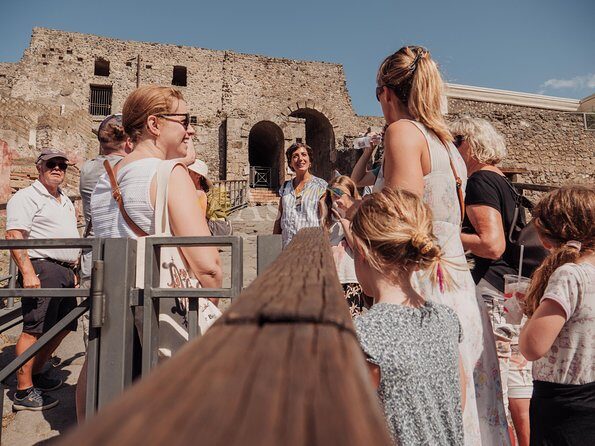
Then you’ll hit Stabian Baths (Terme Stabiane) for a short visit. Roman baths can look confusing if you don’t know the layout. With a guide, you can usually make sense of how people moved through spaces—cooling, warming, and socializing.
This is one of the stops that often feels most relatable. Even when you’re looking at ancient stone, you’re picturing routine: meet up, talk, clean up, and relax. If you like places where you can imagine a typical day, this is a strong match.
One practical note: since the itinerary packs multiple 15-minute stops, pace yourself. If you rush, you miss the “aha” moments—especially in bath layouts where one room makes another room make sense.
You can also read our reviews of more tours and experiences in Sorrento





Two famous houses: Casa del Fauno and Casa del Menandro
Pompeii’s domestic architecture is where it starts to feel like you’re stepping into other people’s lives. Your route includes:
- Casa del Fauno (House of Faun): Expect an emphasis on the grandeur and scale of elite living. You’ll see how wealth expressed itself in the layout.
- Casa del Menandro (House of Menander): Another major residential stop, also tied to famous features and how rooms connected.
Even if you don’t care about every artifact, I think these house visits are valuable because they give you context for the city’s social range—who lived where, how they entertained, and how daily life played out behind street walls.
These stops are short, so it helps to focus on a few big questions: What do the rooms suggest about status? Where would people gather? And what’s one detail you can recognize in photos later?
Granaries and the logistics of a working city
One of the less glamorous but most fascinating stops is Granai del Foro (Granaries). It’s easy to think of Pompeii as a snapshot, but this kind of site reminds you it was a functioning city with supply chains, storage, and trade.
Grain storage is also an easy place to understand why public areas weren’t only political. They were economic. For me, this is where Pompeii shifts from “ruins” to “systems”—a place designed to keep people fed and the city running.
Capri by jetfoil: Marina Grande, Capri town, and the Faraglioni view
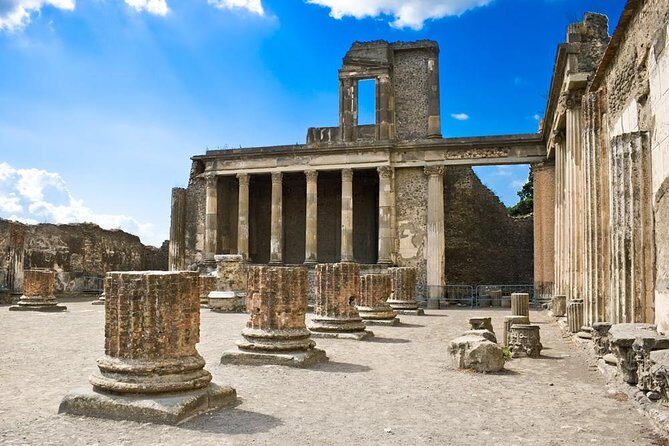
After Pompeii, the day shifts to island time. You travel to Capri by jetfoil, and round-trip ferry tickets are included. The timing matters here because jetfoils run on schedules, not vibes.
Once on Capri, your plan is simple:
- Spiaggia Marina Grande (the port area): about 15 minutes.
- Capri center: about 30 minutes.
- You’ll also see the Faraglioni (the iconic rock formations) as part of the sightseeing flow.
This is not a “see every viewpoint on foot” Capri itinerary. It’s more like getting your bearings and hitting the most recognizable visual moments. That makes sense for a combined day with Pompeii, where you don’t want Capri to take over the entire afternoon.
If you’re hoping for lots of free time for roaming, you’ll likely want to treat this as your first Capri taste. Then, if you return someday, you can slow down and do the island at a calmer rhythm.
Blue Grotto and Giardini di Augusto: what costs extra (and why you should care)
Here’s the part to understand early so there are no surprises. Blue Grotto entry is not included, and Giardini di Augusto admission is not included. Also, transportation on Capri island is not included.
Why that matters: Capri often involves short transfers—moving between areas, using local options like funiculars, or taking transport where walking would eat your time. If you want Blue Grotto, you should expect to pay for the experience directly.
On top of that, one example mentioned in a tour issue included small add-ons such as funicular ticket costs around €2.40 and entrance to Augustus Gardens around €1.50, plus refreshments. I’m not saying you’ll spend the same exact amount, but I am saying you should plan for minor expenses once you’re on the island.
If you’d like the best day experience, decide before you go what matters most:
- If Blue Grotto is a must, budget for it.
- If Giardini di Augusto is a priority for views, budget the admission and factor time for getting there.
- If you mostly want scenery and town wandering, you can skip the paid extras and still get a good Capri snapshot.
Weather and access issues: what to do when Capri isn’t cooperating
The tour notes something important: it operates yearly, but Capri may not be accessible due to weather conditions. Jetfoil schedules and sea conditions can change quickly, especially in shoulder seasons or windy spells.
So how do you handle this in a practical way? Keep your expectations flexible. If Capri time shrinks, it’s not always because the operator is trying to cut corners. It can be because water conditions don’t allow the crossing.
The most helpful mindset is to go in knowing Pompeii will likely deliver. Then treat Capri as the bonus—because the day’s value is anchored in Pompeii’s included guide and included admissions.
Private format in the real world: guides like Paolo and what to ask for
Private tours should mean more than a smaller group size. They should mean a guide who can shape your day around your interests.
From the information you provided, guides can include people like Paolo, described as an archaeologist by profession. The key detail isn’t the title; it’s how he’s said to explain—turning the experience into something interactive rather than just reading facts at you. Another guide name that comes up is Massimo, described as experienced and able to put together a dream day.
If you want to get the most from Pompeii’s short stops, I’d ask your guide a simple set of questions:
- What’s the one thing I should notice in each stop?
- Where did elite life feel different from everyday life?
- What should I photograph that will make sense later?
That’s where private guidance pays off. You’re buying interpretation and flow, not just access.
Price and value: is $700.88 per person fair?
At $700.88 per person, you’re paying for more than tickets. You’re paying for logistics that are hard to manage on your own in one day: hotel pickup, private mainland transport, a private guide, Pompeii admission, and round-trip ferry/jetfoil tickets.
Not included items are the ones that can quietly add up:
- Meals
- Blue Grotto entry
- Giardini di Augusto admission
- Transportation on Capri island
So is it worth it? It usually comes down to this:
- If you want both Pompeii and Capri in one day and you don’t want to play transportation chess, the setup can feel like value.
- If you’re comfortable designing your own route, paying separately for Pompeii entry, and managing ferries, you might spend less—but you’ll also do more work.
For me, the best use of this price is when you value a guided, structured Pompeii route and you want fewer time-wasting transfers.
Avoiding the main headache: timing, inclusions, and what is private
There’s one complaint pattern that’s worth learning from. Some misunderstandings happen when people expect a private boat. This tour includes hydrofoil/jetfoil tickets, but it’s not described as a private boat tour.
So here’s my practical advice: confirm what’s included as private. In this plan, you’re getting private guide time and private transport on the mainland, plus included jetfoil tickets to Capri—not a charter-style private vessel.
Also, timing matters. The day begins at 8:00 am, and if you arrive late, the available time on Capri can shrink because of the next departure. I’d treat the meeting point like an appointment with real consequences—arrive early, stay ready, and don’t cut it close.
Who should book this private Capri and Pompeii day
This tour fits best if you:
- Want a structured Pompeii visit with quick, meaningful stops
- Have limited time and want Capri without building the day yourself
- Prefer private guiding and the chance to ask questions
- Are comfortable with walking and a moderate fitness level
It may not fit if you:
- Want lots of unhurried time in Capri with minimal planning
- Hate paying small add-ons on the island
- Need a guarantee of Capri access regardless of weather
Should you book this Capri and Pompeii private day?
If your top goal is an organized, guided Pompeii with easy add-on Capri time, I think this can be a smart way to spend a day on the Amalfi Coast. The inclusion of Pompeii admission, the guided route, pickup/transport on the mainland, and the included jetfoil tickets are the big value drivers.
Just go in with clear expectations: Blue Grotto and Giardini di Augusto cost extra, island transport is on you, and weather can affect Capri access. If that fits your travel style, booking this private day makes a lot of sense.
FAQ
What time does the tour start and where does it end?
The tour starts at 8:00 am at the Port of Sorrento and ends back at the same meeting point.
How long is the full-day tour?
It runs for about 8 hours.
Is hotel pickup included?
Yes—pickup is offered, and mainland transport is done in a modern minivan.
Is Pompeii admission included?
Yes. Pompeii ruins admission fee is included, and the stops inside Pompeii list admission tickets as included.
Is the Blue Grotto included?
No. Entry/Admission for the Blue Grotto is not included.
What happens if Capri can’t be accessed due to weather?
The tour notes that Capri is sometimes not accessible because of weather conditions, so you may need to accept reduced or changed island time.
You Might Also Enjoy


More Full-Day in Sorrento
More Private Tours in Sorrento



More Tour Reviews in Sorrento
- Sorrento Farm and Food Experience including Olive Oil, Limoncello, Wine tasting
★ 5.0 · 2,524 reviews